Josh Benner

Author: the Josh Benner Blog

  • Could Mitt Romney be fulfilling a Mormon prophecy to take over the country?

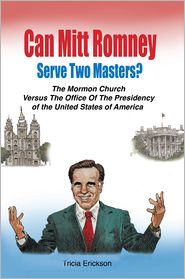
    Review of “Can Mitt Romney Serve Two Masters”
    Part II: Mormon prophecies

    Tricia Erickson argues throughout the first section of her book “Can Mitt Romney Serve Two Masters” why the American people should not want a Mormon president. In the seventh chapter, she kicked it up a notch and her rhetoric took on a much more Dan Brown/conspiratorial tone. Erickson writes:

    “Behind the scenes of the Mormon Church is a secret political agenda that the leaders don’t want you, the public, to know about…Birthed within the (Mormon) Church, yet distinct from the church is a secret organization formed by Joseph Smith during early Mormon history. This organization is the political machinery of the “priesthood” of the Mormon Church, named “the Kingdom of God” and “the Government of God.”

    The American government is a very large, very complex entity. According to the Bureau of Labor Statics,the federal government has roughly two million employees.

    They are spread out across the entire nation through dozens of departments and agencies, many with their own unique “personalities” that have been forged by politics and history. We have a constitution with checks and balances, and within our system of government, the idea that one president with a radical agenda could “take over” the country and force his ideology onto every aspect of our lives is farfetched and a scare tactic used to get people not to vote for certain candidates.

    Maybe we could have a president who had beliefs that were radical or which could be consequentially negative for the rest of the country. Luckily, if that did happen, there is a difference between radical beliefs and actually turning those beliefs into reality. Especially given that Mormons make up less than 3% of congress and 0% of the Supreme Court.

    Furthermore, the idea that the American people would stand by and allow for such a thing to occur is a stretch, especially given the surging atheistic and secular worldviews within this country.

    Given these and other reasons, I have a hard time worrying that a Romney president would lead to the Latter-Day Saint Church taking over America and setting up a Mormon theocracy, as Erickson seems to fear.

    Erickson continued:

    “Mormons believe that they are the only true church and their main objective is to be ready when the time comes for the millennial reign by having their leaders ready to rule or already in key places of authority and power…The political agenda of the church is to place a Mormon man in the presidential office in order that the church may take over and control the country and further the world for the “Kingdom of God.”

    On what is she basing these claims?

    Erickson sites “The White Horse” prophecy which she claims is a belief that exists within the Mormon Church that our government will collapse, and that the church will be in place to take over and run the country.

    Even if there are Mormons who believe that, if God is not the God of Mormonism, what difference do their prophecies make? It is not consequential.

    In politics, I feel like certain factions within an opposition movement will always have themselves convinced of, “If this person gets into office, they will destroy the world.” Some perpetuated this fear when Barrack Obama was running for president in 2008.

    The Glenn Beck’s of the world had certain people believing that if Obama were to become president, the fairness doctrine would be forced upon the media, people wouldn’t be able to have guns, and from there, he would basically setup a Stalinist regime.

    Don’t get me wrong, there are many criticism which could be levied against the Obama White House, but guess what? If people don’t like what he’s doing, someone else will be elected next year.

    I feel that I would be remiss if I did not note the interesting dichotomy that there are people who fear Obama is turning America into a socialist state and Erickson is worried that Romney will turn the country into a nation that is controlled by the Mormon Church. If both groups are right, how utterly amazing is the idea that a nation could swing from one extreme to the other in a span of four years?

    Would the Mormon Church leadership have any influence over Romney? Probably. Would they vicariously be running America and plotting to take over Europe and the rest of the world? Absolutely not.

    I am a proud Freemason, and Erickson’s conspiracy theory of the Mormons attempting to take over the government reminds me of different books I’ve read that try to proove that the Masons are taking over the world. I believe that the crux of these types of arguments is having a psychological justification to explain the fallenness of the world. Depending on people with whom you talk, the Mormons, Freemasons, socialists, and any number of groups are all in the midst of taking over the world, and that there is a proverbial wizzard behind the curtain orchestrating the puppet show.

    I think the world has much bigger problems with which to deal.

    jrb
  • Should we elect a Mormon president? One writer says NO (Part I)

    Review of “Can Mitt Romney Serve Two Masters”
    Part I: Influence of the church on daily life

    Conservative strategist Tricia Erickson does not believe that the American people should elect a Mormon president, and by extension, Mitt Romney. She makes this emphatically clear in her new book: “Can Mitt Romney Serve Two Masters?”

    She puts fourth the idea that the Latter Day Saint movement has been systematically working to get Mormons in places of political and cultural significance. For the author, a former Mormon herself, she sees this as problematic.

    I think that this book is an interesting read, and I do sincerely agree with one of Erickson’s primary theses: the Mormon Church has done a very effective job of depicting itself as being mainstream and just another Christian denomination. But this isn’t comparing Presbyterians to Methodists. Mormonism has a lot of beliefs that are radically different from the rest of evangelical Christianity (which will be discussed in a later post)

    I think Erickson generally presents well reasoned arguments, however her language can come across as inflammatory. Numerous times throughout the book, her writing has undertones of, “Seriously, how can these people actually believe this garbage?!”

    Here is one example towards the end of the book:
    “There are so many lies, distortions, and secrets in the Mormon Church that it boggles the mind as to why they have any followers at all.

    I think that Erickson’s writing style will fail in changing views. For those who are already weary of Mormonism, this book will be preaching to the choir. For those who may want to learn, the abrasive rhetoric will just force people to become galvanized in whatever their prejudices of Mormonism were prior to reading the book, and have opinions which are largely unaltered.

    Erickson does raise several interesting points pertaining to Mormon doctrines, especially pertaining to the loyalty Mormons are commanded to have to the church’s leadership in Utah. Her line of reasoning seems to be based around the fact that Romney has had significant positions of authority within the church, most notably as a “Stake President” which is essentially the Mormon equivalent of being an archbishop. She argues that it wouldn’t make sense for a person to be placed in such positions if he were not a loyal and obedient member of the faith community. In other words, he is someone who sincerely believes Mormon teachings.

    The Mormon Church is lead by a president, two counselors, and twelve apostles. These men are considered prophets within the church and have significant power and influence over the religion. Given that their theological proclamations are considered prophecy, Erickson is concerned that Romney will be beholden to the whims of the church which would be bad for America.

    In the 1960 presidential election, many people were concerned in the potential of a catholic president as John F. Kennedy pursued the White House. Far fetched fears existed of how the Vatican would be running the country.

    Could this just be the same thing?

    No. Erickson says that Romney’s Mormonism is very different from Kennedy’s Catholicism, and Salt Lake City would have a much bigger impact than Rome.

    Certainly a relationship where the church says “jump” and Romney says, “how high?” would be deleterious.

    But is it really that simple? Is Romney just a helpless political shill?

    The author argues that Romney cannot go against the council of the church lest he be subject to penalties which could have negative effects on his eternal security, something which Romney surely would not want.

    I cannot help but think that the idea that Romney would have to follow every arbitrary whim is a stretch. If the church were to ever consider him as an apostate, how bad would that make Mormonism look to outsiders? For that reason, I think that Romney is not without power, especially given the public backlash which would follow from removing the church’s most high profile figure.

    I will have more to say about this book in additional blog posts later in the week. I didn’t want to make one blog post that was several thousand words.

    jrb

  • Controversial billboard raise questions about morality in atheism


    I saw a link to this article on Facebook this afternoon.

    A nationwide atheist organization called the Freedom From Religion Foundation (FFRF) has been posting billboards that focus on individual atheist’s own personal statements pertaining to how they can be moral without the belief in a higher power. The signs have been posted in a handful of cities throughout the country, including my hometown of Columbus, Ohio.

    Over the past couple of weeks, there has been controversy about a billboard that has been removed from two locations.

    The billboard (pictured at the top of this post) was originally removed last week, after a local church complained and insisted that it be taken down. The billboard was posted on property owned by the church.

    The sign was reposted in another Columbus location, and was removed on July 5, after a local business complained, according to FRFF.

    Supporters of the billboards are pointing to societal intolerance of the atheistic viewpoint. Dan Barker is the co-chairman of FRFF and stated through the organization’s website:

    “Probably the number-one myth we need to dispel about atheism is that people can’t be good without supernatural beliefs, rewards and punishments, that people who don’t believe in a god are incapable of morality. Nonbelievers know that it isn’t what you believe, but how you act, that makes you an ethical or unethical person.”

    Certainly an atheist can decide what he or she thinks is moral and virtuous and act in accordance with those beliefs. And, an atheist can act in ways that would be viewed as ethical by the much of our society; I think that very few Christians would disagree on that level.

    But the problem is that the atheists are doing this out of a Judeo-Christian ethic, and simply removing God. For people to try to say they don’t believe in God and that they are moral is appealing to a standard that exists with mankind because there is religion.

    Without a God, I think it is nearly impossible to establish an actually working ethical theory.

    Here are some questions to think about pertaining to morality in a world without God:

    • What makes something good? Maybe you could argue that things are good because they cause happiness, and are enjoyed, but why are those things good? What about the things that cause happiness and which are enjoyed but which society deems to be bad? Why are those things bad if they produce happiness and are enjoyed?

    • Why do we have rights? I think most of us like to believe we have certain rights, but why do we have them? According to whom? In America, are the rights that we have established as rights rights just because we’ve established them? What if the founders had judged differently? Then would we not have those rights?

    • For instance, why is murder wrong? Because it deprives someone of life? But then why is that wrong?

    • In some parts of the world, people don’t enjoy the same rights that we do, is that right or wrong? When people are mistreated in other countries what is it that makes the mistreatment wrong? Is there an intrinsic belief that they have some type of value because they are humans? But that’s just an opinion, some would disagree. Perhaps someone like Kim Jong Il would disagree with you. Who would be right, you or him? Who wins? How do you decide? What is ultimately moral?

    • Why are people like Hitler considered evil? Without a divine giver or objective morality and purpose, how were his actions bad? Was it because he was depriving people of basic human rights? In the grand scheme of things, how do those actions or those people even matter?

    I think Ravi Zacharias puts it very interestingly:

    “When you accept the existence of goodness, you must affirm a moral law on the basis of which to differentiate between good and evil. But when you admit a moral law, you must posit a moral lawgiver. That, however, is who you are trying to disprove and not prove. For if there is no moral law giver, there is no moral law.”

    jrb

  • Myspace sold, Justin Timberlake part of buying group

    I wonder how many people were unaware that this is the current logo for Myspace

    The former king of social networking, Myspace is going to be sold to advertising firm – Specific Media.

    The cost? $35 million.

    To appreciate that cost, there are a few things that must be known:
    -News Corp. boutht the site in 2005 for $580 million (News Corp owns the likes of Fox, Fox News, Fox Sports, Hulu, 49% of the Big Ten Network, and a lot of other stations, websites, etc).
    -In 2006, MySpace was projected at being worth 10-20 billion by the year 2009.
    -In 2006, MySpace reached 100 million accounts. At the time, Facebook had just 10 million users.
    -Over the last several months, News Corp. had been trying to sell the site for a $100 million price tag, and yesterday, they parted with it at the bargain price of $35 million. But there’s a problem.

    While $35 million is a far cry from its previous evaluations and while it may appear to be a steal relative to the asking price, I tihnk News Corp is getting the better end of the deal.

    Why? Because Myspace is irrelevant. The site has about as much action as the Chernobyl power grid. For News Corp, it is no longer their headache. $35 million may seem relativly cheap in the tech world, but it’s $35 million for a website that has not been viable in three years.

    One of the key players in the deal is actor and pop star, Justin Timberlake. He is going to be one of the major creative forces behind the rebranding of MySpace.

    I’m sure Timberlake is an inteligent guy, but if he were serious about getting into social networking, I think a better route into the business would have been creating something new. Not getting involved with something that has already has the stygma for being a site that no one uses, save for indie bands that no one has ever heard of.

    Timberlake will be a creative influence on the site’s efforts to rebrand. Again, that may sound well and good, but Myspace has tried to rebrand multiple times over the past couple of years, and they have kept failing. I also think a website admitting that they are rebranding is not a good strategy. I feel like it’s basically saying, “We’re not relevant, but we’re working to fix that.”

    What’s this rebrand going to be anyway? A platform where you can control your online social network, share music, photos, and video with your friends while connecting with new people?

    That’s basically the jist of their last couple of rebranding efforts, and I feel that the site is going to inevitably try to recreate itself as what it already is.

    I’ve written about Myspace before. I think the reason why it is such an interesting topic for me is the fact that it is an amazing example of how nothing on the internet is invincible. It’s not just that Myspace isn’t as popular as it used to be. It’s the fact that this site is no longer even relevant.

    Also, I could not help but note the irony in the fact that Timberlake played the founder of Napster, sean Parker in “The Social Network,” which was about Facebook. Parker was heavily critizied by the music industry, but was played by a musician, and now that same musician is one of the top men in a company which used to be even bigger than Facebook.

    jrb

  • Did I just see who I think I saw?

    In the summer of 2005, I had an internship working with youth program at a church in Dublin, Ohio. Yesterday was the last Sunday service for that church’s pastor and associate pastor – two men for whom I have much respect. And naturally, I wanted to attend their last Sunday at the church and show my support as they both move on to new positions.

    Now it is a Methodist church. One of the first things that happened in the service was that the pastor baptized a baby. Theologically, I’m not a proponent of baptizing infants. There are certainly a lot of people and a lot of denominations who would disagree with that stance, but that’s just what I believe. I don’t think that it has any negative spiritual consequences; however I think that the point of baptism is more geared towards people who already have faith, and not towards babies who are incapable of having faith (unless that baby is John the Baptist).

    And so I sent a text message to a friend of mine poking fun at the fact that this church was baptizing an infant that morning. I was jokingly referring to the practice as something cultish and went as far as to speculate as to whether or not some sort of voodoo dance would be happening next.

    So the church service continues, it was a great message. Afterwards, I was standing outside of the sanctuary trying to look around for familiar faces. I happen to notice a man wearing a beige, pinstriped suit. I also couldn’t help but notice his unorthodox hairstyle. Thought to myself, “Hopefully he doesn’t have a run in with the fashion police today. He’ll be doing hard time.”

    I continued to look around the room, and see some changes that had happened to the church since the last time I had attended. Then I see the man in the beige suit again, and I see his face, look at him for a second, and a thought entered my mind.

    “I’m pretty sure that is former Ohio State football star AJ Hawk.”

    So I went on to do the logical thing, and as indiscreetly as I could, I held up my phone and nonchalantly snapped a picture. Looked down at the picture – fearful that when I looked back up I was going to have AJ Hawk sprinting towards me – and I was still unsure.

    But I thought, “If that is AJ Hawk, I would assume his wife would be with him.” He is in a pretty high profile marriage. Hawk is married to the sister of former Notre Dame and Cleveland Browns quarterback Brady Quinn. Famously, in the 2006 Fiesta Bowl when Ohio State played Notre Dame, the camera constantly showed Laura Quinn (now Laura Hawk) in her half Ohio State half Notre Dame football jersey.

    Then I saw a woman who looked like Laura Quinn Hawk. Considering that the Quinn family is from Dublin, it seemed possible that they could be in attendance at this church. While I was still processing this in my mind as to whether or not they were the Hawks, whom do I see walk out of the sanctuary? Brady Quinn.

    I could not believe it.

    And then they left the church as I hurried to text one of my college fraternity brothers that I had just seen AJ Hawk and Brady Quinn.

    So I eventually make my way over to the younger son of the pastor of the church: a guy who is a couple of years younger than I am, and who had been in the youth group when I worked at this church. I ask him, “Were AJ Hawk and Brady Quinn at church today?”

    He says, “Yeah. Hawk has a baby and my dad baptized her this morning.”

    I thought, “THAT WAS AJ HAWK’S KID WHO WAS BAPTIZED?!”

    I could not believe it.

    Not only did I see AJ Hawk’s kid get baptized, I was making fun of the practice of baptizing children while I was watching AJ Hawk’s kid get baptized.

    Needless to say, if AJ Hawk ever happens to read this: he has a lovely family, and I think that it’s great that they value such a significant spiritual activity in the lives of their children.

    Also, later that afternoon, the fraternity brother who I had texted when I saw Hawk and Quinn texted me back that a friend of his who works at a local golf course had just texted him that the two football players were both getting ready to tee off.

    jrb