
Josh Benner

Category: Bible

  • 8 signs of a maturing Christian

    photo-1507720708252-1ddeb1dbff34.jpeg

    For a person who believes in the gospel, Jesus did not save us from our sin to keep us the same. Salvation happens in an instant by means of faith. But for the rest of life, a person is on a Spiritual journey. The Bible calls for us to walk and live Godly lives, to grow and mature in our faith.

    In our society, we have ma

    But what does that look like? Here are some of the really significant examples that come to mind through the Bible.

    This list is most definitely not exhaustive.

    1. A maturing Christian is committed to love for God and people.
      A maturing Christian follows the Greatest Commandment. As a result, he loves God and loves people (Lev. 19:18; Deut. 6:5; Matt. 22:36 – 40; Mark 12:28 – 31). He loves the Lord with all of his heart, soul, mind, and strength. Further as part of loving God, for a maturing Christian, faith is supreme over everything else in life (Matt. 10:38, 13:45-46). Along with the idea of loving God, a maturing Christian also loves people. It goes hand in hand with the Greatest Commandment, in regards to loving God. It is impossible to truly love God without loving people (Matt. 22:37-40). He shows love to other Christians and grace to non-Christians. He is not prideful, but recognizes shortcomings and the grace of God in his own life (Matt. 28:19; 2 Tim. 4:2). For non-believers, the maturing Christian is more concerned with a desire for the lost to know Jesus and become his disciples than in judging. The maturing Christian is flexible in ministry and evangelism. He’s not afraid to put in the time in to building relationships. He meets people where they are in life (Acts 17:16-34). He also relates to people as individuals (1 Cor. 9:19-23). A maturing Christian recognizes that Jesus is the way, the truth, and the life (John 14:6). Because of this, the maturing Christian has a desire to see others come to know Christ, because a person’s eternal future depends on faith in the gospel. He knows that God has ordained the means through which the gospel is spread to be through his word and through the proclamation of the gospel.
    2. A maturing Christian pursues God daily.
      A daily pursuit of God fosters transformation and growth. While a person is justified once and for all at the moment of conversion, the process of maturing and growing in faith is continual. Means through which a believer grows include prayer, the study of scripture, and fellowship with believers, and obedience to God. Christians also mature through various trials they face in life (James 1:2-4; Romans 5:1-5). A maturing Christian understands that testing from God and discipline from God are part of the Christian life (Deut. 8; Heb. 12). While we don’t have to like the challenges in and of themselves, a maturing Christian knows that God is sovereign, God is providential, God is good, and that all things will ultimately work for good (Rom. 8:28). Through tests, the result for the maturing Christian will ultimately be growth and increased dependence in God and love for God.
    3. A maturing Christian views it as a divine mandate to make disciples.
      In making disciples of all nations, Christians recognize the command of Christ to go out into the world baptizing and telling people the gospel (Matt. 28:16 – 20). Making disciples is more than evangelism (although evangelism is a part of this process). Making disciples is working with converts and helping to challenge and encourage them in their walk with Christ to an even greater love for Jesus, His Church, and people (Prov. 27:17).
    4. A maturing Christian obeys
      The Bible has much to say about God’s moral will for our lives (Exodus 20:1-17; Deut. 6:4-6; Matt. 5-7). As the maturing Christian grows in the knowledge of the word of God through the Bible, the proclamation of the word, and through Christian community, a cognitive dissonance is created where a person knows what they ought to do and has opportunities to either obey or sin.
    5. A maturing Christian repents.
      While a person is forgiven from sins at the moment they come to faith in the Lord Jesus, people still do commit sins in reality (Rom. 7). Christians are called to confess sins and to repent (Matt. 3:8, 4:17; Luke 17:3; 1 John 1:9). Repentance is turning away from sin and turning to God. A maturing Christian recognizes that how she lives matters, and that God has a moral will for how Christians ought to conduct their lives. In having a high value of the weight of sin, a maturing Christian is enabled to have a greater love for the grace of gospel.
    6. A maturing Christian uses his Spiritual gifts to serve in the Church.
      A maturing Christian understands that the purpose for involvement in a church is not merely how it benefits himself but how God can use the gifts which He has given the believer to serve and build up the Church (Rom. 12:6 – 8; 1 Cor. 12:8 – 10, 28; Eph. 4:11). He uses his gifts in building up the body of Christ (1 Cor. 12:12-31) and understands that he is part of the priesthood of all believers. He also considers himself to be a minster of God, regardless of vocation (1 Tim. 2:5; 1 Peter 2:5-9; Hebrews 3:1).
    7. A maturing Christian is sensitive to the commands of God in loving those marginalized by society.
      Believers are called to love those society looks down upon (Matt. 25:31 – 46; Luke 10:25-37). This is from a recognition of the restoration that Jesus ushered in during his earthly ministry (Luke 4:18-21). The Bible also repeatedly talks about loving widows and orphans (Jas. 1:27). The maturing Christian is called to remember those society forgets.
    8. A maturing Christian bears fruit.
      Followers of Jesus will be known to the world by the good fruit that they bear (Matt. 7:16-20). Depending on if a person has faith or not, a person can grow good or bad fruit (Matt. 3:10, 12:33). Bearing fruit is a direct result of fellowship with the Lord Jesus (John 15:4-5). The maturing Christian brings glory to God when fruit is produced in life (John 15:8). Believers are chosen to become more like Christ and a natural product of this is the bearing of fruit (John 15:16). People who are not in relationship with the Lord are incapable of producing good fruit (Luke 6:43-44). The sinful desires are opposed to the Spirit, which produces fruit (Gal. 5:17, 19-21). The life that is led in accordance with the work of the Holy Spirit results in the bearing of the fruit of the Spirit (Gal. 5:22-23).

    Josh Benner is the associate pastor at Cornerstone Evangelical Free Church in Fergus Falls, Minnesota and has a Master of Divinity from Trinity Evangelical Divinity School. He enjoys writing about faith and culture. He lives with his wife Kari in Minnesota.

  • The American Gospel and the meaning of Easter

    Photo Courtesy of Flickr Creative Commons

    Originally posted April 6, 2012

    Statistically, we know that the vast majority of Americans believe in some form of a higher power. There are relatively few who are atheists. Since people do believe that there is something, and since it’s so easy to think of the majority of Americans as Christians, many simply attach themselves to Christianity.

    But what does it mean? Christianity?

    For so many, we call ourselves Christians but then never pray, or read the Bible, or go to church, or experience fellowship with other believers, or show any actual desire to have a relationship with Jesus. Without these, how can a person be Christian?

    (more…)

  • Jesus and the Last Supper – more than just a meal

    photo-1520629716099-d147346eb224.jpeg

    Originally published April 13, 2017

    As part of Holy Week, Maundy Thursday is recognized this evening. It was the night in which Jesus ate the Last Supper with his disciples. The time in which Jesus died corresponded with the Jewish holiday of Passover. And the Last Supper was the first night of Passover. An annual dinner for Passover is held, called a Seder, which is the Hebrew word for “order.” In 3,500 years, rabbinical tradition and teaching helped to form the ceremony of the Seder.

    Some of these pieces were traced back to the original Passover. Others came in Jewish history from rabbinical traditions.

    Also, once the Israelites were in the land, and after the temple was built, this impacted Passover traditions. When you had the temple, the lambs were sacrificed at the temple. But what didn’t change was that people could only sacrifice lambs that were perfect.

    I think it’s worth spending so much time in talking about Passover because I think it can help give us a greater context and understanding for the events surrounding the death of Jesus.

    In the gospels, the time of the death of Christ revolves around the Passover. That’s not a coincidence! Jesus would be sacrificed at the time that was associated with sacrifice. Jesus had gone to Jerusalem for Passover. In Jerusalem, the city within the Roman Empire that was the epicenter of Jewish culture, thousands of lambs would have been slaughtered annually. Jewish people would have been coming in from all over the empire.

    We see many traditions of the Seder at the last Supper.

    Some of them are small things. In the gospel accounts, it talks about Jesus reclining at the table (Luke 22:14).

    Jesus wasn’t sitting in a la-z-boy. He was on a couch that he was lying on, that was a Seder tradition. They had been enslaved in Egypt but being able to lie down showed the freedom and security.

    Or when Jesus is alluding to his betrayer, he says in John 13:26, “It is he to whom I will give this morsel of bread when I have dipped it.” So when he had dipped the morsel, he gave it to Judas, the son of Simon Iscariot.

    Again, I know the mental image that most of you probably have when you read this. It’s hard to know precisely where in the Seder this is, but it seems that it’s probably referring to when you take Haroset which is made from apple, nuts, cinnamon. They weren’t eating the Last Supper at an Italian restaurant. They didn’t have a bowl of olive oil in the middle of the table. But all of the elements we see at the Last Supper are part of what you’d see in a traditional Seder.

    As part of the Seder, you’d take the unleavened bread…looks like a cracker. And you’d break the bread.

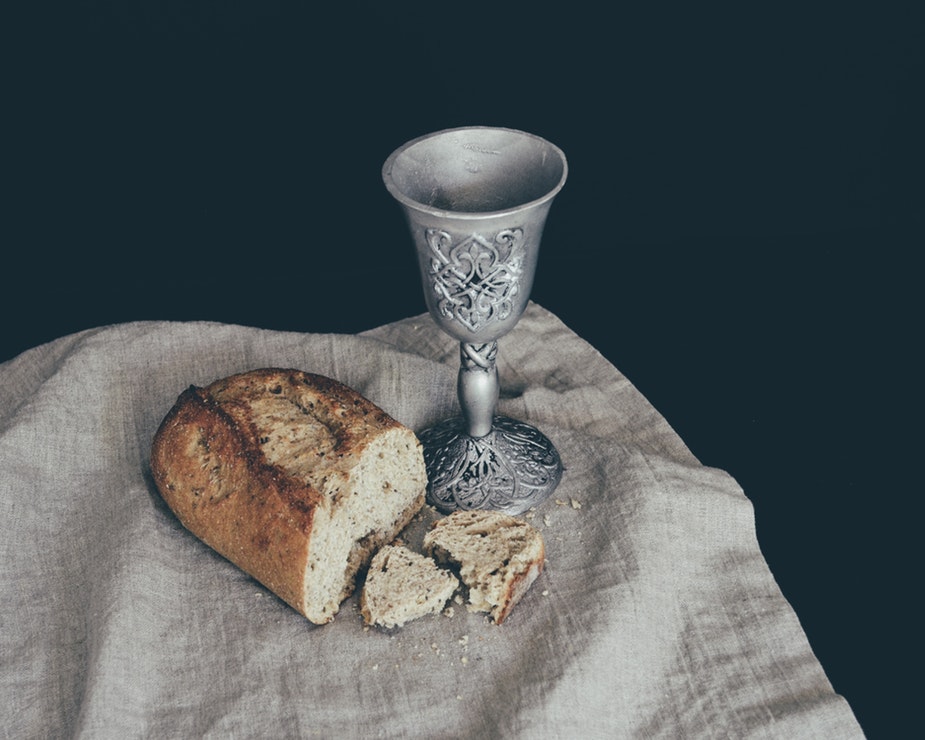
    Luke 22:19, “And he took bread, and when he had given thanks, he broke it and gave it to them, saying, “This is my body, which is given for you. Do this in remembrance of me.”

    For over a thousand years of Seder dinners, bread had been broken. Unleavened bread, just like the Israelite forefathers had eaten before fleeing from Egypt.

    The body of Jesus, given for you, given for your sins. Given for your forgiveness. And he says “do this in remembrance of me.”

    What more fitting words could you say at a Seder? A meal revolving around remembrance, about retelling the story of God saving his people by the blood of the lamb.

    Remembering what God has done. Remembering what Jesus has done. Remembering the sins that he’s redeemed you from. Remembering his body that he gave for you. Remembering his death that he died for you. Remembering the grace that he offers to you. Remembering his gospel.

    Luke 22:20 says, “And likewise the cup after they had eaten, saying, “This cup that is poured out for you is the new covenant in my blood.”

    The Seder dinner involves four glasses of wine. This seems to have been the second or third glass of wine in the meal, although there’s scholarly debate.

    But how profound it is. Wine drank in remembrance of the Passover. Jesus takes the wine, he blesses it, he says it is the new covenant in his blood, at the Seder dinner.

    It clearly points backwards to the blood of the Passover lamb, the blood that was put on the door posts. And it also points forward to the blood of Christ, shed for the forgiveness of sins. The blood of the true lamb.

    At the beginning of the gospel of John, when John the Baptist sees Jesus he says “Behold, the lamb of God who takes away the sin of the world.” Jesus is the true lamb of God. The lamb who took the penalty for sins. The one who was scarified for the salvation of God’s people.

    And by trusting in him and having faith in him, that puts the blood on the doorpost of your heart. On the first Passover, there would not have been a pardon for a person who didn’t put blood on the doorpost. It wasn’t that the blood saved them, God saved them. But to not put the blood on the door was to show that a person didn’t have faith in the Lord, didn’t trust in the Lord.

    When we take the Lord’s Supper, it’s not arbitrary. It’s not just using the random items that were around. It’s all symbolic. It takes symbols important to the first Passover, the first time God had delivered Israel, and it reminds of the new Passover, from the perfect sacrifice for sins.

    The Passover passage in Exodus 12:5 says that the lamb that was used had to be without blemish. Jesus is the ultimate lamb without blemish, a life lived in perfection.

    1 Corinthians 5:7 says “Cleanse out the old leaven that you may be a new lump, as you really are unleavened. For Christ, our Passover Lamb.”

    Josh Benner is the associate pastor at Cornerstone Evangelical Free Church in Fergus Falls, Minnesota and has a Master of Divinity from Trinity Evangelical Divinity School. He enjoys writing about faith and culture. He lives with his wife Kari in Minnesota.

  • The easiest part of the gospel we forget

    photo-1508528075895-be7a6cabd37a.jpeg

    Love.

    In Evangelical circles, we, righty, have a high view of scripture and studying God’s word. That’s important.

    But I sometimes feel like it can be so easy to get caught up in having proper theology we forget the most practical application OF the theology. Love for God and love for people.

    If I have prophetic powers, and understand all mysteries and all knowledge, and if I have all faith, so as to remove mountains, but have not love, I am nothing.

    -1 Corinthians 13:2

    I think for Christians, some excel at theology and the intellectual pursuits. Others re more focused on showing grace, compassion, and love to people but perhaps don’t care as much about theology.

    Both are valuable.

    It’s a message I have to remind myself. It’s easy for me to study these things. And certainly in studying these things, we are exposing ourselves to Godly wisdom.

    But it can also be easy to get bogged down in the theology to the point of losing sight of simply living lives of love.

    What’s your strength in those areas? May you work on cultivating your weaknesses in these areas.

    Josh Benner is the associate pastor at Cornerstone Evangelical Free Church in Fergus Falls, Minnesota and has a Master of Divinity from Trinity Evangelical Divinity School. He enjoys writing about faith and culture. He lives with his wife Kari in Minnesota.

  • Sunday to Friday: “Save us!” to “Crucify!”

    2929336358_1f97bc7308_z
    Photo courtesy of Flickr Creative Commons – Ben Stassen

    Originally published March 20, 2016

    Jesus enters Jerusalem riding on a donkey. It’s a festive scene. Passover week, one of the most significant holidays in the Jewish calendar. Jesus has been preaching throughout the region of Galilee. He has built up quite the following: teaching on the kingdom of heaven and performing miracles.

    And here he enters the holy city, the crowds shouting “Hosanna to the Son of David! Blessed is he who comes in the name of the Lord! Hosanna in the highest!” (Matthew 21:9). Palm branches had become a Jewish symbol of victory and the crowds bring these branches out as they chant. The processional they created was somewhat makeshift, but it had kingly overtones. They’re treating him like someone who was returning to Jerusalem after having conquered an enemy. Ironically, he was coming into Jerusalem to conquer sin. (more…)