Josh Benner

Category: Church

  • Jesus and eternal life – studying John 3:16-21

    Jesus and eternal life – studying John 3:16-21

    The result of belief 

    In John 3:16, Jesus says: 

    God so loved the world, that he gave his only Son, that whoever believes in him should not perish but have eternal life.

    One of the things that this verse teaches is that belief in the son is necessary. Our society really struggles with that idea. 

    I know that 75% of Americans identify as Christians but when you talk to people about their beliefs, far too many people seem to think that Jesus is this really good guy and that most of us are pretty good too and we’re going to get the benefit of heaven because we’re good and he’s good and wants to bless us. 

    That’s not the gospel. 

    The gospel is that Jesus is good. You’re not. He died in your place. Believe in him as your Lord. 

    Eternal life is reserved for the one who believes in Jesus.

    John refers to eternal life more than any other writer in the New Testament. We saw it referenced in our passage last week when Jesus was talking about his crucifixion. 

    John 3:14-15:

    And as Moses lifted up the serpent in the wilderness, so must the Son of Man be lifted up, 15 that whoever believes in him may have eternal life. 

    It is through his death and resurrection that we have eternal life. 

    Couple more noteworthy examples of Jesus talking of eternal life. John 5:24: 

    Truly, truly, I say to you, whoever hears my word and believes him who sent me has eternal life. He does not come into judgment, but has passed from death to life. 

    We are spared eternal death when we turn to Jesus. 

    In John 10, Jesus talks of himself as the good shepherd and talks of eternal life when he says: 

    27 My sheep hear my voice, and I know them, and they follow me. 28 I give them eternal life, and they will never perish, and no one will snatch them out of my hand. (John 10:27-28)

    There he is, among other things, talking about the relationship he invites us into. 

    The eternal life which Jesus offers to all who believe in him is both a future promise but a present reality. 

    It’s not that those who believe in Jesus are eligible for eternal life or may get eternal life. 

    But the person who believes and trusts in Jesus as Lord and savior HAS eternal life. 

    And that assurance is there because it is in the work of Christ that the gift of eternal life is given. 

    It’s an eternal promise which also bears present-day results in the life of a believer. 

    That’s actually how the passage ends in verse 21. 

    whoever does what is true comes to the light, so that it may be clearly seen that his works have been carried out in God.” 

    Not sent to condemn

    Continuing to speak about the salvation which comes through Jesus. 

    Verse 17: 

    For God did not send his Son into the world to condemn the world, but in order that the world might be saved through him. 

    Verse 17 is not saying that there is no condemnation ever. It’s saying that condemnation was not the purpose for Jesus coming into the world. 

    Jesus came into the world to bring salvation. And that salvation comes through his life, death, and resurrection. 

    Part of what I love about this passage is how simple it all is. 

    Some passages are difficult to understand and are enhanced by a lot of digging into historical context. Some passages are best explained when comparing them to numerous other Biblical passages. 

    These verses are simple enough to understand just through honestly reading them for what they say. 

    God so loved the world, that he gave his only Son, that whoever believes in him should not perish but have eternal life. 17 For God did not send his Son into the world to condemn the world, but in order that the world might be saved through him. 18 Whoever believes in him is not condemned, but whoever does not believe is condemned already, because he has not believed in the name of the only Son of God.

    What do you believe in? 

    Is it that Jesus is the Son of God and through him and him alone we have eternal life? Or do you believe in something else? Is your faith in Jesus? Or is it in yourself? 

    We’ve seen the love of God. We’ve seen the result of believing in Jesus. 

    We close this passage with a warning of the consequences of unbelief in Jesus.

    The consequences of unbelief

    John 3:18:

    Whoever believes in him is not condemned, but whoever does not believe is condemned already

    We again are reminded of the catalyst for eternal life. Believing in Jesus. No matter what you do, what you say, how you live, none of that gives you standing before a Holy God. 

    It’s believing in Jesus. Whoever does not believe in Jesus is condemned because there is no other way to God. 

    Jesus did not come to bring condemnation, but you are already condemned and dead in your sins without him. 

    That’s your starting point. 

    So we can either turn to Christ and find life or we can reject Jesus and still be dead. 

    If we could earn our way to God, then God would not have needed to send his son. 

    This passage is not saying “believe what you want.” It’s not saying you’re pretty good.

    It’s saying the opposite. John 3:19-20:

    19 And this is the judgment: the light has come into the world, and people loved the darkness rather than the light because their works were evil. 20 For everyone who does wicked things hates the light and does not come to the light, lest his works should be exposed.

    Those two verses sum up the human condition apart from Christ. It confronts us with reality. We are dead apart from Christ. 

    We either believe that or we don’t. We either believe Jesus is the way or we don’t. 

    What do you believe? Jesus is the light, the truth, the goodness, the salvation which has come into the world. And in a dark world, a world of sin and death, Jesus shines. 

    People loved darkness rather than the light. 

    This is why the world needs Jesus. Because we love our sin more than we love the righteousness of God. 

    A lot of sins make us feel good in the moment. 

    Being drunk can feel good at the moment. Looking at things you shouldn’t look at online feels good at the moment. Gossip feels good at the moment. Selfishness and doing whatever you want to do feels good at the moment. 

    A lot of sinful behaviors feel good. Don’t look at me like you don’t look at me like you have no idea what I’m talking about. 

    That’s why the world loves them. The Bible is the realest book that’s ever been written. 

    And in Hebrews 11:25, it talks about the “fleeting pleasures of sin.” 

    It’s not calling sin good. But it is saying that sin is often pleasurable. At least for a season. At least for a little while. If sin didn’t feel good, then the world wouldn’t love it so much. It wouldn’t be a problem. Nobody grudgingly sins. Nobody sins like it’s a chore that you have to do. “Ok, I guess I’ll say this really nasty thing about my coworker.” Nobody has to work at being prideful. 

    No kid had to be taught to sin. It comes naturally. 

    Eve wasn’t tempted with something she thought was bad. It was the promise of knowledge. David didn’t see Bathsheeba and think “oh what an ugly woman.” The world loves sin. 

    Some of those things might be different for different people. But make no mistake. We love sin. Again, please don’t misunderstand. I’m not saying that that’s a good thing.It’s a horrible thing. It’s why we are condemned and separated from God. By the grace of God, there is redemption. 

    But the world hates the light of the gospel, because the light exposes sin. 

    The world is dead in sin. That’s the bad news.

    But there is good news. 

    Borrowing a quote from Kent Hughes in his commentary on John that I’ve slightly modified. 

    God. The greatest being.

    So loved. The greatest act. 

    The world. The greatest company.

    That he gave. The greatest act. 

    His only Son. The greatest gift. 

    That whoever believes. The greatest offer.

    In him. The greatest savior. 

    Shall not perish. The greatest promise.

    But have. The greatest certainty.

    Eternal life. The greatest hope.

    Thanks for reading! If you liked this post, please share and subscribe! 

  • The Old Testament and believer’s baptism

    The Old Testament and believer’s baptism

    Baptism is not this arbitrary practice that Christians just decided to start doing. 

    During the ministry of Christ, John the Baptist had a ministry where he was the forerunner to Jesus and he baptized with a baptism of repentance. 

    But John the Baptist didn’t invent baptism. Before he was born, baptism was being practiced. When a non-Jewish person – a gentile – converted to Judaism, they made him or her get baptized. 

    And if you go back further, while you don’t have baptism in the Old Testament, you do have various washing rituals both for ordinary people and for the priests which were meant to show purity and to prepare a person for various religious activities. 

    Especially in a book like Leviticus, there’s this strong emphasis on cleanliness and purity and avoiding that which is unclean. All of that was meant to show the purity which a holy God requires. 

    In Exodus 19, before the giving of the Ten Commandments as part of the covenant with Moses, the Israelites were told to wash their garments. 

    There are also Old Testament passages which seek a deeper cleansing from God. 

    In Psalm 51, as David reflected back on his terrible sin of having an affair with a married woman, he prayed to God for cleansing. 

    1 Have mercy on me, O God, 

    according to your steadfast love; 

    according to your abundant mercy 

    blot out my transgressions. 

    2 Wash me thoroughly from my iniquity, 

    and cleanse me from my sin! (Psalm 51:1-2)

    7 Purge me with hyssop, and I shall be clean; 

    wash me, and I shall be whiter than snow. (Psalm 51:7). 

    David sought that cleansing. Baptism is a symbol of sin being washed away. 

    Jesus died for our sins and when we believe in him, we are washed clean but not only that, we are united with Christ. We are dead and raised in Christ. 

    Baptism is a symbol of that. 

    Romans 6:4-5: 

    4 We were buried therefore with him by baptism into death, in order that, just as Christ was raised from the dead by the glory of the Father, we too might walk in newness of life. 

    5 For if we have been united with him in a death like his, we shall certainly be united with him in a resurrection like his. 

    Baptism points us to that. It points us to the gospel. It points us to the death and resurrection of Christ. 

    Baptism also points us to the Church. That’s another reason why I teach believer’s baptism. Because of the theology of the church itself. 

    What is the Church?

    I’m not talking about a building. I’m not even talking about this church. 

    What is THE Church? 

    The Church is comprised of all who are part of the body of Christ. The true church are those who have faith in Christ.  

    Colossians 1:18-23 talks of the imminence of Christ over his church when it says:

    And he is the head of the body, the church. He is the beginning, the firstborn from the dead, that in everything he might be preeminent. 19 For in him all the fullness of God was pleased to dwell, 20 and through him to reconcile to himself all things, whether on earth or in heaven, making peace by the blood of his cross. 

    21 And you, who once were alienated and hostile in mind, doing evil deeds, 22 he has now reconciled in his body of flesh by his death, in order to present you holy and blameless and above reproach before him, 23 if indeed you continue in the faith, stable and steadfast

    The true church is a church comprised of faithful believers in the gospel. 

    It is true that in the Old Testament, you had an ethnic Israel. 

    But the Old Testament also talked of a future time when God would usher in a new covenant where the people of God would be set apart based on faith, not ethnicity. 


    Jeremiah 31:31-33: 

    31 “Behold, the days are coming, declares the Lord, when I will make a new covenant with the house of Israel and the house of Judah, 32 not like the covenant that I made with their fathers on the day when I took them by the hand to bring them out of the land of Egypt, my covenant that they broke, though I was their husband, declares the Lord. 33 For this is the covenant that I will make with the house of Israel after those days, declares the Lord: I will put my law within them, and I will write it on their hearts. And I will be their God, and they shall be my people. 

    So in that passage, it is pointing back to the Old Covenant and how the Israelites repeatedly broke it.  The passage is also pointing forward to a future time of a new covenant that will be different from what came before. A distinguishing mark of this covenant is that God will put his law in his people in their hearts. 

    That is pointing to people who are true believers. 

    And then in the same passage, the very striking verse is verse 34: 

    34 And no longer shall each one teach his neighbor and each his brother, saying, ‘Know the Lord,’ for they shall all know me, from the least of them to the greatest, declares the Lord. For I will forgive their iniquity, and I will remember their sin no more.” 

    What the passage is saying is that in this time of a new covenant, God’s people will know him. It is clear from the Old Testament, that you had many in Israel who were not walking with God, who didn’t love or honor God. 

    But that is not the case with his new covenant community. They shall all know me. 

    You’re not in the new covenant if you don’t know the Lord. In a few minutes, we’re going to take communion. That’s the other sign of the new covenant. Everything in communion revolves around remembering. Remembering the blood of Jesus shed for sins, his body broken for our sins. It’s for people who know and believe in the gospel. 

    There are churches that have hundreds of members on their rolls and a tiny fraction of those people come or have anything to do with that church, but they were baptized one time.

    I do appreciate arguments for infant baptism. But a danger in some churches is that for churches who teach things like salvation through baptism or baptism literally washing away sin or baptismal regeneration, it can give a false since of eternal security to a person who is faithless and cares nothing for the things of God. 

    And again, there are different positions for infant baptism. Not everyone who believes in infant baptism believes that the baptism itself saves. But there are those who do. And when we believe that a baptism can save a person apart from faith, we are resorting to works.

    We also run the risk of turning baptism into a superstition. 

    Ezekiel 36 

    Another key Old Testament passage which looked forward to a new covenant people of God who would have the Spirit of God and live lives for God is Ezekiel 36. 

    What metaphor does Ezekiel use to describe this new spiritual life? Water

    Ezekiel 36:25-27: 

    25 I will sprinkle clean water on you, and you shall be clean from all your uncleannesses, and from all your idols I will cleanse you. 26 And I will give you a new heart, and a new spirit I will put within you. And I will remove the heart of stone from your flesh and give you a heart of flesh. 27 And I will put my Spirit within you, and cause you to walk in my statutes and be careful to obey my rules.

    The Spirit is talked about as a cleansing in water. It is the Spirit of God in the people of God who have been given a new heart by God and who are enabled by the Spirit to live lives in obedience to God. 

    And this cleansing with water which is compared to the Holy Spirit is for believers. 

    We saw the beginning of that in Acts 2.

    Believers in the gospel have the Spirit of God. The new covenant is people who are united in faith, not united along ethnic or familial lines. 

    Baptism is a response to faith, not a precursor to the hope of future faith. 

    Thanks for reading! If you liked this post, please share and subscribe! 

  • The love of God and john 3:16

    The love of God and john 3:16

     “For God so loved the world, that he gave his only Son, that whoever believes in him should not perish but have eternal life.

    –John 3:16: 

    It’s one of the best known and most beloved verses in the Bible. Still a verse that remains a part of popular culture. 

    In the 1970s and 80s, it was a popular verse to be seen in the background of sporting events. Most notably, it was a man who traveled the country in a bright rainbow colored wig in the 1980s with a John 3:16 banner. At his height, he was traveling over 60,000 miles a year to different games. 

    More recently, football star Tim Tebow wrote John 3:16 in his eye paint for the 2009 national championship game. 

    The John 3:16 reference is found on the bottom of cups at the popular west coast restaurant chain Inn-N-Out burger, as well as at the bottom of shopping bags for the clothing retailer Forever 21. 

    With a Bible verse that’s so well-known, I think we can sometimes become tone deaf to it. 

    It’s a great verse because it tells the gospel as succinctly as any verse in the entire Bible. 

    God so loved the world, that he gave his only Son, that whoever believes in him should not perish but have eternal life.

    It points us to the love of God. 

    But because of passages like this one, I think it’s easy for us as Christians to take the love of God for granted. 

    The idea of a loving God is not universal to world religions. In many religious systems, their gods are not loving, they’re not personal, they’re not perfect, and humanity basically has to do what it can to appease them. In most religions, the pressure is put on man to live up to a certain standard. 

    I’ve heard people argue that “all religions are basically the same.” 

    Have you ever heard that one? 

    I think that’s something that Americans say who have generally never studied other religions and who are basically making an arrogant assumption that all other religions have a similar worldview to Christianity. 

    Not the case.

    Because here in America, no matter if someone is a Christian or the most ardent atheist, we are influenced by Christian teachings and beliefs. It’s at the core of our nation’s founding. It influences our ethics, laws, literature. It influences our understanding of a seven day week, it influences how we see the world. 

    Because it’s so fundamental to America, it’s easy take certain Biblical teachings as self-evident assumptions. 

    It’s kind of like how when you grow up, there’s often a certain assumption in the normality of how you’re raised. It’s what you know. But you get older, and sometimes you realize that things that were always part of your life and which you always took for granted were actually not what everyone else experienced. 

    And in America, that happens with Christianity. And it happens with the idea of a loving God. 

    We hear a phrase like “God so loved the world” and are tempted to think “well…yeah.” 

    Because we think we’re pretty good. Pretty loveable. Why wouldn’t God love us?

    Why would God love you? 

    A perfect and holy God. He can have whatever he wants. He is totally self-sufficient, self-sustained. He doesn’t need any favors. He isn’t bored or lonely. 

    Why would he love you? Who’s your dream person to meet? 

    That’s a frequent ice breaker question to ask. If you could meet any person and I’ll say it can’t be a relative. And it can’t be someone from the Bible. 

    Who’s your dream person to meet? Maybe it’s a famous pastor, or an athlete, a movie star, a writer, a musician, a president. Whoever it is. Imagine you actually got to meet that person. 

    That would be a pretty big deal. Right? Just to meet them. 

    Because it’s someone famous, someone influential, someone people know, someone the world loves. You wouldn’t expect them to know you. You certainly wouldn’t expect them to love you. 

    And those are just people. 

    We have such a habit of putting our celebrities up on a pedestal. Finite, fallible, fallen people. 

    But then you compare that to the infinite and almighty God. A God who spoke the universe into being by the power of his word. The God who sustains all of creation. 

    And he knows you. 

    Little ole you. 

    He’s righteous. Meanwhile, you don’t even live up to your own standards. You don’t even live as good a life as you know you could. And you certainly don’t live up to God’s standards.

    We sin so much that become numb to it and often don’t realize it. The times where we act selfishly or manipulate someone. We have a justification for it. The times we lie. The bad things we think about others. The times we disregard God. The times where we know what we should do, and actively decide not to.  

    But that God knows you. And he loves you. 

    God created humanity and he knew would sin. He made us anyway. 

    God made a covenant with Abraham and made a promise that he knew we would not deserve. He gave it anyway. 

    God sent his son into the world. Jesus was perfect, without sin, came to spread light in a dark world, and God knew the world would kill him. He sent him anyway. 

    God knew that you would be a sinner. But God so loved the world that he gave his only son that whoever believes in him will not perish but have eternal life. He forgave you anyway. 

    Through Jesus and what he did on the cross. Nothing about this passage lifts up the goodness of man. This is entirely the goodness and love of God. 

    I wanna know what love is 

    Our era has twisted the meaning of love. The culture acts as though real love is accepting whatever someone wants to do. No matter if it’s sinful. No matter if it’s harmful. We call that love. I call it apathy. 

    Love is a righteous God who would forgive people and give them heaven, and spare them hell, even though they are unrighteous and unholy. 

    Romans 5:6-8:

    6 For while we were still weak, at the right time Christ died for the ungodly. 7 For one will scarcely die for a righteous person—though perhaps for a good person one would dare even to die— 8 but God shows his love for us in that while we were still sinners, Christ died for us.

    God so loved the world. 

    Even though it was fallen and sinful. 

    Even though people loved the darkness rather than the light because their works were evil.

    God loves the world so much that he sent his son. 

    Abraham and the son

    In the Book of Genesis, God makes a great promise to Abraham. He’s promised him land, he’s promises him descendants, God promises that he will make of him a great nation. 

    But time goes by, Abraham and Sarah grow old and in their old age, they’ve never had a child, but God makes a promise that Sarah will still have a son. 

    Genesis 17:17 tells us that Abraham fell over laughing. She was so old that it was such an absurd promise. 

    But miraculously God gives them a son. Isaac. Ironically, the word Isaac in Hebrew means “he will laugh.” 

    God gave Abraham this promised son. 

    In Genesis 22, God asks Abraham to sacrifice Isaac.

    An unimaginable, unfathomable thing to be asked. Parents would do anything to protect their kids. You love them. You’d give up your life for their life without hesitation. 

    But God tells Abraham to sacrifice his own son. 

    Abraham trusted in the Lord. 

    He took Isaac to the top of the mountain and was prepared to sacrifice his promised son when the Lord intervened at the last moment. 

    Do not lay your hand on the boy or do anything to him, for now I know that you fear God, seeing you have not withheld your son, your only son, from me.” 13 And Abraham lifted up his eyes and looked, and behold, behind him was a ram, caught in a thicket by his horns. And Abraham went and took the ram and offered it up as a burnt offering instead of his son. 14 So Abraham called the name of that place, “The Lord will provide.” (Genesis 22:12-14)

    The Lord provided another sacrifice in that story. He provided a ram. 

    But that was ultimately meant to point to a greater sacrifice which the Lord provided. 

    God would not ask Abraham to go through with the sacrifice of his son.  

    But God gave up his. 

    He gave his only son. 

    No other sacrifice was worthy, no other sacrifice could bear the weight of our sins, and atone for our sins. 

    But Jesus could. God so loved the world and the only way for that world to be forgiven was through Jesus. We see more about the work of Christ as this passage continues. 

    Thanks for reading! If you liked this post, please share and subscribe!

  • No, heaven will not be boring. It will be awesome!

    No, heaven will not be boring. It will be awesome!

    In Randy Alcorn’s wonderful book, “Heaven,” he tells a story of an English minister who was asked by a colleague what he expected after death. The man replied: “Well, if it comes to that, I suppose I shall enter into eternal bliss, but I really wish you wouldn’t bring up such depressing subjects.”

    Our views of heaven are too lowly. In life, things often times leave us disappointed.

    A movie looks hilarious in the previews….and then you see the movie and realize every funny scene was basically shown in the preview. People rave about a restaurant, and you think it’s just ok. We vote for a politician who we think will fix things, and they disappoint.

    Perhaps that’s part of the reason why our views of heaven are too low. Because of earth. We live in a fallen world where there is sin and hurt and where things are never quite right.

    But heaven will be a perfect place

    Heaven should be a source of joy. I think of the things we have on earth. The beauty of nature: spectacular beaches and rainforests, mountains and sunsets, the artworks in Europe, the great architectural achievements.

    Those are all just on this earth.

    But God is making a new heaven and a new earth.

    And the point of the new earth is not for God to make a place that’s WORSE than where we currently live.

    With all of the confusion about heaven, there should be no confusion about this: heaven is going to be perfectly awesome. It is not going to disappoint. You’ll never be there and feel like it didn’t live up to all of the hype.

    We have a lot of stereotypes about heaven. We do tend to have the cartoon view with harps on clouds in white robes.

    We aren’t going to be standing on clouds, wearing white robes and playing the harp. It’s a new earth. And we are going to live there eternally.

    Now just think about this earth…

    There’s a lot to it. Imagine if money were no object, you had the time, you could travel everywhere on earth you wanted to go to? Think about how much there is to explore? The great mountains and oceans.

    You might secretly fear the idea of heaven because you find yourself thinking “is it just going to be like a worship service for the rest of eternity?”

    I think part of the answer to that question relates to what you consider worship…

    For you, is worship just something you push through on a Sunday morning? If even then?

    Or is it a way of life? Is going to church worship? Is raising your kids worshipful? Growing with your spouse? Enjoying a good meal? Seeing the beauty of a sunset? Do you turn to God in prayer? Do you enjoy music that honors God? Do you care about loving and serving people, because it’s honoring to God?

    In short, do you live a lifestyle that revolves around worship? Revolves around God?

    Or do you compartmentalize? I’ll go to church for 90 minutes, for the church box…but for other things I do, those are for me?

    Yes there is worship in heaven! It’s the presence of God. In heaven, it’ll be a better and truer form of worship. In heaven, you won’t be dealing with the stresses of life: missed appointments, issues with finances, family stresses, health concerns. Because God is awesome. God is good and heaven is the place that he has made for his people.

    And there are things about heaven we can’t even imagine.

    Many people in America are social Christians. They’re good, moral people, but they’re lukewarm about God. They know he exists but really they just want to do their own thing. Is that you?

    Ultimately we can have a taste of that now. But to just know that it doesn’t compare with the reality that it will be to actually be in heaven in the presence of a holy God.

    In the Great Divorce, CS Lewis says: “The Blessed will say ‘We have never lived anywhere except in Heaven,’: and the Lost, ‘We were always in Hell.’ And both will speak truly.”

    I’m not saying this to be cynical or snarky. But if you dread the idea of worshipping God in heaven, I think you might need to develop a greater love for worshipping him on earth.

    But no. Heaven will not be a church service for all eternity.

    It’s a new heaven and a new earth and a New Jerusalem.

    Other images that the Bible uses: it’s a great feast! Who doesn’t love a great feast?! Great conversations and laughter. Music, not just from harps! And dancing.

    The Bible talks about it, calling it a wedding.

    In America, we go pretty over the top with weddings. But there are other cultures that take it further than we do. And in the first century world in which this book was written, wedding celebrations could last for a week.

    Wonderful times of joy and laughter.

    A wedding, a feast.

    It’s not “come, join us at the jury duty selection pool of the Lord!”

    There will be wonderful company in heaven. You’ll be able to see Jesus. The Lord who took the penalty for your sins. You’ll be able to see him face to face.

    We’ll have greater perspective in heaven. We’ll be able to continue to learn in heaven. For the things that have been struggles. For the things where we’ve suffered, in heaven, somehow, some way, they will be made right. Perhaps heaven will be so glorious that we just won’t care.

    Or perhaps we’ll have a different perspective and see how all things really did work together for our good.

    It will be a place where God will “wipe away every tear from their eyes, and death shall be no more, neither shall there be mourning, nor crying, nor pain anymore, for the former things have passed away” (Revelation 21:4). And it’s a place that will be perfectly awesome.

    Thanks for reading! If you liked this post, please share and subscribe!
    Originally published November 21, 2016.

  • Jesus, Nicodemus, and the bronze serpent. Studying John 3:9-15

    Jesus, Nicodemus, and the bronze serpent. Studying John 3:9-15

    In John 3, Jesus is approached by a pharisee named Nicodemus who is intrigued about his ministry. Jesus controls the conversation and talks to Nicodemus of being born again and born of water and the Spirit. Nicodemus is perplexed by this. 

    Verses 9-10, Nicodemus is still dumbfounded by what Jesus has said. 

    9 Nicodemus said to him, “How can these things be?” 10 Jesus answered him, “Are you the teacher of Israel and yet you do not understand these things?

     Nicodemus is the expert. He should understand what Jesus has said. He should pick up on the Old Testament references to water and the Spirit. It is a grace to the people of God that the Lord gives believers the Spirit. 

    Jesus continues speaking in verse 11. 

    11 Truly, truly, I say to you, we speak of what we know, and bear witness to what we have seen, but you do not receive our testimony. 

    Jesus has come to give a heavenly testimony. He has come to the world to reveal God. 

    12 If I have told you earthly things and you do not believe, how can you believe if I tell you heavenly things? 

    Jesus is the eternal God of creation who has been in heaven. He can therefore speak with authority on what is necessary for admittance into the Kingdom of Heaven. He has revealed to Nicodemus that he must be born again, born of the Spirit. Nicodemus doesn’t even understand that. So how will he understand the heavenly things of God? 

    Sovereign Citizens 

    There’s a small movement in America, perhaps some of you have heard of it: called Sovereign Citizens. Sovereign Citizens are a group of people who question the legitimacy of our government, don’t believe in paying taxes, and don’t believe that they’re accountable to our legal system. 

    I was once watching an episode of Live PD and someone had gotten pulled over. From what I remember, she didn’t have any truly serious violations but had broken a couple of traffic laws and also did not have a valid driver’s license. 

    She kept declaring that she was a sovereign citizen. 

    Kept being difficult. 

    Keeps talking about how she’s a sovereign citizen. 

    Ends up getting arrested. 

    My point with that illustration is that just because a person might say the law doesn’t apply to them doesn’t make it so. Because you still have to suffer the consequences for your actions and choices. 

    When it comes to the faith, people want to invent their own gospel. People want to believe that they’re good enough, that they can get to God on their own. People want to live Godless lives apart from Christ and assume that they will have merit or an inherent worthiness of heavenly blessings. 

    Just because we say “I’m a sovereign citizen” doesn’t make us sovereign. 

    The Lord is sovereign. 

    And Jesus speaks with heavenly authority in this passage. 

    No one has ascended into heaven except he who descended from heaven, the Son of Man.

    In John 3, we see the divine command to be born again, the divine authority by which Jesus can give that command. And in the last two verses of this section, we end with a picture of the gospel. So far, this passage hasn’t really talked about the role of Jesus. 

    It is by the Spirit that we are born again but it is through the work of Christ that we are able to be born again. It is Jesus who has died so we can be redeemed. 

    Remember that Jesus is talking to an expert of the Law and the Old Testament. Jesus is going to make a statement about himself based in an Old Testament event. 

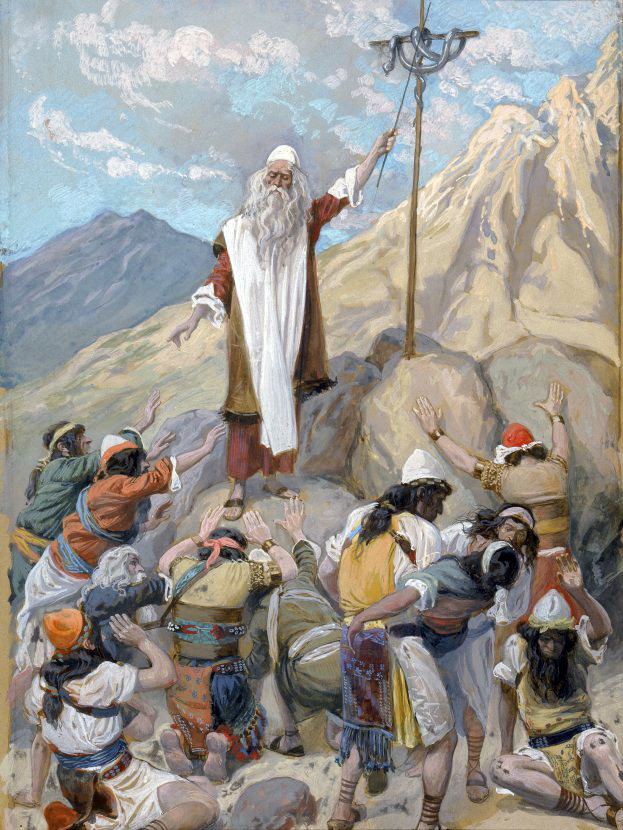
    14 And as Moses lifted up the serpent in the wilderness, so must the Son of Man be lifted up, 15 that whoever believes in him may have eternal life. 

    Jesus is making a reference to the Book of Numbers, 21st chapter. 

    In that chapter, the Israelites have been in their desert wanderings for 40 years. Most of the first generation has died off. Throughout their time in the wilderness, Israel has fallen into sin and grumbling. 

    God has brought them to the edge of the land and they continue to complain. God has sustained them for a generation and they ask why they’ve been brought into the wilderness to die. They’ve been given food but call it loathsome. They’re saying that they hate what God has given them. 

    And as a righteous and divine judgment, God brings a plague of poisonous snakes upon the people. Not just for that, but for a whole history of their rebellion and grumbling. 

    The people turn to Moses and ask Moses to intercede on their behalf. 

    Numbers 21:7: 

    And the people came to Moses and said, “We have sinned, for we have spoken against the Lord and against you. Pray to the Lord, that he take away the serpents from us.” So Moses prayed for the people. 

    God will give Moses instructions on what he must do. 

    8 And the Lord said to Moses, “Make a fiery serpent and set it on a pole, and everyone who is bitten, when he sees it, shall live.” 9 So Moses made a bronze serpent and set it on a pole. And if a serpent bit anyone, he would look at the bronze serpent and live. 

    Jesus looks to this event in the Old Testament and he shows it as pointing to himself. 

    As the bronze serpent was lifted upon the the pole, Jesus also will be lifted up. 

    Five times in the Gospel of John, Jesus refers to being lifted up. It always refers to the crucifixion, where Jesus is literally lifted up on the cross. 

    Again. Keep in mind that so far in this passage, Jesus talked of a need to be born again AND of the role of the Spirit in being born again. 

    But he points to the source of eternal life being Jesus himself who is lifted up. 

    Perhaps it seems like an odd connection that the Lord is making in comparing himself to the serpent of Numbers 21. 

    Several reasons why that story is a good picture of the gospel:

    The bronze serpent and the gospel

    In a person being healed because of looking at the snake, it took what they were doing out of their hands.

    It was entirely the work of God. 

    So too we see this in the gospel. It is not based on us, or how good we are. We are totally helpless to heal ourselves from the disease of sin. It is looking to the cross, to looking at what Jesus has done, to trusting Jesus by faith that we can have salvation. 

    Second. The serpent doesn’t make sense. Why a golden snake? The world is confounded by the gospel and the message of grace, the idea that we can be freely forgiven based on what someone else has done. 

    1 Corinthians 1:18:

    the word of the cross is folly to those who are perishing, but to us who are being saved it is the power of God.

    The world is offended by the message of salvation by grace. 

    We want to save ourselves. We want to see how we measure up and to feel good about how good we are. 

    The gospel is that you cannot earn it. You look to what Jesus has done. 

    Third. The Israelites were grumbling and complaining and blaspheming against God, and yet God saves them. 

    Jesus came into a world where people condemned him, plotted against him, betrayed him, and killed him. 

    While we were yet sinners, Christ died for us (Romans 5:8).

    Fourth. Moses literally lifted up the bronze serpent on a pole. 

    And Jesus was literally lifted up on the cross. 

    Fifth. For the Israelites who were afflicted by the serpent’s bite, life was found by looking to the bronze serpent. For us today, eternal life is found by looking to Jesus. 

    We’re infected with the venom of sin. And it’s a killer. There is nothing we can do on our own to take out that poison. The only antidote is found in looking to Jesus.

    It is he who went to the cross for salvation. 

    In referring to the Numbers passage, Jesus is telling Nicodemus the gospel. It is Christ who will be lifted up for sinners. 

    And to have a heavenly hope, we must believe in what the Lord has done. We believe in Jesus and we are given the Holy Spirit to transform our lives from the inside out. 

    Thanks for reading! If you liked this post, please share and subscribe.