Being born again is another word for the doctrine of “regeneration.” It is a supernatural work that God does within a person who comes to faith. All Christians are born again because all Christians have experienced regeneration. There’s no such thing as an unregenerate Christian. That’s not a Christian!
Being born again is about coming to Christ, turning away from sin, and trusting in Jesus as your Lord and savior. And when we come to him, there is grace. There is forgiveness for our sins.
But here’s a point that people too often miss. It needs to be a genuine faith in what Jesus has done. And the validation of that sincerity will manifest itself in a life that is transformed by the gospel. And if there is no change in your life, if there is no fruit, if there is no greater love for God, no appreciation for the work of Christ, no recognition of the cost of sins for which Jesus went to the cross, then for the sake of your own soul, you need to do some sincere soul searching into whether or not you actually believe.
There are so many things that we like to tie to regeneration. For some, they want to look at baptism. Baptism doesn’t confer regeneration to you. Baptism doesn’t make you born again if you don’t have faith. Baptism doesn’t mean anything if you don’t believe in the triune God in whose name you were baptized.
Some people like to tie it to their family. Mom and dad are Christians, or were Christians. “That’s how I was raised.” That’s a wonderful blessing. But that doesn’t mean you’ve been born again. The faith has to be your own. To
For others, it might be the Sinner’s Prayer. “I asked Jesus into my heart.”
But did you believe it? Did you place your trust in him? If there’s never been any evidence in your life that Jesus is in your heart, is he really? Don’t go through life thinking “I said this prayer one time,” or “I got baptized one time,” and that that’s all that matters if you’re living a faithless life.
This isn’t meant to undermine the justifying work that Christ did on the cross. How we are justified by Christ. And what a glorious promise that is. But that presupposes faith. This isn’t meant to undermine the work that God does in our lives, he does work in our lives through his Spirt but we have to have had faith in him to have the Spirit. We’ll talk about the in June. All of those things are still true.
But this is to say that a person who never did have faith still isn’t saved. And empty words don’t change that. And water doesn’t change that. The only thing that can change that is recognizing your inability to live up to a God who is absolutely perfect and holy. And that while you could not live up to it, while we were yet sinners, Christ died for you (Romans 5:8).
Jesus said “unless one is born again, he cannot see the kingdom of God.” It’s the regeneration of God in our souls.
It’s not some inconsequential change. It is a monumental miraculous work of almighty God.
In the beginning, God created the heavens and the earth. (Genesis 1:1)
Nothing existed and God spoke the universe into being by the power of his words.
But when it comes to being born again, the regeneration that God works in us, God takes a person who is dead in sin, God takes a person who is opposed to him, who does not trust him, and he makes us alive. He gives us a new life, a new birth.
Originally published September 5, 2017
Thanks for reading! I’d love to hear what you think, and don’t forget to subscribe!
Tomorrow will be the fifth anniversary of the landmark Supreme Court decision which guaranteed the right to marry for same-sex couples.
In the years preceding the decision, state after state after state voted against it. 32 of 33 states where this was voted on, voted no. In 13 of those states, the vote wasn’t even close, with more than 70 percent of people voting to ultimately preserve the traditional American definition of a marriage. The will of the people was ignored and five justices -who are no more virtuous than the rest of us – declared the law by fiat.
Many years ago, the argument for recognizing the legal validity of same-sex marriages and unions was the “what if two people are in a loving relationship for many years and one is in the hospital. Their partner can’t visit them?”
We’re so far beyond that now. A celebrity says something critical of same-sex marriage and there’s a backlash, efforts to boycott and essentially destroy the person. If a business owner doesn’t want to support it, he’s a hateful and bigoted. The conversation has been crushed on this issue. In the popular cultural narrative, the only accepted response is enthusiastic support and affirmation. Dissent is not tolerated.
Last week, the Supreme Court enshrined LGBT rights into federal employment law.
This week, California banned state funded travel to Idaho due to Idaho’s transgender laws. In 2016, the NBA moved their all star game with Charlotte, due to a state law that disallowed transgender people from using the bathroom which corresponded to their selected gender. The World Health Organization, which had viewed gender dysphoria as a mental illness decided it no longer was last May. In several states, transgender identified females (biological males) have dominated women in athletic competitions. And this is all being seen as more and more normative.
This would have been unthinkable a decade ago.
In coming years, I expect the popular culture to have more and more support for the LGBT community. I expect more court decisions to go in favor of the LGBT movement. As I look around and survey our current climate, I see destruction in our cities, statues coming down, calls to defund the police. I see people going after our fundamental institutions. These are attacks on our society, our history, and our system of law and order. But the church is another major institution in our society. The church and our religious tradition is fundamental to our history and worldview.
There have already been attempts to force Christian businesses to go against their moral beliefs and provide services for same-sex weddings. We’ve seen more pressure on Christian adoption agencies to work with LGBT couples. With the latest rulings on employment law, churches and Christian organizations will continue to face opposition for their beliefs.
I do expect the culture to more and more come to be at odds with evangelical Christianity. Instead of coexisting, I think the church and Christian organizations will increasingly become targets of legal action.
I look at those who want to attack our society and institutions and see the LGBT movement more and more coming at odds with evangelical Christianity. Certainly there are members of the LGBT community who want to coexist and can agree to disagree, but as Marxist thought runs prevalent within the radical progressive movement, the LGBT movement will be used to undermine religious liberty while pushing a progressive ideology that runs contrary to the gospel.
Thanks for reading! I welcome comments. Please like and subscribe.
Paul was the greatest missionary who ever lived. When writing to the Philippians, he was in jail. That’s the last place he needs to be! Why would God allow this to happen? Wouldn’t it be better for Paul to be out in the mission field sharing Jesus?
Regardless of what is happening in the world, God is still at work.
In Acts 16, Paul was also imprisoned, yet in that passage, it was because God did not spare Paul from prison that he was able to witness to his jailer.And so it goes throughout the history of the church. Where God has been working in ways that people might not have expected. Powerful empires have tried to crush Christianity.
It’s often been true that the church has faced oppression. The blood of the martyrs waters the seeds of the church. And in places where it’s easy, where it’s common to be a Christian, there can be complacency. It’s easy to just assume everyone around us is a Christian. Whereas in other parts of the world, you actually have to take risks to acknowledge Jesus.
None of this is to say that we should want bad things to happen! But to be mindful that in the face of sin and injustice, noting stops God. The gospel is unstoppable.
Sometimes it’s because God does not spare people from the difficulties that people are in positions to evangelize and share the gospel. Sometimes through the wickedness and evil of men, because of God’s immeasurable goodness, he graciously puts them in position to hear the gospel that they don’t even deserve.
A modern example
During the reign of Nicolae Ceausescu, Romanian citizens were facing persecution from the government for transporting Bible across borders, sharing their faith, and even worshipping privately in their own homes.
Virginia Prodan was a Romanian lawyer who defended Christians of these basic human rights. Prodan was a Christian. She had suffered much for her faith. She had been beaten and torutnred. She had been placed under house arrest. One day, when returning to her office, one of her assistants told her a man wanted to speak with her.
The man was a giant, 6’10” which dwarfed the 5 foot tall Prodan.
He pulled out a gun and told her he had come to kill her.
WRITING IN CHRISTIANITY TODAY, SHE SAID: I CONSIDERED THE MAN BEFORE ME. BEHIND THOSE HATE-FILLED EYES WAS A CREATION OF GOD. HE HAD AN IMMORTAL SOUL, AND HE NEEDED TO KNOW ABOUT THE LOVE GOD HAS SHOWN IN JESUS CHRIST. AT ONCE EMBOLDENED, I MET MY KILLER’S EYES. “HAVE YOU EVER ASKED YOURSELF: ‘WHY DO I EXIST?’ OR ‘WHY AM I HERE?’ OR ‘WHAT IS THE MEANING OF MY LIFE?’ I ONCE ASKED MYSELF THOSE QUESTIONS.” MY VOICE STAYED CALM AND DID NOT WAVER.
HE SLID HIS GUN BACK INTO THE HOLSTER. I LEANED FORWARD. “YOU ARE HERE BECAUSE GOD PUT YOU HERE, AND HE HAS PUT YOU TO A TEST. WILL YOU ABIDE IN GOD OR IN THE WILL OF A MAN—YOUR BOSS, PRESIDENT CEAUSESCU, WHO REQUIRES YOU TO WORSHIP HIM? GOD HAS GIVEN YOU FREE WILL TO CHOOSE.”
The assassin didn’t kill her that day. He acknowledged that he had needed Jesus in his life. The power of the gospel had penetrated his heart.
But it was because God had not spared Prodan from that persecution that she had been enabled to witness to that man.
And there are other stories we can find in modern times from almost every empire that has cracked down on Christianity, that has persecuted Christians, of the gospel working through the cracks of the walls that empires have built up. The gospel is unstoppable. Because God is unstoppable at achieving his purposes. Even in oppressive regimes that try to totally crush Christianity, the gospel still takes root. The truth finds a way.
In our world, persecution and challenges shouldn’t be a surprise when the gospel is that Jesus came into a fallen world to redeem people to himself. It’s a message that’s offensive because it confronts people with the reality of sin. It points to the narrow way.
In America, we’re often times too comfortable.
If we think that we always need ideal conditions to share the gospel; if we think that the gospel always needs receptive environments to thrive: it doesn’t. Because the spread of the gospel, is not about our abilities and talents and planning. Not suggest this things are irrelevant. God does equip and gift people in different ways.
But even when it seems to be against all odds, it is the power of God through which the gospel reaches people. The gospel is unstoppable.
What does that mean to you?
It makes sense people would be hostile to the gospel. When Jesus came to redeem a world that was dead in sin. A world that was so sinful the it killed its savior.
And it’s not a shortcoming of God that he doesn’t do more to make the way to share the gospel easy. It’s his grace that he came to earth and made the gospel possible to be proclaimed at all. It displays his power and glory that the gospel still goes forth when people try to thwart his work.
People have tried to stop the gospel’s advance. And those people are dead and gone, but the gospel message continues because Jesus lives on.
Originally published February 6, 2018
Thanks for reading! I’d love to hear what you think, and don’t forget to subscribe!
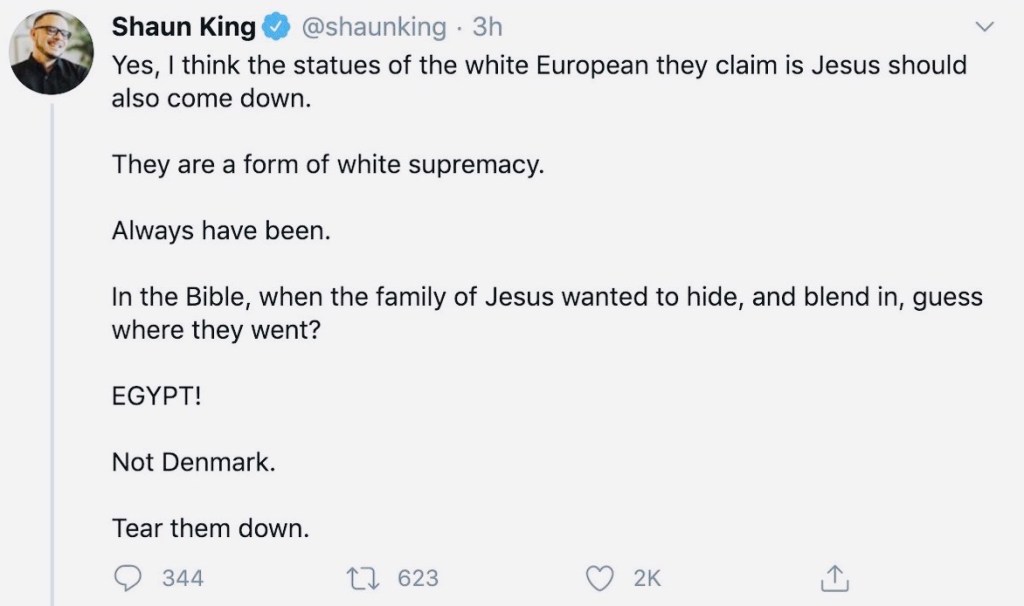
It was only a matter of time. Activist and writer Shaun King has taken aim at images and sculptures which depict Jesus as white.
On Twitter, King said:
Yes, I think the statues of the white European they claim is Jesus should also come down. They are a form of white supremacy. Always have been. In the Bible, when the family of Jesus wanted to hide, and blend in, guess where they went?EGYPT! Not Denmark. Tear them down.
There are a few issues with that. For starters, in Matthew 2, when Joseph and Mary take the newborn Jesus from Bethlehem to Egypt, it was not because they would “blend in.” They left their territory to go outside the jurisdiction and influence of Herod, so he’s wrong on that front.
King is also making the absurd argument that art which depicts Jesus as white is ALWAYS an example of white supremacy.
The roots of Christian art go back a long way. There are artistic depictions of Jesus which go back to the early centuries of the church. Hundreds of years.
And across cultures, throughout the centuries, people have often depicted Jesus as looking like them. European art depicted a European Jesus, Japanese Christian art depicted a Japanese Jesus, Ethiopian Christian art depicted an Ethiopian Jesus.
King assumes the worst and calls it an example of white supremacy. Isn’t it possible that you have centuries of artists who had no idea what Jesus looked like, who didn’t have the internet, or TV, or photos and who didn’t always necessarily know what an Israelite would have looked like and that the artist just painted what they knew? That strikes me as the more reasonable conclusion. And artists in earlier generations influenced the artists of later generations. King says that depicting Jesus as white has always been an example of white supremacy.
Are other cultures also being cultural supremacists when they depict Jesus within their own cultural context?
Who is King to assume the motives of centuries of artists?
King later doubled down on that Tweet: Yes. All murals and stained glass windows of white Jesus, and his European mother, and their white friends should also come down. They are a gross form white supremacy. Created as tools of oppression. Racist propaganda. They should all come down.
Is the key to a better and more tolerant world to tear down the past and destroy art? To erase history? In the last few weeks, too many people are becoming too accepting of censorship as if that’s going to bring us to utopia. Should we also burn books, Shaun?
I’m not disputing that a European looking Jesus is historically inaccurate. And over the years, I’ve become more and more uncomfortable with artistic depictions of Jesus in any format. But that doesn’t mean the mob should be able to dictate what churches and museums can depict.
King has made a mockery of himself with this ridiculous argument.
Thanks for reading! I welcome your comments. Please like, share, and subscribe.
16 When evening came, his disciples went down to the sea, 17 got into a boat, and started across the sea to Capernaum. It was now dark, and Jesus had not yet come to them. 18 The sea became rough because a strong wind was blowing. 19 When they had rowed about three or four miles, they saw Jesus walking on the sea and coming near the boat, and they were frightened. 20 But he said to them, “It is I; do not be afraid.” 21 Then they were glad to take him into the boat, and immediately the boat was at the land to which they were going.
Prayer
Our heavenly Father,
On this father’s day, I do want to pray for the dads in our church. No matter how young or old a father is, they have opportunities to bless, to love, and to share wisdom with their kids. It is a sacred role which you have created.
Lord, it is a day that can mean different things to different people. Some of us no longer have our father’s with us. Some of us might have had difficult relationships with our fathers. We thank you for the men in our lives who influenced us and helped shape us into the people we’ve become.
And with all of their greatnesses and imperfections, Lord may our earthly fathers point us to you, our true and perfect heavenly father.
You rule and reign with sovereign authority.
You know our needs better than we do.
You know the number of hairs on our heads. A sparrow does not fall without your knowledge. That is your exhaustive knowledge of our world.
You know the situations of our past, our present, and future.
Lord, you are our refuge and strength, a very present help in trouble. Therefore we will not fear though the earth gives way, though the mountains be moved into the heart of the sea, though its waters roar and foam, though the mountains tremble at its swelling.
In the stressful times, instead of trying to control situations, manipulate situations, worry about situations, grumble about situations, may we instead turn to you and trust in you.
In times of uncertainty, may we be certain of your goodness. In times of suffering, may we rejoice knowing that suffering produces endurance, 4 and endurance produces character, and character produces hope, 5 and hope does not put us to shame, because God’s love has been poured into our hearts.
Lord, may we trust that there is nothing in our lives, no matter how big or small which falls outside of your sovereign will. May we remember that you are eternal and eternally faithful to your promises and Word and that you never leave us nor forsake us.
Lord, in the frightening times of life, may we draw near to you not run from you.
Lord, please bless our time as we study your Word.
May we again be reminded of your gospel and rejoice in your Son who has come into the world so that we can be forgiven of our sins.
In Jesus’ name, Amen.
Series context
We’re continuing in the Gospel of John this morning. Last week, we looked at Jesus feeding the multitudes.
This week, we look at the story of his disciples being caught in a storm and Jesus walking on water. It’s another one of his greatest hits and best known and loved stories in the gospels.
This event is recorded in three of the gospels. Matthew, Mark, and here in John. In all three of those gospels, it appears directly after Jesus feeds the multitudes.
John’s version of the story is the shortest by a significant margin. Matthew’s account is more than twice as long as John’s, but that makes the account no less important.
Also, I should mention that a good exercise to do sometimes when reading a story that’s recounted in more than one gospel is to look at the stories and see what one writer emphasizes more or less than another.
Before we jump into our passage, I just wanted to make one more comment. Last week, we talked about how John chapters 6-8 echo a number of themes found in the Exodus. We’ll see that again in our passage this week.
Last week, we saw it in the time of year. It’s Passover, the same time of year when the Israelites had been freed. When Jesus feeds the multitudes, it alludes to the Lord providing manna during the Exodus journey.
In Jesus walking on water, it echoes the crossing of the Red Sea. In the preceding passage, the current passage, and next week’s passage, John continues orienting the geography of these events around the Sea. And that will be especially relevant today.
So we’ll jump in and this week we will again look at this passage in three scenes. A setting, a conflict, and a resolution.
First scene – Setting
After the feeding of the multitudes, last week’s passage concluded by telling us that Jesus withdrew again to the mountain by himself (John 6:15).
Just as Moses has gone up to Mount Sinai alone, Jesus departs from the multitude of people to be by himself on the mountain.
Verses 16-17: When evening came, his disciples went down to the sea, 17 got into a boat, and started across the sea to Capernaum. It was now dark, and Jesus had not yet come to them.
So there’s a shift in time of day. It’s now evening.
And so the disciples go down to the sea. Last week’s passage told us that they were next to the Sea of Galilee.
Now, when I hear that something is called a “sea,” I tend to think that it’s a small ocean. But the Sea of Galilee here is actually a large lake. Not impossibly large. If the Sea of Galilee were in America, it would be the 80th largest lake in America.
The important thing about this lake isn’t the size but it’s geography. It’s more than 650 feet below sea level, but you have hills and mountains around the lake and so it can be susceptible to severe weather as cold air coming from over the mountains mixes with the warm air over the lake.
Verse 17 tells us that the disciples get into a boat and start heading for Capernaum. It’s probably about five miles away from where they are.
John also mentions that it’s dark. Solidifying the mood of the story. He’s already said it’s evening and now he mentions darkness.
Light and darkness continues to be an important theme woven throughout John’s Gospel. Yes, it’s dark, literally, but it’s also dark in the sense that they do not have the light of Jesus with them. It’s one of the few places in this gospel where there’s a temporary absence from Jesus in the story.
Second scene – we see the conflict
Verse 18 into 19: The sea became rough because a strong wind was blowing. When they had rowed about three or four miles
The sea became rough because a strong wind was blowing.
It can be easy to just glance at that clause and keep on reading. That’s a very brief description but they were in a precarious situation. They’ve gone about three and a half miles.
Based on the other gospel accounts, we know that it’s about 3 in the morning. Keep in mind that some of the disciples were professional fisherman. They knew how to sail a boat. The trip should have taken an hour or two.
But they get caught up in poor weather. It’s night, it’s dark, waves on the Sea of Galilee can be fierce in poor weather. They’re undoubtedly getting exhausted as they struggle with this storm.
It would be a frightening situation. But then Jesus enters the story.
Third scene – we see the resolution
Verses 19-20: they saw Jesus walking on the sea and coming near the boat, and they were frightened. 20 But he said to them, “It is I; do not be afraid.”
The disciples see Jesus walking to them and they are frightened. None of the gospels mention that the disciples were actually fearful of the weather.
All three gospel accounts mention that the disciples were frightened when they saw Jesus walking on water.
Matthew 14:26: when the disciples saw him walking on the sea, they were terrified, and said, “It is a ghost!” and they cried out in fear.
They’re fearful because they don’t realize it’s Jesus.
In ancient thought, the sea was often thought as being an unfriendly and hostile environment.
For some in the Greco-Roman world, they thought that if you drowned, you could not go to heaven and that your soul was lost. For the disciples, they might have thought that Jesus was an unfriendly spirit coming for them.
But instead, it’s Jesus. In the disciple’s time of need, Jesus shows up. He’s Lord even in the storms. He’s Lord even when a situation seems hopeless. He’s Lord even when we’re afraid.
Jesus sees the disciples struggling in this storm from several miles away. He walks out in this storm with waves crashing down on him and walks out to the boat with his disciples.
This is an allusion to a few events in the Old Testament.
It’s an allusion to creation.
Genesis 1:2: The earth was without form and void, and darkness was over the face of the deep. And the Spirit of God was hovering over the face of the waters.
Jesus is the Lord who was in the beginning and who made all things. In both creation and this miracle, we see the dominion of the Lord over the water.
As I referenced in the beginning, we again see allusions to the Exodus in this event.
In Exodus, God had worked miracle after miracle to free the Israelites. He had brought plagues upon the Egyptians. He had displayed his righteous judgment upon Egypt for their treatment of the Israelites and refusal to release them.
But as a final step before entering into the wilderness, the Israelites were confronted by the Red Sea with the Egyptian army following behind them.
Did they trust in the Lord? Did they look at how far God had already brought them?
Exodus 14:10: When Pharaoh drew near, the people of Israel lifted up their eyes, and behold, the Egyptians were marching after them, and they feared greatly.
The people question why they’ve been brought into the desert to die and talk about how things hadn’t been so bad in Egypt.
Their minds go to absurd places. Moses responds. From Exodus 14:13: And Moses said to the people, “Fear not, stand firm, and see the salvation of the Lord, which he will work for you today.”
What happens next is one of the best-known events in the Bible. Through the mediation of Moses, God parts the waters of the Red Sea and enables the Israelites to pass through on dry ground and to escape their Egyptian persecutors.
For the disciples, in their time of need, it is Jesus who comes to their rescue. Not by walking through the sea but by walking on the sea. Again. Remember the time of year. It’s Passover and here you have Jesus walking on water to come to the rescue of his disciples.
And if you read chapter 6 in one sitting, John keeps orienting the story with its proximity to the Sea. He keeps bringing it back into the story for emphasis.
And the similarities to Passover do not end there. To quote again from Exodus 14:13: Moses had said to the Israelites Fear not, stand firm, and see the salvation of the Lord
Jesus similarly tells the disciples not to fear.
Verse 20:
But he said to them, “It is I; do not be afraid.”
Don’t be afraid. In the Exodus, Moses was able to tell the Israelites not to fear because of the Lord who was bringing salvation. Jesus can definitively say not to fear because he IS the Lord who brings salvation.
Where he says “It is I,” we lose the meaning in translation. Literally what Jesus says in Greek is “I am, do not be afraid.”
In the following section, Jesus will give the first of what are known as the “I am” statements which are statements Jesus makes which further disclose his Messianic identity.
It’s possible that his point is simply to say “it’s me, don’t be afraid.” In the Greek, that’s possible. And perhaps the disciples didn’t catch the reference in the moment.
But given all of the allusion back to the Exodus, I believe Jesus’ “I am” statement is again referring back to the Old Testament.
In Exodus, when God first appears to Moses and tells Moses that he has been chosen to lead the Israelites out of slavery, Moses asks God to reveal his name and the Lord says to Moses in Exodus 3:14: “I am who I am.” And he said, “Say this to the people of Israel: ‘I am has sent me to you.’ ”
What does that mean?
I am.
That’s been debated since before the time of Christ.
In part, it speaks to God’s self-existence. That God is being in itself. That God is so uniquely and purely himself.
And so you have Jesus on the Sea near the time of Passover, coming to rescue his disciples and telling them not to fear because “I am” is with them.”
In the storm, knowing of the life and glory that was in Christ was the reason why the disciples were told not to fear.
You might be tempted to think “Yeah, but they actually had him with them. I wouldn’t be afraid if Jesus was with me either.”
How does Matthew end?
Jesus says: I am with you always, to the end of the age” (Matthew 28:20).
John 15;26, Jesus talks of the helper he sends us. The Holy Spirit: When the Helper comes, whom I will send to you from the Father, the Spirit of truth, who proceeds from the Father, he will bear witness about me.
The Bible says that Jesus prays for us.
Hebrews 7:25: he is able to save to the uttermost those who draw near to God through him, since he always lives to make intercession for them.
Later in John’s Gospel, Jesus will say that he has gone to prepare a place for us. Fear not. For we have a wonderful savior. Is that always easy? It’s not. We’re still fallen and sinful. The world around us is fallen and sinful.
But one of the great temptations that we face is to doubt God when things don’t go the way we should. We so often put more stock into our will being done, than God’s perfect will being done. If you know Christ, then 100 percent of the things that happen in your life are for your ultimate good. Again, in the eyes of the world, that’s nonsense. In the eyes of the world, the cross is foolishness.
But to those who are being saved, it is the power of God (1 Corinthians 1:18-20).
When God tells us to fear not it is not because every situation will always work out the way we think it should or the way we want it to.
We’re told to fear not BECAUSE every situation will work out to our great God’s sovereign will.
Did you know that the most common command in the Bible is to not fear.
An article on Crosswalk brought up that generally when the Bible tells us not to fear, it doesn’t just say that in isolation.
In other words the Bible doesn’t say “don’t fear. All right, onto the next thing.”
It says “fear not” and grounds that in a truth about who God is.
We actually saw that in the Exodus verse where Moses was addressing the Israelites. Final time quoting from Exodus 14:13: Fear not, stand firm, and see the salvation of the Lord, which he will work for you today.”
God tells Abraham in Genesis 15:1: “Fear not, Abram, I am your shield; your reward shall be very great.”
Genesis 26:24, God is speaking to Isaac: “I am the God of Abraham your father. Fear not, for I am with you and will bless you and multiply your offspring for my servant Abraham’s sake.
Lots of other examples. In the Bible, people are told not to fear because God will fight for them (Joshua 10:8).
Joseph is told not to fear taking Mary as his wife because the child she was carrying had been conceived of the Holy Spirit (Matthew 1:20).
In Luke, we’re told not to fear because God has given his kingdom (Luke 12:32).
I think that’s really something that should be instructive for us. When we’re fearful, or worried, or stressed, don’t put the pressure on yourself to just will yourself to not feel that way.
But instead, fill your mind with what God has said in his Word and hold to that in the difficulties.
Don’t just tell yourself to not fear, but tell yourself why you can trust in God.
Jesus says: “I am. Do not be afraid.”
Let us go to him in the times where we fear.
Jesus is Lord of the storm.
We’ve had a lot of storms as a society this year.
For some of us, health issues.
For others, struggles in our family.
I think for all of us, we struggle with all of the little losses we’re going through right now. And those do matter too. Watching a game, going to a restaurant, traveling, the little things that add the little joys to our lives.
I don’t know if I can think of a time in my lifetime where there was more uncertainty and angst about the future. There are concerns over the economy and what that will look like in the coming years.
There are worries about societal upheaval. There are worries about the future and the unknown. There are worries about our churches. Not just this church but churches throughout our nation and world. There is fear of the impact of that. There are fears for our society as America seems to be becoming increasingly secular.
In the Book of Revelation, also written by John, he has a vision of Christ and is terrified.
Revelation 1:17-18:
17 When I saw him, I fell at his feet as though dead. But he laid his right hand on me, saying, “Fear not, I am the first and the last, 18 and the living one. I died, and behold I am alive forevermore, and I have the keys of Death and Hades.
God is still on the throne.
Fear not, for we have the God of the universe.
He is good. He will never leave us nor forsake us. He hasn’t forgotten us. And he loves us.
In Matthew 10, Jesus says:
Do not fear those who kill the body but cannot kill the soul. Rather fear him who can destroy both soul and body in hell. 29 Are not two sparrows sold for a penny? And not one of them will fall to the ground apart from your Father. 30 But even the hairs of your head are all numbered. 31 Fear not, therefore; you are of more value than many sparrows. (Matthew 10:28-31)
Again, the subject of fear comes up. Jesus is Lord of the storm.
Final verse of the passage. The disciples now realize that it’s Jesus. They’re relieved.
Verse 21: Then they were glad to take him into the boat, and immediately the boat was at the land to which they were going.
They want to take Jesus into the boat with them, but Jesus has just nonchalantly worked another miracle.
The story ends with them safely reaching the shore.
I love this quote from Herman Ridderboss in his commentary on John: “in virtue of the glory given him by God, no darkness was too deep, waves too high, or sea too wide for him to find them and be with them in the midst of that tumult.”
Jesus is the God who sees us in our struggles. He’s the God who comes to us in the storms. He’s the God who’s there at our lowest moments. He’s the God who tells us not to fear. Because the safest place to be is in his presence. Even if our body dies, for those who believe in the gospel of Christ, we are eternally secure with him. We don’t always see him. But in whatever we face, he sees us. He knows what we need.