Josh Benner

Category: Commentary

  • 4 goals in every sermon I preach

    photo-1509021436665-8f07dbf5bf1d.jpeg
    I love preaching. I love everything about it. I love preparing to preach. I love behind the pulpit. I love evaluating a message afterwards. I love listening to sermons.

    I think a lot about preaching.

    In preaching, there are a lot of factors to consider in how to construct a sermon: genre of the passage, length of the passage, the audience, etc.

    But four things that don’t change for me are certain goals I have in every message.

    1. To be faithful to the text
      You must begin by going to the text with reverence and not importing opinions onto the text, but prayerfully and carefully trying to understand the text for what it has to say.

      The Apostle Paul addresses the temptation for people to be drawn to unfaithful preaching in 2 Timothy 4:2-4: preach the word; be ready in season and out of season; reprove, rebuke, and exhort, with complete patience and teaching. For the time is coming when people will not endure sound teaching, but having itching ears they will accumulate for themselves teachers to suit their own passions, and will turn away from listening to the truth and wander off into myths.

    2. To preach the gospel
      I’m reminded the word of the Apostle Paul in 1 Corinthians 2:2, I decided to know nothing among you except Jesus Christ and him crucified. Sermons cannot lose sight of the gospel. No matter what else is covered in a sermon, it needs to always go back to Jesus and the grace the he offers to sinners, the life he offers to those dead in sin. No matter how practical a pastor wants to make a sermon, the most practical message of all is that you need Jesus. He is the way, the truth, and the life, and no one comes to the father except through him (John 14:6).

    3. To explain how the text applies to life
      When I started preaching, I think this was one of the things that came hardest for me. But it’s also essential to preaching. Without application, a sermon isn’t a sermon, it’s a lecture.

      The Apostle James said to be doers of the word and not only hearers, adding: the one who looks into the perfect law, the law of liberty, and perseveres, being no hearer who forgets but a doer who acts, he will be blessed in his doing (James 1:25).

    4. To be clear
      A sermon is useless if people can’t understand it. I’ve listened to many sermons and found myself thinking “what is he talking about?!” No idea is so brilliant that it can’t be comprehensibly communicated. I think lack of clarity is often a byproduct of a lack of preparation.

    Thanks for reading! I’d love to hear what you think, and don’t forget to subscribe! 

    Josh Benner is the associate pastor at Cornerstone Evangelical Free Church in Fergus Falls, Minnesota and has a Master of Divinity from Trinity Evangelical Divinity School. He enjoys writing about faith and culture. He lives with his wife Kari in Minnesota.

    Let’s connect!
    Facebook
    Twitter
    Instagram

  • Joshua Harris kisses “I kissed dating goodbye” goodbye

    I_Kissed_Dating_Goodbye.jpg

    It’s crazy that one of the most popular books on dating written in the 90s was the dating philosophy of a 21 year old man…who was single at the time! In 1997, Joshua Harris wrote his dating manifesto “I Kissed Dating Goodbye” where he talked about…kissing dating goodbye. Instead of casual dating and having lots of relationships, Harris favored courtship, intentionality, rules and boundaries.

    It was a popular book.

    This philosophy continues to influence people. While Harris didn’t invent these ideas, “I Kissed Dating Goodbye” exposed many to these approaches and rules.

    This week, the pastor and writer announced that he is working with his publisher to discontinue the book:

    In light of the flaws I now see in I Kissed Dating Goodbye, I think it’s best to discontinue its publication, as well other supplemental resources tied to it (this includes the two books I wrote after it whose content is similar).

    -Joshua Harris statement

    In a 2016 interview with NPR, Harris acknowledged his consideration of the results espoused in IKDG: “I think it’s taken time for the consequences of the way that people applied the book and the way the book affected people to play out. And so I’m hearing these different voices saying, here’s how your book was used against me, here’s how it was forced on me, or here’s how I tried to – no one forced it on me, but I tried to apply it and it had this negative consequence in different ways. I’m trying to go back and really evaluate, you know, where did my book contribute to that? Where was it too stringent? And where was that me and what I was writing, and where was that – the families and the church cultures and so on?”

    Thoughts

    I was never a huge fan of this book. It’s not that everything in it was bad. For instance, of course it’s good to have intentionality in relationships. But Harris’s philosophy wasn’t just conservative on physical intimacy before marriage but also on emotional intimacy.

    In wanting people to not get overly emotionally committed before marriage, it risked a person getting too relationally committed to soon to people they knew too little.

    Some took Harris’s philosophy as gospel when it came to relationships. Harris argued against a culture where people hopped from one dating relationship to another to another. There needed to be more intentionality in dating. It was a courtship model where relationships were only entered into with people you could seriously see yourself marrying and where activities were largely based on building friendship.

    I think these ideas continue to reverberate through American Christian culture. While Harris warned against casual dating, hyper-intentional dating can put tremendous pressure on a couple from the outset of a pursuit. I think in Evangelical Christian circles, when two people do start dating, there can be this tendency to think “well they’re going to get married.”

    But there might be some serious reasons as to why those people are not a good fit. Dating without emotional connection (which Harris was weary of) can lead to superficial relationships.

    I think that millennial Christians tried to navigate relationships while a “hook up culture” existed for much of the rest of this generation.  And while many might not have taken dating and relationships seriously enough, I think Evangelicals pushed too far in taking dating to an opposite extreme which could be just as unhealthy, and where even the beginning of a relationship was taken with extreme seriousness.

    There is still be an “I Kissed Dating Goodbye” approach within Christian circles where courtship is seen as being inherently better and more God-honoring than dating. This is absurd, because neither dating nor courtship is the common method in the Bible of finding love.

    Some young Christians brought a formulaic approach to relationships and marriage. Almost like good things would happen for avoiding certain pitfalls of dating and relationships.

    This approach can lead to legalism and false hope that “if you follow the rules, you’ll have a fulfilling marriage.”

    In his statement this week, Joshua Harris touches on this idea that many took from his book: “The book also gave some the impression that a certain methodology of relationships would deliver a happy ever-after ending—a great marriage, a great sex life—even though this is not promised by scripture.”

    Dating should be taken seriously. But in our society, it does need to be taken casually enough to where a person doesn’t feel prematurely committed to someone who they’re just getting to know. And this isn’t just a critique of “I Kissed Dating Goodbye,” because there are other books from the same late 90s, early 2000s period which espouse similar philosophies.

    I think it’s worth appreciating the humility of Harris. He obviously took a long look at his book and its impact. It’s a book that sold hundreds of thousands of copies and put Harris on the map. For him to look at his own work and say it should be discontinued and to recommend other books, I think that take a big person.

    Thanks for reading! I’d love to hear what you think, and don’t forget to subscribe! 

    Josh Benner is the associate pastor at Cornerstone Evangelical Free Church in Fergus Falls, Minnesota and has a Master of Divinity from Trinity Evangelical Divinity School. He enjoys writing about faith and culture. He lives with his wife Kari in Minnesota.

    Let’s connect!
    Facebook
    Twitter
    Instagram

  • Mega millions – mega problems: why money can’t buy purpose

    dollar-currency-money-us-dollar-47344
    Tonight, the largest lottery drawing in human history will happen. If you have the right numbers for Mega Millions, you can win $1.6 billion dollars. An unbelievable amount of money to acquire in the span of a few minutes.

    To put that in perspective, think if you were given $1 million dollars. For the vast majority of people (and I’m sure anyone who’s reading this), that would be life changing money. Mega Millions is a million times sixteen hundred.

    And that’s not the only huge jackpot available this weekend. Power Ball is drawn tomorrow and is the fifth largest jackpot ever, with $656 million. Slumming it compared to $1.6 billion but still an incredible amount of money.

    Yes, it would be nice to never have to worry about debt, to never have to worry about money. You could pay off all of the debts of family.

    But it would also fundamentally change every relationship you have. Long lost relatives would come out of the woodwork. It would change how people looked at you. Money can unleash unbelievable greed. Families have been divided over a few thousand dollars in someone’s will.

    And how would you ever build any new meaningful friendships?

    Would it really be worth it?

    We can make an idol of money and think that if we just had more, everything would be better.

    Again, I get it. It does fix a lot of problems. If someone is struggling to make ends meet, and you suddenly never had to worry about that, who wouldn’t want that?

    But for whoever eventually wins these huge lotteries, life will never be the same.

    A 2016 article by Time shares stories of various lottery winners who wish they’d never won. Many people who win the lottery end up worse off as a result (I realize that is unlikely with $1.6 billion).

    The author of Ecclesiastes talks of the pitfalls of tremendous wealth:

    I made great works. I built houses and planted vineyards for myself. I made myself gardens and parks, and planted in them all kinds of fruit trees. I made myself pools from which to water the forest of growing trees.

    I also gathered for myself silver and gold and the treasure of kings and provinces. I got singers, both men and women, and many concubines, the delight of the sons of man.

    So I became great and surpassed all who were before me in Jerusalem. Also my wisdom remained with me. And whatever my eyes desired I did not keep from them. I kept my heart from no pleasure, for my heart found pleasure in all my toil, and this was my reward for all my toil.

    Ecclesiastes 2:4-6, 8-10

    The author of Ecclesiastes talks of having great wealth, great wisdom. But none of these things bring ultimately joy and fulfillment on their own.

    Money can’t buy purpose, it can only distract. Money can’t give us life, we can’t take it with us when we die. And no matter how much money we have, we all face death, and having a lot of wealth for a short time in this world matters nothing to eternity.

    Thanks for reading! I’d love to hear what you think, and don’t forget to subscribe! 

    Josh Benner is the associate pastor at Cornerstone Evangelical Free Church in Fergus Falls, Minnesota and has a Master of Divinity from Trinity Evangelical Divinity School. He enjoys writing about faith and culture. He lives with his wife Kari in Minnesota.

    Let’s connect!
    Facebook
    Twitter
    Instagram
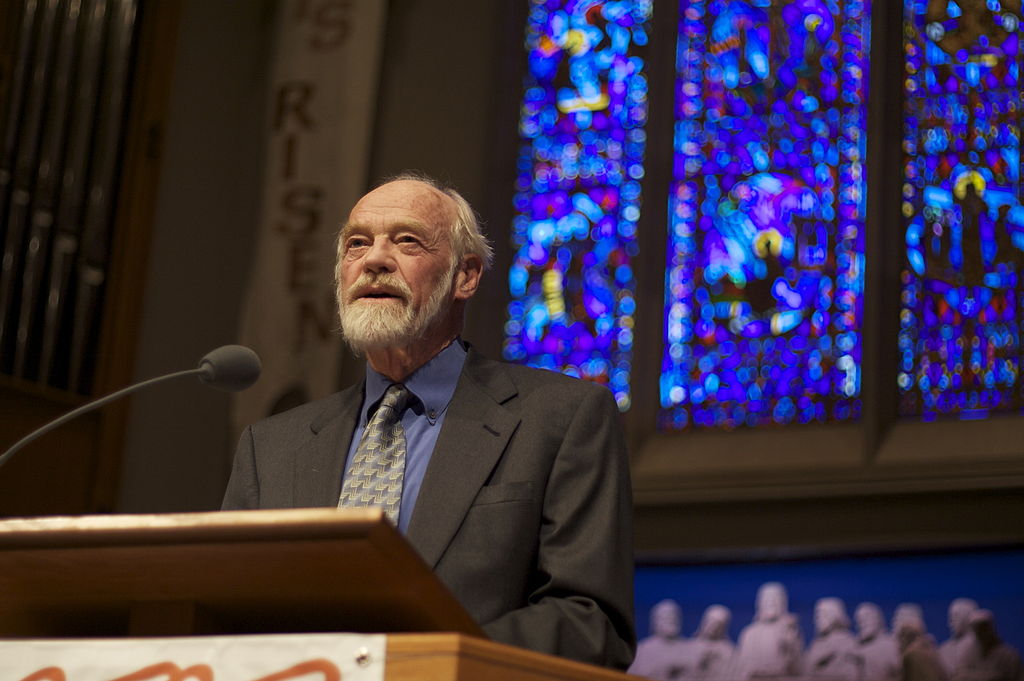
  • Eugene Peterson – author of the Message – dies at 85

    1024px-Eugene_Peterson.jpg
    Photo courtesy of Wikimedia Commons

    Eugene Peterson, pastor, professor, and writer passed away today at the age of 85 after battling dementia and heart failure.

    Peterson authored 35 books in his lifetime. The most popular among them was The Message, which has sold over 20 million copies. The Message is a paraphrase translation which attempts to capture the idea of a Biblical verse and not necessarily the exact wording. This translation philosophy and book are what Peterson is best known for, but it was also perhaps his greatest source of controversy.

    Peterson authored 35 more books, writings cherished by many for Peterson’s pastoral heart and Biblical wisdom.

    He also had broad appeal, with his writings being enjoyed both by Evangelical Christians and mainline Protestants.

    I believe God takes the things in our lives – family, background, education – and uses them as part of his calling. It might not be to become a pastor. But I don’t think God wastes anything.
    -Eugene Peterson

    Among condolences shared online, Russell Moore, president of the Ethics and Religious Liberty Commission Tweeted: “Grateful to God for a long obedience in the same direction. Thank you Eugene Peterson.”

    Pastor and director of LifeWay research Trevin Wax shared a quote from Peterson: “Jesus said “Follow me” and ended up with a lot of losers. And these losers ended up, through no virtue or talent of their own, becoming saints. Jesus wasn’t after the best but the worst. – Eugene Peterson.”

    Peterson’s family released a statement:

    During the previous days, it was apparent that he was navigating the thin and sacred space between earth and heaven. We overheard him speaking to people we can only presume were welcoming him into paradise. There may have even been a time or two when he accessed his Pentecostal roots and spoke in tongues as well.

    Among his final words were, “Let’s go.” And his joy: my, oh my; the man remained joyful right up to his blessed end, smiling frequently. In such moments it’s best for all mortal flesh to keep silence. But if you have to say something say this: “Holy, Holy, Holy.”

    It feels fitting that his death came on a Monday, the day of the week he always honored as a Sabbath during his years as a pastor. After a lifetime of faithful service to the church—running the race with gusto—it is reassuring to know that Eugene has now entered into the fullness of the Kingdom of God and has been embraced by eternal Sabbath.

    Thanks for reading! I’d love to hear what you think, and don’t forget to subscribe! 

    Josh Benner is the associate pastor at Cornerstone Evangelical Free Church in Fergus Falls, Minnesota and has a Master of Divinity from Trinity Evangelical Divinity School. He enjoys writing about faith and culture. He lives with his wife Kari in Minnesota.

    Let’s connect!
    Facebook
    Twitter
    Instagram

  • State of the Church: Jesus is not a created being

    photo-1532140225690-f6d25ab4c891.jpeg
    This week, Ligonier Ministries and Lifeway Research released their “State of Theology” survey. In the study, 3,000 American Christians were surveyed on various theological and moral positions.

    Many of the results were troubling. However the one that I found to be perhaps the most signifiant point of disagreement was with the question “Jesus is the greatest and first being created by God.” 78% of survey respondents agreed.

    I’d like to think some of them might have gotten confused by the wording of the question (and perhaps some did). (more…)