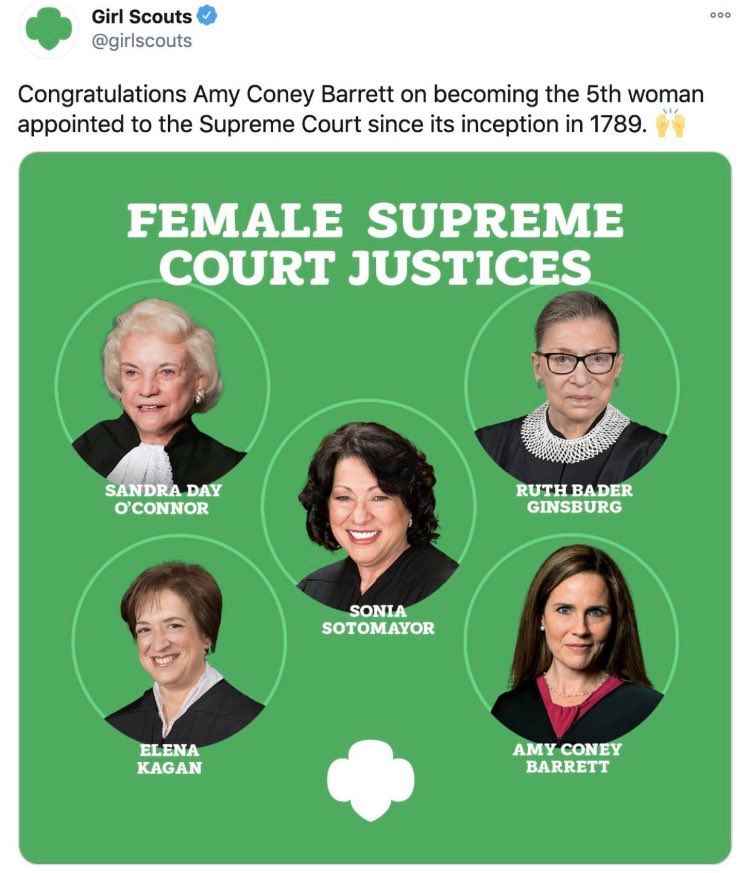
Only women who support killing babies are capable of accomplishing things which should be acknowledged in society.
This week, Amy Coney Barrett was confirmed as an associate justice of the Supreme Court.
In the lead-up to Barrett’s confirmation, Kappa Delta – ACB’s college sorority – congratulated their famous alumna on her nomination with a Tweet which said: “KD alumna Amy Coney Barrett was nominated to serve on the Supreme Court. While we do not take a stand on political appointments, we recognize Judge Coney Barrett’s significant accomplishment. We acknowledge our members have a variety of views and a right to their own beliefs.
Reasonable. Trying to tiptoe around the politics. They faced a backlash from pro-choice members who could not believe the sorority would acknowledge a monumental accomplishment of a famous member. As many organizations do when facing pushback, KD folded.
Where’s the apology for their sisters who approved of the post? The post says that they “began an intentional journey for the betterment of our organization, with a focus on diversity, equity, and inclusion.”
How is it inclusive to post about a historical moment and then apologize for that acknowledgement when some people get offended? Inclusion only goes one way. It’s inclusive when it includes a progressive viewpoint. But other views are not welcomed at the table of inclusivity. The KD statement went on to say that they’ve been working on “recognizing we always need to have a more diverse group.” And the solution is to ignore a position shared by a large swath of their members in the name of bowing to the outrage mob?
Again, Kappa Delta was not endorsing ACB. But even acknowledging her ascendancy onto the nation’s highest court is forbidden.
This isn’t the only such example .
The Girl Scouts also had the audacity to acknowledge the fifth woman in U.S. history being confirmed to the Supreme Court. Once again, the outrage mob responded.
The Girl Scouts quickly backtracked and Tweeted: “Earlier today, we shared a post highlighting the five women who have been appointed to the Supreme Court. It was quickly viewed as a political and partisan statement which was not our intent and we have removed the post.”
This week, Liberty University announced an “independent inquiry” into the university’s former president.
I remember will Bill Hybels resigned from Willow Creek, a megachurch in suburban Chicago in the wake of sexual misconduct allegations. I remember earlier this summer when Menlo Park Presbyterian Church in California announced an independent investigation into there former pastor in the wake of massive failures of leadership when he allowed one of his children (who had admitted sexual attraction to minors) to continue working with the youth program.
Liberty will do an independent investigation. But they had let Falwell run roughshod and embarrass the university time and again. Even before last month’s explosive reports about multiple affairs from Falwell’s wife and allegations that Jerry Falwell was very much aware of the affairs, he had done several things which should have led to the university removing him from leadership.
For Falwell, the independent investigation will be “a thorough investigation into all facets of Liberty University operations during Jerry Falwell, Jr.’s tenure as President, including but not limited to financial, real estate, and legal matters.”
Obviously there’s nothing wrong from learning from mistakes. But in the wake of scandals in the evangelical world, the “independent investigation” seems to be the flavor of the month.
The basics of what goes wrong in these situations aren’t great mysteries. You have highly influential leaders who help to raise or maintain the high profile status of a church (or institution). And because of the charisma and skills (and ability to generate revenue) of the leader, they largely go unchecked.
Instead of organizations needing to do independent investigations as damage control, what churches and Christian colleges need to do is to do the right things in the beginning. In other words: have systems to keep leaders accountable
People are sinful. That should never be a surprise. But that’s why Christians need other Christians. Knives sharpening knives. You need leaders who are accountable and where there are honorable people who know them and who know their struggles. You need people who love the leader. But who don’t excuse or look away from, or justify sin. That isn’t love. What you need is people who love the leader enough to where they can speak into difficult situations and point out patterns of sin in the hopes of bringing restoration. And you need it an an environment where those friends can lovingly confront the leader without being punished or harassed for it.
Without that, many more independent investigations will be needed, because the sinfulness of the human heart isn’t going away.
I think about many of the popular evangelical leaders who have fallen from grace in recent years. For at least some of them, I do wonder how different things could have been had they been surrounded by people who cared enough to sometimes say the difficult things.
In 1948, as he was coming to national prominence, Billy Graham and his close ministry associates signed the “Modesto Manifesto” where they had the forethought to hold themselves to a set of standards regarding sexual morality, finances, interactions with local churches, and publicity. Part of what developed from this meeting was the famous “Billy Graham Rule” where Graham would not travel with, eat lone with, or spend time alone with a woman who was not his wife.
Their agreement worked as non of those men was ever legitimately accused of a moral failing.
And certainly the greatest set of standards for Christian leaders is found in the Bible.
Titus 1:6-9 says: if anyone is above reproach, the husband of one wife, and his children are believers and not open to the charge of debauchery or insubordination. 7 For an overseer, as God’s steward, must be above reproach. He must not be arrogant or quick-tempered or a drunkard or violent or greedy for gain, 8 but hospitable, a lover of good, self-controlled, upright, holy, and disciplined. 9 He must hold firm to the trustworthy word as taught, so that he may be able to give instruction in sound doctrine and also to rebuke those who contradict it.
1 Timothy 3:1-7 says: The saying is trustworthy: If anyone aspires to the office of overseer, he desires a noble task. 2 Therefore an overseer must be above reproach, the husband of one wife, sober-minded, self-controlled, respectable, hospitable, able to teach, 3 not a drunkard, not violent but gentle, not quarrelsome, not a lover of money. 4 He must manage his own household well, with all dignity keeping his children submissive, 5 for if someone does not know how to manage his own household, how will he care for God’s church? 6 He must not be a recent convert, or he may become puffed up with conceit and fall into the condemnation of the devil. 7 Moreover, he must be well thought of by outsiders, so that he may not fall into disgrace, into a snare of the devil.
While Falwell wasn’t a pastor, nevertheless, those would have been good standards to still demand from the president of America’s largest Christian university.
Alumni are speaking up about a recent Tweet shared by Liberty University president Jerry Falwell, Jr. In the photo, Falwell shows a picture of a custom printed medical face mask which features the controversial photo of current Virginia governor Ralph Northam who appeared in a racially insensitive photo in his medical school yearbook which featured two men; one in blackface and one dressed as a klansman.
In another Tweet defending himself, Falwell said he had done this in response to cutbacks in higher education from governor Northam.
Alumni have called for Falwell’s resignation. I think Liberty is a fine school. I respect the university. It’s one of the best known Christian institutions in America, but these antics are unacceptable. Seriously. What is that? He’s the president of the university! And given the conservative Christian values of the school, such a display should absolutely be beneath Falwell. Where’s the grace? Where’s the virtue? If you want to criticize Northam for reducing higher education funding, go right ahead, but that was the most untactful way in which Falwell could have possibly made his point.
Falwell’s relationship with President Trump has bee talked about at length. But one of the ways where a Christian should not be imitating the president is in terms of verbiage and social media escapades.
A letter from a group of 35 Liberty alumni who are all African American pastors and ministry leaders was sent to Falwell. It’s very thoughtful and brings up legitimate grievances with the school’s president. A change.org petition has over 30,000 signatures asking Falwell to apologize.
The letter states:
For several years, you have said and defended inappropriate statements that represent Liberty and our faith very poorly. You have belittled staff, students and parents, you have defended inappropriate behaviors of politicians, encouraged violence, and disrespected people of other faiths. We were all taught at Liberty about the sanctity of life (Jeremiah 1:5) and the dignity of every human – made in the image of God (Genesis 1:27), and yet, you have repeatedly violated and misrepresented core Christian principles (Romans 12:9-21) through brash tweets and statements that harm our Christian witness.
One of the striking indictments in the letter was:
A review of your social media and statements during your presidency would lead many to believe that you care much more about politics than Jesus Christ, Evangelism, and the discipleship of students.
I’ve had the exact same thought before. The Northam Tweet is bad enough, but it’s also part of a pattern of inappropriate behavior. Falwell should apologize and repent.
Thanks for reading. I’d love to hear what you think!
As 2018 comes to a close, I am sharing some of my top posts from this year.
A trio of concerned academics has published seven intentionally absurd papers in leading scholarly journals as part of an investigation to expose extreme bias in fields that study race, gender, sexuality, and other politically-charged topics.
The trio say the papers, which used fabricated authors and credentials, highlight that these fields are being misled by politically-motivated research and biased methodologies.
–Media Release – James Lindsay, Peter Boghossian, and Helen Pluckrose
This is the summary from a group of researchers who set out to expose some of the pitfalls within humanities and liberal studies academic disciplines. They submitted a series of papers to various journals. There work was published in seven of them. (more…)
It’s crazy that I graduated from college a decade ago.
I still remember so many events from that time like they were yesterday. I can still see the map of campus in my memory.
So much of the person I am today I trace back to my time in college. So many of the friendships I made in those years I still maintain.
I think of myself as a freshman. So shy and quiet. I had very little self-reliance. I grew up in college. I went from someone who was always a loner, to being in a fraternity and becoming president of one of the largest student organizations on campus (and involved in what felt like every other student group there was). I never even went to any of our dances in high school and in college, I was popular.
I think about my fraternity. That community was what made college college for me.
I think of all of those philosophy classes. People make fun of philosophy as being a “useless major,” but I still take a lot of pride in having a philosophy degree. I think a background in philosophy gave me some tools that I’ve continued to use.
I struggled a lot at first. I had always managed to get decent grades in high school without really having to try, but college was different. Looking back, I doubt most of those 100 level classes in which I struggled were even that intellectually rigorous, I just had no idea how to take a college class.
Like many freshman, I would come home whenever I had the opportunity, I procrastinated with my work, and my grades suffered. After that first semester, I was sincerely considering leaving Bowling Green and trying to enroll elsewhere.
It wasn’t until my second semester that I had my first taste of Greek Life. That experience made me feel like I was truly a part of the university. For me and the rest of my time at Bowling Green, the rest was history.
Ironically, as a young student, I would go home every chance I got. When I first graduated, I’d go back every chance I got. But the years went on, younger friends graduated, I went back less.
My life has gone in directions I never would have expected. I cherish those experiences and memories. I will always be thankful for Bowling Green. Roll Along!
Thanks for reading! I’d love to hear what you think, and don’t forget to subscribe!
Josh Benner is the associate pastor at Cornerstone Evangelical Free Church in Fergus Falls, Minnesota and has a Master of Divinity from Trinity Evangelical Divinity School. He enjoys writing about faith and culture. He lives with his wife Kari in Minnesota.