
Josh Benner

Tag: apostle Paul

  • An introduction to the Book of Galatians

    An introduction to the Book of Galatians

    Galatians is a letter that is addressed from the Apostle Paul. 

    Paul wrote at least 13 of the 27 books in the New Testament. All of them were written as letters either to churches or to individual people. I say at least 13 because there’s been a longstanding debate about whether or not he wrote the Book of Hebrews as that letter does not have an identified author. 

    Authorship

    Some scholars debate Paul’s authorship of certain letters, but interestingly, Galatians is almost universally agreed upon to be authentically Pauline. The theology of Galatians is thoroughly Pauline and this letter also includes a high degree of autobiographical material. No serious scholar questions that Galatians is from Paul. 

    Most of what we know about the Apostle Paul comes from his letters and from stories involving Paul in the Book of Acts. 

    Paul tends to not talk a ton about himself in his letters. Just little pieces of information here and there but Galatians is different. From the middle of chapter 1 through about the middle of chapter 2, Paul has a prolonged section where he does talk about himself. He’s talking about his status as an apostle and about his various  travels in the years after he came to faith. 

    Date of Galatians 

    Now if you’ve ever noticed the maps in many Bibles, there will be a map in the back that displays the travels of Paul’s three missionary journeys. 

    The first missionary journey is when Paul visited churches in the region known as Galataia, which is in modern day Turkey. We see these events recorded in Acts chapter 13 and 14, and those travels are Paul’s introduction to this Galatian region. 

    Most converstive Biblical scholars believe that the letter to the Galatians was authored after this first missionary journey which would make Galatians Paul’s earliest writing. In the late 40s to early 50s A.D. That would also make it the earliest writing in the entire New Testament.

    Think about that for a moment. Less than a generation after Jesus walked the earth. With most of the apostles still living and with many others who had personally interacted with Jesus still living, Paul wrote Galatians. Interestingly, Paul will have a prolonged section where he talks about living eyewitnesses to Jesus in 1 Corinthians 15. 

    Who was the Apostle Paul? 

    What do we know about Paul?

    We don’t know exactly when he was born but most scholars think it was shortly after Christ, maybe around the year 4 or 5 A.D. 

    Paul goes by two different names in the New Testament: Saul and Paul. 

    A common misconception is that Saul’s name changes to Paul after his conversion. There is no Biblical evidence to support that. In reality, the name Paul comes from the name Paulos which is a Greco-Roman name. Acts 13:9 says: 

    Saul, who was also called Paul

    And so it appears as though he went by two names. Saul was a Jewish name, likely named after King Saul, the first King of Israel. Like King Saul, Saul/Paul was also from the Tribe of Benjamin. 

    Paul was born in Tarsus, which was one of the most cultured and educated cities of the first century Roman world. It’s unclear how long he stayed there but we also know that part of his formative years were spent in Jerusalem. 

    He talks of this in Acts 22:3: 

    ​​3 “I am a Jew, born in Tarsus in Cilicia, but brought up in this city, educated at the feet of Gamaliel according to the strict manner of the law of our fathers

    Paul was famously a persecutor of the early church. The first time we see Paul in the New Testament is when he’s giving approval to the martyrdom of the Apostle Stephen in Acts 7. 

    Acts 7:58:

    they cast him out of the city and stoned him. And the witnesses laid down their garments at the feet of a young man named Saul. 

    There are other references to Paul’s authority. In Acts 26, Paul is reflecting back on his life before coming to faith when he says: 

    9 “I myself was convinced that I ought to do many things in opposing the name of Jesus of Nazareth. 10 And I did so in Jerusalem. I not only locked up many of the saints in prison after receiving authority from the chief priests, but when they were put to death I cast my vote against them.

    Paul had been a pharisee: part of the group of religious teachers and experts in the law who we constantly see having conflicts with Jesus in the gospels. 

    He would have grown up celebrating the holy days of the Old Testament and reciting Biblical passages from the Torah. He would have also had his own beliefs about the Messiah of Israel. 

    He talks about his past life in Judaism in Philippians 3. 


    Philippians 3:4-7: 

    If anyone else thinks he has reason for confidence in the flesh, I have more: 5 circumcised on the eighth day, of the people of Israel, of the tribe of Benjamin, a Hebrew of Hebrews; as to the law, a Pharisee; 6 as to zeal, a persecutor of the church; as to righteousness under the law, blameless. 7 But whatever gain I had, I counted as loss for the sake of Christ. 

    Paul would have been extremely well versed in the Old Testament. It’s no surprise to consider the many connections and allusions he makes to the Old Testament in his writings. 

    Just considering Galatians, we see Paul connect the idea of justification by faith to Abraham. In Galatians 4, he talks of the sons born to Hagar and Sarah as being symbolic of the covenants of grace and works. He also talks extensively of the law of the Old Testament. 

    The Christian response to the law seems to be a major impetus for the writing of this letter. In Acts chapter 9, Paul has a dramatic conversion where Jesus appears to him on the Road to Damascus. This is probably around the year 34-35, a year or two after the resurrection of Jesus. 

    We see his call by Jesus. 

    Acts 9:1-6: 

     Saul, still breathing threats and murder against the disciples of the Lord, went to the high priest 2 and asked him for letters to the synagogues at Damascus, so that if he found any belonging to the Way, men or women, he might bring them bound to Jerusalem. 3 Now as he went on his way, he approached Damascus, and suddenly a light from heaven shone around him. 4 And falling to the ground, he heard a voice saying to him, “Saul, Saul, why are you persecuting me?” 

    5 And he said, “Who are you, Lord?” And he said, “I am Jesus, whom you are persecuting. 6 But rise and enter the city, and you will be told what you are to do.”

    The great persecutor of Christians becomes a Christian. 

    And we know that Paul himself was heavily persecuted throughout his ministry. 

    Acts 16:20-23, just after Paul has arrived in Philippi, he’s attacked by an angry mob: 

    20 And when they had brought them to the magistrates, they said, “These men are Jews, and they are disturbing our city. 21 They advocate customs that are not lawful for us as Romans to accept or practice.” 22 The crowd joined in attacking them, and the magistrates tore the garments off them and gave orders to beat them with rods. 23 And when they had inflicted many blows upon them, they threw them into prison, ordering the jailer to keep them safely.

    Paul was imprisoned multiple times, beaten multiple times, his life was endangered multiple times. On his first visit to the Galatian region, he gets stoned by an angry crowd in Acts 14.

    Five of Paul’s letters were written while imprisoned: Philippians, Ephesians, Colossians, Philemon, and 2 Timothy. 

    2 Timothy was his final letter, written shortly before he was martyred. From that letter, even after the various persecutions, beatings, and imprisonments, Paul seemed to know that he didn’t have much time left. 

    2 Timothy 4:6-8: 

    6 For I am already being poured out as a drink offering, and the time of my departure has come. 7 I have fought the good fight, I have finished the race, I have kept the faith. 8 Henceforth there is laid up for me the crown of righteousness, which the Lord, the righteous judge, will award to me on that day, and not only to me but also to all who have loved his appearing. 

    Other information about Paul. 

    To supplement his ministerial earnings, he also worked as a tentmaker. He was likely never married. No wife is ever mentioned and Paul talks about the gift of singleness in 1 Corinthians 7. 

    Paul seemed to have been afflicted in his missionary journeys at different times by poor health. We see that in Galatians where Paul is thanking the Galatian Churches for their kindness to him. 

    Galatians 4:13-15: 

    it was because of a bodily ailment that I preached the gospel to you at first, 14 and though my condition was a trial to you, you did not scorn or despise me, but received me as an angel of God, as Christ Jesus. 15 What then has become of your blessedness? For I testify to you that, if possible, you would have gouged out your eyes and given them to me.

    The fact that he refers to them being willing to gouge out their eyes has provoked many to suggest that Paul might have had poor eyesight. 

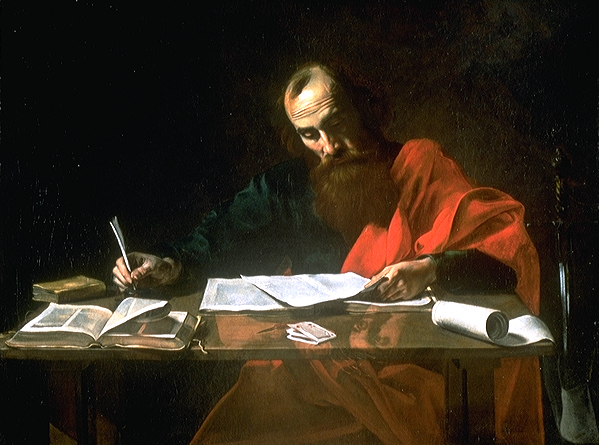
    In Galatians 6:11, Paul draws attention to his handwriting: 

    See with what large letters I am writing to you with my own hand.

    While Galatians is his letter, he most likely did not write in his own hand, but dictated the letter through a scribe. 

    Paul also refers to his thorn in the flesh in 2 Corinthians 12. 

    Occasion for writing

    Think of all of the many different Christian denominations today. Thousands of them. So many different schools of thought, different ways people read the Bible. 

    Well in the early church, they had a lot of theological disagreements too. Christianity was new. There were a lot of theological questions related to the connection of Christianity to Judaism. There were questions of if Christians still needed to follow laws in the Old Testament: did you still have to eat a kosher diet? Did you still have to observe Old Testament holy days and a weekly Sabbath? Did men still need to be circumcised? 

    In Galatians, Paul is addressing some of those very issues as people had sought to still enforce elements of the Old Testament law on new converts to Christianity. 

    Because of that, justification by faith is a major them of this book. 

    He states this most clearly in Galatians 2:16: 

     we know that a person is not justified by works of the law but through faith in Jesus Christ, so we also have believed in Christ Jesus, in order to be justified by faith in Christ and not by works of the law, because by works of the law no one will be justified. 

    But there are numerous other references in this letter to justification by faith. 

    And so Paul is combatting these false teachings in the Galatian churches with the truth of the gospel. 

    Early in the letter, Paul expresses his concerns over people being led astray from the truth of the gospel. 

    Galatians 1:6-7: 

    6 I am astonished that you are so quickly deserting him who called you in the grace of Christ and are turning to a different gospel— 7 not that there is another one, but there are some who trouble you and want to distort the gospel of Christ.

    We see his frustrations with the fruit of these false teachings in chapter 3 when Paul says: 

    O foolish Galatians! Who has bewitched you? It was before your eyes that Jesus Christ was publicly portrayed as crucified. 2 Let me ask you only this: Did you receive the Spirit by works of the law or by hearing with faith?

    Themes

    The last thing I’ll touch on as I introduce us to Galatians. The primary themes of this book. Some of them I’ve already covered.

    I would argue that justification by faith is the main theme of Galatians. Galatians is Paul’s love letter to the Doctrine of Justification by Faith. 

    Other significant themes in Galatians include the relationship of the gospel to the law, the gift of the Holy Spirit, and Paul’s apostolic authority. 

    I’ll close with this. 

    One of the key verses in the book. 

    Galatians 1:11-12: 

    11 For I would have you know, brothers, that the gospel that was preached by me is not man’s gospel. 12 For I did not receive it from any man, nor was I taught it, but I received it through a revelation of Jesus Christ

    The gospel is God’s gospel. It is not invented or created by men. It is not up for a vote. It is not dependent upon popularity. 

    The message that we are sinners and that there is grace through Jesus Christ is a message offered to the whole world and it is the only message that points to eternal life. 

    Galatians points us to that gospel. And it points us to the life that we have in Christ in light of that gospel. 

    Galatians is a great book. We’re going to have a great study in this book. 

    Thanks for reading! If you liked this post, please share and subscribe. 
  • Sermon: A dining controversy – Galatians 2:11-14

    Peter had withdrawn from fellowship with gentile Christians because they had not followed the law of the Old Testament. This was an affront to the gospel as Peter was guilty of adding requirements onto the gospel. It wasn’t because of a change of heart from Peter but it was because others had pressured him and he backed down in fear.

    Sermon manuscript

  • Who is Paul? And why it matters. Studying Galatians 1:1

    Who is Paul? And why it matters. Studying Galatians 1:1

    The defense of the gospel

    I begin this post by asking you to consider two questions. 

    First question: who is Jesus? 

    Second question: who is Paul? 

    That’s the most important question that anyone can answer. Is he a good teacher? Is he a good philosopher? Is he a good idea? Is he a good role model? Is he a good man? Or is he the Lord who died for your sins? And the Son of God? And the king of kings? 

    But who is Paul? 

    While not as important to know Paul as it is to know Jesus, how you view Paul matters, and here’s why. Because how you understand Paul actually points to how you will understand Jesus. 

    A history of Pauline heresy

    When Paul wrote his letter to the Galatians, we don’t know every single detail of background information but one thing seems pretty clear. 

    There were people undermining Paul to the churches in Galatia.

    Who is Paul? 

    He is an Apostle of Jesus Christ.

    Apostles were people who had personally seen the risen Lord in the early church and who were commissioned to lead the church. 

    1 Corinthians 12 lists offices in the early church:: 

    God has appointed in the church first apostles, second prophets, third teachers, then miracles, then gifts of healing, helping, administrating, and various kinds of tongues. 

    The apostles are listed first in that list for a reason. They were the authority. 

    We also see this in Ephesians 4:11-12: 

    he gave the apostles, the prophets, the evangelists, the shepherds and teachers, 12 to equip the saints for the work of ministry, for building up the body of Christ

    In the Book of Acts, after the ascension of the risen Jesus, and with Judas out of the picture, the first thing the apostles do is appoint another apostle: Matthias. 

    The Apostle Stephen dies in Acts 7 and we see Paul later become an apostle. After that, we never see apostles being replaced. And again, as people who had witnessed the risen Jesus, and given the unique role of the apostles in the early church, I would argue that the office of Apostle died out in the age of the original apostles. 

    So as I said a moment ago, there were people who were undermining Paul and his apostolic authority. 

    People still do that to Paul. 

    Many liberal Christians undermine Paul’s writings as just his opinion and not scripture and therefore not authoritative. 

    Paul was one Christian giving his views on the scriptures and that’s no more inherently significant than any other Christian. 

    But that’s why the answer to my second question matters so much. Who is Paul? 

    Is he just some guy who has some thoughts about Jesus? Or is he a man who personally saw the risen Lord Jesus and was personally called by Jesus to be an apostle? 

    Two radically different views of who Paul is. 

    What you think about Paul matters to what you think about the rest of the New Testament. 

    So again, I ask you: who is he? 

    I believe that he’s called to be an apostle and that this was affirmed by the confirmation of the other apostles, by the history of the church, by the fact that the early church viewed his writings to have had apostolic authority, by the account of him having been a witness to the risen Jesus and the radical conversion he had from a persecutor of the church to a man who became a martyr for the church, and because of the signs and wonders the Lord enabled him to perform during his ministry. 

    And I think that’ll hopefully give some more background and meaning to these first verse of chapter 1. 

    Paul, an apostle—not from men nor through man, but through Jesus Christ and God the Father, who raised him from the dead— 

    Paul wrote 13 letters in the New Testament. All of them begin with his first name. That was a standard letter writing practice at the time. In these ancient letters, you would start by naming the sender. It’s the first thing the reader sees. 

    As I’ve already discussed, Paul will affirm his apostolic authority. In nine of his 13 letters, Paul mentions his apostolic office in his opening. 

    But there are a couple of unique things about Galatians. 

    First, Paul doesn’t defend his apostolic authority in his other letters as fervently as in Galatians. He usually takes it as a given that the readers will accept that fact. 

    In Galatians, he says he’s an apostle: not from men nor through man, but through Jesus Christ and God the Father, who raised him from the dead

    Paul is an apostle because of a divine calling. It’s not because he says so, it’s not ultimately because the other apostles say so. 

    In the second half of chapter 1, Paul will again give an extended version of his early actions after coming to faith and a long defense of his apostolic ministry. There is no section in Paul’s letters where he goes into such great detail to explain why he is authentically an apostle. 

    And here’s why it matters so much in this letter. 

    When people are downplaying Paul’s authority, his writing, his teaching, then it makes it easy to also downplay his message. 

    Paul talks so much about being an apostle, not because he’s insecure. 

    Paul isn’t being vain. 

    It matters that they know, and that we know he’s an apostle of Jesus Christ because Paul has the message of the truth about Jesus Christ, that he is the Lord who has died for us and that God reconciles sinful people to Jesus because of Christ and Christ alone. 

    And so Paul so fervently defends his apostolic authority because he needs to defend the gospel itself. 

    And he will be pointing to the gospel even from this first verse. not from men nor through man, but through Jesus Christ and God the Father, who raised him from the dead— 

    Jesus has been raised from the dead and he has led to a paradigm shift in human history and in salvation history. Everything changes because of the cross and because we have a risen Lord.  

    And Paul will point to that gospel. Because that’s what this letter is truly about.

    In verse 2, Paul says: 

    2 and all the brothers who are with me, 

    To the churches of Galatia: 

    All the brothers. 

    Paul includes his associates in the opening salutation. We don’t know exactly who was with him when he wrote Galatians. But notice that he does not call them apostles. He calls them brothers, while Paul is an apostle. 

    And then he addresses his letter to the churches in Galatia. As we’ve discussed the last couple of weeks, this was the region to which Paul had traveled during his first missionary journey. He shared the gospel, many people came to faith, but there were also very many who were hostile to the gospel. In writing to the Galatians, there were people who sought to dilute or distort the true gospel and so Paul writes as a defense of the gospel. 

    Thanks for reading! If you liked this post, please share and subscribe.

  • An introduction to the Book of Galatians

    An introduction to the Book of Galatians

    Galatians is a letter that is addressed from the Apostle Paul. 

    Paul wrote at least 13 of the 27 books in the New Testament. All of them were written as letters either to churches or to individual people. I say at least 13 because there’s been a longstanding debate about whether or not he wrote the Book of Hebrews as that letter does not have an identified author. 

    Authorship

    Some scholars debate Paul’s authorship of certain letters, but interestingly, Galatians is almost universally agreed upon to be authentically Pauline. The theology of Galatians is thoroughly Pauline and this letter also includes a high degree of autobiographical material. No serious scholar questions that Galatians is from Paul. 

    Most of what we know about the Apostle Paul comes from his letters and from stories involving Paul in the Book of Acts. 

    Paul tends to not talk a ton about himself in his letters. Just little pieces of information here and there but Galatians is different. From the middle of chapter 1 through about the middle of chapter 2, Paul has a prolonged section where he does talk about himself. He’s talking about his status as an apostle and about his various  travels in the years after he came to faith. 

    Date of Galatians 

    Now if you’ve ever noticed the maps in many Bibles, there will be a map in the back that displays the travels of Paul’s three missionary journeys. 

    The first missionary journey is when Paul visited churches in the region known as Galataia, which is in modern day Turkey. We see these events recorded in Acts chapter 13 and 14, and those travels are Paul’s introduction to this Galatian region. 

    Most converstive Biblical scholars believe that the letter to the Galatians was authored after this first missionary journey which would make Galatians Paul’s earliest writing. In the late 40s to early 50s A.D. That would also make it the earliest writing in the entire New Testament.

    Think about that for a moment. Less than a generation after Jesus walked the earth. With most of the apostles still living and with many others who had personally interacted with Jesus still living, Paul wrote Galatians. Interestingly, Paul will have a prolonged section where he talks about living eyewitnesses to Jesus in 1 Corinthians 15. 

    Who was the Apostle Paul? 

    What do we know about Paul?

    We don’t know exactly when he was born but most scholars think it was shortly after Christ, maybe around the year 4 or 5 A.D. 

    Paul goes by two different names in the New Testament: Saul and Paul. 

    A common misconception is that Saul’s name changes to Paul after his conversion. There is no Biblical evidence to support that. In reality, the name Paul comes from the name Paulos which is a Greco-Roman name. Acts 13:9 says: 

    Saul, who was also called Paul

    And so it appears as though he went by two names. Saul was a Jewish name, likely named after King Saul, the first King of Israel. Like King Saul, Saul/Paul was also from the Tribe of Benjamin. 

    Paul was born in Tarsus, which was one of the most cultured and educated cities of the first century Roman world. It’s unclear how long he stayed there but we also know that part of his formative years were spent in Jerusalem. 

    He talks of this in Acts 22:3: 

    ​​3 “I am a Jew, born in Tarsus in Cilicia, but brought up in this city, educated at the feet of Gamaliel according to the strict manner of the law of our fathers

    Paul was famously a persecutor of the early church. The first time we see Paul in the New Testament is when he’s giving approval to the martyrdom of the Apostle Stephen in Acts 7. 

    Acts 7:58:

    they cast him out of the city and stoned him. And the witnesses laid down their garments at the feet of a young man named Saul. 

    There are other references to Paul’s authority. In Acts 26, Paul is reflecting back on his life before coming to faith when he says: 

    9 “I myself was convinced that I ought to do many things in opposing the name of Jesus of Nazareth. 10 And I did so in Jerusalem. I not only locked up many of the saints in prison after receiving authority from the chief priests, but when they were put to death I cast my vote against them.

    Paul had been a pharisee: part of the group of religious teachers and experts in the law who we constantly see having conflicts with Jesus in the gospels. 

    He would have grown up celebrating the holy days of the Old Testament and reciting Biblical passages from the Torah. He would have also had his own beliefs about the Messiah of Israel. 

    He talks about his past life in Judaism in Philippians 3. 


    Philippians 3:4-7: 

    If anyone else thinks he has reason for confidence in the flesh, I have more: 5 circumcised on the eighth day, of the people of Israel, of the tribe of Benjamin, a Hebrew of Hebrews; as to the law, a Pharisee; 6 as to zeal, a persecutor of the church; as to righteousness under the law, blameless. 7 But whatever gain I had, I counted as loss for the sake of Christ. 

    Paul would have been extremely well versed in the Old Testament. It’s no surprise to consider the many connections and allusions he makes to the Old Testament in his writings. 

    Just considering Galatians, we see Paul connect the idea of justification by faith to Abraham. In Galatians 4, he talks of the sons born to Hagar and Sarah as being symbolic of the covenants of grace and works. He also talks extensively of the law of the Old Testament. 

    The Christian response to the law seems to be a major impetus for the writing of this letter. In Acts chapter 9, Paul has a dramatic conversion where Jesus appears to him on the Road to Damascus. This is probably around the year 34-35, a year or two after the resurrection of Jesus. 

    We see his call by Jesus. 

    Acts 9:1-6: 

     Saul, still breathing threats and murder against the disciples of the Lord, went to the high priest 2 and asked him for letters to the synagogues at Damascus, so that if he found any belonging to the Way, men or women, he might bring them bound to Jerusalem. 3 Now as he went on his way, he approached Damascus, and suddenly a light from heaven shone around him. 4 And falling to the ground, he heard a voice saying to him, “Saul, Saul, why are you persecuting me?” 

    5 And he said, “Who are you, Lord?” And he said, “I am Jesus, whom you are persecuting. 6 But rise and enter the city, and you will be told what you are to do.”

    The great persecutor of Christians becomes a Christian. 

    And we know that Paul himself was heavily persecuted throughout his ministry. 

    Acts 16:20-23, just after Paul has arrived in Philippi, he’s attacked by an angry mob: 

    20 And when they had brought them to the magistrates, they said, “These men are Jews, and they are disturbing our city. 21 They advocate customs that are not lawful for us as Romans to accept or practice.” 22 The crowd joined in attacking them, and the magistrates tore the garments off them and gave orders to beat them with rods. 23 And when they had inflicted many blows upon them, they threw them into prison, ordering the jailer to keep them safely.

    Paul was imprisoned multiple times, beaten multiple times, his life was endangered multiple times. On his first visit to the Galatian region, he gets stoned by an angry crowd in Acts 14.

    Five of Paul’s letters were written while imprisoned: Philippians, Ephesians, Colossians, Philemon, and 2 Timothy. 

    2 Timothy was his final letter, written shortly before he was martyred. From that letter, even after the various persecutions, beatings, and imprisonments, Paul seemed to know that he didn’t have much time left. 

    2 Timothy 4:6-8: 

    6 For I am already being poured out as a drink offering, and the time of my departure has come. 7 I have fought the good fight, I have finished the race, I have kept the faith. 8 Henceforth there is laid up for me the crown of righteousness, which the Lord, the righteous judge, will award to me on that day, and not only to me but also to all who have loved his appearing. 

    Other information about Paul. 

    To supplement his ministerial earnings, he also worked as a tentmaker. He was likely never married. No wife is ever mentioned and Paul talks about the gift of singleness in 1 Corinthians 7. 

    Paul seemed to have been afflicted in his missionary journeys at different times by poor health. We see that in Galatians where Paul is thanking the Galatian Churches for their kindness to him. 

    Galatians 4:13-15: 

    it was because of a bodily ailment that I preached the gospel to you at first, 14 and though my condition was a trial to you, you did not scorn or despise me, but received me as an angel of God, as Christ Jesus. 15 What then has become of your blessedness? For I testify to you that, if possible, you would have gouged out your eyes and given them to me.

    The fact that he refers to them being willing to gouge out their eyes has provoked many to suggest that Paul might have had poor eyesight. 

    In Galatians 6:11, Paul draws attention to his handwriting: 

    See with what large letters I am writing to you with my own hand.

    While Galatians is his letter, he most likely did not write in his own hand, but dictated the letter through a scribe. 

    Paul also refers to his thorn in the flesh in 2 Corinthians 12. 

    Occasion for writing

    Think of all of the many different Christian denominations today. Thousands of them. So many different schools of thought, different ways people read the Bible. 

    Well in the early church, they had a lot of theological disagreements too. Christianity was new. There were a lot of theological questions related to the connection of Christianity to Judaism. There were questions of if Christians still needed to follow laws in the Old Testament: did you still have to eat a kosher diet? Did you still have to observe Old Testament holy days and a weekly Sabbath? Did men still need to be circumcised? 

    In Galatians, Paul is addressing some of those very issues as people had sought to still enforce elements of the Old Testament law on new converts to Christianity. 

    Because of that, justification by faith is a major them of this book. 

    He states this most clearly in Galatians 2:16: 

     we know that a person is not justified by works of the law but through faith in Jesus Christ, so we also have believed in Christ Jesus, in order to be justified by faith in Christ and not by works of the law, because by works of the law no one will be justified. 

    But there are numerous other references in this letter to justification by faith. 

    And so Paul is combatting these false teachings in the Galatian churches with the truth of the gospel. 

    Early in the letter, Paul expresses his concerns over people being led astray from the truth of the gospel. 

    Galatians 1:6-7: 

    6 I am astonished that you are so quickly deserting him who called you in the grace of Christ and are turning to a different gospel— 7 not that there is another one, but there are some who trouble you and want to distort the gospel of Christ.

    We see his frustrations with the fruit of these false teachings in chapter 3 when Paul says: 

    O foolish Galatians! Who has bewitched you? It was before your eyes that Jesus Christ was publicly portrayed as crucified. 2 Let me ask you only this: Did you receive the Spirit by works of the law or by hearing with faith?

    Themes

    The last thing I’ll touch on as I introduce us to Galatians. The primary themes of this book. Some of them I’ve already covered.

    I would argue that justification by faith is the main theme of Galatians. Galatians is Paul’s love letter to the Doctrine of Justification by Faith. 

    Other significant themes in Galatians include the relationship of the gospel to the law, the gift of the Holy Spirit, and Paul’s apostolic authority. 

    I’ll close with this. 

    One of the key verses in the book. 

    Galatians 1:11-12: 

    11 For I would have you know, brothers, that the gospel that was preached by me is not man’s gospel. 12 For I did not receive it from any man, nor was I taught it, but I received it through a revelation of Jesus Christ

    The gospel is God’s gospel. It is not invented or created by men. It is not up for a vote. It is not dependent upon popularity. 

    The message that we are sinners and that there is grace through Jesus Christ is a message offered to the whole world and it is the only message that points to eternal life. 

    Galatians points us to that gospel. And it points us to the life that we have in Christ in light of that gospel. 

    Galatians is a great book. We’re going to have a great study in this book. 

    Thanks for reading! If you liked this post, please share and subscribe.