Josh Benner

Tag: Bible

  • Cain and Abel. Studying Genesis 4

    Cain and Abel. Studying Genesis 4

    In Genesis 3, we dramatically see the fall of humanity into sin. 

    While death is the ultimate judgment for a sinful world, Adam and Eve do not die immediately. Genesis 4 begins with the continuation of the human race. As Eve has children, it is also a reminder of God’s promise that a child of the woman would crush the head of serpent (Genesis 3:15). 

    Genesis 4:1-2:

    Now Adam knew Eve his wife, and she conceived and bore Cain, saying, “I have gotten a man with the help of the Lord.” 2 And again, she bore his brother Abel. Now Abel was a keeper of sheep, and Cain a worker of the ground. 

    We see the first brothers: Cain and Abel. It will become the first of several sibling rivalries in the Book of Genesis. Cain and Abel, Isaac and Ishmael, Jacob and Esau, Joseph and his brothers. 

    From their introduction in Genesis, we see that the two are different, even down to their occupations. One is a sheep herd, the other is a farmer. It’s not a commentary on one of those jobs being superior to the other. But the brothers are different. 

    In verses 3-5, we see the sacrifice which would spark a bitter and tragic disagreement between the two brothers. 

    3 In the course of time Cain brought to the Lord an offering of the fruit of the ground, 4 and Abel also brought of the firstborn of his flock and of their fat portions. And the Lord had regard for Abel and his offering, 5 but for Cain and his offering he had no regard. So Cain was very angry, and his face fell.

    Sacrifice becomes a significant theme throughout the rest of the Bible. 

    Here we see two sacrifices made to God. One is acceptable. One is not. 

    The NIV Study Bible describes sacrifice and says: ​​”Generally speaking, Israelites presented sacrifices for one of three reasons: to praise and thank the Lord, to emphasize their requests to the Lord, and to atone for sin and impurity.”

    To our modern sensibilities, the idea of sacrifices might seem archaic and backwards. Sacrifices point us to the holiness of God and that there are appropriate ways to approach a holy God. Atoning sacrifices point us to the costliness of sin. Sacrifices were an opportunity to trust God’s provision as people would sacrifice things which were costly (God required a person’s best animals), and to make that sacrifice and to trust that God would still provide what was needed. 

    Sacrifices also point us to the ultimate and perfect sacrifice when Jesus gave himself for our sins. 

    The author of Hebrews talks of Jesus as the ultimate sacrifice. when Christ had offered for all time a single sacrifice for sins, he sat down at the right hand of God (Hebrews 10:12). 

    Cain and Abel make sacrifices. That raises a lot of questions. Were they told to make sacrifices? If so, that’s never recorded. Did they take it upon themselves to make sacrifices? Had Adam made sacrifices? Where did the idea come from? The Bible doesn’t answer any of these questions. Perhaps it’s part of human nature. We prize and value sacrifices for that which we think is worthy. 

    Cain and Abel both make sacrifices. 

    As has already been mentioned, the Lord accepts Abel’s but not Cain’s sacrifice. 

    But the issue with this passage is not the sacrifices themselves, it’s the heart of Cain. 

    Cain brought to the Lord an offering of the fruit of the ground, 4 and Abel also brought of the firstborn of his flock and of their fat portions.

    Cain and Abel each bring sacrifices which are related to their vocations. Cain the farmer brings some of the fruit of the ground while Abel the sheep herd brings the firstborn of his flock. 

    In later Old Testament laws, God would require the firstfruits of what was produced and the firstborn of teh animals to be sacrificed (cf Exodus 13:2; 23:16). 

    This language will also be applied to Jesus in the New Testament. In the Christ hymn of Colossians 1, Jesus is referred to as the firstborn of all creation (Colossians 1:15). 

    There was a greater heart behind the sacrifice of Abel as he brought God his best. In bringing the fat portions, those were the prized cuts of the animal. 

    As I’ve mentioned, the issue is the heart of Cain, not the sacrifice itself because when the Lord had no regard for Cain’s sacrifice, Cain became better.

    Verses 6:

    6 The Lord said to Cain, “Why are you angry, and why has your face fallen? 

    Just like with Adam and Eve in the garden, God begins with a question. 

    More and more, I appreciate the value of the right question.

    God tells Cain what he must do. 

    Genesis 4:7: 

    If you do well, will you not be accepted? And if you do not do well, sin is crouching at the door. Its desire is contrary to you, but you must rule over it.” 

    This is the first time in the Bible that sin is named. It is personified as something that is powerful. On a similar train of thought, Paul would describe the power of sin in Romans 7. 

    Romans 7:15-20:

    15 For I do not understand my own actions. For I do not do what I want, but I do the very thing I hate. 16 Now if I do what I do not want, I agree with the law, that it is good. 17 So now it is no longer I who do it, but sin that dwells within me. 18 For I know that nothing good dwells in me, that is, in my flesh. For I have the desire to do what is right, but not the ability to carry it out. 19 For I do not do the good I want, but the evil I do not want is what I keep on doing. 20 Now if I do what I do not want, it is no longer I who do it, but sin that dwells within me. 

    Instead of dealing with sin, we see Cain against his brother. 

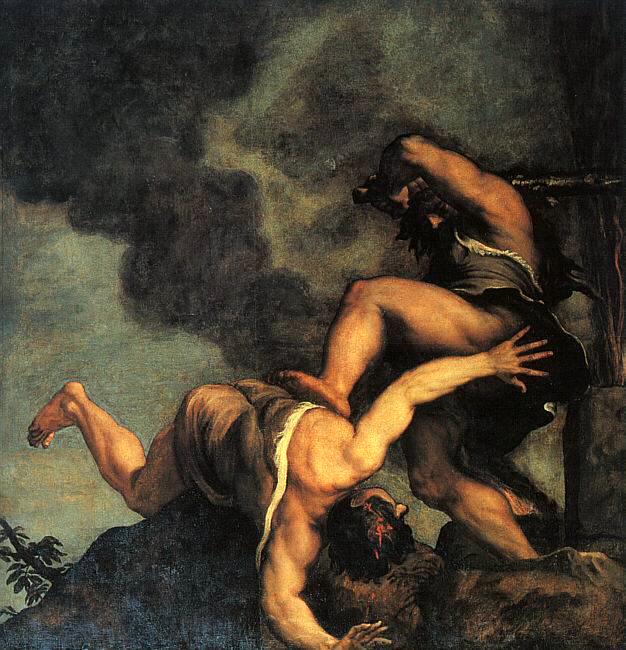
    Cain murders Abel

    Genesis 4:8:

    8 Cain spoke to Abel his brother. And when they were in the field, Cain rose up against his brother Abel and killed him.

    Instead of listening to God, Cain has swung hard the other way. 

    In the first sin, humanity ate the forbidden fruit of the tree of the knowledge of good and evil, and now man is killing man. Cain kills his brother. Man has taken the life of another image bearer. 

    Genesis 4:9, The Lord asks Cain: 

    9 Then the Lord said to Cain, “Where is Abel your brother?” He said, “I do not know; am I my brother’s keeper?” 

    Once again, God comes to Cain with a question. Cain is invited to confess but instead attempts to deflect. He acts as though Abel’s whereabouts are not his responsibility. But he’s the one who has taken the life of his brother! 

    Adam fesses up to his sin, but Cain misdirects and misleads in his attempt to cover up his sin. 

    We see no remorse from Cain for his sin. 

    But God knows. 

    Kenneth Matthews notes that Abel’s blood convicts the sinner, but we will see that the blood of Christ redeems the sinner. 

    Genesis 4:10-12:

    And the Lord said, “What have you done? The voice of your brother’s blood is crying to me from the ground. 11 And now you are cursed from the ground, which has opened its mouth to receive your brother’s blood from your hand. 12 When you work the ground, it shall no longer yield to you its strength. You shall be a fugitive and a wanderer on the earth.”

    When Adam and Eve sinned, the ground was cursed. When Cain sins, we will see that he himself is cursed because of his sin against his brother. 

    In Genesis 4:13-15, we continue to see the heart of Cain:  13 Cain said to the Lord, “My punishment is greater than I can bear.14 Behold, you have driven me today away from the ground, and from your face I shall be hidden. I shall be a fugitive and a wanderer on the earth, and whoever finds me will kill me.” 15 Then the Lord said to him, “Not so! If anyone kills Cain, vengeance shall be taken on him sevenfold.” And the Lord put a mark on Cain, lest any who found him should attack him. 

    Cain’s sin brings alienation both from the land, from people, and from the Lord. We see his concern for vulnerability. Ironic considering he’s just murdered his brother! But just because Cain has killed Abel does not mean that anyone can arbitrarily kill Cain.  

    Genealogy

    Genesis 4 ends by introducing what will become another significant theme in the Book of Genesis. The genealogy from Adam, to Abraham, Isaac, Jacob, and beyond. 

    Cain’s genealogy is first introduced before the passage ends by returning to Adam and Eve and a new son they have. Seth. The line of Adam will continue, but through Seth. 

    25 And Adam knew his wife again, and she bore a son and called his name Seth, for she said, “God has appointed for me another offspring instead of Abel, for Cain killed him.” 26 To Seth also a son was born, and he called his name Enosh. At that time people began to call upon the name of the Lord (Genesis 4:25-26). 

    Thanks for reading! If you liked this post, please share and subscribe! 

  • Saul, the first king of Israel. Studying 1 Samuel 9:1-14

    Saul, the first king of Israel. Studying 1 Samuel 9:1-14

    In 1 Samuel 8, the Israelites demand a king. They will have to pay more in taxes, more of their men will have to serve in the army and fight in wars. The best of their land will have to be given up for service to the king. Women will have to work in various trades that will serve the kingdom. They will be subjects. In spite of all of that, the people still say they want a king.

    In chapter 9, we’re introduced to Saul, the man who would be the first king of Israel. 

    Humble beginnings 

    1 Samuel 9:1:
    There was a man of Benjamin whose name was Kish, the son of Abiel, son of Zeror, son of Becorath, son of Aphiah, a Benjaminite, a man of wealth. 

    As is often the case in the Bible, especially in the Old Testament, when a new person is introduced, we see a family line given to introduce the person. 

    The Benjaminites were one of the 12 tribes of Israel. They were the smallest of the tribes numerically. 

    Other noteworthy Benjaminites in the Bible include Esther and the Apostle Paul. 

    The verse also mentions that the family was wealthy. 

    Continuing in verse 2:

    2 And he had a son whose name was Saul, a handsome young man. There was not a man among the people of Israel more handsome than he. From his shoulders upward he was taller than any of the people. 

    Physical descriptions of people in the Bible are generally pretty rare and when we see them, it’s usually for a reason. We don’t even know what Jesus looked like. But First Samuel mentions that Saul is a tall, handsome man. 

    Saul’s appearance matters to the story. Saul is the only Israelite who’s ever referred to as being tall in the Bible. And the word handsome is found just a handful of times. 

    So now that the general introductory things have been told about Saul, the author gets into the story. 

    The lost donkeys

     3 Now the donkeys of Kish, Saul’s father, were lost. So Kish said to Saul his son, “Take one of the young men with you, and arise, go and look for the donkeys.”

    So Saul might come from a wealthy family, but we’re introduced to him having to engage in a fairly inglorious task of looking for some lost donkeys. 

    Verses 4-5: 

      4 And he passed through the hill country of Ephraim and passed through the land of Shalishah, but they did not find them. And they passed through the land of Shaalim, but they were not there. Then they passed through the land of Benjamin, but did not find them. 5 When they came to the land of Zuph, Saul said to his servant who was with him, “Come, let us go back, lest my father cease to care about the donkeys and become anxious about us.”

    Still talking about donkeys. 

    It seems that the author is trying to show us the simple life that Saul was living. He’s going to be a king, but here, he’s just doing what his father sent him to do.

    Agin, he’s just some Benjaminite. The smallest tribe. While his family seems well off, they’re not even the most prominent family within their tribe. 

    Saul has no ambition of being a King. Israel has never even had a king at this point! 

    It’s kind of like how I doubt George Washington grew up with aspirations of being president. 

    Because he grew up in a time when the presidency wasn’t a thing. 

    Saul has no aspiration of being the leader of Israel. So Saul is with one of his servants looking for the donkeys and they have wandered into this small town: Zuph. Still no donkeys. But they’ve been gone for awhile and Saul starts to worry that his father is going to start to worry. 

    But the servant of Saul makes a suggestion. 

    Verse 6:
    6 But he said to him, “Behold, there is a man of God in this city, and he is a man who is held in honor; all that he says comes true. So now let us go there. Perhaps he can tell us the way we should go.”

    The servant refers to “a man of God” in that city. The man of God is the Prophet Samuel. 

    Samuel is essentially a leader over Israel. He’s not a king. But he’s known throughout the land. 

     For instance, 1 Samuel 3:20 says:
    20 And all Israel from Dan to Beersheba knew that Samuel was established as a prophet of the Lord. 

    Back in our passage. So it’s not Saul that has the idea to see Samuel. It’s his servant who has the idea. The servant knows and Saul doesn’t. And this is the future king of Israel! So Saul’s servant suggests Saul seek out Samuel. To find some donkeys. 

    Saul responds. He’s uncertain.

     7 Then Saul said to his servant, “But if we go, what can we bring the man? For the bread in our sacks is gone, and there is no present to bring to the man of God. What do we have”

    Culturally, he feels like he needs to have some sort of gift to present before a prophet. 

    His servant happens to have some silver on him in verse 8. And so the two men go in pursuit on Samuel. 

    After a quick note on how they needed to have a gift, we see in verses 11-12, their journey is interrupted by a group of women. 

    Saul and his servant are looking for Samuel. And the women tell Saul and his servant that Samuel has just returned to the city. 

    1 Samuel 9:11-12:
    11 As they went up the hill to the city, they met young women coming out to draw water and said to them, “Is the seer here?” 12 They answered, “He is; behold, he is just ahead of you. Hurry. He has come just now to the city, because the people have a sacrifice today on the high place.

    So the women tell Saul and his servant to hurry because Samuel has to perform a sacrifice that day. 

    1 Samuel 9:13:
    13 As soon as you enter the city you will find him, before he goes up to the high place to eat. For the people will not eat till he comes, since he must bless the sacrifice; afterward those who are invited will eat. Now go up, for you will meet him immediately.”

    So the women are talking about this feast. Unknown to the women, unknown to Saul, but the feast is for him. 

    Verse 14:
    14 So they went up to the city. As they were entering the city, they saw Samuel coming out toward them on his way up to the high place. 

    And it is there where they will meet the Prophet Samuel and where Saul will receive some news which will change his life and the future history of Israel.

    Thanks for reading! If you liked this post, please share and subscribe. 

  • Darth Vader and the first king of Israel

    Darth Vader and the first king of Israel

    In Star Wars, you have Anakin Skywalker who becomes Darth Vader. 

    Anakin starts off from very humble beginnings. He’s a slave, but unbeknownst to him, he is set aside for a historic task. 

    A Jedi meets young Anakin and senses that Anakin has a strong presence of the force and that he is the chosen one who will be the Jedi who will restore power to the force. 

    And at first, Anakin does a lot of good things. He’s a heroic figure. He’s serving honorably as a Jedi. He saves an entire planet. 

    He has this priestly figure in Obi Wan Kenobi who trains him in the ways of the Jedi. 

    But then. 

    He joins the dark side. 

    He becomes Darth Vader. He’s evil. He is vengeful. He destroys entire planets. He nearly wipes out the Jedi. He kills his teacher, Obi Wan Kenobi. 

    I give those details because the life of Saul follows the same trajectory of that of Darth Vader. 

    In our passage today, we’re first introduced to Saul, who is a man of humble beginnings. Without knowing it, he finds out that he will be the king of Israel. Saul starts out well and has everything he needs to succeed before turning to sin in later chapters. 

    And he goes on a downward spiral of destruction and murder. 

    Darth Vader kills off most of the Jedi. Saul kills off all of the priests but Abiathar. 

    Both are replaced by greater men. Darth Vader’s son Luke Skywalker restores order to the force. Saul is replaced by David, the greatest of the Israelite kings. 

    Darth Vader fights his son, Luke Skywalker. Saul has a son – Jonathan who opposes Saul and abdicates any opportunity to sit on the throne. 

    Both Vader and Saul have daughters who oppose the evils of their fathers. Princess Leia is a Jedi. Saul’s daughter marries King David. 

    Saul and David are both anointed by Samuel. Darth Vader and Luke Skywalker are both trained by Obi Wan Kenobi. 

    Darth Vader dies on a moon called Endor. Saul dies in battle at a place near Endor! 

    1  Samuel 28:7

    7 Then Saul said to his servants, “Seek out for me a woman who is a medium, that I may go to her and inquire of her.” And his servants said to him, “Behold, there is a medium at En-dor.” 

    He dies in chapter 31 at Gilboa. 

    I think the Star Wars writers might have had a Bible handy when they were writing their script! 

    Humble origins, early successes, a turn to evil and a downward spiral of muder that ends in violent death. I think the comparison is helpful as we consider the long story arc of King Saul in the Book of First Samuel. 

    Thanks for reading! If you liked this post, please share and subscribe! 

  • Choosing your poison. Israel’s demand for a king. Studying 1 Samuel 8:19-22

    Choosing your poison. Israel’s demand for a king. Studying 1 Samuel 8:19-22

    The book of Proverbs dedicates a lot of space to talking about the “fool,” the person who lives a life in opposition to the wisdom of God. The chief way a person can be a fool is in a failure to fear the Lord. We do this when we try to take God off of his thrown. Other examples of foolishness.

    Proverbs 28:26

    Whoever trusts in his own mind is a fool, but he who walks in wisdom will be delivered.

    In 1 Samuel 8, the Israelites speak up and say that they want a king to lead them. The problem is that they wanted a human king instead of God as their king. 

    And in this passage, the Israelites were trusting their own minds. Their own desires and will.And again there are many other examples in the book of Proverbs. 

    The people are going against the wisdom of God. And the chief way they’re doing this is the failure to fear the Lord and to honor him above all else. 

    Had they done that, they would have realized that they didn’t need a king. That they had everything they already needed in God. 

    The best way to know the will of God is to know his word. There are things we can do which are totally contrary to the wisdom of God. For the Israelites, it had been explained to them why a king was not going to be good for them. And they wanted it anyway. 

    And again, we can do that too. We can have all of the reasons to know that something will not be good for us. But then we do it. The Bible has wisdom in regards to how we manage our households, our finances, our health, our rest, our language. It’s in our best interest to get with the program. To live for God. To follow his wisdom. 

    Sometimes we even know better and continue to do what we want anyway. 

    It’s so easy to let the ways of the world influence us more than it is us influencing the ways of the world. We might not be asking for an earthly king, but we so often want another god. We so often look to areas of life that we think will lead to our flourishing. 

    Because of his goodness, God insisted that the Israelites be warned with what they were doing. He TOLD them it wouldn’t work well. And we receive warnings in God’s word. 

    The heart of the issue isn’t just about wanting a different king. It was putting something over God. And any time we choose to go against God, to go against his word, we’re putting ourselves on the throne. 

    Is there’s something you don’t have right now, but where you think “if only I had THIS” everything would be better? Or you’d truly be happy? 

    Don’t replace the true king. The issue is when we buy into the lies of what objects or relationships can give us and place those on a pedestal above God and the true fulfillment, and purpose, and grace, and the life that comes from him. There is a price to be paid for wanting to change the king.

    At the end of the passage, the Israelites make their choice. 

    Verses 19-20: 

    19 But the people refused to obey the voice of Samuel. And they said, “No! But there shall be a king over us,20 that we also may be like all the nations, and that our king may judge us and go out before us and fight our battles.”

    In this chapter of the story, it doesn’t tell us too much about the result. But upon continuing to read in the Old Testament, the things that Samuel had warned about did end up befalling the Israelites. With the advent of the monarchy, it did institute high taxes, losses of land, more wars. And the kings weren’t there to fight their battles for them. And those problems would continue to spiral from one generation to the next. 

    Isn’t that what happens in our lives too? When we decide to go against the wisdom of God? There are consequences for that. They might be external. They might be in our environment. But they’re also always going to be internal.

    Our sins, our putting things ahead of God, our living life as though a new king or a new source of purpose is going to fulfill us will chip away at our relationship with God. 

    God allows us to make bad decisions. It is sometimes through the tough decisions and struggles that we see that there is no other way besides God.

    God is the one true king. He is to be the king of your life. It’s not about looking elsewhere when we’re struggling. 

    In spite of the sin of the people, God was still gracious. Because God is a good God who is faithful to his promises. 

    The first king of Israel was Saul. But he would be replaced in the following generation by King David. And through David, came a line that would lead to the king of kings, the Lord Jesus. Even though God allowed for their to be a new king, he was always the one who was really in charge. He was always the one who was still sovereignly reigning and ruling in the world. For all eternity past, God had known what the Israelites were going to do and had already known how he was going to work through the sins of his people to bring about his kingdom. 

    But that doesn’t change the fact that it’s God’s desire for our obedience and to properly worship him as the king. We are to listen to his warnings. It’s his will for us to put him first, to worship him alone, to place our trust in him.  

    Don’t look to earthly kings when we have a heavenly king. Because unlike earthly kings who sin and fail, who can be in things for their own gain, our heavenly king is perfect, and he is just as he rules and reigns supreme over all creation.

    Thanks for reading! If you liked this post, please share and subscribe!

  • Sermon: Called from obscurity – 1 Samuel 9:1-27

    In 1 Samuel 8, the Israelites had demanded a king. In this ninth chapter, we are introduced to Saul, the man who would become the first king of Israel. From humble beginnings, we that Saul was chosen for this royal purpose but his story will also point forward to a greater king. 

    Sermon manuscript