Josh Benner

Tag: Bible

  • The Church: being part of something bigger than yourself

    photo-1519491050282-cf00c82424b4.jpeg
    An astounding 16 million soldiers, sailors and Marines served America in the Second World War.
    And while most of our focus on World War II is on the military and combat, within the United States, there was an effort to support the war unlike anything our nation had seen or has seen since.
    With millions going overseas, Americans at home took up new jobs.
    Coming out of the Great Depression, unemployment dried up, reaching an all time low in 1944.

    (more…)

  • Jesus and the Last Supper. More than just a meal.

    photo-1520629716099-d147346eb224.jpeg

    Originally published April 13, 2017

    As part of Holy Week, Maundy Thursday is recognized this evening. It was the night in which Jesus ate the Last Supper with his disciples. The time in which Jesus died corresponded with the Jewish holiday of Passover. And the Last Supper was the first night of Passover. An annual dinner for Passover is held, called a Seder, which is the Hebrew word for “order.” In 3,500 years, rabbinical tradition and teaching helped to form the ceremony of the Seder.

    Some of these pieces were traced back to the original Passover. Others came in Jewish history from rabbinical traditions.

    Also, once the Israelites were in the land, and after the temple was built, this impacted Passover traditions. When you had the temple, the lambs were sacrificed at the temple. But what didn’t change was that people could only sacrifice lambs that were perfect.

    I think it’s worth spending so much time in talking about Passover because I think it can help give us a greater context and understanding for the events surrounding the death of Jesus.

    In the gospels, the time of the death of Christ revolves around the Passover. That’s not a coincidence! Jesus would be sacrificed at the time that was associated with sacrifice. Jesus had gone to Jerusalem for Passover. In Jerusalem, the city within the Roman Empire that was the epicenter of Jewish culture, thousands of lambs would have been slaughtered annually. Jewish people would have been coming in from all over the empire.

    We see many traditions of the Seder at the last Supper.

    Some of them are small things. In the gospel accounts, it talks about Jesus reclining at the table (Luke 22:14).

    Jesus wasn’t sitting in a la-z-boy. He was on a couch that he was lying on, that was a Seder tradition. They had been enslaved in Egypt but being able to lie down showed the freedom and security.

    Or when Jesus is alluding to his betrayer, he says in John 13:26, “It is he to whom I will give this morsel of bread when I have dipped it.” So when he had dipped the morsel, he gave it to Judas, the son of Simon Iscariot.

    Again, I know the mental image that most of you probably have when you read this. It’s hard to know precisely where in the Seder this is, but it seems that it’s probably referring to when you take Haroset which is made from apple, nuts, cinnamon. They weren’t eating the Last Supper at an Italian restaurant. They didn’t have a bowl of olive oil in the middle of the table. But all of the elements we see at the Last Supper are part of what you’d see in a traditional Seder.

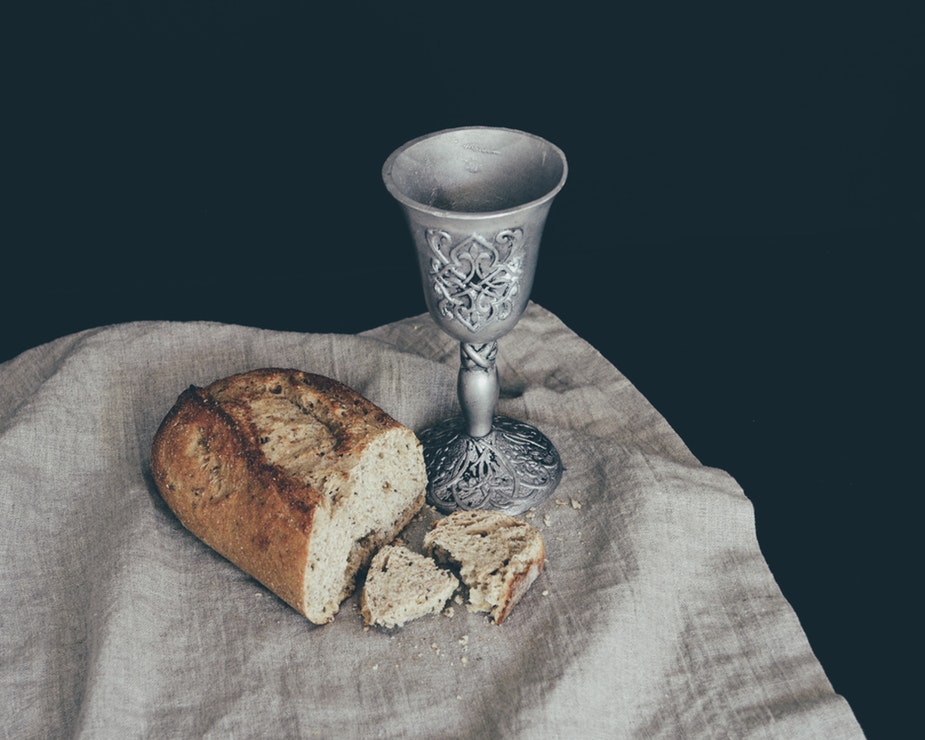
    As part of the Seder, you’d take the unleavened bread…looks like a cracker. And you’d break the bread.

    Luke 22:19, “And he took bread, and when he had given thanks, he broke it and gave it to them, saying, “This is my body, which is given for you. Do this in remembrance of me.”

    For over a thousand years of Seder dinners, bread had been broken. Unleavened bread, just like the Israelite forefathers had eaten before fleeing from Egypt.

    The body of Jesus, given for you, given for your sins. Given for your forgiveness. And he says “do this in remembrance of me.”

    What more fitting words could you say at a Seder? A meal revolving around remembrance, about retelling the story of God saving his people by the blood of the lamb.

    Remembering what God has done. Remembering what Jesus has done. Remembering the sins that he’s redeemed you from. Remembering his body that he gave for you. Remembering his death that he died for you. Remembering the grace that he offers to you. Remembering his gospel.

    Luke 22:20 says, “And likewise the cup after they had eaten, saying, “This cup that is poured out for you is the new covenant in my blood.”

    The Seder dinner involves four glasses of wine. This seems to have been the second or third glass of wine in the meal, although there’s scholarly debate.

    But how profound it is. Wine drank in remembrance of the Passover. Jesus takes the wine, he blesses it, he says it is the new covenant in his blood, at the Seder dinner.

    It clearly points backwards to the blood of the Passover lamb, the blood that was put on the door posts. And it also points forward to the blood of Christ, shed for the forgiveness of sins. The blood of the true lamb.

    At the beginning of the gospel of John, when John the Baptist sees Jesus he says “Behold, the lamb of God who takes away the sin of the world.” Jesus is the true lamb of God. The lamb who took the penalty for sins. The one who was scarified for the salvation of God’s people.

    And by trusting in him and having faith in him, that puts the blood on the doorpost of your heart. On the first Passover, there would not have been a pardon for a person who didn’t put blood on the doorpost. It wasn’t that the blood saved them, God saved them. But to not put the blood on the door was to show that a person didn’t have faith in the Lord, didn’t trust in the Lord.

    When we take the Lord’s Supper, it’s not arbitrary. It’s not just using the random items that were around. It’s all symbolic. It takes symbols important to the first Passover, the first time God had delivered Israel, and it reminds of the new Passover, from the perfect sacrifice for sins.

    The Passover passage in Exodus 12:5 says that the lamb that was used had to be without blemish. Jesus is the ultimate lamb without blemish, a life lived in perfection.

    1 Corinthians 5:7 says “Cleanse out the old leaven that you may be a new lump, as you really are unleavened. For Christ, our Passover Lamb.”

    Thanks for reading! I’d love to hear what you think, and don’t forget to subscribe! 

    Josh Benner  has a Master of Divinity from Trinity Evangelical Divinity School. He has served churches in Minnesota and Illinois. He enjoys writing about faith and culture. He lives with his wife Kari in St. Louis.


  • Joaquin Phoenix changes Bible story while playing Jesus

    800px-Joaquin_Phoenix_at_the_2018_Berlin_Film_Festival
    Photo courtesy of Wikimedia Commons.

    Actor Joaquin Phoenix plays Jesus in a new movie revolving around the life of Mary Magdalene. In the movie, Phoenix took liberty with one of the miracles of Jesus.

    In John 9, Jesus heals a man who had been born blind. In John 9:6, the process by which Jesus heals the man is described as follows: “he spit on the ground and made mud with the saliva. Then he anointed the man’s eyes with the mud.” (more…)

  • Developing a daily Bible reading plan

    photo-1515118058350-d72d92dd5140.jpeg

    I did a survey of people who say that they spend time reading in the Bible everyday. I asked “For people who read the Bible everyday, curious if it’s ever a challenge?”
    I gave two possible answers:
    1. There are days where I definitely have to push myself.
    2. Nope, never ever a challenge, never fight being lazy about it. Always love it.
    Of the 134 people who responded, 133 chose option one.
    Spending time in the Bible everyday is hard.
    It’s a challenging book to read. It’s highly self-referential. We’re reading it in different cultures separated by thousands of years of history. We often don’t understand the significance of events and teachings. Some things can seem cryptic.
    It can be easy to get discouraged.
    It can be easy to put it off.
    But in the Christian life, it is so important to spend time in the Bible every single day.
    If this is something that you’ve tried and failed at doing, here are some tips on developing a daily devotional life.
    1. Figure out a reading plan
    There are lots of great Bible reading plans. If you need any suggestions, Bible Gateway has a list.
    What’s the best plan?
    It’s the one that has you in the Bible everyday.
    Different plans might work for different people. One popular plan has four readings a day from four different books. That’s not my personal favorite but it works well for many others.
    Some plans go through the Bible chronologically. Some plans go through the Bible in its canonical order.
    Find a ;lan that has you going through the whole Bible.
    1. Find a time of day that works best for you. 
    For  me, this has changed at different times of my life. It used to be in the evening. Lately, I like to do some reading in the Bible as soon as I wake up, before my feet even touch the ground.
    Fifteen minutes a day, and you can read through the whole Bible in a year.
    1. If you miss a day, don’t let that be a reason to derail the entire plan. 
    It happens.
    1. Some days will be easier than others. 
    Just like the result of my survey. Even for people who read from the Bible everyday, there are definitely times where you do it more because you feel like it’s what you should do than it being what you want to do on that day.
    If you’re holding out for a time when it’ll always be easy, and you’ll always be in the mood to read, that day will never come.
    Don’t make Bible reading about doing it only when you feel like it. I’m not knocking the Bible. As sinful people, we struggle.
    1. Some days are more enriching than others. 
    If you workout with any frequency, you know that not all workouts are equally good. Somedays, it’s an amazing workout.
    Other days, you went to the gym, you did your program, but it just didn’t feel as productive.
    But it’s still worth working out. You might not always see huge gains. But working out over time produces results.
    The Bible is unlike any other book. The book of Hebrews says: “the word of God is living and active, sharper than any two-edged sword, piercing to the division of soul and of spirit, of joints and of marrow, and discerning the thoughts and intentions of the heart” (Hebrews 4:12).
    Matthew 24:35 says: “Heaven and earth will pass away, but my words will not pass away.”
    Somedays, you can read a passage in the Bible, and it almost seems like it was put there just for your situation and what you’re facing.
    There can be other times where you read, and think “I don’t understand what’s going on at all.”
    1. Get a good study Bible. 
    A study Bible can help to make some connections and point out some things about the background and history of a verse or passage that you wouldn’t have noticed.
    My favorites are the ESV Study Bible and the New Bible Commentary.
    1. Start today! 
    Don’t wait. Don’t put it off. It’s the word of God. It is the story of God’s work in a sinful world. It tells us God’s gospel. It points us to moral truths which God desires for us to live by.
    “Blessed rather are those who hear the word of God and keep it” (Luke 11:28).
    I’d love to hear other things you’ve found helpful. Feel free to leave a comment below.
    Originally written March 19, 2018

    Thanks for reading! I’d love to hear what you think, and don’t forget to subscribe! 

    Josh Benner  has a Master of Divinity from Trinity Evangelical Divinity School. He has served churches in Minnesota and Illinois. He enjoys writing about faith and culture. He lives with his wife Kari in St. Louis.

    Let’s connect!
    Facebook
    Twitter
    Instagram


  • To live is Christ

    photo-1524785281156-c3c68d1e03c5.jpeg
    A beloved verse from Paul’s letters to the Philippians comes from the 21st verse of chapter 1: “To live is Christ, and to die is gain.”
    It’s truly profound.
    Living life on this side of heaven with everything revolving around Christ. Living for him, worshipping him, walking with him, been filled by His Spirit. Every single day.

    (more…)