Josh Benner

Tag: covenant

  • The covenant with Abram. Studying Genesis 12

    The covenant with Abram. Studying Genesis 12

    In Genesis, we see three acts of divine judgment each followed by acts of divine grace. 

    We see the curse of the original sin which brings forth death but the Lord also makes a promise of ultimate victory to come from an offspring of the woman (Genesis 3:15). 

    The next major divine judgment is the flood where God wipes out the earth and all of its inhabitants, save for Noah, his family, and the animals on the ark. But then we also see this event followed by another divine blessing as the Lord makes his covenant with Noah. In this sense, Noah becomes like another Adam figure in a reconstituted world. 

    In Genesis 11, we see another major sin event: the Tower of Babel as a prideful world tries to build a monument to their own glory. The Lord brings confusion to the people in Genesis 11. But we are also introduced to Abram in that same chapter and it would be Aram through whom the Lord would make a great covenant. 

    In this sense, Abram too will be another Adam figure who is the father of a new humanity, a people of God and through whom the Lord will ensure divine blessings to the world and through whom he will bring the ultimate blessing of the Lord Jesus (Galatains 3:16). 

    In Genesis 11, Abram is introduced as a son of Terah. We’re also told that he has a wife named Sarai and that she is barren. This introduces a theme of barrenness that will also come up in numerous future Bible stories including with Rachel and Rebekah as well as with Hannah in First Samuel and with Elizabeth in the Gospel of Luke. 

    Genesis 11 ends by saying that Abram and his family had settled in Haran. 

    Genesis 11:31-32: 

    ​​31 Terah took Abram his son and Lot the son of Haran, his grandson, and Sarai his daughter-in-law, his son Abram’s wife, and they went forth together from Ur of the Chaldeans to go into the land of Canaan, but when they came to Haran, they settled there. 32 The days of Terah were 205 years, and Terah died in Haran. 

    Genesis 12 hits the ground running with the Lord calling Abram away from the land where they had settled. 

    Genesis 12:1-3: 

    Now the Lord said to Abram, “Go from your country and your kindred and your father’s house to the land that I will show you. 2 And I will make of you a great nation, and I will bless you and make your name great, so that you will be a blessing. 3 I will bless those who bless you, and him who dishonors you I will curse, and in you all the families of the earth shall be blessed.” 

    The Lord makes three promises to Abram. 

    A great nation

    As Adam was the first man in the world, as Noah was the leader of a new world and the one chosen by God to be spared (along with his family), Abram is also uniquely positioned as the one man through whom the Lord makes this covenant. As Thomas Schreiner notes in the Short Studies of Biblical Theology of Covenant, the rest of the world was still opposed to God when he made his covenant promise with Abram. 

    As with all covenants in the Bible, it is totally at the initiative of God that the covenant is made. The Hebrew word translate for “covenant” is not found in Genesis 12 but it is found in chapters 15 and 17 in similar contexts of talking about the same promises. For that reason, it is appropriate to view chapter 12 as the beginning section of this covenant. 

    In verse 2, the Lord promises to make Abram a great nation. This promises will also be elaborated upon in Genesis chapters 15 and 17. The promise of being a great nation will imply two things. 

    In chapter 11, a kingdom had just fallen at Babel. But here, the Lord tells Abram that he will be a great nation. It’s because the Lord was establishing a nation that would be dedicated to him and set apart for the purposes of God. As Schreiner notes, “the word nation also implies offspring, for Abraham couldn’t be a great nation without offspring” (Covenant and God’s Purpose for the World, Page 43). 

    In chapters 15 and 17, the Lord would also promise that his offspring would be as numerous as the stars (15:5) and that Abram would be a father of many nations (17:4) and that kings will come from him (17:6). 

    Abram would also later be gold that his offspring would possess the gates of their enemies (22:17). This victory links the offspring of Abram ot the seed of the woman in Genesis 3:15 who would defeat the serpent. 

    In the New Testament, we see that this promise is fulfilled in Christ. 

    Galatians 3:16: 

    the promises were made to Abraham and to his offspring. It does not say, “And to offsprings,” referring to many, but referring to one, “And to your offspring,” who is Christ

    We see a further elaboration of the political natures of God’s promise to Abraham. 

    Genesis 28:14: 

    Your offspring shall be like the dust of the earth, and you shall spread abroad to the west and to the east and to the north and to the south, and in you and your offspring shall all the families of the earth be blessed.

    And again in Genesis 35:11 where we see a furthering of the promise: 

    God said to him, “I am God Almighty: be fruitful and multiply. A nation and a company of nations shall come from you, and kings shall come from your own body. 

    And all of this happens through a man and a woman who are barren and have no children when we’re first introduced to them! 

    Land

    God had also promised land to Abram. 

    Schreiner notes that if Abram is like a new Adam, then the Promised Land is like a New Eden. 

    In Genesis 15:18, we’re told of the parameters of the Promised Land: 

    18 On that day the Lord made a covenant with Abram, saying, “To your offspring I give this land, from the river of Egypt to the great river, the river Euphrates,

    They arrive in the land under the leadership of Joshua.  

    We seem to see a realization of these promises during the reign of King Solomon. 1 Kings 4:20-21: 

    20 Judah and Israel were as many as the sand by the sea. They ate and drank and were happy. 21  Solomon ruled over all the kingdoms from the Euphrates to the land of the Philistines and to the border of Egypt. They brought tribute and served Solomon all the days of his life. 

    We saw a picture of what God’s promises were supposed to look like but the people sinned and lost it. God was still faithful to his people. 

    Blessing

    Abram was told that he would be a blessing. Schreiner points out that the covenant was always intended to be a blessing for all of the nations, not just Israel. God would bless his people but also bring blessings to the world through his people. 

    In the New Covenant age, we see the blessings to the world through the gospel and as a result of the cross of Christ. 

  • Noah, his sons, and shame. Studying Genesis 9:18-29

    Noah, his sons, and shame. Studying Genesis 9:18-29

    After the covenant which the Lord makes with Noah, we see a scandal involving Noah and his three sons at the end of Genesis 9. 

    The story is introduced by reminding the reader of the Sons of Noah. They will come up again in the genealogies of Genesis 10.

    Genesis 9:18: 

    18 The sons of Noah who went forth from the ark were Shem, Ham, and Japheth. (Ham was the father of Canaan.) 

    The verse mentions the Canaanites, the tribe who will be an adversary of the Israelites for many generations. They’re introduced here but will be talked about at the end of this section and into chapter 10. This is also the first mention of the Caanaites in the Bible. 

    Genesis 9:19: 

     19 These three were the sons of Noah, and from these the people of the whole earth were dispersed. 

    As Adam was the progenitor of the human race, from Noah and his sons, we will see a newly constituted humanity after the flood. This is continuing with the themes of creation and new creation in Noah’s story 

    Genesis 9:20-21: 

    20 Noah began to be a man of the soil, and he planted a vineyard. 21 He drank of the wine and became drunk and lay uncovered in his tent.

    Noah is the only person in the Bible referred to as “a man of the soil.” 

    As Adam was given charge to work and keep the garden in creation, we see Noah keeping with the family business of working the vineyard. As an interesting side note, there are ancient mythologies which attribute the creation of wine to the gods, such as the Egyptian myth of Osiris or the Greek myth of Dionysus. The Bible points to wine as being cultivated by humanity. 

    The text says that Noah became drunk. It’s interesting to wonder if he knew the effects of the wine since cultivation of grapes was new. Noah might have survived being in the ark through the great flood, but a little bit the wine is too much for him. 

    The text mentions that he lay uncovered in his tent. 

    Genesis 9:22: 

    22 And Ham, the father of Canaan, saw the nakedness of his father and told his two brothers outside.

    For the second time in the passage, Canaan is referred to. 

    Verses 22 and 23 are a bit cryptic as to what exactly is happening. Throughout the generations, there have been various interpretations as to the extent of Ham’s sin against Noah. Some have thought that there was some sort of sexual sin involved agaisnt Noah or his wife. The text does talk about how Ham “saw” Noah and this language is sometimes referred to in the Bible as referring to sexual activity but it also just as likely refers to simply seeing something and that word alone cannot lead to the conclusion that Ham physically did something against Noah. 

    Another theory is that Ham castrated Noah. That may seem like a big leap in interpretations, and it is not the view that I hold. Part of the reasoning for this interpretation is that Noah has only three sons but cursed Ham’s fourth son (Canaan) and that Noah curses Ham’s fourth son because he was prevented from having a fourth son. 

    It’s impossible to know exactly the sin issue from what’s provided in the text, but I hold to the view that Ham dishonored Noah in a vulnerable time and then told his brothers about this and the heart behind that is why his actions were so grievous. 

    Genesis 9:23: 

    23 Then Shem and Japheth took a garment, laid it on both their shoulders, and walked backward and covered the nakedness of their father. Their faces were turned backward, and they did not see their father’s nakedness.

    As Ham dishonored Noah, we see the other two sons covering up his nakedness. They walk in backwards to prevent seeing the nakedness of their father and bringing further shame. 

    In the following verses, Noah awakens and realizes what has happened. 

    Genesis 9:24-25: 

    24 When Noah awoke from his wine and knew what his youngest son had done to him, 25 he said, 

    “Cursed be Canaan; 

    a servant of servants shall he be to his brothers.” 

    Canaan is mentioned for the third time in the passage. Noah does not bring a curse upon Ham but upon his son. It is unclear as to why this happened. Canaan does in fact become a major rival of Israel in the Old Testament so the curse does prove to be true. 

    Is Canaan being unfairly punished? It’s another complication textual matter. The point of the curse is that it’s pointing to the offspring of Ham which is why it’s a curse given to Canaan. 

    There’s blessing and also curses as Noah calls for blessings on his other two sons. 

    Genesis 9:26-27: 

    26 He also said, 

    “Blessed be the Lord, the God of Shem; 

    and let Canaan be his servant. 

    27 May God enlarge Japheth, 

    and let him dwell in the tents of Shem, 

    and let Canaan be his servant.” 

    The chapter ends, and the life of Noah ends in verses 28-29: 28 After the flood Noah lived 350 years. 29 All the days of Noah were 950 years, and he died. 

    Parallels to Adam

    As has already been mentioned, Adam planted a garden and Noah planted a vineyard. 

    As there is a curse on humanity after the fall into sin, there is a curse (Gen. 9:25) as a result of dishonoring Noah. Both stories involve the shame of nakedness. Both stories lead to familial strife. 

    With the first sin, they eat the fruit of the tree in the midst of the garden. With the sin against Noah, Noah is witnessed within his tent. Eve sees the fruit looks good for food. Ham sees the nakedness of his father (Shem and Japheth do not). 

    In this story, we see the continuation of human sin after the flood. 

    Thanks for reading! If you liked this post, please share and subscribe! 

  • The Noahic Covenant. Studying Genesis 8:20-9:17

    The Noahic Covenant. Studying Genesis 8:20-9:17

    God formally establishes a covenant with Noah. 

    In Genesis 6:18 we see the word covenant used for the first time in the Bible. 

    I will establish my covenant with you, and you shall come into the ark, you, your sons, your wife, and your sons’ wives with you. 

    Between Genesis 6 and Genesis 9, a lot has happened. God has flooded the earth, he’s killed all people and inhabitants of the earth, save for Noah, his family, and the animals on the ark. 

    We see more covenant language at the end of Genesis 8. After the flood, Noah builds an altar to the Lord in Genesis 8:20. Sacrifice is an important aspect of Biblical covenants. And it is here where Noah is able to make sacrifices in a newly cleansed creation after the flood. 

    Genesis 8:20: 

    20 Then Noah built an altar to the Lord and took some of every clean animal and some of every clean bird and offered burnt offerings on the altar

    The altar Noah builds is the first time we see an altar mentioned in the Book of Genesis. The altars represent locations where man could make sacrifices to the Lord and it prefigures the later temple which is also an important aspect of covenantal theology. 

    Abraham, Isaac, and Jacob would all build altars at times of great significance in Genesis. With the Mosaic covenant, there would be the tabernacle which was the portable structure which symbolized God’s presence with the Israelites and the place where the sacrifices were made. In 2 Samuel 7, when David is told to construct the temple, the thing to which the tabernacle was pointing, God also makes a promise to him in another covenant where the Lord promised a Son from David’s line who would have a kingdom that would never end. 

    2 Samuel 7:12-13: 

     When your days are fulfilled and you lie down with your fathers, I will raise up your offspring after you, who shall come from your body, and I will establish his kingdom. 13 He shall build a house for my name, and I will establish the throne of his kingdom forever

    And in Christ, we see the true temple, the true presence of God with the people where the true sacrifice is made who establishes a new covenant in his own blood and with his own body. 

    Luke 22:19-20: 

    19 And he took bread, and when he had given thanks, he broke it and gave it to them, saying, “This is my body, which is given for you. Do this in remembrance of me.” 20 And likewise the cup after they had eaten, saying, “This cup that is poured out for you is the new covenant in my blood


    Back in Genesis 8, Noah builds the altar to make the sacrifices. 

    We see the Lord make a promise. He will restate it in chapter 9, but it’s the same thing the Lord will promise in his covenant with Noah. 

    Genesis 8:21-22:

    21 And when the Lord smelled the pleasing aroma, the Lord said in his heart, “I will never again curse the ground because of man, for the intention of man’s heart is evil from his youth. Neither will I ever again strike down every living creature as I have done. 22 While the earth remains, seedtime and harvest, cold and heat, summer and winter, day and night, shall not cease.” 

    Coming into chapter 9, we see all sorts of language both of covenant and creation. God has spared Noah, his family, and the animals on the ark because he is making a new creation through them. As in creation, when the Lord gives the mandate to Adam and Eve to be fruitful and multiply, he will give that same command to Noah and his family. 

    Genesis 9:1: 

    And God blessed Noah and his sons and said to them, “Be fruitful and multiply and fill the earth.

    But while there are creation themes, this world after the creation is not perfect. There is animosity within the creation itself. Genesis 9:2-3:

     2 The fear of you and the dread of you shall be upon every beast of the earth and upon every bird of the heavens, upon everything that creeps on the ground and all the fish of the sea. Into your hand they are delivered.  3 Every moving thing that lives shall be food for you. And as I gave you the green plants, I give you everything.

    While man can eat meat, there are still stipulations on how we can eat it. The lifeblood of the animal is something which is sacred, as is the life of our fellow man. For any who unjustly takes the life of another, the just penalty for that is death. As man is created in the image of God, so man has inherent value and worth. 

    Genesis 9:5-6: 

     for your lifeblood I will require a reckoning: from every beast I will require it and from man. From his fellow man I will require a reckoning for the life of man. 

    6 “Whoever sheds the blood of man, 

    by man shall his blood be shed, 

    for God made man in his own image. 

    In Genesis 9:7, we see the repetition of the command for humanity to be fruitful and multiply. Once again, the language harkens back to creation. 

    While the passage has already been steeped in the language and ideas of covenants, it is verse 8 when the Lord formally ratifies his covenant. 

    It’s striking in itself that God makes a covenant with a humanity that he knows is sinful and that he knows will continue to sin. 

    The Noahic Covenant

    Genesis 9:8-10:

    8 Then God said to Noah and to his sons with him, 9 “Behold, I establish my covenant with you and your offspring after you, 10 and with every living creature that is with you, the birds, the livestock, and every beast of the earth with you, as many as came out of the ark; it is for every beast of the earth.

    God’s covenant doesn’t begin by focusing on the sinfulness of man. This covenant is universal. As Noah, his family, and the animals who come off the boat represent all of the life on earth, the covenant promise is made to all of them and applies to all of mankind and to all of the animal kingdom. 

    It is the only covenant in the Bible that does this. Where it’s universal and applies to everyone and every living creature in the world. 

    Later covenants will have more specific application. Abraham’s covenant is a promise for a people who will come from Abraham. The Mosaic covenant is given to Israel. The New Covenant is given to the faithful in Christ. 

    The Noahic covenant applies to all, regardless if someone knows and honors the Lord, regardless if someone considers themselves to be part of this covenant. 

    So first, we see to whom the covenant applies. Next, we see what the covenant promises. 

    Covenant promises

    Genesis 9:11: 

    11 I establish my covenant with you, that never again shall all flesh be cut off by the waters of the flood, and never again shall there be a flood to destroy the earth

    The Lord will never again destroy the earth. 

    But what’s amazing is that he could. 

    Again, it is purely out of his grace that he makes the promise to a sinful humanity that he won’t do this again. The only thing that God is bound by is his own character and righteousness. We can’t stop him from doing whatever he wants. 

    The covenant is made by God based in the character of God. The text continues to use possessive language. The Lord keeps calling it my covenant. I will establish my covenant with you. 

    It’s not like humanity can negotiate with God. All that we have is from him. 

    The flood will be a unique event in human history. That’s not to say that local floods can’t happen. But God will never repeat the flood that he brought as his great judgment on the world. Again, not that the world doesn’t deserve that but because God is gracious and has promised not to. 

    It can be easy to be frustrated with the state of our world. So much sin. So much darkness. Wars, killings, violents, drugs. 

    The flood reminds us that God once did away with all of creation save for one family and a set of each of the animals. As Thomas Schreiner notes in his biblical theology of covenants, that the flood reminds us that the fundamental nature of humanity hasn’t changed. 

    Noah’s covenant does show God’s grace to humanity but it does not bring salvation in itself. It instead points to the preservation of humanity and the continuation of the world. Based on other covenants and promises, we know that this will continue until Christ returns. And the ultimate hope of the world is to be remade once again as a new heaven, a new earth, and a new creation at the end of the age. 

    Covenant sign

    In addition to his promise, the Lord also makes a covenant sign. 

    Genesis 9:12-13:

    12 And God said, “This is the sign of the covenant that I make between me and you and every living creature that is with you, for all future generations: 13 I have set my bow in the cloud, and it shall be a sign of the covenant between me and the earth.

    The rainbow is a sign of God’s covenant. Other covenants will have signs of their own. With Abraham, the sign of the covenant is circumcision. With the new covenant, communion would be a sign of that covenant which Christ instituted. 

    From th foreboding clouds of a thunderstorm, we can see a rainbow. 

    In a dark world, we still have a good God who is faithful. 

    Genesis 9:14-15, the Lord restates his promise not to flood the earth. 

    14 When I bring clouds over the earth and the bow is seen in the clouds, 15 I will remember my covenant that is between me and you and every living creature of all flesh. And the waters shall never again become a flood to destroy all flesh.

    Thanks for reading! If you liked this post, please share and subscribe! 

  • Best of 2018. #2 Bring your fussy child to church day

    41399491_10156449724805900_4799046815594840064_n
    As 2018 comes to a close, I am sharing some of my top posts from this year. 

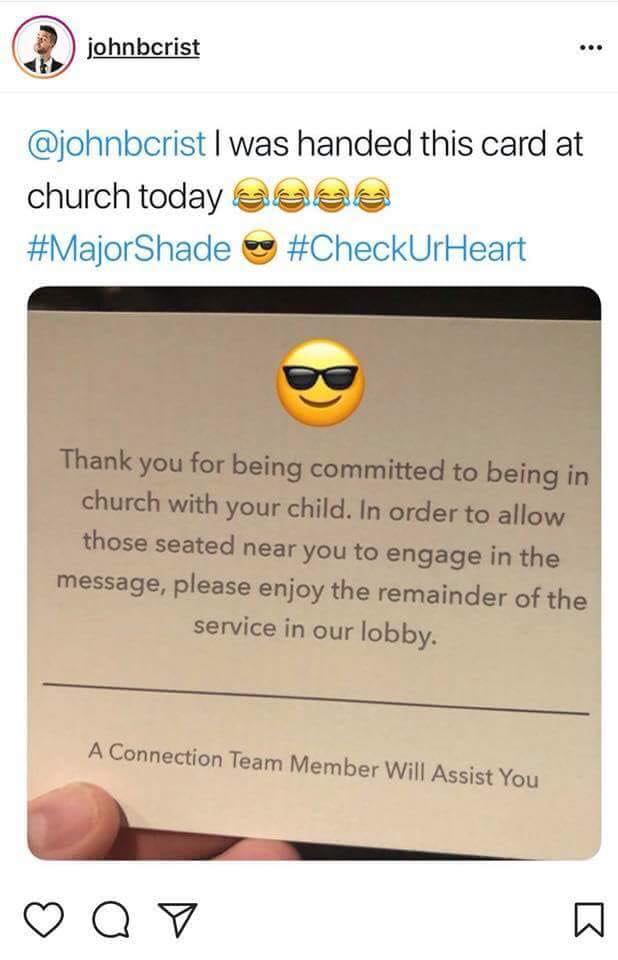
    Christian comedian John Crist shared this photo on Instagram this weekend that’s gone viral. The photo is a card from a church, apparently meant to be distributed to parents of fussy children, instructing them that a “connection team member” would assist them in leaving the sanctuary during worship.

    It’s a sad commentary on the American church that we shame parents for bringing their kids and their kids…acting like kids in a church service. (more…)

  • Bring your fussy child to church day

    41399491_10156449724805900_4799046815594840064_n
    Christian comedian John Crist shared this photo on Instagram this weekend that’s gone viral. The photo is a card from a church, apparently meant to be distributed to parents of fussy children, instructing them that a “connection team member” would assist them in leaving the sanctuary during worship.

    It’s a sad commentary on the American church that we shame parents for bringing their kids and their kids…acting like kids in a church service.

    If the gospels were written today, and Jesus was teaching to great multitudes and a child was fussing, would he ask the parent and child to be escorted away from his presence? In the Gospel of Matthew, Jesus said: “Let the children come to me. Don’t stop them! For the Kingdom of Heaven belongs to those who are like these children” (Matthew 19:14).

    A baby has just as much right to be there as you do.

    It’s unfortunate that a parent who’s tired, who’s working, who’s doing their absolute best, and on top of all of the other hassles in life, knows it’s worth it to take their young child to church, and when they do that, has to worry about the eye rolls, the murmurs, the complaints for if their child gets fussy. That should be the last place where they’re going to be criticized. Those parents should be applauded, not judged.

    Can it be annoying to hear a fussy child? Yes. Obviously. But it’s more annoying to hear a fussy adult whining about a baby. There isn’t a Biblical mandate: thou shalt wait until thine child will behave before thou shalt bring them into the Lord’s house.

    Yes, if a young child is having an absolute meltdown, of course it’s reasonable to step outside of the room for a moment. A parent has enough sense to know that. But the fact that this church had a special card printed up and ready to hand out? Yes, I realize that card compliments the parent for bringing their kid but it’s underhanded when couched in “now please leave the corporate worship service.”

    Jesus spoke to multitudes of thousands during his ministry. Those parents weren’t dropping their kids off with the babysitter. There would have been fussy children then. Other parts of the world have livestock nearby making sounds. Worship in other parts of the world is done in secret at the threat of persecution. But heaven forbid a little kid sometimes cry or speak up.

    They’ll learn. Their behavior will improve. But what’s priceless is teaching them from a young age that church is important and something that should be part of life.

    If we’re going to want to make parents feel ostracized or unwelcome because of their children, I think we need to check our own hearts in that. What do we value? Can we put up with a little bit of inconvenience so that a young child can be included in the service too?

    The church isn’t a restaurant, it’s not a movie theater. If you want to complain about a fussy child in those establishments, go ahead. But we should not approach it like our satisfaction with every visit is the supreme end of the service.

    Thanks for reading! I’d love to hear what you think, and don’t forget to subscribe! 

    Josh Benner is the associate pastor at Cornerstone Evangelical Free Church in Fergus Falls, Minnesota and has a Master of Divinity from Trinity Evangelical Divinity School. He enjoys writing about faith and culture. He lives with his wife Kari in Minnesota.

    Let’s connect!
    Facebook
    Twitter
    Instagram