Josh Benner

Tag: evangelical

  • Megachurch pastor takes leave of absence for inappropriate online relationship

    Influential megachurch pastor Matt Chandler announced yesterday that he was being placed on leave as a result of an online social media relationship.

    We shouldn’t jump to conclusions. And the more facts we get about this situation, the better. But I am a believer that when popular ministry figures acknowledge (as Chandler does) or are credibly accused of potentially disqualifying sins, that people should be investigated. We have created a culture where it is appealing to become an influential pastor. It brings money, fame, and power. The character of these individuals does matter. 

    Chandler’s story

    One of the peculiarities of the revelation of Chandler’s leave of absence is that he was allowed to announce it to the church. This also allowed him to get out ahead of the controversy and give his own narrative. 

    Chandler begins with his series of events, “Several months ago, a woman approached me outside here in the foyer. She had some concerns for how I was DM’ing on Instagram with a friend of hers. I didn’t think I had done anything wrong in that. My wife knew that, her husband knew that. And yet, there were a couple of things that she said that were disorienting to me.” 

    Chandler says he immediately contacted the church’s lead pastor, Josh Patterson as well as the chairman of their elder board. He said he went home and told his wife about the exchange and that the elder board looked into it. Chandler says “We cannot be a church where anyone is above the Scriptures and above the high heavenly call into Christ Jesus.” 

    He says that the elder board had some concerns but that the conversations were not romantic or sexual but that the conversations were “unguarded and unwise” and that the concerns were “really about frequency and familiarity” and language Chandler had used which was “coarse and foolish.” 

    Because of Chandler’s inability to see what he was in was probably revealing some “unhealth” in him, but that he agreed with the board’s decision to put him on a leave of absence. 

    Chandler again thanks the elders for holding him accountable saying “do you know how easy it would have been to make it nothing and just let me not address whatever this is?”  

    Commentary

    I think this is part of the problem with Chandler being able to speak in this situation. Even if I take his statement at face value. He starts off by talking about how his wife and the other lady’s husband knew about the conversations (minimizing the issue). He didn’t think they were doing anything inappropriate. 

    Plus the wording of his statement is vague. It was unguarded and unwise but it wasn’t romantic. It was coarse and foolish but it wasn’t sexual. 

    So what was it?! What did he say that was so bad that he got put on leave? The really striking phrase to me is “do you know how easy it would have been to make it nothing and just let me not address whatever this is?” I feel like that could almost have a double meaning, but perhaps that’s me being cynical.. 

    So you have Chandler speaking and saying he hadn’t thought it was a big deal but he is also totally respecting the decision of the board (to suspend him for something that is totally undefined and unclear). 

    It makes it look like the Village has the highest elder standards of any church in America! Their standards are so high that they would even suspend a rockstar pastor without it even being an overtly, obviously, disqualifying sin. 

    Do they have the highest standards? Time will tell. 

    The church’s story

    According to a statement from the church who had commissioned an investigation in to Chandler’s texting, emails, and social media, they said that the messages were not “romantic or sexual in nature” but that “the frequency and familiarity of the messages crossed a line. They revealed that Matt did not use language appropriate for a pastor” 

    The church’s statement agrees with Chandler that “the messages were not romantic or sexual in nature, the frequency and familiarity of the messages crossed a line.”

    The best possible light

    I think that the best possible light, and what I hope is the reality is that Chandler made some mistakes and that the church is holding him accountable. That’s how it’s being framed. The church has crafted a narrative of how they want things to appear. 

    If it’s all true, then yes, the Village could be looked at as a model of pastoral standards, ministerial integrity, and Biblically restorative discipline. Again, I hope that’s the case. But for now, all we have is their side of the story. 

    The worst possible light 

    There are no shortage of skeptics out there who want to assume the worst, to assume that there’s much more under the surface, that this is just the tip of the iceberg. Sadly, that is something we’ve seen before with ministry scandals. 

    If it’s the worst case scenario, it would be another fall from grace from another popular pastor. And it would be a sad day for me, someone who’s always really appreciated Chandler’s ministry. In my early 20s, Chandler’s sermons were a major influence on my faith. I had never heard anyone preach like him before. He was engaging and matter of fact. He was funny. I found his sermons smart without being pretentious. I felt like he wasn’t afraid to address the gritty and difficult parts of life, while painting a beautiful picture of what living life for Jesus could be like. For all of those reasons, I again say with sincerity, that I hope that everything he and his church have said is true. If it’s true, I hope they also have a healthy process for restoration and that he can eventually be restored to ministry and to continue to do the work he’s done for nearly two decades at the Village which has blessed so many across the world. 

    Thanks for reading! If you liked this post, please share and subscribe!

  • Scandal in the Southern Baptist Convention

    Scandal in the Southern Baptist Convention

    Even though I’ve never been part of a Southern Baptist church, I have always loved the Southern Baptist Convention. I feel that this denomination is one of the leaders is spreading the gospel and teaching the Bible in America and through missions efforts across the world. 

    On Sunday, a 288 page report was released related to the handling of sexual misconduct within the denomination. 

    The fact that there were issues was not a new revelation. In 2019, I wrote about a Houston Chronicle expose which talked about sexual predators within the SBC. 

    But the issue isn’t simply that the denomination failed to be proactive. That would be bad enough. What’s worse is that they intentionally avoided mechanisms to hold abusers accountable and steps which could have been taken to prevent abuses. 

    From the report: 

    “Rather than focusing on these accused ministers, some EC (executive committee) leaders turned against the very people trying to shine a light on sexual abuse. The survivors – those persons who actually suffered at the hands of SBC clergy or SBC church staff or volunteers – who spoke out the most, and who criticized the SBC’s inaction, were denigrated as “opportunistic,” having a “hidden agenda of lawsuits,” wanting to “burn things to the ground,” and acting as a “professional victim.” 

    The report notes several high profile SBC figures who were either involved in scandals of their own or who failed to hold abusers accountable. 

    Leadership failures

    Former SBC President Steve Gaines admitted that, as senior pastor at Bellevue Baptist Church, he had delayed reporting a staff minister’s prior sexual abuse of a child of “heartfelt concern and compassion for th[e] minister,” while acknowledging that he should have “brought it to the attention of our church leadership immediately;”

    Former SBC President Jack Graham, when he was pastor at Prestonwood Baptist Church, allegedly allowed an accused abuser of young boys to be dismissed quietly in 1989 without reporting the abuse to police. The accused abuser, John Langworthy, later was charged with abusing young boys in Mississippi in 2011;

    Former SBC President Paige Patterson was terminated from his position at Southwestern Baptist Theological Seminary in 2018 after it was revealed that he his intention to meet with another student who had reported an assault, with no other officials present, so he could “break her down;” told a student not to report a rape in 2003 and, in 2015, emailed Former SBC Vice President Judge Paul Pressler is the defendant in a civil sexual abuse lawsuit alleging that he repeatedly sexually abused the plaintiff beginning when the plaintiff was 14 years old. Two other men submitted separate affidavits in the case also accusing Judge Pressler of sexual misconduct; and

    Former EC Interim President and General Counsel Augie Boto testified as a character witness for Mark Schiefelbein, a gymnastics coach convicted of multiple counts of sexual assault against a minor. During his testimony at a post-conviction evidentiary hearing in September 2008, Mr. Boto identified himself as general trial counsel for the Executive Committee of the Southern Baptist Convention.

    In 2007, a database was proposed to list offenders who had served in SBC churches. 

    The Washington Post reports: 

    “In an April 2007 email, the convention’s attorney sent Boto a memo explaining how a SBC database could be implemented consistent with SBC polity, saying “it would fit our polity and present ministries to help churches in this area of child abuse and sexual misconduct.” The report states that he recommended “immediate action to signal the Convention’s desire that the [executive committee] and the entities begin a more aggressive effort in this area.” That same year, after a Southern Baptist pastor made a motion for a database, Boto rejected the idea.”

    The database is another important finding from the report. A database of known and accused offenders had long been suggested within the SBC. It’s a denomination with thousands of churches. Some predators would leave one church and go to another. Leaders continually stonewalled the idea of a database and said it would be impossible to manage. According to the report, the database existed. 

    It’s my understanding that it’s not definitively known which leaders had access but the database existed. People in leadership lied and withheld a useful tool from their churches. Unconscionable. 

    And this all scratches the surface. 

    The New Testament repeatedly gives warnings about those infiltrating the church who mean to do harm. 

    Matthew 7:15-16: 

    15 “Beware of false prophets, who come to you in sheep’s clothing but inwardly are ravenous wolves. 16 You will recognize them by their fruits.

    In John 10, Jesus famously says that he is the good shepherd who lays down his life for his sheep (his people). At the same time, Jesus is warning of shepherds who will fail to protect the flock  and teh wolves that will prey upon the flock: 

    John 10:10-13:

    10 The thief comes only to steal and kill and destroy. I came that they may have life and have it abundantly. 11 I am the good shepherd. The good shepherd lays down his life for the sheep. 12 He who is a hired hand and not a shepherd, who does not own the sheep, sees the wolf coming and leaves the sheep and flees, and the wolf snatches them and scatters them. 13 He flees because he is a hired hand and cares nothing for the sheep.

    These are verses that I’ve always taken seriously. There are those who will cause harm within the church. Sadly, far too many SBC “leaders” failed to do their part in helping to protect the churches in their denomination and sadder still, their failures to act (or outright participation in cover ups) helped foster a culture where people could commit acts of abuse. 

    29 I know that after my departure fierce wolves will come in among you, not sparing the flock; 30 and from among your own selves will arise men speaking twisted things, to draw away the disciples after them (Acts 2:29-30).

    All of this just scratches the surface. But it’s unconscionable. It is beyond me how these leaders could justify the things they’ve done. 

    There has been a massive sexual abuse scandal in the Catholic Church. There have been scandals from several universities: Penn State with assistant football coach Jerry Sandusky and Ohio State with former athletic department physician Richard Strauss. There was the USA Gymnastics scandal with Larry Nasser. There was the #metoo movement. Jeffrey Epstein. 

    Large institutions are vulnerable to predators and the SBC was unable to read the room and take any steps at avoiding abuse? 

    One of the findings of the report was that these evasive steps from the SBC were done in an effort to avoid legal liability. But at what cost? In avoiding liability, the leadership of the denomination failed to help protect people within their congregations. That’s the worst of it. 

    And ironically, in their effort to protect the denomination, they have done damage that will linger in the SBC until Christ returns. Churches will leave the SBC, members will leave churches within the SBC, the reputation of the SBC will take irreversible damage. And Christ’s Church takes another strike against it because people failed to live up to what the Church is supposed to be. 

    Thanks for reading. If you liked this post, please share and subscribe.

  • NYT suggests evangelicalism needs to be more liberal to save itself

    NYT suggests evangelicalism needs to be more liberal to save itself

    David Brooks had a piece in the New York Times under the headline: “The Dissenters Trying to Save Evangelicalism From Itself.”

    Brooks talks of the divide within evangelicalism. Early in the article, Brooks suggests: “There have been three big issues that have profoundly divided them: the white evangelical embrace of Donald Trump, sex abuse scandals in evangelical churches and parachurch organizations, and attitudes about race relations, especially after the killing of George Floyd.”

    I’ve read this same basic piece several times in the last couple years in trying to diagnose the problems with evangelicalism in America. 

    Brooks interviews a familiar cast of characters. Russell Moore and Beth Moore (no relation to each other) who were recently popular figures in evangelical circles but have become critics of the movement. He interviews Kristin Kobes Du Mez, the author of “Jesus and John Wayne,” which is a one-sided rant against evangelicalism which only looks at the bad and overlooks any redeeming qualities in the movement. He mentions Tim Dalrymple, the president of Christianity Today who said Trump should have been removed from office.

    There’s a lot fo discourse on the problems of evangelicalism but I feel like I never see similar critiques of liberal and progressive Christianity. These articles get preoccupied with evangelical support of Trump, and that always gets framed as if it’s some obvious scourge on the gospel. 

    My question is: what in the world is so good about liberalism? What are they doing right now to benefit our country? These articles want to criticize churches for being too conservative. As if there are not thousands of churches in America that are liberal, that support values that are not Biblical values such as the LGBT movement and abortion. Liberal churches who undermine the Bible. Those churches get a pass. 

    It’s the churches who support Trump and who are not woke social justice warriors who are the problem. Basically the problem with evangelicals is that they’re not liberals. And if they embrace liberal ideologies, then they’ll be doing the Lord’s work.

    Conservative evangelicalism is an easy target because our culture institutions are increasingly liberal. The mainstream media, Hollywood, big business, big tech, pro sports, the federal government, higher education, public education, healthcare, and on and on. It’s ok to be liberal. It’s not ok to be conservative. 

    And the focus needs to be that evangelicals don’t have a big enough tent. Brooks has the audacity to frame it as if evangelicals are not welcoming enough to other points of view. Is a conservative welcome in a progressive church? Is a belief in traditional marriage, traditional gender roles, the inherency of the Bible welcome in a progressive church? 

    There are problems with evangelicalism. There are far too many powerful people in influential ministries who are corrupt and who have no accountability. That’s an issue. Brooks mentions the scandal involving Ravi Zacharias and a scandal involving Willow Creek Church. I’ve written about both. They were terrible. I’ve written about Jerry Falwell, Jr, and James MacDonald, and the Southern Baptist Convention sexual assualt scandal.

    I think too many evangelical churches have done a poor job about teaching the Bible and focus on easy to listen to messages and appealing to cultural trends and having watered down youth ministries that are not teaching kids the Bible. Again, there are problems in evangelicalism.

    There are churches and pastors who might call themselves “evangelical” with whom I would greatly disagree. But evangelicalism is a broad movement. I think we should call out people when they’re in the wrong. But I don’t think that American evangelicalism has the inherent problems that progressivism poses to the church. Progressive churches fall right in line with that ideology. I see that as the bigger threat on our culture and on the gospel.

    Thanks for reading. If you liked this post, please share and subscribe.

  • Popular Christian author renounces faith

    67298391_1765046073639226_3780920432916430848_n
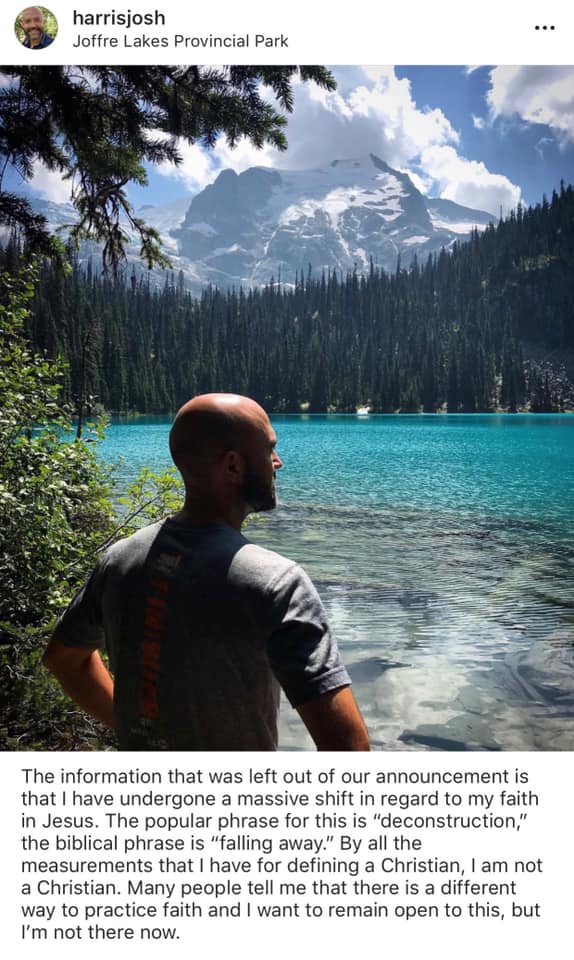
    Joshua Harris, who wrote the highly influential Evangelical Christian dating book “I kissed dating goodbye” in the mid 90s announced last week that he and his wife were separating. Today, Harris announced that he has also kissed Christianity goodbye. (more…)

  • What’s the greatest danger to the American church?

    photo-1476455479340-25ee0cee09bf.jpeg
    There are 300,000 churches in America.
    There are many wonderful churches that boldly proclaim the gospel and faithfully teach the Bible every week. There is no perfect church in the world, because every church is full of members who are imperfect people.
    I think that the biggest issue the American church faces today is related to truth and love.
    Love that undermines truth and truth that doesn’t practice love. I’ll briefly explain what that means.
    Love that undermines truth 
    Love is important. The greatest command in scripture is to love God and to love people. God is love.
    But some churches can emphasize love to the point where it undermines truth.
    For instance, there is a temptation in some Christian circles to consider the love of God and reason that: “since God is love, his love extends to all people, whether or not they believe in God and whether or not they want or accept his love.”
    God is love. But that is just taking a slice of the character of God and acting as if that’s the whole pie. God is love. But he is also just, and righteous, and holy. He judges, he has wrath towards sin. God has all of those qualities at all times.
    God is love. But the idea of love is not only exclusive to what our culture defines love as.
    We tend to value acceptance and tolerance as what it is to love. And it’s true that God meets us where we are, but Jesus doesn’t save us to keep us the same. God is a perfecting God. We sin. We sin so much that we needed a savior, and the gospel is not a message that teaches us that we’re ok and we should just keep doing what we’re doing. We need to live for God and pursue him.
    Making love purely about acceptance and tolerance is not the full Biblical scope of what love is. And so it undermines the truth of scripture. And it runs the danger of undermining the inerrancy of scripture (taking the Bible as practical wisdom rather than the infallible word of God). And this view runs the risk of undermining the gospel itself.
    Assuming that love and  demand for justice are mutually exclusive.

    I observe this being the great risk in more liberal denominations.

    Truth that doesn’t practice love

    I think this is more of a danger in conservative and evangelical circles. We place a high value on the scripture and theology. And well we should because both of those are hugely important.

    But we can get so preoccupied with having the right answer that we lose sight of actually living out what we know. This is very similar to the failure of the Pharisees in the gospels. They were very well studied and trained in theology, but they missed the heart of the message.

    It can be easy to know the right answer but it’s difficult to live it out in practice.

    Truth and love. It comes down to belief and practice. We need both.

    Originally published May 9, 2018 under the title “What’s the greatest danger to the church?”

    Thanks for reading! I’d love to hear what you think, and don’t forget to subscribe!

    Josh Benner has a Master of Divinity from Trinity Evangelical Divinity School. He has served churches in Minnesota and Illinois. He enjoys writing about faith and culture. He lives with his wife Kari in St. Louis.