
Josh Benner

Tag: Moses

  • Wrath and judgment – did God command genocide in the Old Testament

    photo-1526404797061-471b58efc8ef.jpeg
    When the Lord your God brings you into the land that you are entering to take possession of it, and clears away many nations before you, the Hittites, the Girgashites, the Amorites, the Canaanites, the Perizzites, the Hivites, and the Jebusites, seven nations more numerous and mightier than you, and when the Lord your God gives them over to you, and you defeat them, then you must devote them to complete destruction. You shall make no covenant with them and show no mercy to them.
    -Deuteronomy 7:1-2
    In Deuteronomy 7, the Israelites are just outside the land and the Lord gives a challenging command. The Israelites are told to wipe out the nations who inhabit the land.
    It’s not a popular idea. It’s a notion that many find reprehensible and immoral. For skeptics and people who believe in other religions, it’s fodder for them to undermine the teachings of the Bible.
    God is using Israel as a divine judgment for cleansing the land against wicked nations who lived totally contrary to the will of God. It was divine mercy that God had allowed these nations to exist as long as they did. But their sin eventually reached a braking point.
    The judgment was divine and righteous judgment.
    In this judgment, everything needed to be destroyed. The people, but not just the people. Also their livestock, also their crops, also their gold and possessions.
    It was all given to the Lord. The point wasn’t plunder for the Israelite’s gain because victory was from the Lord and everything was given to the Lord.
    Part of the reason why they had to be wiped out was that it was trying to preserve the Israelites from idolatry.
    It’s a very challenging idea. It’s a very unpopular idea.
    For a student of the Bible, I’d like to include a few thoughts on this challenging passage.
    God is just. 
    The fact that God doesn’t wipe out anyone immediately due to their sin is evidence of God’s grace and mercy. No one deserves grace. We willingly sin and transgress against the holy and righteous God of the universe.
    This judgment wasn’t Moses’ idea, or later, Joshua’s idea. It was God’s judgment. It wasn’t the Israelite elders who decided they should do this. God decided.
    And it was ultimately God who was enacting his judgment.
    Judgment for a particular time and place
    It was not meant to be a worldwide judgment. It was clearing out the land. Once the Israelites were in the land, there aren’t any indications that they were supposed to become raiders just attacking other groups or committing violence for its own sake.
    This command was for the Israelites in the specific context of the Promised Land.
    Israel never followed through at carrying out this judgment 
    While it might seem unfair or unnecessarily harsh, The Israelites never actually fully enact the devoting of their enemies to destructing in the land.
    And it is to their own peril and difficulty as they will historically be plagued by idolatry and turning away from the Lord.
    Picture of future judgment 
    For anyone who will not bend a knee to God, there will be a day of reckoning. This is a foretaste of the final judgment. There is an eternal consequence for rejecting the Lord, because without his saving grace, we are dead in sin.
    Opposing the Lord comes with severe consequences.
    God is just.
    And no one dies who would have otherwise repented. No one goes to hell because they didn’t have enough time.
    It’s not because God is mean. Not because he’s unfair.
    But because he is holy and righteous. And God cares about his own holiness.
    The good news is that God has made a way for people to avoid all of that. It’s a matter of trusting in the gospel. Believing in the Lord.
    We can’t be good enough, we can’t earn it. Our only hope is Jesus. God with us. Who lived a sinless life so that all who believe in him could be forgiven.

    Thanks for reading! I’d love to hear what you think, and don’t forget to subscribe! 

    Josh Benner is the associate pastor at Cornerstone Evangelical Free Church in Fergus Falls, Minnesota and has a Master of Divinity from Trinity Evangelical Divinity School. He enjoys writing about faith and culture. His hobbies include working out, watching sports, and photography. Josh and his wife Kari live in Minnesota.

    Let’s connect!
    Facebook
    Twitter
    Instagram

  • Christians too often settle for less

    landscape.JPG

    In Numbers 32, the Israelites are pursuing the Promised Land when some of the tribes decide that they would prefer to stay outside the land.

    The chapter begins with: “Now the people of Reuben and the people of Gad had a very great number of livestock. And they saw the land of Jazer and the land of Gilead, and behold, the place was a place for livestock (Numbers 32:1).” The passage goes to their request to stay in the land: “And they said, “If we have found favor in your sight, let this land be given to your servants for a possession. Do not take us across the Jordan (Numbers 32:5).”

    They didn’t want to go to the Promised Land!

    What they wanted was unwise.  What they wanted was settling for less than God’s best, settling for a land that wasn’t the Promised Land.

    It’s an interesting situation.

    They do offer to support the other tribes in the pursuit of the land. So it’s not that they’re totally abandoning their brothers and sisters. But this is still them making a decision that undermines the wisdom and goodness of God. (more…)

  • Meaning of the bronze serpent: the gospel in Numbers

    maxresdefault-11.jpg

    In Numbers 21, the Israelites experience victory over the Canaanites but soon fall back into grumbling and complaining.
    God brings a plague of snakes upon the people. It’s a divine judgment.
    Their grumbling against God was to their downfall. But the people beg for mercy.
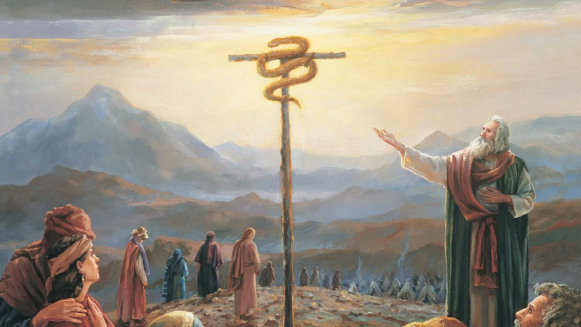
    8 And the Lord said to Moses, “Make a fiery serpent and set it on a pole, and everyone who is bitten, when he sees it, shall live.” 9 So Moses made a bronze serpent and set it on a pole. And if a serpent bit anyone, he would look at the bronze serpent and live.
    -Numbers 21:8-9
    Moses prays. God tells Moses to make a fiery serpent and set it on a pole. So God doesn’t simply take the snakes away. He also doesn’t prevent people from continuing to get bitten by the snakes.
    But once bitten, a person could respond by faith in the Lord by looking to the serpent on the pole.
    It’s an odd story. A number of questions might come to mind.
    Isn’t that idolatry? Making this bronze serpent?
    In the Golden Calf episode of Exodus 32, Moses is on the mountain receiving instruction from the Lord. He’s there for 40 days and the Israelites get restless. They take their gold and melt it into the image of a cow.
    Why is it ok with the bronze serpent?
    It’s a totally different situation. Most importantly, because God told them to do it this time.
    Secondly, this wasn’t idol worship because they weren’t worshiping the serpent.
    The serpent didn’t represent God to the people.
    There are many wonderful gospel themes in this scene.
    The Israelites sin against the Lord.
    And so God brings a plague of snakes upon the people as divine judgment.
    And yet, once the people repent and the bronze snake is made, it is in looking to that by which people are healed.
    A symbol of death becomes a symbol of life 
    Snakes were bringing death, but looking to this particular snake brought the promise of healing.
    A symbol of judgment the Lord then uses as a symbol of victory.
    The cross was the greatest symbol of judgment and condemnation in the Roman world.
    A brutal punishment. And yet, it is to the cross that we see Christ’s victory over sin.
    Perhaps you look at the story and think “but why a snake? Aren’t snakes bad in the Bible?”
    Yeah, so are people, but it is through a man that we are saved. The Lord Jesus, both God and man.
    The gospel 
    In a person being healed because of looking to the snake, it took what they were doing out of their hands. It was entirely the work of God.
    So too we see this in the gospel. It is not based on us, or how good we are. We are totally helpless to heal ourselves from the disease of sin. It is looking to the cross, to looking at what Jesus has done, to trusting Jesus by faith that we can have salvation.
    It’s foolishness 
    The serpent doesn’t make sense.
    The world is confounded by the gospel and the message of grace, the idea that we can be freely forgiven based on what someone else has done.
    The world is offended by the message of salvation by grace.
    Paul says in 1 Corinthians that the cross is folly to those who are perishing, but to those who are being saved, it is the power of God (1 Corinthians 1:18).
    We want to save ourselves. We want to see how we measure up and to feel good about how good we are.
    The gospel is that you cannot earn it. You look to what Jesus has done.
    Salvation for the undeserving 
    The Israelites were grumbling and complaining and blaspheming against God, and yet God saves them.
    Jesus came into a world where people condemned him, polluted against him, betrayed him, and killed him.
    While we were yet sinners, Christ died for us (Romans 5:8).
    In both looking to the serpent and the death and resurrection of Jesus, what people needed was faith.
    In the Gospel of John, Jesus will make specific reference to this event in Numbers. John chapter 3, Jesus is talking to Nicodemus, the Pharisee.
    Jesus says “as Moses lifted up the serpent in the wilderness, so must the Son of Man be lifted up.” (John 3:14)
    Moses literally lifted up the bronze serpent on a pole.
    And Jesus was literally lifted up on the cross.
    There, Jesus compares himself being lifted up to the bronze serpent.
    For the Israelites who were afflicted by the serpent’s bite, life was found by looking to the bronze serpent. For us today, eternal life is found by looking to Jesus.
    The main idea of our passage this evening is that: Opposing God brings death but true life is fond by faith.
    Are you trusting in Jesus?
    We’re infected with the venom of sin. And it’s a killer. There is nothing we can do on our own to take out that poison. The only antidote is found in looking to Jesus.
    Look to him. Love him. Live for him.

    Josh Benner is the associate pastor at Cornerstone Evangelical Free Church in Fergus Falls, Minnesota and has a Master of Divinity from Trinity Evangelical Divinity School. He enjoys writing about faith and culture. He lives with his wife Kari in Minnesota.

    Let’s connect!
    Facebook
    Twitter
    Instagram

  • Not taking the Lord’s name in vain – more to it than just bad words

    photo-1499810631641-541e76d678a2

    The Third Commandment
    “You shall not take the name of the Lord your God in vain, for the Lord will not hold him guiltless who takes his name in vain.
    -Exodus 20:7
    The third commandment involves more than just not using God’s name in profanities. That’s part of it but it’s not the whole picture.
    In its historical context, it seems that part of the meaning of the third commandment involved swearing oaths in the Lord’s name. A person could make such an oath and yet fail to follow through, and God doesn’t want his name invoked with falsity.
    However this commandment is more broad than only applying to oaths.
    It also involves misusing the Lord’s title.
    Psalm 29:2: “Ascribe to the Lord the glory due his name; worship the Lord in the splendor of holiness.”
    In the beginning of the Lord’s prayer, Jesus addresses God the Father and says:
    “Our Father in heaven, hallowed be your name. (Matthew 6:9).
    God’s name is to be hallowed. It is to be spoken in reverence.
    There are still Orthodox Jews who won’t say the word God out of concern that they’ll never say his name with due reverence.
    We must keep in mind the awesome holiness of the Lord when we invoke his name.
    The Westminister Confession of Faith puts it well:
    The third commandment requireth the holy and reverent use of God’s names, titles, attributes, ordinances, Word, and works.
    But another way how people speak the name of the Lord in vain is by misrepresenting God theologically.
    People often attempt to speak for God. People will say what God’s standards are for love but it can misrepresent God’s holiness and justice.
    People speak for God in comparison to other religions.
    People who don’t seek to honor God speak for what God does or doesn’t accept.
    This is a terrible blasphemy against the Lord.
    We misuse the name of the Lord when we speak for God in ways that are not true to how God has revealed himself in scripture.
    We see that at the heart of the original sin.
    God originally gave one commandment.
     “You may surely eat of every tree of the garden, but of the tree of the knowledge of good and evil you shall not eat, for in the day that you eat of it you shall surely die.” (Genesis 2:16-17).
    But his words were twisted.
    Genesis 3:1: “Did God actually say, ‘You shall not eat of any tree in the garden’?”
    He never said such a thing.
    But then Eve responded by further misrepresenting the words of the Lord.
    Genesis 3:2-3
    2 And the woman said to the serpent, “We may eat of the fruit of the trees in the garden, but God said, ‘You shall not eat of the fruit of the tree that is in the midst of the garden, neither shall you touch it, lest you die.’ ”
    And the serpent undermines the consequences that God had spoken.
    Genesis 3:5: “You will not surely die.”
    Listen to the ways people talk about God. It’s a pattern that constantly happens.
    Twisting his words. Speaking on his behalf in false ways.
    Terrible sins.
    In undermining the consequences of God’s word, we make God out to be a lair and there is no deceit in the Lord. He is true to his word.
    This is part of the reason why it’s so important to have such reverence for the scripture.
    Because people are imperfect but God’s word is perfect.
    2 Timothy 3:16-17 says: “All Scripture is breathed out by God and profitable for teaching, for reproof, for correction, and for training in righteousness, that the man of God may be complete, equipped for every good work.”
    Unfortunately, our society has little Biblical literacy today.
    As we continue to study the Israelites, we will see that it had consequences for them and we suffer consequences in our world for a lack of reverence and training in God’s word.
    So in the first three commands, we get glimpses of the position where God is to be in our lives: first. We see glimpses of the reverence for how God wants us to approach him.

    Josh Benner is the associate pastor at Cornerstone Evangelical Free Church in Fergus Falls, Minnesota and has a Master of Divinity from Trinity Evangelical Divinity School. He enjoys writing about faith and culture. He lives with his wife Kari in Minnesota.