Josh Benner

Tag: pastor

  • 4 goals I have with every sermon I preach

    4 goals I have with every sermon I preach

    I’ve had the privilege of preaching over 450 sermons. In every sermon, I have four goals and those never change.

    1. To be faithful to the text

    Preaching must begin with the text itself. That might sound like stating the obvious, but it’s not actually where every pastor starts. Many pastors start with an idea “how to be a good parent,” “how to be a good financial steward,” “how to have a happy marriage,” etc. From that thesis, they seek out Biblical texts or passages which support that idea.

    It’s my conviction that the better place to begin in preaching is with a Biblical text itself.

    Sermons around topics can often take or leave the Bible.

    I believe that the best sermons are the ones that are so intimately tied to the Biblical text that they would be incomprehensible without it. The sermon must be grounded in the text. My goal is to let the text speak for itself and to preach that faithfully.

    2. To preach the gospel

    This is just as important as the first goal. Every sermon should be a gospel sermon. Every sermon should be an opportunity to communicate the Good News of Jesus Christ and that we have an offer of grace and forgiveness from a good and loving savior.

    There are two key reasons why every sermon should be a gospel sermon. First, because Christians need to constantly be reminded of the gospel.

    In Romans 1:16-17, Paul says:

    For I am not ashamed of the gospel, for it is the power of God for salvation to everyone who believes, to the Jew first and also to the Greek. 17 For in it the righteousness of God is revealed from faith for faith, as it is written, “The righteous shall live by faith.” 

    Secondly, there will almost always be someone listening to the sermon who does not actually believe in the gospel. For that reason, every sermon should be taken as an opportunity to proclaim the message of salvation.

    3. To explain how the text applies to life

    If the sermon has no real world application, it’s not a sermon. It’s a lecture!

    The great 20th century expositor and preacher John Stott said “if there is no summons, there is no sermon.” His point was that if a sermon isn’t calling on the congregation to do something, it’s not truly a sermon.

    Application can be challenging. Good application requires having an understanding of the true heart of the text. If the great takeaway from every sermon is “read the Bible more and pray more,” then it is ultimately lazy preaching. Great preaching must be mining for gold in the passage.

    4. To preach with clarity

    I’ve heard many a sermon that began well and then wandered off into incoherence.

    I’ve been in the middle of sermons and thought “what is the preacher even talking about?” Clarity is important in good preaching.

    I think the easiest way to preach with clarity is to have a clear outline for the sermon. Honestly, a good outline can be one of the biggest challenges of writing a sermon. Studying the passage is the easy part. Arranging the sermon in a logical way is where a lot of the real work of sermon writing comes in. But it’s the difference between a good sermon and a bad sermon.

    Thanks for reading! If you liked this post, please share and subscribe

  • Coronavirus, fear, and theology

    800px-2019-nCoV-CDC-23312_without_background

    Coronavirus continues to spread, causing fear and uncertainty with global markets. There have been people who have blamed the media for sensationalizing the virus and who point to the hundreds of thousands of people who die from the flu every year. There are people who blame China. People who blame President Trump for how he’s handling coronavirus in America. People stealing surgical masks from hospitals. You’ve had major events such as SXSW cancelled. We’ve seen universities close classrooms and shifted lectures to online formats. We’ve seen totalitarian steps taken within China to try to contain the virus (which some experts believe may have been successful). You have Italy quarantine its whole country.

    It’s a mess. (more…)

  • James MacDonald starting home church network less than a year after being fired from mega church

    JMacDonald_-_Walk_in_the_Word.jpg
    James MacDonald. Photo courtesy of Wikimedia Commons.

    A year ago, James MacDonald was fired from Harvest Bible Chapel, a megachurch located primarily around Chicago, which he had founded more than 30 years ago.

    MacDonald’s dismissal came after Chicago radio host Mancow Muller played explosive clips of MacDonald criticizing investigative reporter Julie Roys, Christianity Today editor Mark Galli (and making implications about an inappropriate relationship between them). He makes reference to putting illegal materials on the computer of the former Christianity Today editor (not suggesting that this event actually happened).

    At the time of his dismissal, MacDonald had faced years of criticism for domineering leadership towards staff and church members as well as abuse and mismanagement of church finances.

    This week, MacDonald has announced that he is starting his own home church network.

    In a statement on his website, MacDonald said:

    “I am not disillusioned with traditional local church, but large churches present complicating logistics and often negatively affect Christian relationships. For that reason, we feel led by the Lord to offer an alternative for those who need it – something different and refreshing that we are calling the Home Church Network – with all the impact of a large church but none of the drama.”

    -James MaDonald

    Commentary
    I’m sorry for being such a cynic but this is all very rich.

    A pastor who was rightfully fired because of his own sin says that he’s not disillusioned with traditional local church.

    Why would he be? The local church wasn’t the problem. The irony is that many of the things that drive people away from churches are the very things MacDonald perpetuated in his ministry: enriching himself off of people’s generosity, unchecked power, cult of personality, etc.

    And he has the audacity to clear the air that he doesn’t have any animosity against the local church?

    Second thing about this story that catches my attention.  MacDonald says: large churches present complicating logistics and often negatively affect Christian relationships.

    Once again, I find this interesting. A man who was fired from a large church is going to throw the large church movement under the bus because it’s the logistics which can negatively impact

    Christian relationships? He will also talk of the drama that exists in large churches.

    From reading his website, it seems like home groups will meet and watch videos of his teaching and utilize worship music that is put together through the ministry.

    This alternative already exists. He didn’t invent the idea of house church. It goes back to the New Testament era. In recent years, it has seen growing popularity in America. It’s also a common church style for Christians in many parts of the world where they face the risk of persecution for being Christians. And for MacDonald, it’s his newest avenue of ministry. In his statements, he again throws large churches under the bus for their “drama.”

    It’s the pot calling the kettle black.

    I know I’m being harsh. But it’s because I love the local church. And I hate seeing people abusing the local church. I think it’s shameful that time and again, megachurch pastors get caught up in areas of major sin and are disqualified from leading in their churches. When this happens, with few exceptions, they almost never stay away. MacDonald is starting a home church network.

    Same old story
    Mark Driscoll was removed for abusive leadership. He’s now leading a new church. Tulian Tchividjian was removed for having an affair, then hired by Willow Creek. Then he was fired again when another previously undisclosed affair became known. Then he started a new church. Perry Noble was fired from the megachurch he started in South Carolina for alcoholism and familial neglect, then divorced, and about a year and a half later, started another church.

    And there are many other examples. Ted Haggard using drugs and hiring a male prostitute, Jim Bakker with his affairs and fraud (he went to prison), Jimmy Swaggart and his prostitution scandal.

    And all of them are back in churches or ministries.

    That isn’t the way it’s supposed to be.

    The good news of the gospel is that no matter what a person has done, no matter how great the sin, that for the person who has trusted in Jesus, there is grace and forgiveness.

    But that’s not the debate. The issue is when you have pastors who are disqualified from leading on legitimate Biblical grounds, and who sit on the bench for a few months and proclaim themselves fit to lead.

    MacDonald didn’t even wait a year. And the pattern seems to often be that after a little time away, the pastor declares himself as ready to lead again within the church.

    Can a pastor ever be restored? It’s difficult because part of the qualification is that he be above reproach. But the restoration should never be as simple as a person deciding that they’re all better and ready to pastor again. None of these people are so valuable that the church can’t function without them. Ministry is a sacred privilege, not a right.

    Thanks for reading! I’d love to hear what you think, and don’t forget to subscribe!


  • Popular Christian author renounces faith

    67298391_1765046073639226_3780920432916430848_n
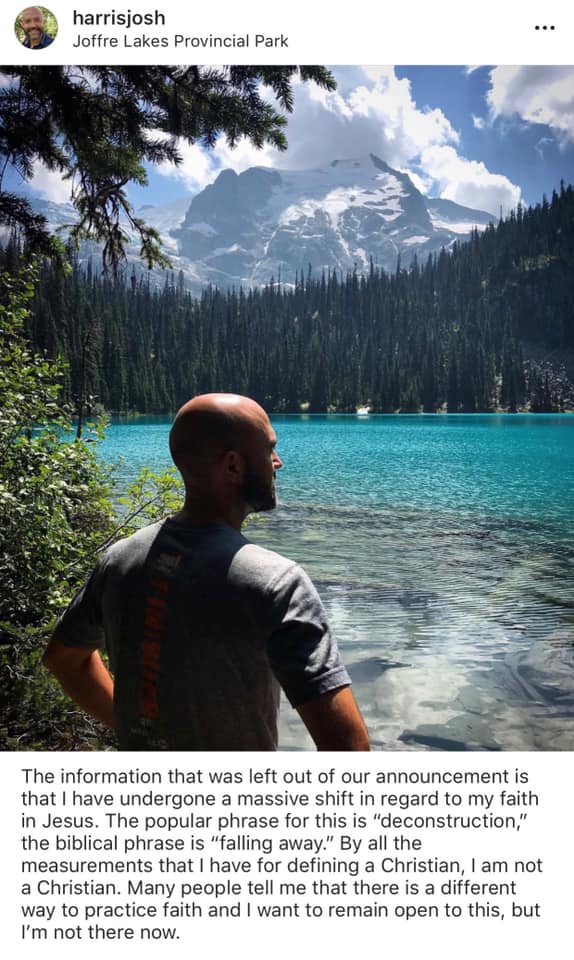
    Joshua Harris, who wrote the highly influential Evangelical Christian dating book “I kissed dating goodbye” in the mid 90s announced last week that he and his wife were separating. Today, Harris announced that he has also kissed Christianity goodbye. (more…)

  • Best of 2018. #4 No matter how terrible things seem, the gospel shows that there is always hope

    photo-1524024753536-2478712fa702.jpeg
    As 2018 comes to a close, I am sharing some of my top posts from this year. 

    Andrew Stoecklein was pastor of a megachurch in California who took his life last week. I’ve seen many stories shared about this man this week. I’ve seen articles about social media posts his wife has made in the wake of the loss of her husband.

    It’s an incredibly sad story. Successful young pastor. Growing megachurch. He had struggled with depression and anxiety. Stoecklein had actually taken a four month sabbatical as he was battling these mental health issues and had returned earlier this month. (more…)