Josh Benner

Tag: Tim Keller

  • The fruit of the Spirit – something we can’t produce

    photo-1545135933-53630a9f3537.jpeg

    But the fruit of the Spirit is love, joy, peace, patience, kindness, goodness, faithfulness,23 gentleness, self-control; against such things there is no law.
    -Galatians 5:22-23
    In the Book of Galatians, the Apostle Paul talks about the fruit of the Spirit.
    It’s a section that fascinates me. Because the fruit is produced by the Holy Spirit in the life of a believer.
    There are certain areas in our lives we can control.
    Think about it.
    Honesty. You can force yourself to be honest. I’ll just choose to not lie. You can decide that for yourself. Honesty isn’t a fruit of the Spirit.

    (more…)

  • Tim Keller on an underlying motivation for tolerance

    Timothy_Keller
    Photo courtesy of Wikimedia Commons @Frank Licorice

    I was reading an old sermon from Tim Keller, and was blown away by an observation he made regarding acceptance.

    “Some of us are extremely accepting. People will come to you and talk to you about their problems because you are so accepting. You are so non-judgmental. The reason you’re non-judgmental is … You’re gentle. The reason you’re gentle is because you have no self-control in your own life. You’re always falling down, and you’re always lapsing. You’re always breaking your own promises. You’re always breaking promises to others. That’s the reason why you’re so tolerant and accepting. You have no discipline of your own. That’s why you’re so open.

    In other words, your tolerance and your acceptance are not coming from humility and peace and joy. It’s just a way of dealing with your own conscience. Some people are incredibly unflappable. They seem to have peace, but they’re not gentle, and they’re not kind. Where did they get their peace from? They don’t care. They don’t care! That’s not real peace. These things will all break down.”

    -Tim Keller “New hope, new family”

    Acceptance and tolerance are popular ideas in our society. They’re basically the cardinal virtues of 21st century America.

    No matter what people do, accept and tolerate it. We call that love.

    I think Keller is onto something. We don’t want to acknowledge our own failures and sins and shortcomings and so we instead want to justify the actions of others so we can feel better about our own actions.

    The problem is that it doesn’t make us feel better. On the outside, it might, but we know our sinfulness in our own hearts. We know we often don’t even measure up to our own standards, let alone those of God.

    Thanks for reading! I’d love to hear what you think, and don’t forget to subscribe! 

    Josh Benner is the associate pastor at Cornerstone Evangelical Free Church in Fergus Falls, Minnesota and has a Master of Divinity from Trinity Evangelical Divinity School. He enjoys writing about faith and culture. He lives with his wife Kari in Minnesota.

    Let’s connect!
    Facebook
    Twitter
    Instagram

  • Tim Keller argues that Christians don’t fit into the two-party system – he’s right

    Timothy_Keller
    Photo courtesy of Wikimedia Commons @Frank Licorice

    Pastor and theologian Tim Keller had an op-ed in the New York Times last week entitled “How do Christians fit into the two-party system? They don’t.”

    In the piece, Keller outlines the complexity of the situation for Americans in the political arena. Keller argues (and I agree) that neither political party perfectly encompasses Christian teaching. This can be a challenging view for people because the temptation can be to look at whatever their party is and think “THIS is where real Christians belong. Honestly, I don’t even know if a person can be a Christian and vote for the other side.”

    The conservative platform certainly has elements which more closely align with Christianity including traditional marriage values and a pro-life stance.

    It is problematic that the democratic party holds to unbiblical beliefs on these issues.

    But they’re not entirely wrong and the republican platform is also not perfectly aligned with Biblical teaching. For instance, the Bible does have much to say about care for the poor, those who society looks down upon, and aliens. Now there is room for disagreement on the extent to which social welfare programs should go, but it’s a conversation where there is often greater empathy on the left side of the political aisle.

    Both parties have major flaws. One of the unfortunate issues in our society is that we’re losing the ability to see anything good or any redeeming qualities in the political party we oppose.

    That’s why I like Keller’s article (and he’s said similar things elsewhere). Because Christians are doing life in a fallen world and that fallenness most certainly carries over into political philosophies.

    Some have opted to go a third route which is to remove oneself from the political process. But even being apolitical is to be political. Not taking a stance on major moral evils is taking a stance.

    I’ve been saying for a long time that political values are a common  idol in our society. Politics matter. But they’re not the end all, be all. And politics are not our hope for a better world. The gospel is.

    Again, the point isn’t to totally withdraw from politics. But I think we need to keep our priorities straight. And for Christians, the objective is not to politically conquer our enemies but to love and serve, to spread the gospel and make disciples. And for those who politically disagree, I think we must be respectful and humble. Another key point that Keller makes is that if we get too concerned about prioritizing political beliefs and giving them gospel importance, we are then adding requirements to the gospel. And that’s wrong.

    At the end of his piece, Keller says:

    The Gospel gives us the resources to love people who reject both our beliefs and us personally. Christians should think of how God rescued them. He did it not by taking power but by coming to earth, losing glory and power, serving and dying on a cross. How did Jesus save? Not with a sword but with nails in his hands.

    Thanks for reading! I’d love to hear what you think, and don’t forget to subscribe! 

    Josh Benner is the associate pastor at Cornerstone Evangelical Free Church in Fergus Falls, Minnesota and has a Master of Divinity from Trinity Evangelical Divinity School. He enjoys writing about faith and culture. He lives with his wife Kari in Minnesota.

    Let’s connect!
    Facebook
    Twitter
    Instagram

  • Tim Keller Tweets about the incarnation: disagreement ensues

    36315657_572647029858388_5034138606524956672_n.jpg

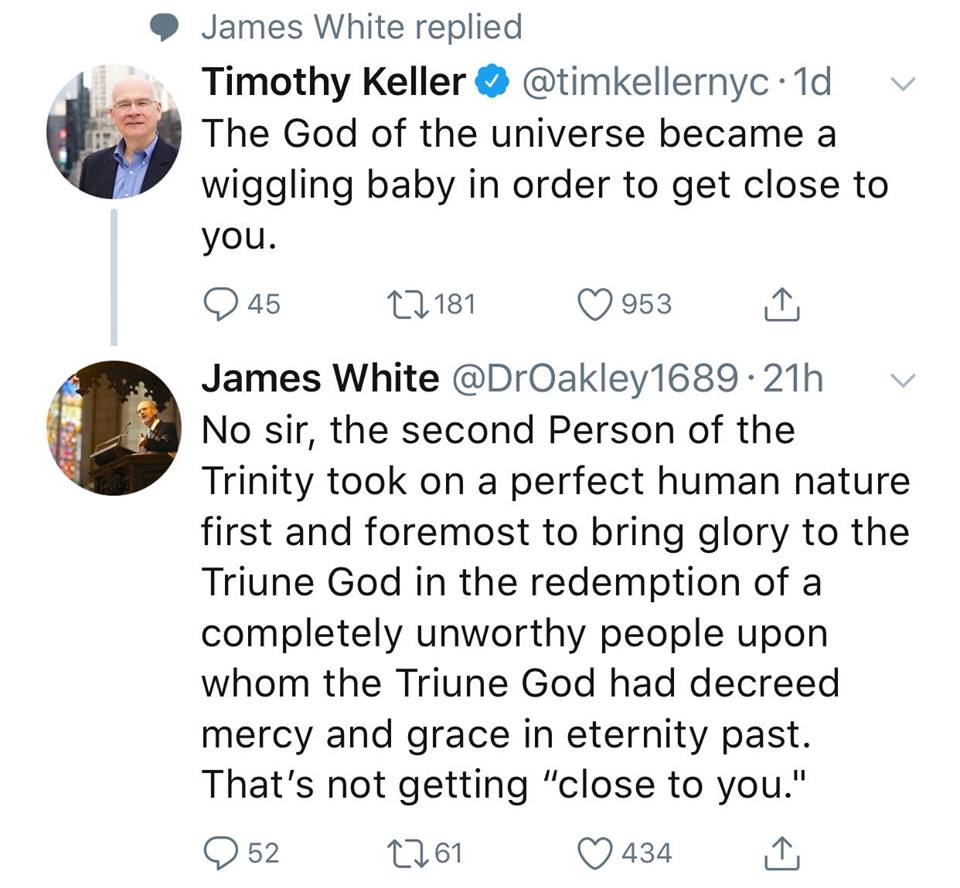
    Pastor and theologian Tim Keller made a Tweet in regards to the incarnation of Jesus this week. Keller said: “The God of the universe became a wiggling baby in order to get close to you.”

    James White, another theologian, was critical of Keller’s comment: “No sir, the second person of the Trinity took on a perfect human nature first and foremost to bring glory to the Triune God in the redemption of a completely unworthy people upon whom the Triune God had decreed mercy and grace in eternity past. That’s not getting ‘close to you.”

    I’m a huge fan of Keller, but I also really enjoy White’s work, but I disagree with the criticism that White is raising here. Both men are in the Reformed camp, and one of the great strengths of Reformed theology is its emphasis on the glory of God. As part of this idea, everything that God does is for his own glory. I affirm that belief.

    However I do think that people in the Reformed camp can sometimes emphasize the glory of God to the point where I feel that it can also undermine the love of God and that God is relational. It’s because God so loved the world that he gave his one and only son that whoever believes in Him shall not perish (John 3:16). Yes, God is glorious and we need to live to glorify God.

    I feel like we can treat glory almost like a utilitarian idea, that glory is the only thing that matters to God, and we act like the things that God does which happen to benefit humanity have nothing to do with God’s love for humanity. But we can’t reduce the attributes of God. Everything that the Lord is, the Lord is always, and to the superlative decree. So it’s not that God is sometimes glorious, sometimes loving, sometimes more or less loving, sometimes powerful. But it’s that everything God is, God always is.

    I’m not suggesting that White has a low view of the love of God.

    I do think that staunchly Reformed Evangelicals can communicate theological ideas which very much give that impression.

    Yes, Jesus came into the world to bring glory to God. But he also came so that everyone who believes in him can be with him. That’s the heart of the gospel. The God who created the world came into the world to save the world.

    Why go to theological battle over that?

    It’s not an either/or. It’s both/and.

    Josh Benner is the associate pastor at Cornerstone Evangelical Free Church in Fergus Falls, Minnesota and has a Master of Divinity from Trinity Evangelical Divinity School. He enjoys writing about faith and culture. He lives with his wife Kari in Minnesota.
  • Couldn’t God just forgive us? Why was the cross necessary?

    photo-1414018895695-96fe3f0d0765.jpeg

    A person might look at the crucifixion, look at what the Lord did on the cross, and wonder “Why was that the only way? Why was that necessary? Couldn’t God simply forgive us?”
    No.
    This is an idea I’ve heard from Tim Keller before, and it’s an important idea on having a theology of forgiveness.
    In any meaningful way a person has ever wronged you and you’ve forgiven them, when you forgive, you then bear a burden. You bear a burden for the way they originally sinned against you, and whatever you lost in the process: opportunity, time, happiness, money. Whatever it was. You were wronged and lost something. And when you forgive, you bear a cost a second time because you are relinquishing an opportunity to get even, to inflict vengeance upon them.
    And the worse the wrong is, the harder it is to forgive. The more costly the forgiveness, because it’s a greater debt that you’re forgiving. Not to say that people shouldn’t have consequences when they’ve committed crimes or acted violently. But even in those situations, we are called to be forgiving.
    But forgiveness is not as simple as just ignoring a wrong done.
    If someone destroys something you own, you can make them pay for it. That’s often what happens. Or perhaps you and the person can both pay for part of what was destroyed. Or you can personally pay for it. You can bear that cost yourself.
    My point is that in either event, someone has to pay. Forgiveness is not a write-off that where the wrong disappears and is forgotten about. Someone has to pay the price for what was broken.
    So with our sin against God, how does God approach forgiveness? All of the wrongs and injustices in the world. All of the wrongs and sins in our own lives, in our hearts, our actions.
    We could have never paid that price. We could never have done enough to earn our forgiveness. There was no hope.
    But on the cross, we see that Jesus himself bore the cost for us.
    That was the cost of forgiveness. The horrible death he died, the injustice that he faced. All of that shows us the cost of our sin.
    At the cross, we see the love of God.
    God shows his love for us in that while we were still sinners, Christ died for us. Since, therefore, we have now been justified by his blood, much more shall we be saved by him from the wrath of God. For if while we were enemies we were reconciled to God by the death of his Son, much more, now that we are reconciled, shall we be saved by his life.
    -Romans 5:8-10
    Because Jesus bore infinite wrath for sin. There is infinite grace when we turn to him. There is no sin he is unable to forgive. It’s not that he died and can forgive every sin, but he can’t forgive that one, or this one, or what you did, or what you’re struggling with.
    Infinite wrath because of our sin. But infinite mercy on the cross because of his grace.
    If you’re not a Christian, you need to know that Jesus paid for sins on the cross. Jesus showed that he is the way to God. Jesus died so that we could have a relationships with him. He promises eternal life for everyone who comes to him.
    All you have to do is believe in that. The Bible says that faith is credited to you as righteousness.
    “Everyone who calls on the name of the Lord will be saved.” (Romans 10:13)
    The Bible teaches that “there is salvation in no one else, for there is no other name under heaven given among men by which we must be saved.” (Acts 4:12).
    And the proof of that is on the cross. Many other places where people look for salvation, where people look for life.  None of those things will give you life. On the cross, Jesus died so that you could have life.
    You can’t earn God. The cross shows us that. If we could earn it, we wouldn’t have needed Jesus to die.
    2 Timothy 2:5-6 says:
    There is one God, and there is one mediator between God and men, the man Christ Jesus,6 who gave himself as a ransom for all, which is the testimony given at the proper time
    Jesus said “I am the way and the truth, and the life, no one comes to the father except through me (John 14:6).
    The validation for these things, what testifies to the salvation and ope that is found in Jesus…is the cross.
    Because he died on the first Good Friday. But he rose on Sunday. God has authority over life and death. God has authority over how to be made right with him.
    And while we didn’t deserve it, the good news of the gospel is that he made a way.
    Josh Benner is the associate pastor at Cornerstone Evangelical Free Church in Fergus Falls, Minnesota and has a Master of Divinity from Trinity Evangelical Divinity School. He enjoys writing about faith and culture. He lives with his wife Kari in Minnesota.