Last week, Saturday Night Live’s Pete Davidson told a joke about congressional candidate-elect Dan Crenshaw. Crenshaw is a decorated Navy SEAL who lost his right eye fighting in Afghanistan in the War on Terror.
Naturally, many were unhappy that Davidson made a joke about the appearance of a war hero.
This weekend, Crenshaw appeared on Saturday Night Live. And after giving a couple of comedic jabs back to Davidson (Crenshaw had some pretty good timing on his jokes), he forgave Davidson. (more…)
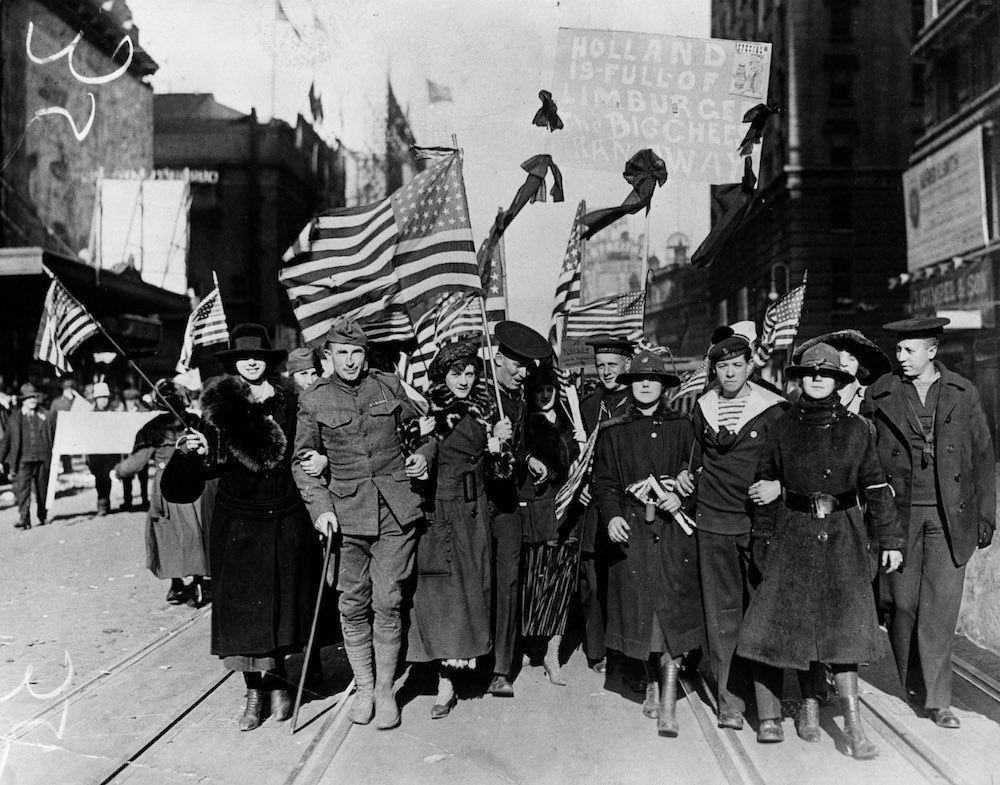
Crowds in New York celebrate the signing of the armistice which ended World War I
At this hour, a century ago, the First World War ended. They called it “The War to End All Wars.” But sadly, a generation later, the world would be embroiled in an even bigger, even more deadly, even more catastrophic war.
But at the time of World War I, it was something the likes of which the world had never seen.
The loss of life was catastrophic, with an estimated 37 million military and civilians dying in World War I. One of the striking features of World War I to me has always been the enormous losses of life in such short periods of time. In the First Battle of the Somme, there were over a half million casualties in a battle which lasted just 16 days. The First Battle of the Marne was an early battle in 1914. In less than a week, there were a half million casualties and over 150,000 troops killed.
World War I is fascinating to me.
I think for most Americans who are history buffs, our interests tend to go to one of three periods: the American Revolution, the Civil War, and World War II.
With World War I, America was certainly a major contributor in helping the Allies win the war but we also got involved relatively late (April 6, 1917), after the war had been raging for over 2 and a half years.
But our year and a half long contribution to the conclusion of World War I was hard fought, with over 116,000 soldiers dying (more than we lost in Vietnam and Korea combined).
Much of the past century has been shaped by the First World War. Three dynasties came to an end in World War I: The Romanovs in Russia were overthrown by the Bolsheviks in 1917. The Habsburgs were overthrown in Austria-Hungary. And WWI would lead to the downfall of the Ottoman Empire, which had held influence since the 13th century.
It led to an even bigger and deadlier war a generation later. One of the especially interesting things to me about World War I are the origins of the war. How the assassination of an unpopular prince in Serbia escalated to an international crisis. The alliance system pulled in several nations on both sides. The alliance system was a major factor that led to World War I, that perhaps the war was always inevitable and just waiting for a spark. World War II seems much more inevitable and unavoidable because of World War I.
The national boundaries in much of the Middle East came in the aftermath of World War I, and were established by the victorious Allied nations.
World War I was a modern war fought with modern weapons, but the scale of the war and the advancement of technology were beyond what the military philosophy of the day had developed. Most people thought it would be a quick war, but as countries who had large populations and who were relatively evenly equipped, it led to massive stalemates between armies. For much of human history, the populations would not have supported this style of warfare. Tragically, in World War I, armies could keep sending men into the trenches.
The world changed. At the beginning of the war, the French were still wearing blue coats, similar to what they wore in the Napoleonic Wars. This made them stand out. Officers were still wearing white gloves and caps with horsehair plumes. Entering a modern war with relics of the past. One of the earliest battles in World War I was the battle of the Frontiers. In just over a month of fighting, France alone suffered more than 300,000 casualties. But while the war began with elements of bygone eras, by the end of World War I, armies were using planes (still a pretty new invention at the time) in warfare and shooting guns from them.
Thanks for reading! I’d love to hear what you think, and don’t forget to subscribe!
Josh Benner is the associate pastor at Cornerstone Evangelical Free Church in Fergus Falls, Minnesota and has a Master of Divinity from Trinity Evangelical Divinity School. He enjoys writing about faith and culture. His hobbies include working out, watching sports, and photography. Josh and his wife Kari live in Minnesota.
It’s become somewhat of an annual tradition. I always watch a documentary about September 11 on the anniversary of that day. In American history, it’s still the most significant event to have happened in my lifetime. By far. It’s our “you remember where you were when you heard” moment.
It’s interesting to watch the documentaries, to see the video at the time. I remember the day like it was yesterday but every year, the quality of the videos seems a little more dated, the outfits people are wearing seem a little more 90s.
I remember it like it was yesterday, and so it’s crazy for me to consider that kids in school (aside from seniors) weren’t even born when this event happened. This monumental day that was a paradigm shift in American history is just that to kids, history. They learn about that day from what people tell them and from the same documentaries I watch.
If you weren’t alive that day, and watch documentaries about 9/11, I think it’s hard to appreciate the chaos of September 11th. There’s a sense of fatalism in the documentaries. They almost always begin by contrasting the beauty of that morning against the pandemonium that was soon to burst forth. (more…)
I was born in Vietnam, but I was not Vietnamese; I was raised in America, but I was not American. I grew up Asian in character but American in culture, a citizen but always refugee. I had no lessons from the past to guide me, no right way to do things in the present, and no path to follow me in the future.
-Where the Wind Leads
Labor Day weekend is upon us, the unofficial end to the summer.
Chung came to America as a child from Vietnam. I won’t give any spoilers about the book (Vinh survives the journey to America….obviously…he did write the book).
The book is basically in three parts, each was fascinating in its own right. The first third (roughly a third) of the book talked about his family in Vietnam, his larger-than-life grandmother and the tremendous struggles (and tremendous successes) that his family had faced in Vietnam. They had nothing, had it all, and then had nothing.
The second third of the book deals with things getting worse in Vietnam during the years of war and Vinh’s family leaving Vietnam. He recounts their journey out of Vietnam and the harrowing experience that it was to ultimately be saved. This section could be a movie. It was that compelling.
The last portion of the book (at this point, I honestly thought the story would be anti-climactic. The action was over). But I honestly enjoyed the last section just as much as the rest of the book. He talks of being a refugee in America, learning a totally new culture. It was inserting to see Chung’s perspective as someone who came to America as a child. A Vietnamese family who was still very traditional but living life in America. There’s a lot more I could say but I don’t want to give spoilers.
It’s a book that shows the providence of God, the love of family, and the value of hard work. Amazing book. One of those books that you wish wasn’t done because it’s so good.
Thanks for reading! I’d love to hear what you think, and don’t forget to subscribe!
Josh Benner is the associate pastor at Cornerstone Evangelical Free Church in Fergus Falls, Minnesota and has a Master of Divinity from Trinity Evangelical Divinity School. He enjoys writing about faith and culture. He lives with his wife Kari in Minnesota.
President Trump visited the United Kingdom this week. I saw a few posts and articles this morning in regards to the president’s meeting with Queen Elizabeth II.
Many are complaining about the president breaking protocols with the monarch. For instance, there is a tradition that people walk slightly behind the queen. At one point, the president was in front of the queen during her ceremonial inspection of the guard at Windsor Castle.
Oh the humanity!
The comments online talked about how this was an embarrassment, a sign of disrespect, and a president who lacked manners.
There are all of these protocols for meeting a royal.
Men are supposed to bow, women are supposed to curtsy. You’re supposed to walk behind her. You’re not supposed to turn your back to the queen. On first meeting, the queen is supposed to be addressed as “your majesty.”
And as we saw with President Trump breaching some of these protocols, there was criticism.
And that’s just for meeting a person. Think about the respect that Americans have for the queen of a different country. There is an expectation of this reverence for the queen. There’s this expectation of following the rules.
Yet we often have a very casual view of what it would be like to be in the presence of God. God is righteous, holy, set apart. He is awesomely mighty and glorious. And being in his presence also has its own protocols. You don’t just approach the King in any way you want. You approach God on his terms, not yours.
God requires perfection to enter his presence. It takes holiness to be with a holy God. We bristle at that, thrash against that, complain about that. But that is God’s standard.
We are not worthy of that.
You wouldn’t just go to Buckingham Palace and demand an audience with the queen. We don’t approach God on our terms.
It is faith in Jesus who gives us access to God. We are unholy, but Jesus makes a person holy. We are unrighteous, but Jesus makes a person righteous.
The Prophet Isaiah reports one of the great heavenly visions of the Bible in chapter 6.
In the year that King Uzziah died I saw the Lord sitting upon a throne, high and lifted up; and the train of his robe filled the temple. 2 Above him stood the seraphim. Each had six wings: with two he covered his face, and with two he covered his feet, and with two he flew. 3 And one called to another and said:
“Holy, holy, holy is the Lord of hosts;
the whole earth is full of his glory!”
4 And the foundations of the thresholds shook at the voice of him who called, and the house was filled with smoke. 5 And I said: “Woe is me! For I am lost; for I am a man of unclean lips, and I dwell in the midst of a people of unclean lips; for my eyes have seen the King, the Lord of hosts!”
-Isaiah 6:1-5
The presence of God is always depicted as being an awesome and overwhelming experience. As people realize their unworthiness, it’s often a terrifying experience to be in the presence of this holiness.
The good news of the gospel is that Jesus brings us in.
Josh Benner is the associate pastor at Cornerstone Evangelical Free Church in Fergus Falls, Minnesota and has a Master of Divinity from Trinity Evangelical Divinity School. He enjoys writing about faith and culture. He lives with his wife Kari in Minnesota.