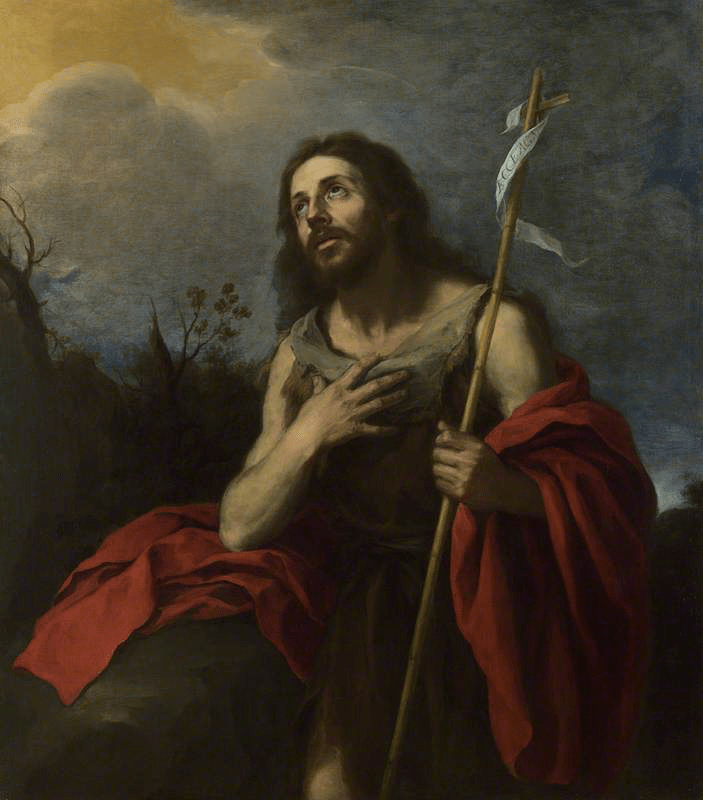
One of the most intriguing people we meet in the Gospel of John is a man named John the Baptist.
Who is he?
He is not the same John who wrote the Gospel of John. They’re two different men.
He’s often called John the Baptist. That title is referring to what John did rather than a denominational affiliation. It’s not that we had John the Baptist, Peter the Presbyterian, and Paul the Methodist.
John the Baptist is mentioned in all four gospels, and in all of the gospels, he’s introduced prior to the ministry of Jesus. So he’s pretty important.
Between the gospels, they give us accounts of both John’s birth and his death. I can’t think of any other New Testament figure besides Jesus where that could be said.
We find out in the Gospel of Luke that John’s mom, Elizabeth, is a relative of Mary which means that John the Baptist is related to Jesus.
John is a few months older than the Lord. After John the Baptist is born, his father gives a prophecy to his son’s life.
Luke 1:76-77:
76 And you, child, will be called the prophet of the Most High; for you will go before the Lord to prepare his ways, 77 to give knowledge of salvation to his people in the forgiveness of their sins,
Luke chapter 1 ends with an interesting note about John:
Verse 80:
80 And the child grew and became strong in spirit, and he was in the wilderness until the day of his public appearance to Israel.
He was in the wilderness until the day of his publican appearance in Israel.
There’s not a whole lot of elaboration on that.
We know nothing about his formative years. He was in the wilderness. Some scholars suggest the possibility that John may have actually be raised within a small community within the wilderness. That’s speculation, but it would make historical sense.
John is related to Jesus, but the gospels tell us nothing about how well they may have known each other. It doesn’t seem like they grew up going to a family dinner every week. When his ministry began, it quickly grew in popularity:
Matthew 3:5-6 says: Then Jerusalem and all Judea and all the region about the Jordan were going out to him, 6 and they were baptized by him in the river Jordan, confessing their sins.
Several years after John’s death, the Apostle Paul is ministering in Ephesus in Acts 19. Ephesus is several hundred miles away from Judea but people talk of the baptism which John practiced, showing that his name and reputation were known throughout the region.
John also faced persecution during his life.
He was arrested and later executed under the Romans in Matthew 14. John the Baptist is mentioned throughout the first chapter of the Gospel of John.
John 1:6-8: There was a man sent from God, whose name was John. 7He came as a witness, to bear witness about the light, that all might believe through him. 8 He was not the light, but came to bear witness about the light.
That’s the first thing the author tells us about John. He was sent from God. His ministry was not arbitrary. It was not on a whim. It was not something he just chose to do. He was chosen by God.
Second thing we find out about him: his purpose. Verse 7 says that he came as a witness to bear witness about the light that all might believe through him.
John came into the world to point people to the light of the world.
John 1:19-34 talks more about John and his unique ministry as a forerunner to Christ.
In John 1:22, John the Baptist is being questioned about who he is. In the preceding section, he’s given a series of denials of who he is not. He is not Elijah, he is not the Christ, he is not the prophet.
So they said to him, “Who are you? We need to give an answer to those who sent us. What do you say about yourself?”
So then who is he?
While John isn’t answering in the affirmative to any of his questions, that does not mean he’s insignificant.
Verse 23: He said, “I am the voice of one crying out in the wilderness, ‘Make straight the way of the Lord,’ as the prophet Isaiah said
They’ve seen who John isn’t. This is who he is. He quotes the text from Isaiah 40. That passage is applied to John in all four gospels.
Isaiah 40 is a passage talking of a future time of deliverance for the people of God. It’s an incredibly hopeful passage. It talks of God’s faithfulness to his people in spite of their sin. It talks of God’s restoration.
The heart of what this is getting at for John is that his purpose is to call people to repentance and preparation for the coming Messiah.
They ask John about his baptism.
25 They asked him, “Then why are you baptizing, if you are neither the Christ, nor Elijah, nor the Prophet?”
Baptism was instituted in the New Testament for followers of Jesus. But baptism was not a foreign idea prior to that time.
In the first century, when non-Jews would convert to Judaism, they would sometimes do something similar to baptism which was meant to be a cleansing ritual to symbolically wash away impurity and sin.
A difference with John was that he administered baptism. The leaders question his authority.
And he responds by turning the question right back to his purpose in the world.
John 1:26-27: 26 John answered them, “I baptize with water, but among you stands one you do not know, 27 even he who comes after me, the strap of whose sandal I am not worthy to untie.”
John says that it points to someone who’s shoes he’s not worthy to untie. In other words, he’s unworthy of even doing the most menial and humiliating task. John would need a promotion in order to be worthy of untying Jesus’ sandals.
John has authority to baptize because it’s been given to him by God but that baptism is meant to point to something greater.
Thanks for reading! If you liked this post, please share and subscribe.
This post is part of a larger study through the Gospel of John. This specific post is part of a 3 part series on John the Baptist from John 1:19-34
 Josh Benner
Leave a Reply