
25 Seven full days passed after the Lord had struck the Nile.
Then the Lord said to Moses, “Go in to Pharaoh and say to him, ‘Thus says the Lord, “Let my people go, that they may serve me. 2 But if you refuse to let them go, behold, I will plague all your country with frogs. 3 The Nile shall swarm with frogs that shall come up into your house and into your bedroom and on your bed and into the houses of your servants and your people, and into your ovens and your kneading bowls. 4 The frogs shall come up on you and on your people and on all your servants.” ’ ”
5 And the Lord said to Moses, “Say to Aaron, ‘Stretch out your hand with your staff over the rivers, over the canals and over the pools, and make frogs come up on the land of Egypt!’ ” 6 So Aaron stretched out his hand over the waters of Egypt, and the frogs came up and covered the land of Egypt. 7 But the magicians did the same by their secret arts and made frogs come up on the land of Egypt.
8 Then Pharaoh called Moses and Aaron and said, “Plead with the Lord to take away the frogs from me and from my people, and I will let the people go to sacrifice to the Lord.” 9 Moses said to Pharaoh, “Be pleased to command me when I am to plead for you and for your servants and for your people, that the frogs be cut off from you and your houses and be left only in the Nile.” 10 And he said, “Tomorrow.” Moses said, “Be it as you say, so that you may know that there is no one like the Lord our God. 11 The frogs shall go away from you and your houses and your servants and your people. They shall be left only in the Nile.”
12 So Moses and Aaron went out from Pharaoh, and Moses cried to the Lord about the frogs, as he had agreed with Pharaoh. 13 And the Lord did according to the word of Moses. The frogs died out in the houses, the courtyards, and the fields. 14 And they gathered them together in heaps, and the land stank. 15 But when Pharaoh saw that there was a respite, he hardened his heart and would not listen to them, as the Lord had said.
Prayer
14 Let the words of my mouth and the meditation of my heart
be acceptable in your sight,
O Lord, my rock and my redeemer.
Introduction
We’re continuing in Exodus this morning.
In the Book of Exodus, God has chosen to redeem the Israelites from Egyptian slavery but when the king of Egypt refuses to let his people go, the Lord brings a series of judgments on Egypt.
Last week, we looked at the first of those ten plagues.
Today as we cover chapter 8, we look at the next three plagues.
And for most of the month of October, Lord willing, we’ll be looking at these sections in Exodus.
And with that brief introduction, we’re going to jump right back into the text this morning.
We will be looking at the second, third, and fourth plagues which are all found in Exodus 8.
Second plague: frogs
Chapter 7 ends with the first plague where the Lord turns the waters of the Nile River red. The last verse of chapter 7 says:
25 Seven full days passed after the Lord had struck the Nile.
So it gives us a little indication of time.
Now we don’t have those notes with all of the plagues.
Someone asked me a very good question: “how long did these plagues last?”
We don’t know for certain.
Jewish tradition holds that the ten plagues lasted about a year. Some scholars believed they lasted for a few months.
But ultimately, we don’t know for sure.
But even if it was a few months, considering how these were wreaking havoc, it probably felt like a much longer period of time.
So examining this second plague.
Chapter 8, verses 1-2, the Lord sends Moses to warn Pharaoh:
Then the Lord said to Moses, “Go in to Pharaoh and say to him, ‘Thus says the Lord, “Let my people go, that they may serve me. 2 But if you refuse to let them go, behold, I will plague all your country with frogs.
Next, the conditions of this plague are noted.
Verses 3-4:
3 The Nile shall swarm with frogs that shall come up into your house and into your bedroom and on your bed and into the houses of your servants and your people, and into your ovens and your kneading bowls. 4 The frogs shall come up on you and on your people and on all your servants.” ’ ”
So in the first plague, we saw the Nile itself as the source of where the plague would strike.
Here the plague will be something that comes from the Nile River.
And as a reminder, the Nile was really the lifeblood of Egyptian life. They depended on it for their drinking water. It was the source of water that they used for agriculture. Egypt gets very little rainfall. The main source of river water for the Nile comes from further south in Africa during the monsoon season and then flows up into Egypt.
And so the first two plagues are both plagues of water.
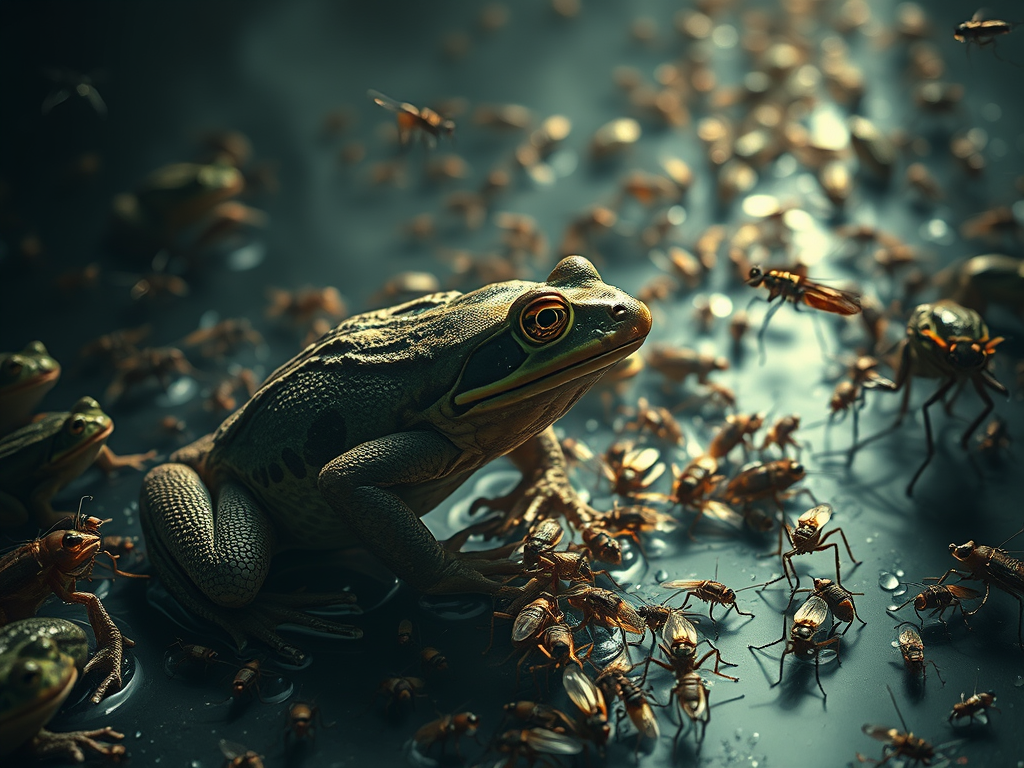
And Pharaoh is told that these frogs are going to be everywhere.
A swarm of frogs. And that word “swarm” in the Hebrew is the same word that is used in Genesis 1 in creation.
Example, Genesis 1:20:
20 And God said, “Let the waters swarm with swarms of living creatures, and let birds fly above the earth across the expanse of the heavens.”
In the plagues, there is actually a lot of language that refers back to creation. Because for the Egyptians in their rebellion, the plagues are an uncreation.
That passage says that they’ll be in Pharaoh’s bedroom, on his bed, and into the homes of his people, even their ovens and kneading bowls will have frogs hopping out of them.
It’s almost comical. It probably wasn’t for the Egyptians and the Israelites, but everywhere you look, there’s just frogs hopping out.
And ribetting!
It’s also significant that the text mentions frogs will be in Pharaoh’s bedroom.
The two Hebrew words used there which the ESV translates bedroom are found together only five times in the Old Testament.
In four of the five instances – including our passage this morning – it’s a passage which is talking about the vulnerability of a king, even in his own bedroom, a place you would think would be as secure and protected as any in his kingdom. But even the place where the king sleeps can be under threat.
Pharaoh might be the king. He might have a lot of political powers, societal powers.
But at the end of the day, he’s just a man.
What’s the thing that makes you feel most secure?
It’s really amazing how quickly the facades of the things that give us security can be gone.
Meditation – losing everything
I was reading this week about female judges in Afghanistan. The danger that they’re in. How quickly, in just a few weeks, their lives have been totally turned upside down. On the run, in hiding, in danger. Bank accounts frozen. Totally dependent upon others right now.
Security can be taken away.
Some of us can rely on our money. That can be taken away.
I had a relative who was the CFO of a company. The CEO had embezzled money which was supposed to go for things like payroll taxes. The CEO ended up going to prison. While my family member hadn’t done anything illegal, CFO’s do have certain legal liabilities and he was financially held accountable.
A person who had exercised integrity for a lifetime and worked hard for a lifetime paid dearly for someone else’s crime and had almost all of his assets liquidated when he died.
For some, that’s where our hope is. And it can be taken away.
For some, we can want to rely on our health.
I remember starting off at a restaurant job a few years back. In our new employee orientation, they had us fill out a questionnaire. One of the questions was something like “what’s the most important thing to you?”
I said faith.
Our manager also answered the questions. And though he had a wife and kids, said that the most important thing to him was nutrition.
Priorities.
Well you can be the healthiest person in the world. You can do it all right.
And still get cancer.
The person who popularized jogging as a fitness activity in the 1980s died of a heart attack while jogging.
I think of powerful people. I’ve always been struck that much of Ronald Reagan’s post-presidency, he was dealing with the effects of Alzheimer’s disease. I’ve always thought of what that must have been like for his family and secret service agents. You’re interacting with a man who had been the most powerful man in the world but who was ailing, aging, and undoubtedly came to a point where he couldn’t even remember the substantial and historical life that he had led.
No matter how powerful a person is, they still die.
Life is fleeting.
And whatever we want to put our security in, if it’s not the Lord, we will lose it. It will not sustain us. It will not protect us.
It’s interesting. We live in a time when there’s so much we can seem to control.
So much of human history was and is a battle against the elements. But in the comfort of our own homes, we get to decide the temperature.
Our basic needs are met.
We have modern medicine. We aren’t starving.
We have options over entertainment.
We have mobility and freedom about where we choose to live. Something else that has been the exception throughout much of human history.
We have options about what we do for employment. We aren’t surfs. We aren’t bound to be somewhere or do something we don’t want to do.
We have so many options and choices in our society.
And so it’s easy to feel like we have so much control of our own lives. It’s easy to look at all of our forms of security we surround ourselves with.
Yet life is so fragile that all of us can have our world’s turned upside down at any moment by a phone call about someone we love, or our own health. Or an accident can happen and totally change everything.
And the one constant, the one thing you are guaranteed to have is a faithful God.
And so let us as Christians not forget that God is all we ultimately need.
In Psalm 46, the Psalmist says:
1 God is our refuge and strength,
a very present help in trouble.
2 Therefore we will not fear though the earth gives way,
though the mountains be moved into the heart of the sea,
3 though its waters roar and foam,
though the mountains tremble at its swelling. Selah
6 The nations rage, the kingdoms totter;
he utters his voice, the earth melts.
10 “Be still, and know that I am God.
I will be exalted among the nations,
I will be exalted in the earth!”
Everything can be collapsing.
But nothing is ultimately meant to sustain us but God.
And so Pharaoh is warned that even in his own room, in his sanctuary, the frogs will be there.
They will be everywhere.
In verse 5, Moses is told by the Lord to tell Aaron to stretch his staff over the waters and the frogs inundate the land.
Something that perhaps added insult to injury is that the Egyptians believed in a fertility goddess named Heket.
Heket is depicted as having the body of a woman but the head of a frog.
It’s ironic when you remember that in Exodus 1, Pharaoh had ordered midwives to kill the newborn Israelite males.
And here it’s almost a mockery of Egypt’s own fertility goddess as the lands are overwhelmed by frogs.
Verses 6-7:
6 So Aaron stretched out his hand over the waters of Egypt, and the frogs came up and covered the land of Egypt. 7 But the magicians did the same by their secret arts and made frogs come up on the land of Egypt.
We’ve previously seen this a couple other times.
Pharaoh’s magicians have been able to recreate the signs.
We don’t know how.
For the first plague, when the Nile River was turned to blood and the magicians also did the same thing to water, Pharaoh seemed to use that as a justification to not believe in the miracle he had just witnessed.
But in verse 8, Pharaoh’s response is striking.
8 Then Pharaoh called Moses and Aaron and said, “Plead with the Lord to take away the frogs from me and from my people, and I will let the people go to sacrifice to the Lord.”
Even though his magicians could do the same thing, he realizes that there is divine power at work.
He tells Moses to plead with God to take the frogs away and says that he will allow the Egyptians to leave to make sacrifices.
Just as a reminder, at the beginning of Exodus 5, when Pharaoh is first given the command to release the Israelites, Pharaoh says:
Who is the Lord, that I should obey his voice and let Israel go? I do not know the Lord, and moreover, I will not let Israel go.”
But here Pharaoh is finally forced to acknowledge the power of God.
Even after his magicians had done the same miracle.
Because the fact that the magicians can copy the miracle is not as important as the fact that they cannot undo the miracle.
God shows his power in the Exodus just as much from his ability to stop the plagues as he does to start them.
9 Moses said to Pharaoh, “Be pleased to command me when I am to plead for you and for your servants and for your people, that the frogs be cut off from you and your houses and be left only in the Nile.”
So Pharaoh has just told Moses to ask God to make it stop.
And Moses is like “just tell me when.”
God is that powerful.
Moses and Aaron bring this before the Lord. The plague ceases.
Yet Pharaoh does not uphold his end of the bargain.
Verse 15:
15 But when Pharaoh saw that there was a respite, he hardened his heart and would not listen to them, as the Lord had said.
Pharaoh reneges on the deal.
It’s the first time he does this in the plagues, but it won’t be the last.
Third plague: gnats
16 Then the Lord said to Moses, “Say to Aaron, ‘Stretch out your staff and strike the dust of the earth, so that it may become gnats in all the land of Egypt.’ ”
No warning on this plague.
In the first two plagues, Pharaoh had been warned. But after he reneges on his promise to free the Isratelites, they are immediately stricken with this third plague.
Couple notes on this third plague.
The least amount of Biblical space is given to this third plague.
It’s the first plague that does not involve water. Instead, Aaron is instructed to take his staff and strike the dust of the earth, so that it may become gnats in all the land of Egypt
We again see creation language here. In creaton, God makes man from the dust of the earth. When he makes his covenant promise with Abrham, he promises in Genesis 13:16 that his offspring will be so numerous that they will be like the dust of the earth.
But in the plagues, God makes gnats from the dust of the earth.
In this plague, we also see a difference of ecosystem. No longer does the plague come from the water but from the dust of the earth.
Something else to consider. The ESV and most English translations use the word gnats. It’s also the word that the earliest Greek translations of the Old Testament used, which predate Jesus, so those go back a ways.
King James uses the word lice.
In the Hebrew, there can be different meanings here. It’s some sort of small winged creature that causes a nuisance.
And bugs can be a nuisance.
And whatever bugs these are, it probably doesn’t help that the frogs and fish are all dead, who would normally help to somewhat control insect populations.
Mosquitoes
I think of when I used to live in Minnesota. There’s a joke in Minnesota that the mosquito is the state bird. Minnesota is known as the land of 10,000 lakes. The county that we lived in by itself had over 1,000 lakes. Water everywhere. Which meant in the summertime that there were misquotes everywhere.
They could be unbearable. Minnesota is the only place I’ve ever been that I’ve had a mosquito land on top of clothing and bite me through it. You get to late summer and you start hoping for a couple of cold nights just to kill them off.
The bug game
There’s a famous baseball game from 2007. It was game 2 of the American League Division Series and featured the Cleveland Indians hosting the New York Yankees. In the 8th inning, leading 1-0, a swarm of midges – which are tiny mosquito like insects – flew off of Lake Erie and onto the field. They also swarmed the pitcher’s mound.
Play had to be stopped while players could be sprayed down with bug spray. But with a 1-0 lead, the midges got to Yankee relief pitcher Joba Chamberlain. The infestation seemed to clearly impact Chamberlain’s accuracy as he threw two wild pitches, walked two and blew the save.
The Indains would go on to win the game and the series.
Infestations of bugs can be disruptive.
And in Exodus, from the dust of the earth, we see this miraculous sign of the infestation of gnats.
Verse 17:
17 And they did so. Aaron stretched out his hand with his staff and struck the dust of the earth, and there were gnats on man and beast. All the dust of the earth became gnats in all the land of Egypt.
So the plagues are affecting both people and animals.
Something else that’s important to keep in mind.
These first three plagues are also impacting the Israelites.
They’re a judgment against Egypt, but the Israelites are dealing with these plagues as well.
In the Sermon on the Mount, Jesus says in Matthew 5:45:
he makes his sun rise on the evil and on the good, and sends rain on the just and on the unjust.
It rains on the saint and the sinner.
Now in later plagues, God will start to spare Israel.
But there’s no promise in life that as Christians we will be insulated from the same difficulties as the rest of the world.
Christians also live in places that suffer from natural disasters. We aren’t in a bubble and protected from them.
Christians get the same diseases that the rest of the world gets. Christians face layoffs.
Christians suffer injustice, abuse, assault, and death.
Because even though we’re God’s people and we are righteous in Christ and redeemed because of the gospel, the world is still fallen.
Romans 8:22-23 says:
22 For we know that the whole creation has been groaning together in the pains of childbirth until now. 23 And not only the creation, but we ourselves, who have the firstfruits of the Spirit, groan inwardly as we wait eagerly for adoption as sons, the redemption of our bodies.
The impacts of sin are cosmic and global.
But as we said in our first point, the bedrock of our lives is meant to be God.
The cynic looks at the faithful person who suffers and calls them a fool for their faith. Asks why they believe in a God who wouldn’t spare them from various sufferings.
The person of true faith knows that the greatest thing that God can give is himself.
And that though we live on in a fallen world, that we have God. We have his promises.. We have the means of communication with him through prayer. We have the means of experiencing and growing with him through the Holy Spirit. We have the opportunity to serve him through his church. We have the opportunity to worship him, to enjoy fellowship.
We have the opportunity to live abundantly in him.
So yes, because the world is fallen, we are still affected by that. But because we have God, we can overcome that. God is greater than our circumstances. He’s greater than our challenges.
I touched on this in the last plague, but we feel like we have so much control over our lives, and my concern is that it can make us feel like our circumstances are king.
But one of the things that truly befuddles the world is that sometimes the times of greatest struggle, greatest suffering, greatest pain, greatest need can be the times where we have the greatest experience of God and knowing him.
And so through these first three plagues, the Israelites are exposed to the same difficult circumstances of the Egyptians.
18 The magicians tried by their secret arts to produce gnats, but they could not. So there were gnats on man and beast. 19 Then the magicians said to Pharaoh, “This is the finger of God.” But Pharaoh’s heart was hardened, and he would not listen to them, as the Lord had said.
This is the first of the plagues that the magicians are not able to recreate.
As Pharaoh came to the edges of acknowledging God, so too must the magicians.
But that doesn’t mean that they become believers.
We can know something about God but that doesn’t mean we’re a follower of him.
God doesn’t want vague acknowledgement.
He wants committed followers who believe and trust in Jesus.
These passages don’t give us any “you believe what you want, and I’ll believe what I want.” This passage doesn’t give us “all roads lead to God.”
There is truth and falsity.
Fourth plague. Flies.
Something that’s noteworthy is that when you look back to the second plague, ultimately it says that the frogs died.
The text never tells us that the third plague ended, so it’s possible that it persisted and while future plagues are happening, the Egyptians are still dealing with gnats.
Fourth plague: flies
So for the third plague, the Lord brought it without warning.
Fourth plague, Pharaoh is warned again. Similar to the first plague, Moses is told to get up early in the morning and go to Pharaoh and warn him.
The end of verse 20 into verse 23 says:
Thus says the Lord, “Let my people go, that they may serve me. 21 Or else, if you will not let my people go, behold, I will send swarms of flies on you and your servants and your people, and into your houses. And the houses of the Egyptians shall be filled with swarms of flies, and also the ground on which they stand. 22 But on that day I will set apart the land of Goshen, where my people dwell, so that no swarms of flies shall be there, that you may know that I am the Lord in the midst of the earth. 23 Thus I will put a division between my people and your people. Tomorrow this sign shall happen.”
Again Pharaoh is told to let the people go so that they can serve the Lord.
Swarms of flies is the threatened plague.
Similar to the previous plague, the word “flies” in the Hebrew can mean more than one type of winged insect.
I think when we hear of flies, we immediately think of the house fly.
That’s possible. And a plague of house flies would be miserable. One fly in a room is enough to put even the nicest person on a mission to kill.
Others have suggested various types of beetles might have been in mind.
The Greek translation associated this fly with dog flies, which are a type of fly found in Egypt which bite and suck blood.
Ultimately it’s another incredible nuisance.
Unique features of this fourth plague.
It’s noteworthy that the first two plagues come from the water. The third plague takes the dust of the earth to create gnats. And the fourth plague is flies.
So water, earth, and now air. God has used all of these classical elements to exact judgement and show his divine power.
It’s also noteworthy that the Lord is working through smaller means. We saw it in the last plague with gnats and here we again see it with flies. The Lord can use the big things such as weather and nature. But he is also powerful over the small things.
He’s God on the macro and the micro level.
This plague highlights the power of God in that he can localize the plagues.
It’s also the first of the plagues where the Israelites are spared. I talked in the last plague about how God’s people suffer as the rest of the world suffers. And to this point, the Israelites had as well.
But God shows his favor for the Isreaelites by sparing their lands from this plague and all subsequent plagues.
It shows God’s grace. And it shows that God has a distinct people. It’s a theme throughout the Bible. There is a people of God. In the Old Testament, we rightly associate that with Israel. Although if you read in the Exodus, there are clearly people with the Israelites who are not ethnically Jewish. So there were those who were joining the Israelites.
In the New Testament, we have a savior who has grace that is less focused on one nation, and is extended through his followers to advance his gospel to people of every tribe, and tongue, and nation.
So the Israelites are spared from the wrath in the plagues going forward.
For this plague, it doesn’t even make reference to Pharaoh’s magicians attempting to replicate it.
Pharaoh is ready to make a deal with Moses.
Verse 25:
25 Then Pharaoh called Moses and Aaron and said, “Go, sacrifice to your God within the land.”
Now if you’re not paying close attention, that can seem like Pharaoh is making a significant concession.
But he isn’t.
Pharaoh was called to surrender and to allow the Israelites into the wilderness to worship the Lord. He tries to negotiate. Tries to bargain. Says that they can worship within the land of Egypt.
Sometimes we try to hold back from God.
Sometimes when God is asking us to give up something, when God is asking us to do something, we try to play games and negotiate.
What do we do when we feel that the Lord is calling us to something difficult? When we’re challenged?
Do you have an area in your life right now where you’re holding back from God?
It might be different things for different people.
It might be something with how you use your time. But you’d have to have less time for another activity or hobby you enjoy.
It might be with investing in a relationship with someone, but justifying why you don’t because you don’t have the time, or assuming they probably already know the gospel, or they might think you’re weird, or they’d never want to talk about that.
It can be something you’ve felt God calling you to for awhile and you keep holding back.
Pharaoh was very far from God. He couldn’t bring himself to surrender to God.
But so often, even as Chrsitians, we struggle to do that too.
Pharaoh offers that they make sacrifices in the land.
Verses 26 and 27, Moses explains why that wouldn’t be right. They’re in Egypt. They need to ultimately be obedient to what the Lord has commanded, and it would also be an offense to the Egyptians to do their religious practices in Egypt.
The final five verses of this chapter.
28 So Pharaoh said, “I will let you go to sacrifice to the Lord your God in the wilderness; only you must not go very far away. Plead for me.” 29 Then Moses said, “Behold, I am going out from you and I will plead with the Lord that the swarms of flies may depart from Pharaoh, from his servants, and from his people, tomorrow. Only let not Pharaoh cheat again by not letting the people go to sacrifice to the Lord.” 30 So Moses went out from Pharaoh and prayed to the Lord. 31 And the Lord did as Moses asked, and removed the swarms of flies from Pharaoh, from his servants, and from his people; not one remained. 32 But Pharaoh hardened his heart this time also, and did not let the people go.
Once again, as we saw in the second plague, Pharaoh permits the Egyptians to leave but when the plague is lifted, he reneges on the deal.
And so the cycles continue.
He has paid dearly and suffered greatly, but there will be much more pain to come as Pharaoh continues to resist the will of the Lord.
A plague of frogs, a plague of gnats, a plague of flies.
As I close, I have this simple thought in looking over the plagues of Exodus.
It’s amazing to consider the love that the Lord has for his people and the great lengths that he goes to in order to redeem his people from slavery in Egypt.
God turned the world upside down to free his people.
And on the cross, Jesus turned heaven upside down to redeem us.
In Exodus, we see the lengths God went to in order to free Israel.
At the cross, we see God’s only son dying so that we could be redeemed.
We see Jesus himself, the eternal Son of God, the second person of the Trinity giving up his life so that we could have life.
So as we study these passages, I hope that these are edifying, I hope that these events are interesting, I hope that these messages are informing.
But more than anything else, I pray that they be pointing us to the tremendous love that God has always had for his people.
 Josh Benner
Leave a Reply