Josh Benner

Author: the Josh Benner Blog

  • Thousands sign petition for national holiday in honor of Billy Graham

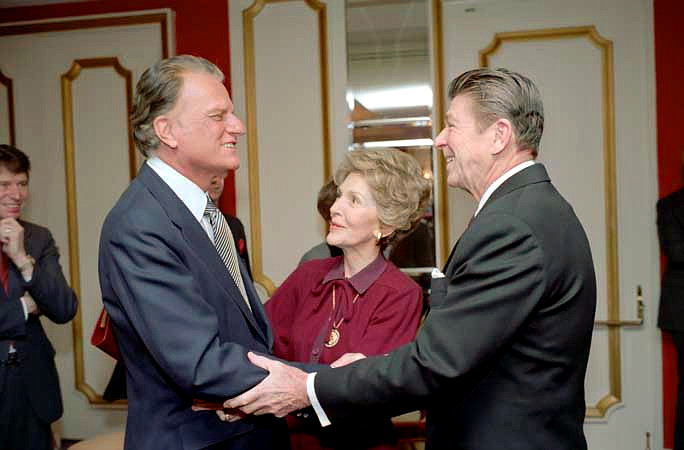
    Reagans_with_Billy_Graham.jpg

    There’s an online petition that’s gathered thousands of signatures in favor of doing just that. The petition currently has over 71,000 signatures and the numbers are surging.

    Billy Graham’s ministry and life revolved around pointing people to Jesus.

    It was a man telling the world about someone greater than he.

    So the idea of having a holiday named after Graham doesn’t honor his legacy. It goes against what he stood for. It’s too aggrandizing.

    From reading comments on change.org, many people talk about Graham’s impact (indisputable) and have this sense of Graham “deserving” this honor.

    If you want to honor Billy Graham and what he stood for, tell someone about Jesus.

    The petition says:

    Lets get a National Holiday for Billy Graham!! Mr. Graham preached the Gospel to more people in live audiences than anyone else in history—nearly 215 million people in more than 185 countries and territories—through various meetings, including Mission World and Global Mission. Hundreds of millions more have been reached through television, video, film, and webcasts. Mr. Graham’s counsel was sought by presidents, and his appeal in both the secular and religious arenas is evidenced by the wide range of groups that have honored him, including numerous honorary doctorates from many institutions in the U.S. and abroad. Help us with our cause of setting a national holiday to remember this great man.

    Undoubtedly, many non-Christians oppose this arguing “separation of church and state.” And to their point, I think it’s highly unlikely that this holiday would come to fruition.

    But even for Christians, we should not be concerned with lionizing mere men.

    Josh Benner is the associate pastor at Cornerstone Evangelical Free Church in Fergus Falls, Minnesota and has a Master of Divinity from Trinity Evangelical Divinity School. He enjoys writing about faith and culture. He lives with his wife Kari in Minnesota.


  • The science of timing and how to maximize your day

    41Z0sxEkUBL._SX329_BO1,204,203,200_

    I’m finishing up the new book “When: the scientific secrets of perfect timing” by Daniel H. Pink. Pink writes on management and behavioral science.
    Everyone knows that timing is everything. But we don’t know much about timing itself. Our lives are a never-ending stream of “when” decisions: when to start a business, schedule a class, get serious about a person. Yet we make those decisions based on intuition and guesswork.
    Timing, it’s often assumed, is an art. In When: The Scientific Secrets of Perfect Timing, Pink shows that timing is really a science.
    This book was helpful for me. Since getting married last year, I’ve spent a lot of time evaluating my schedule and how I utilize time.
    How do we maximize our time?
    We all have times of the day that are more optimal for us to get work done. From “When” and numerous other books I’ve read on the subject, it is essential for people who work in fields that take a lot of mental energy to allow their minds time to recharge.
    To some, that might seem lazy.
    But it’s really just human nature. We have a finite amount of physical and mental energy.
    Pink talks in the book about how it used to be a badge of honor for people who worked long hours and sacrificed sleep to work. But how, often times, the quality of the work struggles when people do that.
    We aren’t robots who can just devote endless hours to accomplishing tasks.
    What is more likely to happen is that our minds start to wander and drift and we have time that is spent pretending to work, or looking like we’re working but actually accomplishing very little. In reality, people spend a lot of time socializing, texting, playing on their phones, looking online.
    In one study (not mentioned in this book), 1,989 British office workers were found to spend just less than three hours a day actually working.
    This is a reality of what happens.
    So my interest is in maximizing efficiency in that.
    And that’s where I found “When” helpful, because part of what this book did was analyze the rhythms of the day. It’s important to structure the day where we are working on what’s important at our optimal times of productivity.
    Many (not all) adults are able to hit the ground running in the morning. As the morning goes on, closer to lunch time, that mental productivity can wane. In the middle of the afternoon, around 2:30, our productivity hits another low.
    For many people, we hit a rut approximately seven hours after waking up.
     And the peaks and valleys of the day have real consequences. Citing numerous studies, in the late morning and mid-afternoon lulls, there is a statistical increase in medical errors during surgery; people who are up for parole have a higher chance of being denied; test scores go down for students.
    So with this knowledge and applying it to life, it might be a waste of prime mental real estate to start the day off by doing a relatively mindless task like checking emails.
    The book also talks of the importance of rest. But not just any rest but productive rest. Pink argues that checking text messages on a break can actually be counterproductive. We do many things that aren’t productive but which also aren’t conducive to rest and recharging. And perhaps the lack of rest also perpetuates the problem of a lack of productivity.
    Work hard, play hard.
    I thought the book was well-written, well researched, practical. I’d recommend it.
    Josh Benner is the associate pastor at Cornerstone Evangelical Free Church in Fergus Falls, Minnesota and has a Master of Divinity from Trinity Evangelical Divinity School. He enjoys writing about faith and culture. He lives with his wife Kari in Minnesota.

     

  • 5 thoughts on being “all things to all people” in the Christian life

    earth

    Originally published April 11, 2016

    In 1 Corinthians 9:19-23, the Apostle Paul talks about being “all things to all people.” In the rest of the passage, he talks about different groups with whom he demonstrates this. While that passage is not an exhaustive guide to ministry, it provides significant insights into how to reach people for Jesus.

    Based on studying this passage, and thinking of this in the ministry context of the Bible, I have five reflections over the past few weeks on what it is to be “all things to all people.” (more…)

  • “Living Biblically” series an opportunity for conversations about faith

    get_tickets_to_living_biblically.jpg

    Last night, CBS premiered its new show “Living Biblically” about a man who’s life is suddenly thrown into a crisis when his best friend dies and his wife finds out she’s pregnant.

    Lead character Chip Curry (Jay R. Ferguson) evaluates his life.

    He had tried to throw himself into his work as a movie reviewer. Although his office shows off worldly decadence. A coworker is having an affair. Chip’s boss is cold hearted and only cares about the bottom line.

    Chip goes to a bookstore in an attempt to find a self help book, but ends up coming across a Bible. “Do you believe in signs?” Chip asks the bookstore’s clerk.

    As a sort of project, Chip decides to entirely throw himself into living Biblically for the next nine months (premise based on the book “the year of living Biblically” by A.J. Jacobs).

    Chip’s wife who’s a physician and who has a focus on science is skeptical of the role of faith. But she tries to be supportive of her husband.

    Chip talks to a priest (and later a Rabbi) and seeks out their counsel as he tries to live Biblically.

    The pilot had a couple of humorous moments, but I also find comedies hard to judge based on their first episode.

    Some Christians will absolutely dislike this show. For instance, because of situations like a coworker having an affair (spoiler alert: after Chip throws a rock at the coworker, he evaluates his decisions and comes clean to his wife and later thanks Chip). But there will be people who find some of the subject matter crass. But those situations are also necessary in a series that revolves around a character trying to living Biblically in a culture where that’s countercultural.

    Executive producer Johnny Galecki (of Big Bang Theory and Roseanne fame) said that he wanted to do a comedy about religion. Galecki cites his own Catholic upbringing and has talked in interviews of how many who are involved with the production of the show are devout in their beliefs.

    In an interview with the Television Critics Associated Winter Press Tour, Galecki said, ““I think, hopefully, [people of faith] will find this show a cool take on what a lot of people base their entire lives around.”

    From other interviews Galecki has done, it seems that one of his goals is for people to be able to have honest conversations about religion. The show hasn’t set out to mock religion.

    Although it is a show about faith, it’s a man exploring faith. I don’t necessarily consider it to be a family show, but it’s a relevant show in that many are on spiritual journeys in society. The show is more of a cultural commentary. The vast majority of Americans believe in God. And through various situations of life, many face times where they truly begin to more seriously seek God out.

    As we see in the show, there are different sources of truth that people try to pursue. There are many sources of purpose to which people look.

    And then there’s Chip, who has thrown himself into Godly living. So many in our society are lukewarm to faith and seem to believe in a God who affirms whatever they want to do. Chip, on the other hand, is trying to truly live a Godly life. In that, there are times when he doesn’t understand but he follows.

    There are situations where he faces conflict about knowing what is Biblical but facing challenges to his newfound values. We see this when Chip and his wife run into the coworker who’s on a date and where Chip is conflicted about telling the truth vs playing along with his friend’s lie in order to avoid an uncomfortable situation).

    By the end of the episode, even secular characters are noticing positive aspects to the changes in Chip’s life (one says he might even need to start).

    What the show is trying to do is very difficult. Have a comedy about religion that appeals to a large audience. But for many in America, regardless of beliefs, I think that this show can achieve one of Galecki’s goals about being a thought provoking look into religious life in America.

    Josh Benner is the associate pastor at Cornerstone Evangelical Free Church in Fergus Falls, Minnesota and has a Master of Divinity from Trinity Evangelical Divinity School. He enjoys writing about faith and culture. He lives with his wife Kari in Minnesota.

  • Your church is not a restaurant: the mentality of consumerism and its danger to the American church

    pexels-photo-375889.jpeg

    In America, where we have so many options with everything, every business with which we interact lives and dies on our satisfaction.

    And we often treat churches in much the same way. Like it’s just another business that we’re patronizing. Where if you’re not happy with a church, if you decide you don’t like something about a church, it’s become so easy just to uproot and go to the next church.

    It’s coming from a consumeristic mindset where we want the experience to revolve around us. (more…)