
Jesus is at the last supper with his disciples. In this passage, we learn that it’s Judas who will betray Jesus but – with the exception of John – the rest of the disciples are oblivious.
Author: the Josh Benner Blog
-

Grace vs Legalism. Studying John 5:10-14
A conflict between grace and legalism
In John chapter 5, Jesus heals a man who had never walked. It’s a miraculous sign which points to the power of Jesus. But we see him confronted by the Pharisees, who were experts in the Law of the Old Testament involving the fact that he had healed the man on the Sabbath.
The religious figures will disapproved of the timing of this miracle. As soon as this healed man picks up his bed, religious figures are ready to swoop in and bring judgment on him for violating the Sabbath.
John 5:10:
10 So the Jews said to the man who had been healed, “It is the Sabbath, and it is not lawful for you to take up your bed.”
Legalism without grace
The Pharisees are more concerned for their man made laws and judging this man for breaking the Sabbath.
In his commentary on John, Richard Phillips argues that an inevitable result of legalistic religion is that it treats people without compassion.
They’re not rejoicing in this miracle, they’re not glorifying God for this man who can now walk.
All they care about is that he has broken the law, in their eyes.
Legalism vs License
The Law of the Old Testament is good.
But men adding laws onto God’s law is not good. And it’s worse when we expect people to live based on extra-Biblical rules.
I’m not undermining things that the Bible commands. For someone who’s a professing Christian, expecting, encouraging, and exhorting them to live based on Biblical principles and values is not legalism.
But whether or not carrying a mattress on the Sabbath counted as work is another matter entirely.
In trying so hard to defend the Bible, they had taken themselves away from the Bible. In trying so hard to compel obedience to the Law, they had lost sight of the Spirit of the Law.
During his earthly ministry, Jesus is involved with several controversies regarding his various healings and activities on the Sabbath. In Mark 2:27, Jesus says: The Sabbath was made for man, not man for the Sabbath.
And the point was that God had given us the Sabbath as a blessing and a way to have one day in seven that was totally devoted to him and that was set apart and scared.
It’s easy to make rules. It’s easy to give people lists of things to do and not do. And you can follow all of the extra rules to the Sabbath and yet have no love for God.
During the ministry of Jesus, he will confront the Pharisees, the people who were experts in the Law but yet missed the true heart and purpose of the scriptures concerning what they’re truly about and what they point to, namely, Jesus.
In the prophets, Israel’s failure to keep the Sabbath was a source of divine judgment. They responded by going too far the other way in thinking that their justification was in observance to that and to their obedience to the rest of the law.
But to again remind us of the passage in Isaiah 1:13, God does not desire vain offerings. Just because you’re following the rules outwardly, but you’re cold and distant to God inwardly means nothing.
That is the great mistake of legalism.
And they lost sight of the greater commands of the Bible, loving God and loving people, and when the Lord healed this man, they could not appreciate that.
So you have the Pharisees and the man who has just been healed.
Verse 11, the man responds.
11 But he answered them, “The man who healed me, that man said to me, ‘Take up your bed, and walk.’ ”
He simply refers to Jesus as “the man who healed me.”
He also deflects attention from himself to Jesus. This can be interpreted as if this man is actually blaming Jesus for a supposed violation of the Sabbath since it was Jesus who told him to pick up his bed.
Either way, the Pharisees are quick to take their attention off of this man. They’re blind to the miraculousness of what Jesus has just done.
Verses 12-13:
12 They asked him, “Who is the man who said to you, ‘Take up your bed and walk’?”
13 Now the man who had been healed did not know who it was, for Jesus had withdrawn, as there was a crowd in the place.
Jesus has already disappeared into the crowd.
Verse 14 again moves the story forward:
14 Afterward Jesus found him in the temple and said to him, “See, you are well! Sin no more, that nothing worse may happen to you.”
Verse 14 is very interesting.
Sin no more that nothing worse may happen to you?
Is it saying that this man’s previous handicap was the result of his sin? It’s possible, but not necessarily what the text is saying.
In John 9, it’s the story of Jesus healing a man who had been born blind – one thing we learn from that passage is that not all of our suffering is directly related to a sin that we specifically committed.
That sometimes happens. We see that in the Book of Acts where Ananias and Sapphira are judged and struck dead.
And certainly we are all sinful and live in a fallen and sinful world.
But in establishing a theology of suffering, we mustn’t think that all human suffering is directly a punitive response to a sin that a person committed and that had a person not committed that sin, they would therefor never have suffered.
Suffering is part of life for all people. So what does Jesus mean then?
Sin no more that nothing worse may happen to you?
Is he saying if the man commits one more sin, something worse will happen?
I don’t believe so.
Consider for a moment a few other verses from this gospel.
18 Whoever believes in him is not condemned, but whoever does not believe is condemned already, because he has not believed in the name of the only Son of God
John 8:23-24, Jesus is again talking to Pharisees:
“You are from below; I am from above. You are of this world; I am not of this world. 24 I told you that you would die in your sins, for unless you believe that I am he you will die in your sins.”
unless you believe that I am he you will die in your sins
Jesus is talking about people having faith in who he is and the eternal consequences for rejecting him.
So I return again to our passage.
Sin no more, that nothing worse may happen to you.”
What’s the worst sin we can commit?
Not believing and trusting in Jesus as the Son of God.
And where he talks of sinning no more so that nothing worse may happen, he’s talking about something far worse than being paraylyzed for 38 years. He’s talking about spending all of eternity facing the wrath and judgment of God for not believing.
This passage tells us about superstitions. People going to the pool in Jerusalem in the hopes that the waters would heal them. Superstitious practices are not our hope.
This passage tells us about legalism. The pharisees added rules on top of rules. Following rules is not our hope.
Our hope is in following Jesus who calls us to sin no more. Yes, Jesus wants us to live lives of holiness and devotion to him. But more than anything else, we are called to trust God and live by faith and live as a result of that faith.
Thanks for reading! If you liked this post, please share and subscribe.
-

The Tower of Babel. Studying Genesis 11
Now the whole earth had one language and the same words. 2 And as people migrated from the east, they found a plain in the land of Shinar and settled there. 3 And they said to one another, “Come, let us make bricks, and burn them thoroughly.” And they had brick for stone, and bitumen for mortar. 4 Then they said, “Come, let us build ourselves a city and a tower with its top in the heavens, and let us make a name for ourselves, lest we be dispersed over the face of the whole earth.” 5 And the Lord came down to see the city and the tower, which the children of man had built. 6 And the Lord said, “Behold, they are one people, and they have all one language, and this is only the beginning of what they will do. And nothing that they propose to do will now be impossible for them. 7 Come, let us go down and there confuse their language, so that they may not understand one another’s speech.” 8 So the Lord dispersed them from there over the face of all the earth, and they left off building the city. 9 Therefore its name was called Babel, because there the Lord confused the language of all the earth. And from there the Lord dispersed them over the face of all the earth.
-Genesis 11:1-9
It’s amazing how alike we are from one generation to another. In Genesis 11, people attempt to build a tower to reach the heavens so that they can make a name for themselves.
The flood has just happened, and we so quickly see that humanity has not learned its lesson in the Tower of Babel incident.
In ancient times, Pharaoh’s built monuments to themselves in the pyramids. In modern times, if someone is wealthy enough, they’ll have a campus name a building or a scholarship after themselves. Most of us don’t have the money to pay for such monuments, but there are lots of other ways we try to make our own names great. Some do it through bragging. I’ve known people who seemed pathologically incapable of doing a good deed and not telling others what they did. Social media is perhaps the greatest tool for self-aggrandizement ever invented. We can curate a specific image of ourselves and our lives.
In our sin, humanity attempts to build our own structures to get to God. The good news of the gospel is that we have a savior who has come from heaven to us.
This is the third major act of sin we’ve seen to this point in the Book of Genesis. Certainly, there is the fall of Adam and Eve in the garden in Genesis 3. The response to that is God’s promise of a coming offspring from the woman.
15 I will put enmity between you and the woman,
and between your offspring and her offspring;
he shall bruise your head,
and you shall bruise his heel.”
-Genesis 3:15
The second major act of sin is the sinful world which led to God’s divine judgment through bringing about the flood. God’s gracious response was saving Noah, his family, and the animals; but it was also the covenant which the Lord made with Noah.
The Tower of Babel is humanity’s third major act of sin. Once again, we see both judgment and grace. The judgment is the destruction of the tower and the confusion of the languages. We see the grace through a man who will be introduced at the end of this chapter.
26 When Terah had lived 70 years, he fathered Abram, Nahor, and Haran.
27 Now these are the generations of Terah. Terah fathered Abram, Nahor, and Haran; and Haran fathered Lot. 28 Haran died in the presence of his father Terah in the land of his kindred, in Ur of the Chaldeans. 29 And Abram and Nahor took wives. The name of Abram’s wife was Sarai, and the name of Nahor’s wife, Milcah, the daughter of Haran the father of Milcah and Iscah. 30 Now Sarai was barren; she had no child.
31 Terah took Abram his son and Lot the son of Haran, his grandson, and Sarai his daughter-in-law, his son Abram’s wife, and they went forth together from Ur of the Chaldeans to go into the land of Canaan, but when they came to Haran, they settled there. 32 The days of Terah were 205 years, and Terah died in Haran.
-Genesis 11:26-32
Man continued to sin, even after receiving grace, and so the Lord would call Abram and make a new covenant with Abram that would be administered through faith.
Thanks for reading! If you liked this post, please share and subscribe.
-
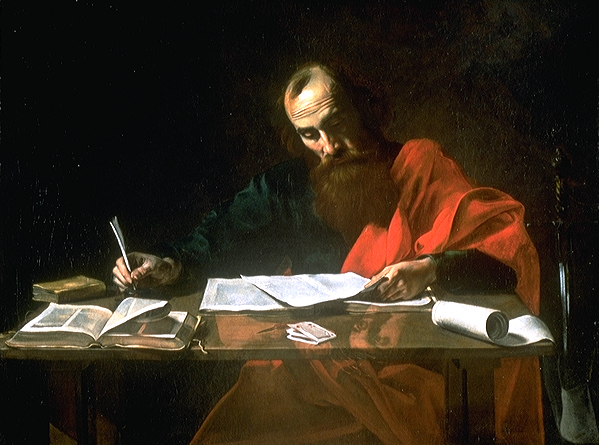
Who is Paul? And why it matters. Studying Galatians 1:1
The defense of the gospel
I begin this post by asking you to consider two questions.
First question: who is Jesus?
Second question: who is Paul?
That’s the most important question that anyone can answer. Is he a good teacher? Is he a good philosopher? Is he a good idea? Is he a good role model? Is he a good man? Or is he the Lord who died for your sins? And the Son of God? And the king of kings?
But who is Paul?
While not as important to know Paul as it is to know Jesus, how you view Paul matters, and here’s why. Because how you understand Paul actually points to how you will understand Jesus.
A history of Pauline heresy
When Paul wrote his letter to the Galatians, we don’t know every single detail of background information but one thing seems pretty clear.
There were people undermining Paul to the churches in Galatia.
Who is Paul?
He is an Apostle of Jesus Christ.
Apostles were people who had personally seen the risen Lord in the early church and who were commissioned to lead the church.
1 Corinthians 12 lists offices in the early church::
God has appointed in the church first apostles, second prophets, third teachers, then miracles, then gifts of healing, helping, administrating, and various kinds of tongues.
The apostles are listed first in that list for a reason. They were the authority.
We also see this in Ephesians 4:11-12:
he gave the apostles, the prophets, the evangelists, the shepherds and teachers, 12 to equip the saints for the work of ministry, for building up the body of Christ
In the Book of Acts, after the ascension of the risen Jesus, and with Judas out of the picture, the first thing the apostles do is appoint another apostle: Matthias.
The Apostle Stephen dies in Acts 7 and we see Paul later become an apostle. After that, we never see apostles being replaced. And again, as people who had witnessed the risen Jesus, and given the unique role of the apostles in the early church, I would argue that the office of Apostle died out in the age of the original apostles.
So as I said a moment ago, there were people who were undermining Paul and his apostolic authority.
People still do that to Paul.
Many liberal Christians undermine Paul’s writings as just his opinion and not scripture and therefore not authoritative.
Paul was one Christian giving his views on the scriptures and that’s no more inherently significant than any other Christian.
But that’s why the answer to my second question matters so much. Who is Paul?
Is he just some guy who has some thoughts about Jesus? Or is he a man who personally saw the risen Lord Jesus and was personally called by Jesus to be an apostle?
Two radically different views of who Paul is.
What you think about Paul matters to what you think about the rest of the New Testament.
So again, I ask you: who is he?
I believe that he’s called to be an apostle and that this was affirmed by the confirmation of the other apostles, by the history of the church, by the fact that the early church viewed his writings to have had apostolic authority, by the account of him having been a witness to the risen Jesus and the radical conversion he had from a persecutor of the church to a man who became a martyr for the church, and because of the signs and wonders the Lord enabled him to perform during his ministry.
And I think that’ll hopefully give some more background and meaning to these first verse of chapter 1.
Paul, an apostle—not from men nor through man, but through Jesus Christ and God the Father, who raised him from the dead—
Paul wrote 13 letters in the New Testament. All of them begin with his first name. That was a standard letter writing practice at the time. In these ancient letters, you would start by naming the sender. It’s the first thing the reader sees.
As I’ve already discussed, Paul will affirm his apostolic authority. In nine of his 13 letters, Paul mentions his apostolic office in his opening.
But there are a couple of unique things about Galatians.
First, Paul doesn’t defend his apostolic authority in his other letters as fervently as in Galatians. He usually takes it as a given that the readers will accept that fact.
In Galatians, he says he’s an apostle: not from men nor through man, but through Jesus Christ and God the Father, who raised him from the dead
Paul is an apostle because of a divine calling. It’s not because he says so, it’s not ultimately because the other apostles say so.
In the second half of chapter 1, Paul will again give an extended version of his early actions after coming to faith and a long defense of his apostolic ministry. There is no section in Paul’s letters where he goes into such great detail to explain why he is authentically an apostle.
And here’s why it matters so much in this letter.
When people are downplaying Paul’s authority, his writing, his teaching, then it makes it easy to also downplay his message.
Paul talks so much about being an apostle, not because he’s insecure.
Paul isn’t being vain.
It matters that they know, and that we know he’s an apostle of Jesus Christ because Paul has the message of the truth about Jesus Christ, that he is the Lord who has died for us and that God reconciles sinful people to Jesus because of Christ and Christ alone.
And so Paul so fervently defends his apostolic authority because he needs to defend the gospel itself.
And he will be pointing to the gospel even from this first verse. not from men nor through man, but through Jesus Christ and God the Father, who raised him from the dead—
Jesus has been raised from the dead and he has led to a paradigm shift in human history and in salvation history. Everything changes because of the cross and because we have a risen Lord.
And Paul will point to that gospel. Because that’s what this letter is truly about.
In verse 2, Paul says:
2 and all the brothers who are with me,
To the churches of Galatia:
All the brothers.
Paul includes his associates in the opening salutation. We don’t know exactly who was with him when he wrote Galatians. But notice that he does not call them apostles. He calls them brothers, while Paul is an apostle.
And then he addresses his letter to the churches in Galatia. As we’ve discussed the last couple of weeks, this was the region to which Paul had traveled during his first missionary journey. He shared the gospel, many people came to faith, but there were also very many who were hostile to the gospel. In writing to the Galatians, there were people who sought to dilute or distort the true gospel and so Paul writes as a defense of the gospel.
Thanks for reading! If you liked this post, please share and subscribe.
-

Evangelism Training Podcast interview: Thad Bergmeier
The newest episode of the Evangelism Training Podcast is now available. In this month’s episode, Josh talks to Thad Bergmeier. Thad visited us in February and helped with the MyCircle evangelism training. In this episode, we revisit the subject of evangelism training and talk about some of the challenges with evangelism as well as the successes we can celebrate.

