Josh Benner

Category: Atheism

  • Young Sheldon episode tackles struggles in faith

    Young_Sheldon_title_card.png

    While it’s a comedy about a boy-genius, CBS’s “Young Sheldon” took up some heavy theological topics in last weeks episodes titled “A crisis of faith and octopus aliens.”

    The show is a spin off of the Big Bang Theory where Iian Armitage plays Big Bang Theory character Sheldon Cooper as a child. It’s a comedy featuring this boy who’s incredibly brilliant in a family that’s pretty ordinary. His mother Mary (played by Zoe Perry) is an Evangelical Christian.

    In this episode,  a family friend passes away and Mary’s character is thrown into a Spiritual crisis.

    Her pastor tries to help by saying what works for him (serving others). Serving others is great. Serving others is healthy and it can be helpful to some people in a time of depression, because it shifts your focus onto others and their needs. In the episode, Mary attempts to throw her into service, church activity, Bible studies, plants a new garden. Yet she still can’t get over her sadness.

    She turns to drinking and withdrawing from faith, stops saying grace and doesn’t go to church one weekend. Sheldon notices the changes in her behavior and reaches out in his concern.

    “Faith means believing in something you can’t know for sure is real, and right now I am struggling with that,” Mary says.

    Sheldon doesn’t believe in God, but throws in an apologetic for his struggling mother:

    “Did you know that if gravity was slightly more powerful the universe would collapse into a ball? Also if gravity was slightly less powerful the universe would fly apart and there’s be no star or planets,”

    “Gravity is precisely as strong as it needs to be and if the ratio of the electromagnetic force to the strong force wasn’t one percent, life wouldn’t exist, what are the odds that would happen all by itself?”

    -Young Sheldon

    When his mom question points out that Sheldon doesn’t even believe in God, he says he doesn’t, “but the precision of the universe at least makes it logical to conclude there’s a creator.”

    I really thought it was a great episode. I appreciate how it dealt with the subject of a person hitting a Spiritual wall. Because a significant part of Mary’s character both on Young Sheldon (and the same character on Big Bang Theory) is that she’s an Evangelical Christian. I didn’t think the episode was making fun of faith, rather I thought it was a sincere look into real struggles.

    The road of faith is not without its twists and turns, not without its bumps. It’s not without construction and slow downs.

    The temptation can be to want to make ourselves busy. That’s what Mary’s character initially does. But in the face of tragedy, in a world where people sin and where death is a result of that sin and where death is a consequence of the fallen world that all will face, to take that to God, and to lament the death that is in the world. It was not the original creation for the world, and it goes against our natural inclinations. Lament is a common practice in the Bible. It’s a practice that I think the modern American church (especially WASPs often overlook).

    Lament is an expression of grief and sorrow. Lament is based in the reality of who God is. Lament is based in a high view of the goodness of God in a fallen world.

    I think it’s important to be humble and to recognize that God is God and we are not. That God is sovereign.

    I think it’s important for Christians to remember the promises of God. And to remember them for what they are, not as caricatures or distortions. God doesn’t promise that life will be without pain (he promises the opposite). God doesn’t promise life will be without loss (he promises the opposite). God doesn’t promise that we’ll always be happy with our situations, or that things should be easy, or that we’ll be free of suffering. He promises the opposite.

    Sometimes our major misgivings with God come from a faulty understanding of who God is or what he has promised. Life is hard. The Bible doesn’t hide from that reality. Some churches can create this pressure that everything should always be ok, or that if you have enough faith, you should always be happy. Those aren’t Biblical views.

    The promises that God does make are that those who mourn can be blessed, for they shall be comforted (Matthew 5:4). That everyone who calls upon the name of the Lord shall be saved (Romans 10:13). That nothing can separate us from the Lord of God (Romans 8:38). That there is grace and redemption for sin and that God has given us every Spiritual blessing (Ephesians 1:3). That God hears the prayers of his people (1 Peter 3:12). And so many more promises the Bible makes.

    Sadly, many people turn away in times of despair.

    Where is your hope?

    People put hope in a lot of different things. For some, they put hope not in God but in the Church. The Church is great, but that is not our hope. For some, people put their hope in their efforts, their pursuits, their activities. That too will inevitably fail you. Our hope must be in the good, loving, and eternal God of the universe.

    Spiritual depression is common in the Christian life. Some of the greatest leaders in the history of the Church struggled with it. Because, as Mary said in the show, faith is believing in something you can’t know for sure. And when that is coupled with our sin, with our unfulfilled hopes, and with the sin that is in the world, sometimes there are struggles. There can hopefully be solace in knowing that. You’re not alone.

    And while we change, God is unchanging. And God continues to invite us into life through his son Jesus.

    Thanks for reading! I’d love to hear what you think, and don’t forget to subscribe! 

    Josh Benner is the associate pastor at Cornerstone Evangelical Free Church in Fergus Falls, Minnesota and has a Master of Divinity from Trinity Evangelical Divinity School. He enjoys writing about faith and culture. He lives with his wife Kari in Minnesota.

    Let’s connect!
    Facebook
    Twitter
    Instagram

  • Would it be better if parents raised their kids without religion?

    photo-1499051702423-a69ae318af8f.jpeg
    A friend recently asked me this question. As a Christian, there are several reasons why I believe the answer is no.

    This reminded me of an article I read a couple years ago by former NFL running back Arian Foster. In an article he wrote for Yahoo, Foster was talking about his parenting philosophy. When it came to faith, he said:

    The flying spaghetti monster. There are billions of people on Earth with hundreds of religions and sects that trickle off each other. I will never tell her what to believe in. I know parents are very influential on kids’ spiritual beliefs and that can be a positive or negative thing. I can give her a basic understanding of religions when she starts showing interest and asking questions. But I will remain silent otherwise. How can I make a young mind believe this is the truth for them when they don’t yet have the capacity nor the cognitive desire to delve into something like this? If she shows interest I would advise her to fully investigate a religion and see if it fits her. And if she chooses none of the above, I’ll be fine with that as well. The values I instill in her should guide her to her decision. What’s most important, I believe, is to support her decision no matter what.

    Foster argues that he doesn’t want to push religious beliefs saying “I will never tell her what to believe in” and “I can give her a basic understanding of religions…but I will remain silent otherwise.”

    To raise a child without faith can be framed as “not telling them what to believe in.” However that’s clearly affirming and privileging a secular worldview. It’s raising someone with a default setting of irreligion.

    Foster says that he’s fine if she eventually chooses faith (I don’t doubt his sincerity in that). But he argues that what matters more than raising someone according to a faith tradition is raising them with a certain set of values. That was similar to my friends question. Instead of raising someone according to religion, why not just raise them to be good/benevolent?

    The gospel is predicated on the idea that a person can’t be good on their own. And faith in Jesus Christ is essential to the salvation of a person’s soul. For a Christian, that is part of why a hands off approach to faith does not harmonize with parenting. Any loving, Christian parent should raise their children in the knowledge and fear of the Lord. This isn’t unique to Christianity. It’s true of the major faith systems. There is no faith tradition (that I’m aware of) that says “Hey, raise your kids outside of this faith and see what they believe.”

    I understand why someone who’s not religious would have such a view that undermines the role of faith in a person’s life. Christian faith is meant to be a parent’s source of meaning, morality. It’s meant to shape your life, your family, and your parenting. The idea of not passing that tradition onto one’s kids is fundamentally inconsistent.

    Furthermore, the Bible constantly commands parents to raise their children to know the Lord. In the Old Testament, the Israelites failed to do this which was the source of a lot of their struggles.

    The Book of Deuteronomy commands:

    6 And these words that I command you today shall be on your heart. 7 You shall teach them diligently to your children, and shall talk of them when you sit in your house, and when you walk by the way, and when you lie down, and when you rise.

    -Deuteronomy 6:6-7

    For Christian parents, it’s not meant to be an option. Ultimately no one can control what someone believes. But a kid needs to be given every chance to hear the gospel. It is faith in the gospel by which souls are saved. Also the flavor of the month in our society today is about letting kids dictate everything (faith, gender, etc). But they have to be raised with a foundation.

    There’s also covenantal theology but I’ll save that for another post.

    Josh Benner is the associate pastor at Cornerstone Evangelical Free Church in Fergus Falls, Minnesota and has a Master of Divinity from Trinity Evangelical Divinity School. He enjoys writing about faith and culture. He lives with his wife Kari in Minnesota.

    Connect with me!
    Facebook
    Twitter
    Instagram

  • What do you do with an empty tomb?

    Photo Courtesy of Flickr Creative Commons
    Photo Courtesy of Flickr Creative Commons

    What do you do with an empty tomb?

    On Friday, a man had been put in there. On Sunday, it was empty. Why?

    Was it that he had merely been badly wounded but didn’t die? Was it that his body had been removed by his followers?

    The tomb was empty or it wasn’t. If it wasn’t empty or if Jesus didn’t raise from the dead, than Christianity is pointless. But if that tomb was empty, then the gospel is true and that reality is more important than anything else in your life.

    What do you do with this reality if it’s true? Do you just put it off to the side? Do you say that you accept it without actually believing it or caring?

    If Jesus Christ rose from the dead on Easter morning, and you actually believed it to be true, how would that impact how you lived?

    It shows that God loves us enough to take the penalty for our sin. It shows that our sins were bad enough to warrant such a serious penalty. It affirms the truth of the scripture which foretells and points to Jesus, while recording his teachings, ministry, death, and resurrection. It shows that Jesus is more than just a good moral teacher. It gives purpose to our lives, and that purpose is to know this God. It gives us hope for the future because Jesus died and rose and the same power that raised him can raise you.

    It’s easy to believe that Jesus lived, but there’s no reason to worship him if he didn’t raise from the dead. What hope do we have in our own resurrection otherwise?

    What do YOU do with the empty tomb? You can disregard the issue if the you don’t believe he rose. But if you don’t know, it’s a question worth exploring. Not at some distant point in the future, but right now. Because if you don’t know, maybe you’ll discover you believe it’s true. If you do believe it, is it impacting your life?

    jrb

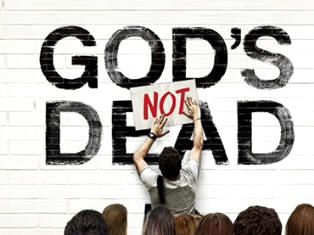
  • God’s Not Dead: film attaches absurd stereotypes to non-Christians and philosophy professors

    movie

    I had heard reviews that the movie “God’s Not Dead” was bad (like really bad). For the first 90 minutes, seeing some of the absurd elements of the plot, I was torn between blurting out “Oh come on!” or laughing because it was so bad. I think having a movie about doubt and Christians confronting atheists could have been done well. But there was no depth to the characters. The Christians were unrealistically pious. In showing the lives of the secular characters, they were too heavy-handed in contrasting how messed up they were to how the Christian characters were depicted. (more…)

  • Debate over origins: Nye vs Ham

    nye
    Ken Ham who’s a Christian young earth creation apologist, the founder of the Creation Museum, and Answers in Genesis website debated famed science educator and television personality, Bill Nye at the Creation Museum tonight. The topic was: Is creation a viable model of origins in today’s modern, scientific era?

    To be fair, I’m not a scientist. I’m not going to pretend to be an expert. Some of the hot button issues against young earth creationism pertain to the age of the earth, the flood, and evolution. I do consider myself to be an intelligent person and I am a conservative, evangelical Christian who does believe that the Bible is the divinely inspired word of God. I disagree with the idea of the earth being thousands of years old, and favor the belief that it is hundreds of millions or billions of years old. (more…)