Josh Benner

Category: Christian living

  • Jesus and the Last Supper. More than just a meal.

    photo-1520629716099-d147346eb224.jpeg

    Originally published April 13, 2017

    As part of Holy Week, Maundy Thursday is recognized this evening. It was the night in which Jesus ate the Last Supper with his disciples. The time in which Jesus died corresponded with the Jewish holiday of Passover. And the Last Supper was the first night of Passover. An annual dinner for Passover is held, called a Seder, which is the Hebrew word for “order.” In 3,500 years, rabbinical tradition and teaching helped to form the ceremony of the Seder.

    Some of these pieces were traced back to the original Passover. Others came in Jewish history from rabbinical traditions.

    Also, once the Israelites were in the land, and after the temple was built, this impacted Passover traditions. When you had the temple, the lambs were sacrificed at the temple. But what didn’t change was that people could only sacrifice lambs that were perfect.

    I think it’s worth spending so much time in talking about Passover because I think it can help give us a greater context and understanding for the events surrounding the death of Jesus.

    In the gospels, the time of the death of Christ revolves around the Passover. That’s not a coincidence! Jesus would be sacrificed at the time that was associated with sacrifice. Jesus had gone to Jerusalem for Passover. In Jerusalem, the city within the Roman Empire that was the epicenter of Jewish culture, thousands of lambs would have been slaughtered annually. Jewish people would have been coming in from all over the empire.

    We see many traditions of the Seder at the last Supper.

    Some of them are small things. In the gospel accounts, it talks about Jesus reclining at the table (Luke 22:14).

    Jesus wasn’t sitting in a la-z-boy. He was on a couch that he was lying on, that was a Seder tradition. They had been enslaved in Egypt but being able to lie down showed the freedom and security.

    Or when Jesus is alluding to his betrayer, he says in John 13:26, “It is he to whom I will give this morsel of bread when I have dipped it.” So when he had dipped the morsel, he gave it to Judas, the son of Simon Iscariot.

    Again, I know the mental image that most of you probably have when you read this. It’s hard to know precisely where in the Seder this is, but it seems that it’s probably referring to when you take Haroset which is made from apple, nuts, cinnamon. They weren’t eating the Last Supper at an Italian restaurant. They didn’t have a bowl of olive oil in the middle of the table. But all of the elements we see at the Last Supper are part of what you’d see in a traditional Seder.

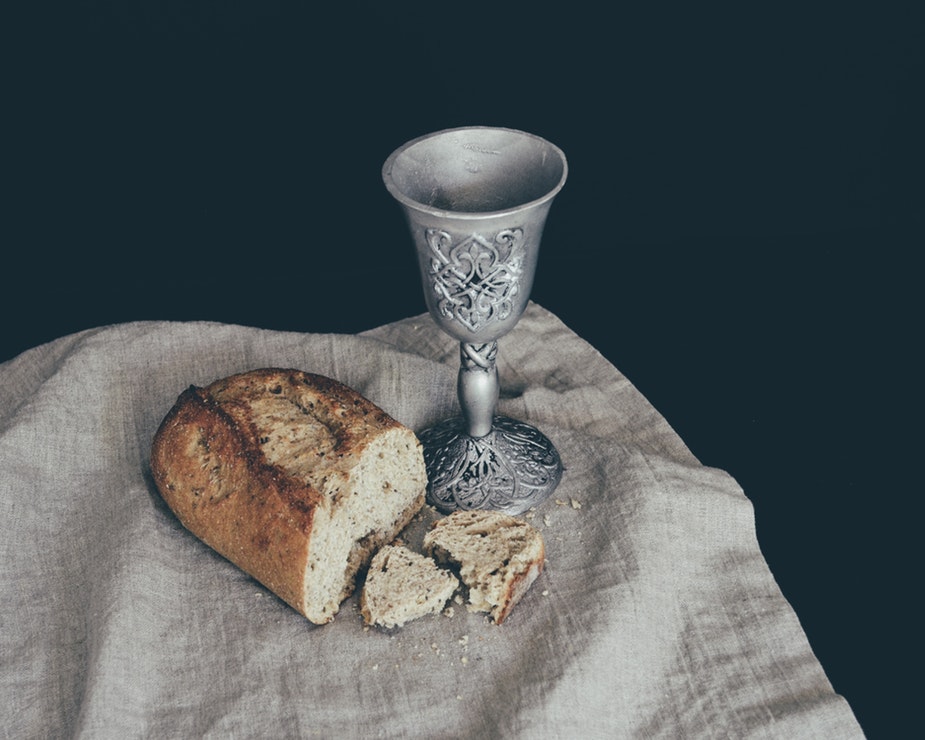
    As part of the Seder, you’d take the unleavened bread…looks like a cracker. And you’d break the bread.

    Luke 22:19, “And he took bread, and when he had given thanks, he broke it and gave it to them, saying, “This is my body, which is given for you. Do this in remembrance of me.”

    For over a thousand years of Seder dinners, bread had been broken. Unleavened bread, just like the Israelite forefathers had eaten before fleeing from Egypt.

    The body of Jesus, given for you, given for your sins. Given for your forgiveness. And he says “do this in remembrance of me.”

    What more fitting words could you say at a Seder? A meal revolving around remembrance, about retelling the story of God saving his people by the blood of the lamb.

    Remembering what God has done. Remembering what Jesus has done. Remembering the sins that he’s redeemed you from. Remembering his body that he gave for you. Remembering his death that he died for you. Remembering the grace that he offers to you. Remembering his gospel.

    Luke 22:20 says, “And likewise the cup after they had eaten, saying, “This cup that is poured out for you is the new covenant in my blood.”

    The Seder dinner involves four glasses of wine. This seems to have been the second or third glass of wine in the meal, although there’s scholarly debate.

    But how profound it is. Wine drank in remembrance of the Passover. Jesus takes the wine, he blesses it, he says it is the new covenant in his blood, at the Seder dinner.

    It clearly points backwards to the blood of the Passover lamb, the blood that was put on the door posts. And it also points forward to the blood of Christ, shed for the forgiveness of sins. The blood of the true lamb.

    At the beginning of the gospel of John, when John the Baptist sees Jesus he says “Behold, the lamb of God who takes away the sin of the world.” Jesus is the true lamb of God. The lamb who took the penalty for sins. The one who was scarified for the salvation of God’s people.

    And by trusting in him and having faith in him, that puts the blood on the doorpost of your heart. On the first Passover, there would not have been a pardon for a person who didn’t put blood on the doorpost. It wasn’t that the blood saved them, God saved them. But to not put the blood on the door was to show that a person didn’t have faith in the Lord, didn’t trust in the Lord.

    When we take the Lord’s Supper, it’s not arbitrary. It’s not just using the random items that were around. It’s all symbolic. It takes symbols important to the first Passover, the first time God had delivered Israel, and it reminds of the new Passover, from the perfect sacrifice for sins.

    The Passover passage in Exodus 12:5 says that the lamb that was used had to be without blemish. Jesus is the ultimate lamb without blemish, a life lived in perfection.

    1 Corinthians 5:7 says “Cleanse out the old leaven that you may be a new lump, as you really are unleavened. For Christ, our Passover Lamb.”

    Thanks for reading! I’d love to hear what you think, and don’t forget to subscribe! 

    Josh Benner  has a Master of Divinity from Trinity Evangelical Divinity School. He has served churches in Minnesota and Illinois. He enjoys writing about faith and culture. He lives with his wife Kari in St. Louis.


  • Notre Dame, the Church, and the beauty of things that are bigger than ourselves

    photo-1554564820-b8993b6bc860
    Since the fire at Notre Dame on Monday, I’ve been awestruck by the thoughts of the longevity of that building. If you had asked me “when was Notre Dame built?” three days ago, I probably would have guessed 16th or 17th century. I knew it was old. I would have guessed it was older than America. I would not have guessed that the construction began in 1163 (around the time Genghis Khan was born). (more…)

  • Joaquin Phoenix changes Bible story while playing Jesus

    800px-Joaquin_Phoenix_at_the_2018_Berlin_Film_Festival
    Photo courtesy of Wikimedia Commons.

    Actor Joaquin Phoenix plays Jesus in a new movie revolving around the life of Mary Magdalene. In the movie, Phoenix took liberty with one of the miracles of Jesus.

    In John 9, Jesus heals a man who had been born blind. In John 9:6, the process by which Jesus heals the man is described as follows: “he spit on the ground and made mud with the saliva. Then he anointed the man’s eyes with the mud.” (more…)

  • Couldn’t God just forgive us? Why was the cross necessary?

    photo-1414018895695-96fe3f0d0765.jpeg

    A person might look at the crucifixion, look at what the Lord did on the cross, and wonder “Why was that the only way? Why was that necessary? Couldn’t God simply forgive us?”
    No.
    This is an idea I’ve heard from Tim Keller before, and it’s an important idea on having a theology of forgiveness.

    (more…)

  • The positive and encouraging message isn’t always the message we need

    It’s interesting to me to consider the popular Christian music. It’s almost always easy listening.

    I was looking at some of the slogans for popular Christian radio stations.

    Perhaps the biggest in America, K-Love, which plays on 440 stations “positive – encouraging.”

    The River, which was the Christian radio station in Columbus, “uplifting and encouraging.”

    Smile FM, which is a popular station in Michigan says “positive hits.”

    Air1 which plays on 123 stations in 43 states: “positive hits.”

    Joy FM which is in Florida “helping you find joy.”

    Way FM “uplifting, upbeat, real.”
    There’s no Christian radio stations that advertise as being “convicting and sanctifying.” None advertise as being “sackcloth and ashes.”

    Now there’s nothing wrong with being positive, there’s nothing wrong with being encouraged.

    But is that the way Christians are always supposed to feel? Our society likes the easy listening message. The American church likes the positive and encouraging message.
    But we come to the second of the Beatitudes, in the Sermon on the Mount, and it’s: “blessed are those who mourn, for they shall be comforted.”

    Life verses

    I think of popular life verses people pick. Philippians 4:13: “I can do all things through Christ who strengthens me”

    Or Jeremiah 29:11 “For I know the plans I have for you, declares the Lord.”

    Proverbs 3:5-6

    Trust in the Lord with all your heart,
    and do not lean on your own understanding.
    In all your ways acknowledge him,
    and he will make straight your paths.

    Positive, encouraging verses.

    There are churches where there’s almost this pressure on people to always be smiling, happy, positive.

    Because we like a positive, encouraging culture. But what about when you’re not doing well?

    Is a church to be another place where a person has to put up a front? Or is it a place where people can be honest?

    Now I’m not saying we should be unkind or rude to one another. But sometimes people are hurting. And there’s no virtue in white-knuckling it when you’re struggling.

    Blessed are those who mourn, for they shall be comforted.
    Church is not a place that’s primary mission is positivity and encouragement.
    It’s preaching Christ crucified (1 Corinthians 2:2).

    And in studying God’s word, the primary goal should not always be the easy listening, K-love, positive and encouraging message.

    Because blessed are those who mourn, for they shall be comforted.

    The first of the Beatitudes is “Blessed are the poor in spirit, for theirs is the kingdom of heaven.”

    And that is for the person who realizes that they are nothing and have nothing to offer God, to warrant favor, to merit grace, to earn heaven. And the blessedness is realizing that the grace of God is your only hope.

    The second of the beatitudes flows from the idea of the first. For a person who realizes how small they are before God and their utter need and dependence on God, that in seeing sin, there is blessedness in that.

    In the first case, you realize that God is your only hope.

    In the second, it’s having a greater sense of the state from which God redeemed you.

    Blessed are those who mourn.

    That word. “Blessed.” It’s one of those theologized and churchy words. Another way to translate it would be fortunate are those who mourn” or “happy are those who mourn.”

    And abundant, supernatural heavenly blessing for those who mourn.

    Part of what the beatitudes are doing is showing us that the values of heaven are not the same as the values of this world. In fact, it’s a set of values that are utterly incoherent to our world.

    Perhaps none of them more starkly displays the difference in the values of heaven and earth than the second of the beatitudes. Blessed are those who mourn, for they shall be comforted.

    That’s not the K-love message. That’s not the positive and encouraging message.

    And that’s ok.

    In fact, I hope you don’t always leave encouraged.

    That’s not saying I want you to be discouraged. That’s not to say I want you feeling hopeless. That even when a text hits us hard, that we might rejoice all the more because of the hope that we do have in Christ.

    But in studying the Bible, I hope there are times when the weight of God’s word eviscerates you.

    There should be times where you’re convicted because of it. Times where you reexamine your life, your heart, your decisions, your motivations because of it.

    There should be messages that ring in your heart long after the benediction.

    But again, not to be left in total despair, but to be worshipful and rejoicing in the tremendous grace that Jesus gives.

    And that might not always be cheery and positive. Because we’re sinful people. And for a thoughtful Christian, sometimes we get hit by stark realities about ourselves and our hearts as we study his word.

    Thanks for reading! I’d love to hear what you think, and don’t forget to subscribe! 

    Josh Benner  has a Master of Divinity from Trinity Evangelical Divinity School. He has served churches in Minnesota and Illinois. He enjoys writing about faith and culture. He lives with his wife Kari in St. Louis.

    Let’s connect!
    Facebook
    Twitter
    Instagram