
Josh Benner

Category: Christian living

  • Gratitude to God in times of difficulty

    photo-1491425432462-010715fd7ed7.jpeg
    After spending a year at Mt. Sinai, the Israelites head back into the desert in Numbers 11.
    In the first ten chapters of the Book of Numbers, things are going pretty smoothly for the Israelites.
    They celebrate the Passover, they dedicate the Tabernacle. We don’t really see any major sin issues. But nearly as soon as the Israelites hit the road, they’ll start complaining, a common theme during the Israelite wanderings.
    God had saved, redeemed, and sustained the Israelites.
    But the Israelites struggled with gratitude to God for all that he had done for them.
    We don’t have control over the circumstances that we face in life. But we do always have control over how we respond.
    We can respond by complaining and grumbling or we can respond in faith and confidence in God.
    Viktor Frankel was a psychiatrist who endured the horrors of the Holocaust at Auschwitz.
    After surviving the Holocaust, he wrote a very influential book called “Man’s Search for Meaning.” And part of the thesis of that book is that the most fundamental of human freedoms is the freedom to control how one responds.
    Even in difficult situations, even in broken relationships, even in financial hardships, even in the face of sickness, you still have a choice in how you respond.
    You can despair, you can feel like it’s all pointless and futile. You can get mad at God, question his goodness and love. You can get bitter.
    You can be cynical, you can become self-centered.
    Or you can continue to grow. You can be selfless. You can take the focus solely off of yourself.
    You can still walk with God in the struggle. In the desert.
    You can still trust in God when you’re tired and warn down.
    Our contentment and joy must be found in God.
    God is leading all of his people to greater places. And if we lose sight of that on the journey, we can make the mistakes that the Israelites made of losing sight of the goodness of God.
    Numbers 11:4-6 features the Israelites continuing to complain, while they look back at their time in Egypt (in slavery) longingly.
    Now the rabble that was among them had a strong craving. And the people of Israel also wept again and said, “Oh that we had meat to eat! We remember the fish we ate in Egypt that cost nothing, the cucumbers, the melons, the leeks, the onions, and the garlic.6 But now our strength is dried up, and there is nothing at all but this manna to look at.” 
    They might be complaining about food. But the underlying issues are so much bigger than the divine meal plan.
    “Oh when we were in Egypt, the food was so much better!”
    Verse 20 summarizes the scene well: you have rejected the Lord who is among you and have wept before him, saying, “Why did we come out of Egypt?” ’
    It was wicked and sinful after all that God had done for the people: freeing them, sustaining them, forgiving them when they had fallen into idolatry and sin.
    And yet they have the audacity to say “Oh Egypt. Those were the good old days.”
    Sometimes in life, it can be easy when we’re in a season when things are generally good to go to church, maybe read your Bible sometimes.
    But the moment there’s some adversity and challenge, there’s this temptation to want to complain against God.
    Just like the Israelites, we have many great blessings from the Lord.
    Most importantly, the gift of eternal life that God has promised through Jesus Christ.
    We were slaves to sin. And God redeemed us. God gives his Spirit. God invites us into a relationship to know him. And God is bringing us to a new land too. To a New Heaven, and a New Earth, and a New Jerusalem.
    But sometimes we have to spend some time in the desert to get to the promised land.
    How will we respond when we’re there though?
    Will we criticize God and forget his goodness? Or will we trust him?
    Josh Benner is the associate pastor at Cornerstone Evangelical Free Church in Fergus Falls, Minnesota and has a Master of Divinity from Trinity Evangelical Divinity School. He enjoys writing about faith and culture. He lives with his wife Kari in Minnesota.
  • Not taking the Lord’s name in vain – more to it than just bad words

    photo-1499810631641-541e76d678a2

    The Third Commandment
    “You shall not take the name of the Lord your God in vain, for the Lord will not hold him guiltless who takes his name in vain.
    -Exodus 20:7
    The third commandment involves more than just not using God’s name in profanities. That’s part of it but it’s not the whole picture.
    In its historical context, it seems that part of the meaning of the third commandment involved swearing oaths in the Lord’s name. A person could make such an oath and yet fail to follow through, and God doesn’t want his name invoked with falsity.
    However this commandment is more broad than only applying to oaths.
    It also involves misusing the Lord’s title.
    Psalm 29:2: “Ascribe to the Lord the glory due his name; worship the Lord in the splendor of holiness.”
    In the beginning of the Lord’s prayer, Jesus addresses God the Father and says:
    “Our Father in heaven, hallowed be your name. (Matthew 6:9).
    God’s name is to be hallowed. It is to be spoken in reverence.
    There are still Orthodox Jews who won’t say the word God out of concern that they’ll never say his name with due reverence.
    We must keep in mind the awesome holiness of the Lord when we invoke his name.
    The Westminister Confession of Faith puts it well:
    The third commandment requireth the holy and reverent use of God’s names, titles, attributes, ordinances, Word, and works.
    But another way how people speak the name of the Lord in vain is by misrepresenting God theologically.
    People often attempt to speak for God. People will say what God’s standards are for love but it can misrepresent God’s holiness and justice.
    People speak for God in comparison to other religions.
    People who don’t seek to honor God speak for what God does or doesn’t accept.
    This is a terrible blasphemy against the Lord.
    We misuse the name of the Lord when we speak for God in ways that are not true to how God has revealed himself in scripture.
    We see that at the heart of the original sin.
    God originally gave one commandment.
     “You may surely eat of every tree of the garden, but of the tree of the knowledge of good and evil you shall not eat, for in the day that you eat of it you shall surely die.” (Genesis 2:16-17).
    But his words were twisted.
    Genesis 3:1: “Did God actually say, ‘You shall not eat of any tree in the garden’?”
    He never said such a thing.
    But then Eve responded by further misrepresenting the words of the Lord.
    Genesis 3:2-3
    2 And the woman said to the serpent, “We may eat of the fruit of the trees in the garden, but God said, ‘You shall not eat of the fruit of the tree that is in the midst of the garden, neither shall you touch it, lest you die.’ ”
    And the serpent undermines the consequences that God had spoken.
    Genesis 3:5: “You will not surely die.”
    Listen to the ways people talk about God. It’s a pattern that constantly happens.
    Twisting his words. Speaking on his behalf in false ways.
    Terrible sins.
    In undermining the consequences of God’s word, we make God out to be a lair and there is no deceit in the Lord. He is true to his word.
    This is part of the reason why it’s so important to have such reverence for the scripture.
    Because people are imperfect but God’s word is perfect.
    2 Timothy 3:16-17 says: “All Scripture is breathed out by God and profitable for teaching, for reproof, for correction, and for training in righteousness, that the man of God may be complete, equipped for every good work.”
    Unfortunately, our society has little Biblical literacy today.
    As we continue to study the Israelites, we will see that it had consequences for them and we suffer consequences in our world for a lack of reverence and training in God’s word.
    So in the first three commands, we get glimpses of the position where God is to be in our lives: first. We see glimpses of the reverence for how God wants us to approach him.

    Josh Benner is the associate pastor at Cornerstone Evangelical Free Church in Fergus Falls, Minnesota and has a Master of Divinity from Trinity Evangelical Divinity School. He enjoys writing about faith and culture. He lives with his wife Kari in Minnesota.


  • Roseanne, the NFL and hypocrisy

    Roseanne_Logo.svg

    Roseanne Barr made an offensive comment about former Obama Administration official Valerie Jarrett. Shortly after, ABC announced they have cancelled the show Roseanne.

    That the show was canceled is not shocking. People don’t like offensive and racially charged comments (nor should we).

    It’s interesting reading Tweets and comments about the cancellation. Many draw a parallel between Barr’s comments and how some will defend her and say the show shouldn’t be canceled. But some of those same people are fine with the NFL banning players kneeling during the National Anthem. This is pointed to as being hypocritical.

    The irony is that the hypocrisy can run on both sides. To think that the players should be able to kneel without consequences yet to think Roseanne should be cancelled is also somewhat hypocritical.

    Because in both instances, it shows us that we cannot always say or do whatever we want without that having ramifications on our professional lives.

    As a society, there are things we don’t like. We don’t like racist comments. We don’t generally like unpatriotic behaviors. People can say whatever they want. People can take whatever political stance they want to make. But that doesn’t mean that there aren’t ever consequences.

    Neither ABC nor the NFL owes it to Roseanne Barr or the players to promote ideals that go against what they stand for.

    Some will disagree with that. “It’s not the same. Players are making a reasonable protest and Roseanne make a comment that can’t be defended.” While we should all be able to agree that what Roseanne said was wrong, millions of people find kneeling during the national anthem just as offensive (if not more offensive) than one woman’s comment.

    Roseanne already had a target on her for various other political comments and comments seen as being racially insensitive. It was wrong to make the comment that she made about Jarrett. It’s not shocking that ABC cancelled the show.

    But it is an unfortunate situation. It’s unfortunate that in a politically charged country where division is high, we had a throwback sitcom that people of various views enjoyed from a time when there were not such heightened political sensitivities. The new Roseanne had the goal of a show where a family who was divided politically and who was navigating the 21st century could still come together in love. That’s a message that we don’t often hear in the media. Because of an unnecessary comment, it’s a voice that will now go silent.

    And the political divide widens.

    But I want to take our attention back to the double standards we so often have. If we are ok with either Roseanne being cancelled or with NFL players being forbidden from kneeling, than we must also accept the other can happen too. Because both are examples that freedom of speech is not freedom from consequences of that speech.

    We must all remember the power of our words and actions. The Apostle James said: “The tongue is a small member, yet it boasts of great things. How great a forest is set ablaze by such a small fire!” (James 3:5). We’re blessed to live in a nation with the First Amendment. It’s a wonderful thing. But let us not assume that words are free of consequences, or that they don’t matter greatly. 

    Josh Benner is the associate pastor at Cornerstone Evangelical Free Church in Fergus Falls, Minnesota and has a Master of Divinity from Trinity Evangelical Divinity School. He enjoys writing about faith and culture. He lives with his wife Kari in Minnesota.
  • Billy Graham’s last will reminds us of how short life is

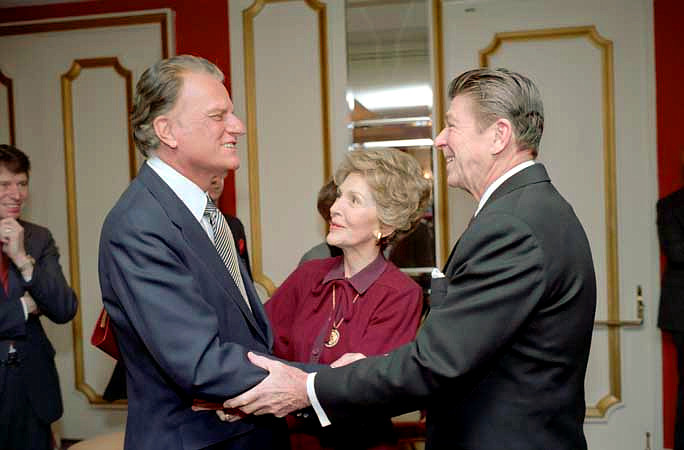
    Reagans_with_Billy_Graham.jpg

    Billy Graham’s last will and testament was released to the public today. The great evangelist died in February.

    In the frist section, he encourages people to take up Godly devotion in their daily lives and to defend the gospel.

    I commit myself wholly into the hands of my Savior, the Lord Jesus Christ, knowing by God’s Word that through His shed blood my sins have been atoned for and taken away and that through His merits I shall be presented faultless in the presence of His glory.

    When you read this I will be safely with Jesus in Paradise. I will be awaiting the reunion of our family in Heaven. Time on earth is so short. It seems only yesterday that I was a little boy playing on the family farm near Charlotte. It seems only yesterday that I took your mother on our first date on the second Sunday of December, 1940. It seems only yesterday that we were married on the full moonlit night in August, 1943. It seems only yesterday that I opened a letter from your mother to say that we were expecting our first child in the fall of 1945.

    That idea is what struck me in his note.

    Billy Graham lived 99 years. And yet even long lives are still so short.

    I’m in my thirties. Billy Graham was older than some of my great grandparents. But it is amazing how quickly time goes by. Memories of my youth, events that happened over a quarter century ago “seem only yesterday.”

    Life is short. And while we’re so tempted to all assume that we will have long lives, no one knows when the last day will be. It’s easy to take time for granted. But it’s finite and fleeting.

    As I think about Billy Graham, he was a man who had his first priority right: living a life that revolved around the gospel.

    There’s no time to wait. We need to live for God today. If you don’t know Jesus, or if you do but you have never really taken that relationship seriously, don’t wait. Don’t put it off. Today is the day.

    Childhood seems only yesterday. And even for those who live Billy Graham lifespans, the last day will seem like only tomorrow. Live for Jesus today!

    Humble yourselves, therefore, under the mighty hand of God so that at the proper time he may exalt you, casting all your anxieties on him, because he cares for you.
    -1 Peter 5:6-7

    Josh Benner is the associate pastor at Cornerstone Evangelical Free Church in Fergus Falls, Minnesota and has a Master of Divinity from Trinity Evangelical Divinity School. He enjoys writing about faith and culture. He lives with his wife Kari in Minnesota.

  • The lost art of lament

    photo-1483611703176-31a1e4306d2c.jpeg
    Lament is a topic that is often overlooked in American churches (especially in predominately caucasian churches).
    Lament is very common in the Bible, especially in the Old Testament. We see it as a theme throughout the prophetic books, and the Bible has more books on prophecy than in any other genre. We see it in places like Job, Ruth, and Ecclesiasties.
    Lament is not whining.
    It’s not complaining. It’s not grumbling. Lament is an expression of grief and sorrow. Lament is based in the reality of who God is. Lament is based in a high view of the goodness of God in a fallen world. Grumbling is not based in reality and doubts the goodness of God.
    In the Psalms, lament is the theme of more Psalms than any other subject. And that is the hymnal of the Old Testament!
    We also see lament in…Lamentations. A book literally named after lament.
    We do see elements of lament in the New Testament as well.
    For example, Matthew 5:4 says “blessed are those who mourn for they shall be comforted.” And the mourning that Jesus talks about is mourning sin, grieving the sin that is in the world. Jesus lamented in the garden, when he asked God “if it is possible, let this cup pass from me; nevertheless, not as I will, but as you will” (Matthew 26:39).
    Lament is honest
    With the times where people lament in the Bible, God never rebukes them for lamenting.
    The heart that cries out “how long O Lord” isn’t criticized for asking.
    In the dialogue of our hearts with God, we must always be honest with how we feel.
    Lament applies to struggles we face, times where we feel lonely or betrayed. Times where we have poor health. We can lament other hardships that we face. We can lament our own sins.
    God knows your thoughts and your heart.
    We need to be honest with God.
    We need to be honest about the hurt that we feel. About the distressing nature of sin.
    We need to be honest with God about the struggles we’re experiencing. We need to be honest about the harshness we see in the world around us.
    The temptation can be to keep a stiff upper lip, to remain stoic. To give the outward appearance that we’re fine. And I think that we can be tempted to want to appear strong. But the problem with that is it doesn’t make you weak to hurt. It makes you human.
    Lament is an important aspect of the Christian experience in a fallen world. Blessed are those who mourn, for they shall be comforted.
    Josh Benner is the associate pastor at Cornerstone Evangelical Free Church in Fergus Falls, Minnesota and has a Master of Divinity from Trinity Evangelical Divinity School. He enjoys writing about faith and culture. He lives with his wife Kari in Minnesota.