Josh Benner

Category: Church

  • The first rule of accountability

    photo-1483428400520-675ef69a3bc4.jpeg
    “Accountability” is one of those popular words that I hear in the church.

    People form accountability groups where they answer questions in regards to lust. People tell friends that they “need to be held accountable” for a certain area of sin in their lives.

    Accountability is a good, wise, and Biblical practice. James calls us to accountability: confess your sins to one another and pray for one another, that you may be healed. The prayer of a righteous person has great power as it is working (James 5:16).

    But accountability is only as good as a person’s willingness to be held accountable. In a moment of struggle, there can be a renewed commitment to changing your life and calling people to hold you accountable. But what about a few days, a few weeks, a few months later when the same old temptations come creeping back? An initial reaction can be to want to hide, to withdraw, to say “I’m fine” when you’re not fine. All of these make accountability worthless.

    It’s good when we hold one another accountable. But more important than someone else’s commitment to holding you accountable is your commitment to actually being held accountable, to being willing to be held accountable when the going gets tough, and a willingness to be vulnerable before you’ve fallen back into an area of struggle.

    Accountability must be accountability in practice, not in theory. It’s more impo

    Josh Benner is the associate pastor at Cornerstone Evangelical Free Church in Fergus Falls, Minnesota and has a Master of Divinity from Trinity Evangelical Divinity School. He enjoys writing about faith and culture. He lives with his wife Kari in Minnesota.

    Facebook
    Twitter
    Instagram

  • The best commentaries on Matthew (in my opinion)

    photo-1520099078215-db50d947d060.jpegLike many pastors, I’m a commentary nerd.
    Bible commentaries are scholarly books which give a verse by verse analysis of a book of the Bible. There are commentaries on every book of the Bible. Over the last 20 years, there have been hundreds of new commentaries that have been released. Commentaries are helpful to me in my studies of the Bible as I prepare sermons, Sunday school lessons, youth group lessons, and small group discussions. They’re a huge blessing to me and my ministry.

    If you’re looking to study a book in depth, which commentaries should you read?

    I’m starting a new series where I give my opinions on some of the best commentaries I’ve encountered for various books of the Bible.

    Today, we start with the Gospel of Matthew. It’s my favorite book of the Bible to study. I’ve also preached more from Matthew than any other book and I’m familiar with all of the major commentaries.

    Matthew has many great commentaries. I would put it right up with Romans as being the New Testament books with the best literature.

    1. Grant Osborne – Zondervan Exegetical Commentary of the New Testament (2010). Osborne was a professor at my seminary but I never actually had him for a class (so many great professors, it was difficult to get ’em all). I love his writing. Commentaries can be very dense and intellectual but Osborne’s commentaries (and he’s written one on every book of the New Testament) are written in an approachable manner, while still being academically rigorous.
    2. R.T. France – New International Commentary of the New Testament (2007). The late R.T. France actually wrote two commentaries on Matthew. He wrote one the New International Commentary of the New Testament (NICNT) and the Tyndale New Testament Commentary on Matthew. The NICNT commentaries can at times get highly academic, but, like Osborne, France writes with great clarity. Every time I read France’s observations of Matthew’s gospel, I feel that there is something fresh and interesting he has gleaned from the text. The Tyndale commentary is still very solid, more condensed than the NICNT, and a bit more approachable for the lay person, but still very solid.
    3. Leon Morris – Pillar New Testament Commentary (1992). Unlike any other commentator I’ve read, Morris could write with brevity while feeling like he fully captured the idea of a verse. Truly a gift. A solid Evangelical scholar.
    4. D.A. Carson – The Expositor’s Bible Commentary (1984). This is my favorite commentary in the Expositor’s Bible Commentary series. Carson is my favorite New Testament scholar. As with anything Carson does, excellent exegesis and explanations of the text. One of the things I most appreciate about Carson is his ability to explain a passage while seamlessly connecting it to the rest of the context of the passage and within the overarching book.
    5. Craig Blomberg – North American Commentary (1992). As a critique (and not so much a direct criticism of Blomberg because there are often restrictions from publishers on how long a book can be), but at times, I feel like his exposition can be too brief, and leaves me wanting more. But what he gives you in his commentary of Matthew is first rate. Blomberg approaches challenging subjects in a gentle manner.

    What’s your favorite commentary on Matthew?

    Josh Benner is the associate pastor at Cornerstone Evangelical Free Church in Fergus Falls, Minnesota and has a Master of Divinity from Trinity Evangelical Divinity School. He enjoys writing about faith and culture. He lives with his wife Kari in Minnesota.

  • Not exchanging the gospel for another to-do list.

    photo-1446484002819-52e5423f94a0.jpeg
    Many people in our society don’t understand the gospel because they don’t understand the cost of sin. We can do nothing to earn forgiveness because of our sin. The only hope humanity has is the grace of God, freely given to anyone who trusts in the gospel of Jesus Christ.

    Many don’t understand that, don’t appreciate that, think that they’re basically good enough on their own.

    On the other side of the coin, a person can come to faith and have an appreciation for the magnitude of their own sin.

    One of the great struggles that Christians can face is making life about performance, even after you acknowledge that the grace is freely given by Jesus.

    But we’ll never be good enough on our own. That’s why we needed a savior!

    It’s a difficult balance to strike. Because I’m certainly not suggesting that we should just live however we want. We should live for God. But that must be done while also understanding that his love is not based on our goodness or obedience.

    When a person places faith in Jesus, you are saved from the sins you have committed and the ones you will commit. Jesus doesn’t just save you from the sins of your past and leave it up to you to figure it out in the future. Jesus saves you entirely, when you place your faith in him.

    We can know the forgiveness that we have though the gospel but still fall into the trap of making our relationship with God about our performance. Or acting like God has forgiven you, but like you have to earn his love. That’s not the gospel.

    That’s a good way to set a person up for a life that lacks joy and leads to an exhausting (and impossible) cycle of legalism and works based righteousness.

    For a Christian, you are adopted as God’s child. You’re his. God loves with an everlasting love. No matter how good you are, you can never make God love you more. Nor can any sin make him love you less.

    Josh Benner is the associate pastor at Cornerstone Evangelical Free Church in Fergus Falls, Minnesota and has a Master of Divinity from Trinity Evangelical Divinity School. He enjoys writing about faith and culture. He lives with his wife Kari in Minnesota.

  • Tim Keller Tweets about the incarnation: disagreement ensues

    36315657_572647029858388_5034138606524956672_n.jpg

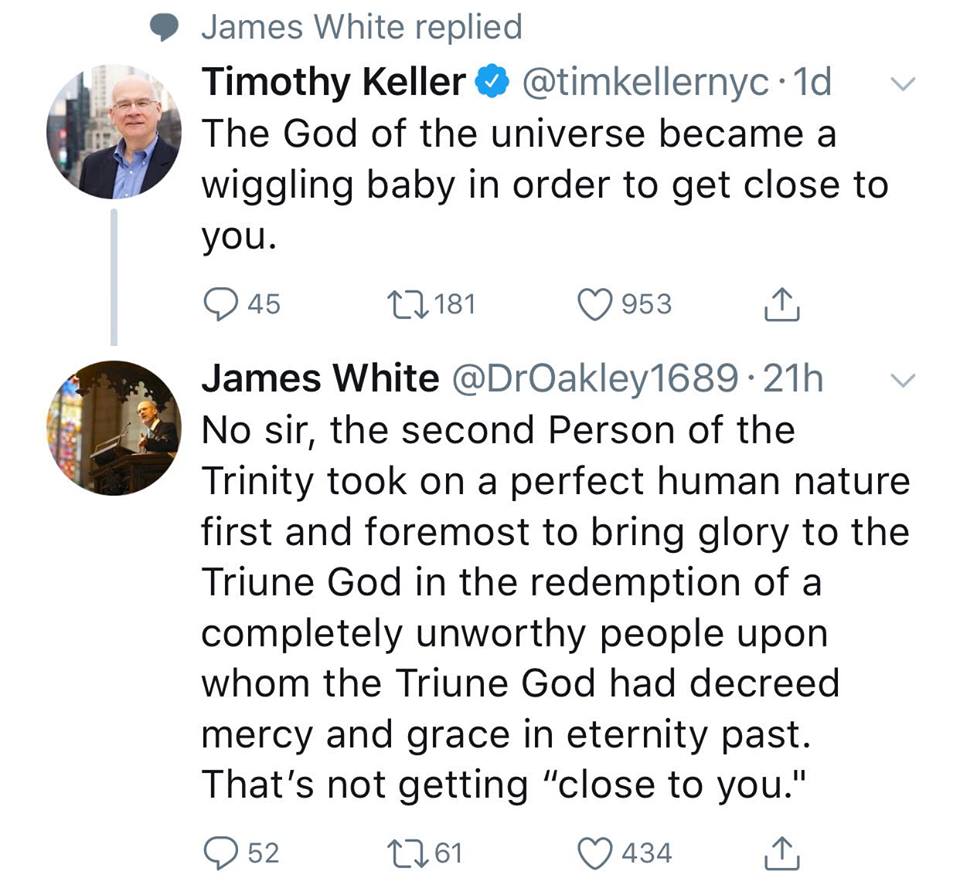
    Pastor and theologian Tim Keller made a Tweet in regards to the incarnation of Jesus this week. Keller said: “The God of the universe became a wiggling baby in order to get close to you.”

    James White, another theologian, was critical of Keller’s comment: “No sir, the second person of the Trinity took on a perfect human nature first and foremost to bring glory to the Triune God in the redemption of a completely unworthy people upon whom the Triune God had decreed mercy and grace in eternity past. That’s not getting ‘close to you.”

    I’m a huge fan of Keller, but I also really enjoy White’s work, but I disagree with the criticism that White is raising here. Both men are in the Reformed camp, and one of the great strengths of Reformed theology is its emphasis on the glory of God. As part of this idea, everything that God does is for his own glory. I affirm that belief.

    However I do think that people in the Reformed camp can sometimes emphasize the glory of God to the point where I feel that it can also undermine the love of God and that God is relational. It’s because God so loved the world that he gave his one and only son that whoever believes in Him shall not perish (John 3:16). Yes, God is glorious and we need to live to glorify God.

    I feel like we can treat glory almost like a utilitarian idea, that glory is the only thing that matters to God, and we act like the things that God does which happen to benefit humanity have nothing to do with God’s love for humanity. But we can’t reduce the attributes of God. Everything that the Lord is, the Lord is always, and to the superlative decree. So it’s not that God is sometimes glorious, sometimes loving, sometimes more or less loving, sometimes powerful. But it’s that everything God is, God always is.

    I’m not suggesting that White has a low view of the love of God.

    I do think that staunchly Reformed Evangelicals can communicate theological ideas which very much give that impression.

    Yes, Jesus came into the world to bring glory to God. But he also came so that everyone who believes in him can be with him. That’s the heart of the gospel. The God who created the world came into the world to save the world.

    Why go to theological battle over that?

    It’s not an either/or. It’s both/and.

    Josh Benner is the associate pastor at Cornerstone Evangelical Free Church in Fergus Falls, Minnesota and has a Master of Divinity from Trinity Evangelical Divinity School. He enjoys writing about faith and culture. He lives with his wife Kari in Minnesota.

  • The Church: serving together in the Mission of God

    800px-The_Earth_seen_from_Apollo_17.jpg
    What this is saying is that we have one body but our body has many parts to it.
    In 1 Corinthians 12, the Apostle Paul gives a fantastic illustration for the church. It functions like a human body. Everyone in the church is part of the body and has a purpose within the body. If a part of the body is unhealthy or is not functioning properly, that effects the rest of the body.
    The church exists to spread the gospel, to make disciples, and to support each other as the body of Christ on earth.
    The church is called to work together for the mission of God.
    I love the practicality of Paul’s illustration.
    For the body does not consist of one member but of many.If the foot should say, “Because I am not a hand, I do not belong to the body,” that would not make it any less a part of the body.And if the ear should say, “Because I am not an eye, I do not belong to the body,” that would not make it any less a part of the body
    -1 Corinthians 12:14-16
    If the foot should say, “because I am not a hand, I do not belong to the body,” that would not make it any less a part of the body.
     Feet.
    Kind of smelly.
    Often times out of sight. The foot isn’t nearly as glamorous as a hand.
    A hand brings pizza closer to your mouth.
    And so Mr. Foot might be tempted to feel like he’s not contributing much.
    But he helps you keep balance and to walk. The foot matters.
    “And if the ear should say, “Because I am not an eye, I do not belong to the body,” that would not make it any less a part of the body.”
    The ear.
    Might be tempting for the ear to also be insecure.
    It’s not an eye.
    People get complimented for their eyes. “Oh you have such pretty eyes.”
    If someone has ears that are worth mentioning, it’s not for a good reason….
    But ears are important. They’re part of the body. They funnel sound in. They hold on our glasses.
    Everyone in the church has a place, has a role. You have an area where you fit. You’re part of the body. You have a way to serve that is valuable for the church.
    Verse 17 gets at the idea that it’s necessary for there to be differences of parts within the body.
    If the whole body were an eye, where would be the sense of hearing? If the whole body were an ear, where would be the sense of smell?
    -1 Corinthians 12:17
     Imagine that.
    Just a big eye rolling around.
    Not only are there different parts, but there need to be different parts.
    We don’t all need the same gifts. We don’t need everyone to be a preacher.
    What a nightmare that would be!
    God equips us with gifts for his own glory. And the church flourishes when people are living on a mission and committed to living lives to serve God.
    Verse 20 is somewhat of a summary verse to this entire passage: “As it is, there are any parts, yet one body.”
    Verse 21 is affirmation from the passage how every part of the body needs every other part of the body.
    The eye cannot say to the hand, “I have no need of you,” nor again the head to the feet, “I have no need of you.”
    -1 Corinthians 12:21 
    Every part matters.
    In the world of theater, they have a saying “there are no small parts, just small actors” and the point is that everyone ni a production is still important to the story.
    Or I think about when I would play football with my friends as a kid. My friends and I always wanted to be the quarterback or running back or receiver. We never had dreams of being the kicker.
    But a kicker is still part of the team.
    Kickers are important.
    A kicker can win you a Super Bowl
    There’s no reason to be jealous of gifts that you don’t have. Because again, everything is part of serving God’s purposes. And those are eternal purposes. Because of his goodness and grace, God allows his people to be part of his mission in the world.
    Are you serving your church for the Mission of God today?
    Josh Benner is the associate pastor at Cornerstone Evangelical Free Church in Fergus Falls, Minnesota and has a Master of Divinity from Trinity Evangelical Divinity School. He enjoys writing about faith and culture. He lives with his wife Kari in Minnesota.