Josh Benner

Category: Commentary

  • The importance of constant gospel focus

    IMG_0198.jpg

    Originally published October 31, 2016

    As someone who doesn’t have kids, over the last few years, more and more of my friends have began to have children.

    When you have your first kid, you’re a member of a new club. You are a parent. Being a parent is something that becomes part of who you are. Your whole life, you haven’t had kids….but then you leave the hospital, and you have this baby.

    I’ve always thought, “Wow. That must be so…weird!”

    Your whole life, you haven’t had kids, and then suddenly you have one, and forever. (more…)

  • Pope Francis decrees that capital punishment is an “attack on the dignity of the person” – The Bible disagrees

    Canonization_2014-_The_Canonization_of_Saint_John_XXIII_and_Saint_John_Paul_II_(14036966125)
    Photo courtesy of Wikimedia Commons @Jeffrey Bruno

    Pope Francis is reversing the teachings of the Catholic Church in saying that capital punishment is inadmissible.

    One of the significant differences between Catholics and Protestants is the approach to scripture and tradition. Tradition is weighted more heavily in Catholic than Protestant theology. Tradition is significant to dogma and interpreting the Bible.

    However this reversal of Catholic teaching by Pope Francis is not in line with scripture OR tradition.

    There have been 266 Popes, and none of them ever publicly opposed capital punishment, categorically. Pope Francis’ interpretation runs counter to almost 2,000 years of Catholic teaching.

    But more importantly, it runs contrary to the Bible.

    Pope Francis says that the death penalty attacks the inherent dignity of all persons.

    It attacks the inherent dignity of persons?! The Bible permits it!

    There can be disagreement about whether or not the practice should be permitted outside of an Old Testament context (I believe that it is permitted), but given the numerable texts which allow for capital punishment in the Bible, it clearly is not seen as being something that is universally impermissible. And people in older times had just as much dignity as we do today.

    I’m never a fan of the argument against the death penalty that “it undermines their dignity.”

    It’s just as logical to order that the death penalty affirms the dignity of the victim.

    For generations, faithful Catholics would have been in step with the teachings of the Catholic Church to favor the death penalty, at least in certain situations. But now, the head of their church has decreed something new.

    A few weeks ago, one view was fine. And now, that same view contradicts the Church.

    This could have ramifications on republican Catholics in congress, among state legislatures, and on the courts. Undoubtedly, opponents of capital punishment will utilize this new teaching as a club to bash proponents of capital punishment with.

    Even before the Law was given to Moses, the Bible warranted capital punishment for murder: “Whoever sheds the blood of man, by man shall his blood be shed, for God made man in his own image” (Genesis 9:6).

    Josh Benner is the associate pastor at Cornerstone Evangelical Free Church in Fergus Falls, Minnesota and has a Master of Divinity from Trinity Evangelical Divinity School. He enjoys writing about faith and culture. He lives with his wife Kari in Minnesota.

    Let’s connect!
    Facebook
    Twitter
    Instagram

  • The danger of bad Biblical teaching

    photo-1472145246862-b24cf25c4a36.jpeg

    Not many of you should become teachers, my brothers, for you know that we who teach will be judged with greater strictness.
    -James 3:1

    Words matter.

    We can use words to bless, words to harm, words to boast, words to give instruction, and words to deceive. Through words we can tell a person that we love them, or that we hate them. Through words we can compliment or tear a person down.

    When the Prophet Isaiah had a heavenly vision of the throne room of God, and beheld the holiness of God, he said in Isaiah 6:5: “Woe is me! For I am lost; for I am a man of unclean lips, and I dwell in the midst of a people of unclean lips; for my eyes have seen the King, the Lord of hosts!”

    Words were part of the original sin. In the garden, the serpent, twisting God’s words: “Did God actually say, ‘You shall not eat of any tree in the garden’?”

    God had never said that. He said they could eat of any tree except for the tree of the knowledge of good and evil.

    “We may eat of the fruit of the trees in the garden, but God said, ‘You shall not eat of the fruit of the tree that is in the midst of the garden, neither shall you touch it, lest you die” (Genesis 3:2-3).

    Eve also gets it wrong. God had never said they couldn’t touch the tree. Twisting God’s words. Further provoked into sin by the devil In Genesis 3:4-5, “You will not surely die. For God knows that when you eat of it your eyes will be opened, and you will be like God, knowing good and evil.”

    When Adam and Eve are confronted with their sin, they use words to blame in Genesis 3:12, “The woman whom you gave to be with me, she gave me fruit of the tree, and I ate.”

    Words matter.

    In the first part of James 3, James zeroes in on teachers. He gives a warning to teachers that they will be judged with greater strictness. The reason why carries into verse 2 that we all sin in many ways, but one of the ways common to us all is that we stumble and sin in what we say.

    There is danger in bad Biblical teaching. It can lead people astray. It can teach people falsities, because the God who is revealed in scripture is the eternal, immortal, wise God. He’s the King of the universe, the creator of all things, he spoke the universe into being.

    There’s not a canvas where we are painting and where we can make something look however we want it to look.

    God is God. He has revealed himself in his scripture, his nature, his holiness. And so sound teaching about God matters. Teaching truth about God matters. Understanding God -in terms of how he has revealed himself in the Bible – matters.

    And not all churches do that. And not all teachers do that.

    Not many should be teachers because teaching necessarily involves words. Teaching about God’s word, teaching about God’s gospel necessarily involves words and language, and in talking, it makes it easy to say things that are untrue.

    We can’t be fast and loose with God’s gospel. We can’t make God who we want God to be if that’s not true about how God reveals himself in scripture.

    Unbiblical teachings that resort more to our feelings than to truth.

    Doesn’t God just want me to be happy? Not at the expense of sin!

    Words matter. How we approach the word of God matters. Like the serpent in the garden, twisting the very words of God.

    So it is true that there is a warning given to those who teach. And anyone who does teach from the word of God should question his motives, should be humble before God, and prayerful about the text. It should be taken seriously.

    We should be careful in our approach to God’s word.

    But regardless of if someone is a teacher or not, all of us should still use discernment in listening to what our teachers say. In listening to that which is in accordance with scripture. Of being fed by sound Biblical preaching. And that’s true here, and thats’ true if you ever move to a new community. And that’s true of any teacher who you might watch on tv or who you might podcast. We should be discerning with the Bible teachers we listen to.

    Josh Benner is the associate pastor at Cornerstone Evangelical Free Church in Fergus Falls, Minnesota and has a Master of Divinity from Trinity Evangelical Divinity School. He enjoys writing about faith and culture. He lives with his wife Kari in Minnesota.

    Let’s connect!
    Facebook
    Twitter
    Instagram

  • Meaning of the bronze serpent: the gospel in Numbers

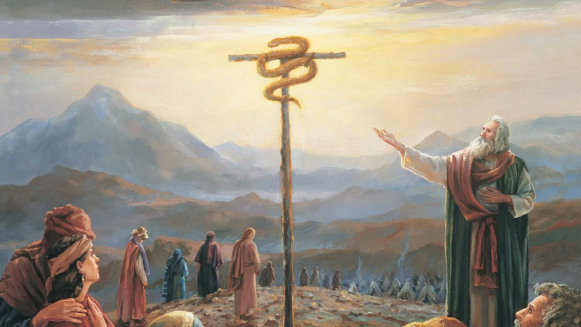
    maxresdefault-11.jpg

    In Numbers 21, the Israelites experience victory over the Canaanites but soon fall back into grumbling and complaining.
    God brings a plague of snakes upon the people. It’s a divine judgment.
    Their grumbling against God was to their downfall. But the people beg for mercy.
    8 And the Lord said to Moses, “Make a fiery serpent and set it on a pole, and everyone who is bitten, when he sees it, shall live.” 9 So Moses made a bronze serpent and set it on a pole. And if a serpent bit anyone, he would look at the bronze serpent and live.
    -Numbers 21:8-9
    Moses prays. God tells Moses to make a fiery serpent and set it on a pole. So God doesn’t simply take the snakes away. He also doesn’t prevent people from continuing to get bitten by the snakes.
    But once bitten, a person could respond by faith in the Lord by looking to the serpent on the pole.
    It’s an odd story. A number of questions might come to mind.
    Isn’t that idolatry? Making this bronze serpent?
    In the Golden Calf episode of Exodus 32, Moses is on the mountain receiving instruction from the Lord. He’s there for 40 days and the Israelites get restless. They take their gold and melt it into the image of a cow.
    Why is it ok with the bronze serpent?
    It’s a totally different situation. Most importantly, because God told them to do it this time.
    Secondly, this wasn’t idol worship because they weren’t worshiping the serpent.
    The serpent didn’t represent God to the people.
    There are many wonderful gospel themes in this scene.
    The Israelites sin against the Lord.
    And so God brings a plague of snakes upon the people as divine judgment.
    And yet, once the people repent and the bronze snake is made, it is in looking to that by which people are healed.
    A symbol of death becomes a symbol of life 
    Snakes were bringing death, but looking to this particular snake brought the promise of healing.
    A symbol of judgment the Lord then uses as a symbol of victory.
    The cross was the greatest symbol of judgment and condemnation in the Roman world.
    A brutal punishment. And yet, it is to the cross that we see Christ’s victory over sin.
    Perhaps you look at the story and think “but why a snake? Aren’t snakes bad in the Bible?”
    Yeah, so are people, but it is through a man that we are saved. The Lord Jesus, both God and man.
    The gospel 
    In a person being healed because of looking to the snake, it took what they were doing out of their hands. It was entirely the work of God.
    So too we see this in the gospel. It is not based on us, or how good we are. We are totally helpless to heal ourselves from the disease of sin. It is looking to the cross, to looking at what Jesus has done, to trusting Jesus by faith that we can have salvation.
    It’s foolishness 
    The serpent doesn’t make sense.
    The world is confounded by the gospel and the message of grace, the idea that we can be freely forgiven based on what someone else has done.
    The world is offended by the message of salvation by grace.
    Paul says in 1 Corinthians that the cross is folly to those who are perishing, but to those who are being saved, it is the power of God (1 Corinthians 1:18).
    We want to save ourselves. We want to see how we measure up and to feel good about how good we are.
    The gospel is that you cannot earn it. You look to what Jesus has done.
    Salvation for the undeserving 
    The Israelites were grumbling and complaining and blaspheming against God, and yet God saves them.
    Jesus came into a world where people condemned him, polluted against him, betrayed him, and killed him.
    While we were yet sinners, Christ died for us (Romans 5:8).
    In both looking to the serpent and the death and resurrection of Jesus, what people needed was faith.
    In the Gospel of John, Jesus will make specific reference to this event in Numbers. John chapter 3, Jesus is talking to Nicodemus, the Pharisee.
    Jesus says “as Moses lifted up the serpent in the wilderness, so must the Son of Man be lifted up.” (John 3:14)
    Moses literally lifted up the bronze serpent on a pole.
    And Jesus was literally lifted up on the cross.
    There, Jesus compares himself being lifted up to the bronze serpent.
    For the Israelites who were afflicted by the serpent’s bite, life was found by looking to the bronze serpent. For us today, eternal life is found by looking to Jesus.
    The main idea of our passage this evening is that: Opposing God brings death but true life is fond by faith.
    Are you trusting in Jesus?
    We’re infected with the venom of sin. And it’s a killer. There is nothing we can do on our own to take out that poison. The only antidote is found in looking to Jesus.
    Look to him. Love him. Live for him.

    Josh Benner is the associate pastor at Cornerstone Evangelical Free Church in Fergus Falls, Minnesota and has a Master of Divinity from Trinity Evangelical Divinity School. He enjoys writing about faith and culture. He lives with his wife Kari in Minnesota.

    Let’s connect!
    Facebook
    Twitter
    Instagram

  • What Jim Thome can teach us about strengths and weaknesses

    Jim_Thome_(18421174923).jpg
    Jim Thome. Photo courtesy of Wikimedia commons @Erik Drost

    Like any Cleveland Indians fan growing up in the 90s, Jim Thome is one of my all time favorite baseball players.

    Always had a good reputation as being friendly, a slugger, wore high socks like he was playing in the 30s. What wasn’t there to love?

    This past weekend, Thome was enshrined in baseball’s Hall of Fame in Cooperstown, New York. It’s well deserved. Thome’s 612 career home runs ranks him eighth all time.

    Baseball fans talk about guys who are five tool players, which refers to someone who can hit for power, hit for average, run well, throw well, and who has a good glove.

    Obviously Thome excelled at hitting for power. And while his career batting average was a respectable (though not exactly phenomenal .276), he actually is 51st all time in on base percentage because Thome also walked a lot.

    But he wasn’t known for being a great fielder or runner (19 career stolen bases, compared to being caught stealing 20 times).

    Simply put, Jim Thome was not a five tool player. And yet he’s in the Hall of Fame, because parts of his game were great.

    We all have room to grow, areas where we can improve. And we should always strive to get better in those areas. But there are also some skills where we’ll probably never excel, and that’s ok, because we can still do a lot with the talent and ability we have.

    Sometimes we can get bogged down for modest improvements in areas that aren’t our strengths when we could be working to cultivate our strengths to become even better. Let us never be so good at something that we think we can’t still do it better.

    What’s something you’re good at where you could get even better?

    Josh Benner is the associate pastor at Cornerstone Evangelical Free Church in Fergus Falls, Minnesota and has a Master of Divinity from Trinity Evangelical Divinity School. He enjoys writing about faith and culture. He lives with his wife Kari in Minnesota.

    Let’s connect!
    Facebook
    Twitter
    Instagram