Josh Benner

Category: Culture

  • The positive and encouraging message isn’t always the message we need

    The positive and encouraging message isn’t always the message we need

    It’s interesting to me to consider the popular Christian music. It’s almost always easy listening.

    I was looking at some of the slogans for popular Christian radio stations.

    Perhaps the biggest in America, K-Love, which plays on 440 stations “positive – encouraging.”

    The River, which is the Christian radio station in Columbus, “uplifting and encouraging.” Smile FM, which is a popular station in Michigan says “positive hits.” Air1 which plays on 123 stations in 43 states: “positive hits.” Joy FM which is in Florida “helping you find joy.” Way FM “uplifting, upbeat, real.”

    There’s no Christian radio stations that advertise as being “convicting and sanctifying.” None advertise as being “sackcloth and ashes.”

    Now there’s nothing wrong with being positive, there’s nothing wrong with being encouraged.

    But is that the way Christians are always supposed to feel? Our society likes the easy listening message. The American church likes the positive and encouraging message.
    But we come to the second of the Beatitudes, in the Sermon on the Mount, and it’s: “blessed are those who mourn, for they shall be comforted.”

    Life verses

    I think of popular life verses people pick. Philippians 4:13: “I can do all things through Christ who strengthens me”

    Or Jeremiah 29:11 “For I know the plans I have for you, declares the Lord.”

    PROVERBS 3:5-6

    TRUST IN THE LORD WITH ALL YOUR HEART,
    AND DO NOT LEAN ON YOUR OWN UNDERSTANDING.
    IN ALL YOUR WAYS ACKNOWLEDGE HIM,
    AND HE WILL MAKE STRAIGHT YOUR PATHS.

    Positive, encouraging verses.

    There are churches where there’s almost this pressure on people to always be smiling, happy, positive.

    Because we like a positive, encouraging culture. But what about when you’re not doing well?

    Is a church to be another place where a person has to put up a front? Or is it a place where people can be honest?

    Now I’m not saying we should be unkind or rude to one another. But sometimes people are hurting. And there’s no virtue in white-knuckling it when you’re struggling.

    Blessed are those who mourn, for they shall be comforted.
    Church is not a place that’s primary mission is positivity and encouragement.
    It’s preaching Christ crucified (1 Corinthians 2:2).

    And in studying God’s word, the primary goal should not always be the easy listening, K-love, positive and encouraging message.

    Because blessed are those who mourn, for they shall be comforted.

    The first of the Beatitudes is “Blessed are the poor in spirit, for theirs is the kingdom of heaven.”

    And that is for the person who realizes that they are nothing and have nothing to offer God, to warrant favor, to merit grace, to earn heaven. And the blessedness is realizing that the grace of God is your only hope.

    The second of the beatitudes flows from the idea of the first. For a person who realizes how small they are before God and their utter need and dependence on God, that in seeing sin, there is blessedness in that.

    In the first case, you realize that God is your only hope.

    In the second, it’s having a greater sense of the state from which God redeemed you.

    Blessed are those who mourn.

    That word. “Blessed.” It’s one of those theologized and churchy words. Another way to translate it would be fortunate are those who mourn” or “happy are those who mourn.”

    And abundant, supernatural heavenly blessing for those who mourn.

    Part of what the beatitudes are doing is showing us that the values of heaven are not the same as the values of this world. In fact, it’s a set of values that are utterly incoherent to our world.

    Perhaps none of them more starkly displays the difference in the values of heaven and earth than the second of the beatitudes. Blessed are those who mourn, for they shall be comforted.

    That’s not the K-love message. That’s not the positive and encouraging message.

    And that’s ok.

    In fact, I hope you don’t always leave encouraged.

    That’s not saying I want you to be discouraged. That’s not to say I want you feeling hopeless. That even when a text hits us hard, that we might rejoice all the more because of the hope that we do have in Christ.

    But in studying the Bible, I hope there are times when the weight of God’s word eviscerates you.

    There should be times where you’re convicted because of it. Times where you reexamine your life, your heart, your decisions, your motivations because of it.

    There should be messages that ring in your heart long after the benediction.

    But again, not to be left in total despair, but to be worshipful and rejoicing in the tremendous grace that Jesus gives.

    And that might not always be cheery and positive. Because we’re sinful people. And for a thoughtful Christian, sometimes we get hit by stark realities about ourselves and our hearts as we study his word.

    Originally published on March 6, 2019

    Thanks for reading! Don’t forget to like, comment, and subscribe.

  • Liberty to have independent investigation in wake of Falwell resignation

    Photo courtesy of Wikimedia Commons.

    This week, Liberty University announced an “independent inquiry” into the university’s former president.

    I remember will Bill Hybels resigned from Willow Creek, a megachurch in suburban Chicago in the wake of sexual misconduct allegations. I remember earlier this summer when Menlo Park Presbyterian Church in California announced an independent investigation into there former pastor in the wake of massive failures of leadership when he allowed one of his children (who had admitted sexual attraction to minors) to continue working with the youth program.

    Liberty will do an independent investigation. But they had let Falwell run roughshod and embarrass the university time and again. Even before last month’s explosive reports about multiple affairs from Falwell’s wife and allegations that Jerry Falwell was very much aware of the affairs, he had done several things which should have led to the university removing him from leadership.

    For Falwell, the independent investigation will be “a thorough investigation into all facets of Liberty University operations during Jerry Falwell, Jr.’s tenure as President, including but not limited to financial, real estate, and legal matters.”

    Obviously there’s nothing wrong from learning from mistakes. But in the wake of scandals in the evangelical world, the “independent investigation” seems to be the flavor of the month.

    The basics of what goes wrong in these situations aren’t great mysteries. You have highly influential leaders who help to raise or maintain the high profile status of a church (or institution). And because of the charisma and skills (and ability to generate revenue) of the leader, they largely go unchecked.

    Instead of organizations needing to do independent investigations as damage control, what churches and Christian colleges need to do is to do the right things in the beginning. In other words: have systems to keep leaders accountable

    People are sinful. That should never be a surprise. But that’s why Christians need other Christians. Knives sharpening knives. You need leaders who are accountable and where there are honorable people who know them and who know their struggles. You need people who love the leader. But who don’t excuse or look away from, or justify sin. That isn’t love. What you need is people who love the leader enough to where they can speak into difficult situations and point out patterns of sin in the hopes of bringing restoration. And you need it an an environment where those friends can lovingly confront the leader without being punished or harassed for it.

    Without that, many more independent investigations will be needed, because the sinfulness of the human heart isn’t going away.

    I think about many of the popular evangelical leaders who have fallen from grace in recent years. For at least some of them, I do wonder how different things could have been had they been surrounded by people who cared enough to sometimes say the difficult things.

    In 1948, as he was coming to national prominence, Billy Graham and his close ministry associates signed the “Modesto Manifesto” where they had the forethought to hold themselves to a set of standards regarding sexual morality, finances, interactions with local churches, and publicity. Part of what developed from this meeting was the famous “Billy Graham Rule” where Graham would not travel with, eat lone with, or spend time alone with a woman who was not his wife.

    Their agreement worked as non of those men was ever legitimately accused of a moral failing.

    And certainly the greatest set of standards for Christian leaders is found in the Bible.

    Titus 1:6-9 says:
    if anyone is above reproach, the husband of one wife, and his children are believers and not open to the charge of debauchery or insubordination. 7 For an overseer, as God’s steward, must be above reproach. He must not be arrogant or quick-tempered or a drunkard or violent or greedy for gain, 8 but hospitable, a lover of good, self-controlled, upright, holy, and disciplined. 9 He must hold firm to the trustworthy word as taught, so that he may be able to give instruction in sound doctrine and also to rebuke those who contradict it. 

    1 Timothy 3:1-7 says:
    The saying is trustworthy: If anyone aspires to the office of overseer, he desires a noble task. 2 Therefore an overseer must be above reproach, the husband of one wife, sober-minded, self-controlled, respectable, hospitable, able to teach, 3 not a drunkard, not violent but gentle, not quarrelsome, not a lover of money. 4 He must manage his own household well, with all dignity keeping his children submissive, 5 for if someone does not know how to manage his own household, how will he care for God’s church? 6 He must not be a recent convert, or he may become puffed up with conceit and fall into the condemnation of the devil. 7 Moreover, he must be well thought of by outsiders, so that he may not fall into disgrace, into a snare of the devil. 

    While Falwell wasn’t a pastor, nevertheless, those would have been good standards to still demand from the president of America’s largest Christian university.

    Thanks for reading! Don’t forget to subscribe!

  • Gospel Coalition article sees “egregious contrast” between Jacob Blake and Kyle Rittenhouse

    Photo courtesy of Wikimedia Commons

    The Gospel Coalition website ran a piece last week titled “Why I hate August” by Illinois pastor K. Edward Copeland. I strongly disagree with many of the statements in the article.

    At the beginning of the piece, Dr. Copeland talks of good experiences with August. It’s his birthday and wedding anniversary month. He loves the summer. But then the article shifts “I hate August because it reminds me that some view bodies like mine as disposable.”

    The piece quickly turns into propaganda as Copeland irrelevantly brings up the weather. “As Hurricane Laura decimates the South I’m also haunted by the black and brown bodies that were stranded on rooftops during Hurricane Katrina in August 2005.”

    What’s his point? That the weather is also racist?

    Copeland talks about the seven shots from the police which struck Jacob Blake, whom Copeland describes as “unarmed” and points out that the now paralyzed Blake is handcuffed to his hospital bed.

    Couple of points to be made in response to that. While Copeland jumps to assuming that this was racially motivated, there is still dispute as to whether or not Blake had a knife or if he might have been reaching for a knife prior to being shot. But that’s part of the issue. Blake was not compliant, he had been tasered twice, he was a felon with warrants, and he was either reaching into a car or was trying to flee in a car with three kids in the vehicle. Copeland brings up that Blake was handcuffed to his hospital bed. Once again, he’s giving propaganda and appeals to emotion. Blake may be paralyzed but he’s still a criminal and there are protocols. The rules for how prisoners are restrained in the hospital are not up to the whims of the staff or how practical or necessary they think the restraints are.

    When Copeland talks about Rittenhouse, he calls that an “egregious contrast.”

    Copeland talks about how Rittenhouse “killed people in the street” and then was able to calmly approach the police. In my opinion, Copeland does too much to assume the mindset of these men, especially Rittenhouse when he says things like “He assumed there was something about his person that would allow him to approach law enforcement with a visible automatic weapon that had just taken lives.” We can’t know his thoughts.

    Then Copeland compares Rittenhouse to Dylann Roof as another mass shooter. And this is where I must call Copeland out. That is absurd. I get that his point might have been that they were both people who were peacefully taken into custody but to compare the two is insane. Dylann Roof attended a prayer meeting at a predominantly black church and then murdered nine people in an effort to ignite a race war. Kyle Rittenhouse shot at people who were attacking him. More information will need to come out about Rittenhouse and if he had motivations for violence beforehand, but there is also a legitimate argument that his shootings were a matter of self-defense. You can see video of people attempting to assault Rittenhouse (some of whom also had guns).

    I’m not positive, but Copeland seems to be implying that Rittenhouse wasn’t afraid of the police because he’s white.

    Copeland says “The inconsistency between how these two bodies were treated in Kenosha reinforces my childhood suspicions.”

    Copeland is taking these two events and acting like they’re a case study in how white and black people are treated by police. Nevermind that there is a longstanding standard of situations when officers are legally justified to use deadly force and that Blake’s situation pretty clearly fits that criteria. No, let’s just push the narrative that Blake was shot purely because of race, not because he was resisting, had weathered tasers, was reaching into his vehicle, and posed a threat. Rittenhouse was peacefully arrested because he was white, not because he surrendered.

    Copeland says, “Those who claim my same convictions about Christ will be the first and loudest to castigate me for these observations. They’ll be the most proficient at finding some excuse for Rittenhouse, the most cavalier in discounting my trauma, the most eager to somehow find a “Marxist” or “Critical Race Theory” connection in my reflections.”

    When you ignore facts and simply go with a narrative and attempt to make what appears to be a justifiable use of force into another flash point, it’s hard to not feel that you’re perpetuating the agenda of critical race theory.

    There are absolutely egregious injustices which have happened to African Americans. But not all uses of police force are unjustified. And in line with the critical theory agenda, Blake’s actions have no relevance in this Gospel Coalition article. He’s purely the innocent victim. It’s nonsense.

    Thanks for reading!

  • Grumbling: when we forget God’s goodness

    Grumbling: when we forget God’s goodness

    In the Book of Exodus, God had worked in mighty ways for the Israelites. He had brought a series of plagues against the Egyptians. He dramatically parted the waters of the Red Sea. Once the Israelites were in the desert, God continued to lead. But through a series of uncertain events, the Israelites continued to respond by grumbling.

    They ran low on water. Israel grumbled. God provided water. They didn’t have food. Israel grumbled. God provided food. After all that the Lord had done, the people should have trusted that God would provide.

    But their struggle is one that we too can have. In spite of all of the ways how God has provided for us, blessed us, sustained us, in a time of adversity, it can be easy to fall into grumbling and doubt.

    But this isn’t God’s desire for us. He wants us to live in faith.We can be so quick to forget what God has done, how he’s blessed us.Forgetting can lead to unbelief and faithlessness.Let us actively remember the blessings of the Lord in our lives.

    We forget about his past blessings and forget about his future promises.And so we grumble.God is the Lord of our past, present, and future.God has promise all of his children a wonderful and glorious future.And between now and then, he has not abandoned us in the desert.God is God of your life today.If you’ve placed faith in Jesus, you know that you’re a sinner, saved by grace, and know that Jesus saved you, you have that to thank God for.Ad that’s the most important thing of all.He redeemed you.

    He saved you from the penalty of sin. To remember that the Lord is good. The Israelites lose sight of that.To remember that God made everything and that everything belongs to him.You’re here today. Which means that God has provided for you up to this point in your life. For some of us, it might not have always been easy.There might have been times of real hardship.But we’ve made it to this moment.It’s easy to forget.For some of us, when a blessing gets answered, we might celebrate for a moment, but it can be easy to just move on to the next thing to stress about.And we can go through so much of our lives grumbling, complaining to God, feeling like he hasn’t given us enough.

    For the Israelites, they’ve seen God act in mighty ways, but then they go right back to worrying.The Israelites face difficult situations. And they choose to grumble instead of trust.Part of the root of a grumbling heart is one that loses sight of the sovereignty of God.I mentioned earlier that it was God who had led Israel to their circumstance between the Egyptians and the sea. It was no accident.It was God who was leading the Israelites in the desert. It’s so easy to lose sight of the divine hand of God at work in our lives. Israel did. In our passages, they actually don’t even grumble directly to God. They actually grumble to Moses and his brother Aaron.As if it was their fault.Nothing happens outside of the sovereign will of God.And while they might have directed their complaints to Moses and Aaron, the real displeasure of the people was with God.God is God of all circumstances.

    Job 12:10 refers to God and says: in his hand is the life of every living thing and the breath of all mankind.

    Grumbling is a lack of trust in God. Grumbling is feeling like God hasn’t give us enough. It’s a sense that perhaps God isn’t good.Grumbling is turning away from God. It’s complaining to others, it’s ignoring the goodness of God, and is not rooted in the truth of the character of the Lord.We don’t like the unknown.

    Thanks for reading! Make sure to like, comment, and subscribe.

  • Falwell Jr. on leave after inappropriate Instagram photo

    Photo courtesy of Wikimedia Commons.

    The largest Christian university in the world should not be led by a person who’s controversial because of his antics. It’s one thing to be controversial due to conviction or controversial due to moral stances which cut against the grain of society.

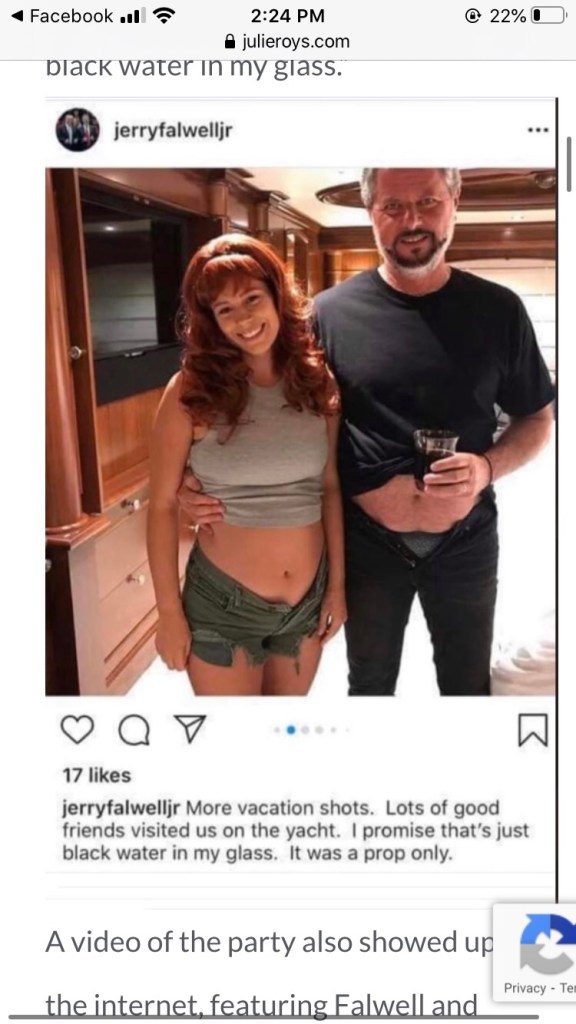
    But Jerry Falwell, Jr’s controversies largely stem from his antics. This week, Falwell posted a photo on his Instagram of him and a woman (who he later said is his wife’s assistant) at a yacht party. In the photo – which was later deleted – Falwell has his arm around the woman, both have their shirts lifted above their stomachs, and show their pants unzipped. Along with the photo, Falwell included the caption:  “Lots of good friends visited us on the yacht. I promise that’s just black water in my glass. It was a prop only.”

    The following day, Falwell explained the photo in a slurred radio interview where he said:  “She’s pregnant so she couldn’t get her — she couldn’t get her pants up,” he said. “And I was like, trying to like — my — I had on pair of jeans that I hadn’t worn in a long time so I couldn’t get mine zipped either. And so — and so — I just put my belly — I just put my belly out like hers.” Falwell said that he was “gonna try to be a good boy.”

    Everything about that situation looks bad. And his explanation didn’t do him any favors. “I’m gonna try to be a good boy?” You’re the president of the largest Christian University on earth and a 58 year old man. Also, in the photo when he says “I promise it’s just black water?” That sounds like an excuse an underage drinker would make when getting caught.

    Appearances matter. Being above reproach matters. Falwell failed on both fronts with that photo. Video from the yacht party also emerged showing people in a themed party based off of the Canadian television series “Trailer Park Boys.”

    Today, Liberty announced that Falwell will be taking an indefinite leave of absence, effective immediately. It’s a decision which is long overdo. It’s a microcosm of a larger problem in evangelical Christianity where organizations and churches fail to hold influential leaders accountable.

    If a student at Liberty had done what Falwell did, they would face disciplinary action. For Falwell, the standard for his conduct should be higher, not lower, than for his students.

    And again, it’s not an isolated incident. In May, Falwell Tweeted a picture of a custom surgical face mask which displayed the image of Virginia Governor Ralph Northam in a racially insensitive photo from his medical school yearbook. Falwell said that it was in protest to budget cuts for higher education made by Northam. Thousands called for Falwell to apologize and resign.

    He eventually did apologize. Kind of. Although his Instagram account still features a link in the bio section to a Breitbart story which paints Falwell as the victim in that story.

    Last year, there were photos which emerged of photo and his family at a Miami nightclub. Not the worst thing in the world (although not a great look for the president of a major Christian University, either). But Falwell vehemently denied the photos and said they were photoshopped, which prompted a response from the photographer who had taken the photos.

    Last October, there was a bizarre settlement involving a business deal gone awry.

    On social media, there are numerous occasions where Falwell has called people “stupid” and “idiot.”

    I appreciate Liberty University. But they deserve better. Standards and accountability matter. I’ve written about numerous influential pastors who have been fired or resigned due to misconduct. And so often, I feel like those situations could have been averted had their respective boards held leaders accountable in the beginning. And we see it here with Falwell. His board has allowed him to run wild time and again. And each time, it further diminishes the institution.