Josh Benner

Category: Editorial

  • Scandal in the Southern Baptist Convention

    Scandal in the Southern Baptist Convention

    Even though I’ve never been part of a Southern Baptist church, I have always loved the Southern Baptist Convention. I feel that this denomination is one of the leaders is spreading the gospel and teaching the Bible in America and through missions efforts across the world. 

    On Sunday, a 288 page report was released related to the handling of sexual misconduct within the denomination. 

    The fact that there were issues was not a new revelation. In 2019, I wrote about a Houston Chronicle expose which talked about sexual predators within the SBC. 

    But the issue isn’t simply that the denomination failed to be proactive. That would be bad enough. What’s worse is that they intentionally avoided mechanisms to hold abusers accountable and steps which could have been taken to prevent abuses. 

    From the report: 

    “Rather than focusing on these accused ministers, some EC (executive committee) leaders turned against the very people trying to shine a light on sexual abuse. The survivors – those persons who actually suffered at the hands of SBC clergy or SBC church staff or volunteers – who spoke out the most, and who criticized the SBC’s inaction, were denigrated as “opportunistic,” having a “hidden agenda of lawsuits,” wanting to “burn things to the ground,” and acting as a “professional victim.” 

    The report notes several high profile SBC figures who were either involved in scandals of their own or who failed to hold abusers accountable. 

    Leadership failures

    Former SBC President Steve Gaines admitted that, as senior pastor at Bellevue Baptist Church, he had delayed reporting a staff minister’s prior sexual abuse of a child of “heartfelt concern and compassion for th[e] minister,” while acknowledging that he should have “brought it to the attention of our church leadership immediately;”

    Former SBC President Jack Graham, when he was pastor at Prestonwood Baptist Church, allegedly allowed an accused abuser of young boys to be dismissed quietly in 1989 without reporting the abuse to police. The accused abuser, John Langworthy, later was charged with abusing young boys in Mississippi in 2011;

    Former SBC President Paige Patterson was terminated from his position at Southwestern Baptist Theological Seminary in 2018 after it was revealed that he his intention to meet with another student who had reported an assault, with no other officials present, so he could “break her down;” told a student not to report a rape in 2003 and, in 2015, emailed Former SBC Vice President Judge Paul Pressler is the defendant in a civil sexual abuse lawsuit alleging that he repeatedly sexually abused the plaintiff beginning when the plaintiff was 14 years old. Two other men submitted separate affidavits in the case also accusing Judge Pressler of sexual misconduct; and

    Former EC Interim President and General Counsel Augie Boto testified as a character witness for Mark Schiefelbein, a gymnastics coach convicted of multiple counts of sexual assault against a minor. During his testimony at a post-conviction evidentiary hearing in September 2008, Mr. Boto identified himself as general trial counsel for the Executive Committee of the Southern Baptist Convention.

    In 2007, a database was proposed to list offenders who had served in SBC churches. 

    The Washington Post reports: 

    “In an April 2007 email, the convention’s attorney sent Boto a memo explaining how a SBC database could be implemented consistent with SBC polity, saying “it would fit our polity and present ministries to help churches in this area of child abuse and sexual misconduct.” The report states that he recommended “immediate action to signal the Convention’s desire that the [executive committee] and the entities begin a more aggressive effort in this area.” That same year, after a Southern Baptist pastor made a motion for a database, Boto rejected the idea.”

    The database is another important finding from the report. A database of known and accused offenders had long been suggested within the SBC. It’s a denomination with thousands of churches. Some predators would leave one church and go to another. Leaders continually stonewalled the idea of a database and said it would be impossible to manage. According to the report, the database existed. 

    It’s my understanding that it’s not definitively known which leaders had access but the database existed. People in leadership lied and withheld a useful tool from their churches. Unconscionable. 

    And this all scratches the surface. 

    The New Testament repeatedly gives warnings about those infiltrating the church who mean to do harm. 

    Matthew 7:15-16: 

    15 “Beware of false prophets, who come to you in sheep’s clothing but inwardly are ravenous wolves. 16 You will recognize them by their fruits.

    In John 10, Jesus famously says that he is the good shepherd who lays down his life for his sheep (his people). At the same time, Jesus is warning of shepherds who will fail to protect the flock  and teh wolves that will prey upon the flock: 

    John 10:10-13:

    10 The thief comes only to steal and kill and destroy. I came that they may have life and have it abundantly. 11 I am the good shepherd. The good shepherd lays down his life for the sheep. 12 He who is a hired hand and not a shepherd, who does not own the sheep, sees the wolf coming and leaves the sheep and flees, and the wolf snatches them and scatters them. 13 He flees because he is a hired hand and cares nothing for the sheep.

    These are verses that I’ve always taken seriously. There are those who will cause harm within the church. Sadly, far too many SBC “leaders” failed to do their part in helping to protect the churches in their denomination and sadder still, their failures to act (or outright participation in cover ups) helped foster a culture where people could commit acts of abuse. 

    29 I know that after my departure fierce wolves will come in among you, not sparing the flock; 30 and from among your own selves will arise men speaking twisted things, to draw away the disciples after them (Acts 2:29-30).

    All of this just scratches the surface. But it’s unconscionable. It is beyond me how these leaders could justify the things they’ve done. 

    There has been a massive sexual abuse scandal in the Catholic Church. There have been scandals from several universities: Penn State with assistant football coach Jerry Sandusky and Ohio State with former athletic department physician Richard Strauss. There was the USA Gymnastics scandal with Larry Nasser. There was the #metoo movement. Jeffrey Epstein. 

    Large institutions are vulnerable to predators and the SBC was unable to read the room and take any steps at avoiding abuse? 

    One of the findings of the report was that these evasive steps from the SBC were done in an effort to avoid legal liability. But at what cost? In avoiding liability, the leadership of the denomination failed to help protect people within their congregations. That’s the worst of it. 

    And ironically, in their effort to protect the denomination, they have done damage that will linger in the SBC until Christ returns. Churches will leave the SBC, members will leave churches within the SBC, the reputation of the SBC will take irreversible damage. And Christ’s Church takes another strike against it because people failed to live up to what the Church is supposed to be. 

    Thanks for reading. If you liked this post, please share and subscribe.

  • The positive, encouraging message isn’t always the message we need

    The positive, encouraging message isn’t always the message we need

    It’s interesting to me to consider the popular Christian music. It’s almost always easy listening.

    I was looking at some of the slogans for popular Christian radio stations.

    Perhaps the biggest in America, K-Love, which plays on 440 stations “positive – encouraging.”

    The River, which was the Christian radio station in Columbus, “uplifting and encouraging.”

    Smile FM, which is a popular station in Michigan says “positive hits.”

    Air1 which plays on 123 stations in 43 states: “positive hits.”

    Joy FM which is in Florida “helping you find joy.”

    Way FM “uplifting, upbeat, real.”
    There’s no Christian radio stations that advertise as being “convicting and sanctifying.” None advertise as being “sackcloth and ashes.”

    Now there’s nothing wrong with being positive, there’s nothing wrong with being encouraged.

    But is that the way Christians are always supposed to feel? Our society likes the easy listening message. The American church likes the positive and encouraging message.
    But we come to the second of the Beatitudes, in the Sermon on the Mount, and it’s: “blessed are those who mourn, for they shall be comforted.”

    Life verses

    I think of popular life verses people pick. Philippians 4:13: “I can do all things through Christ who strengthens me”

    Or Jeremiah 29:11 “For I know the plans I have for you, declares the Lord.”

    Proverbs 3:5-6 says:
    Trust in the Lord with all your heart,
        and do not lean on your own understanding.
    6 In all your ways acknowledge him,
        and he will make straight your paths.

    Positive, encouraging verses.

    There are churches where there’s almost this pressure on people to always be smiling, happy, positive.

    Because we like a positive, encouraging culture. But what about when you’re not doing well?

    Is a church to be another place where a person has to put up a front? Or is it a place where people can be honest?

    Now I’m not saying we should be unkind or rude to one another. But sometimes people are hurting. And there’s no virtue in white-knuckling it when you’re struggling.

    Blessed are those who mourn, for they shall be comforted.
    Church is not a place that’s primary mission is positivity and encouragement.
    It’s preaching Christ crucified (1 Corinthians 2:2).

    And in studying God’s word, the primary goal should not always be the easy listening, K-love, positive and encouraging message.

    Because blessed are those who mourn, for they shall be comforted.

    The first of the Beatitudes is “Blessed are the poor in spirit, for theirs is the kingdom of heaven.”

    And that is for the person who realizes that they are nothing and have nothing to offer God, to warrant favor, to merit grace, to earn heaven. And the blessedness is realizing that the grace of God is your only hope.

    The second of the beatitudes flows from the idea of the first. For a person who realizes how small they are before God and their utter need and dependence on God, that in seeing sin, there is blessedness in that.

    In the first case, you realize that God is your only hope.

    In the second, it’s having a greater sense of the state from which God redeemed you.

    Blessed are those who mourn.

    That word. “Blessed.” It’s one of those theologized and churchy words. Another way to translate it would be fortunate are those who mourn” or “happy are those who mourn.”

    And abundant, supernatural heavenly blessing for those who mourn.

    Part of what the beatitudes are doing is showing us that the values of heaven are not the same as the values of this world. In fact, it’s a set of values that are utterly incoherent to our world.

    Perhaps none of them more starkly displays the difference in the values of heaven and earth than the second of the beatitudes. Blessed are those who mourn, for they shall be comforted.

    That’s not the K-love message. That’s not the positive and encouraging message.

    And that’s ok.

    In fact, I hope you don’t always leave encouraged.

    That’s not saying I want you to be discouraged. That’s not to say I want you feeling hopeless. That even when a text hits us hard, that we might rejoice all the more because of the hope that we do have in Christ.

    But in studying the Bible, I hope there are times when the weight of God’s word eviscerates you.

    There should be times where you’re convicted because of it. Times where you reexamine your life, your heart, your decisions, your motivations because of it.

    There should be messages that ring in your heart long after the benediction.

    But again, not to be left in total despair, but to be worshipful and rejoicing in the tremendous grace that Jesus gives.

    And that might not always be cheery and positive. Because we’re sinful people. And for a thoughtful Christian, sometimes we get hit by stark realities about ourselves and our hearts as we study his word.

    Thanks for reading! I’d love to hear what you think, and don’t forget to subscribe! 

    Originally published March 6, 2019

  • We can complain and know that others have it worse

    We can complain and know that others have it worse

    There’s a meme that I’ve seen on social media that criticizes complaining about the surging gas prices in lights of the sufferings of the Ukrainian people.

    The meme says: “Instead of complaining about gas prices going up, try feeling grateful that you aren’t sitting on a concrete floor in a train terminal, holding your cat, wondering if your home and everyone you love has been blown to bits.”

    I find that view to be utterly unhelpful, condescending, and impractical.

    There are real struggles right now. Inflation is a problem. Gas prices were already high and they’re now the highest they’ve ever been. And they’re gong to continue going up and with shipping costs going up, more prices will increase. I don’t think it’s helpful to be dismissive of those very real challenges people are facing. It’s emotional tyranny to tell people how they ought to feel.

    Of course the people of Ukraine have it worse. But challenging situations are not a competition. You don’t only have the license to acknowledge difficulties if you’re going through the most difficult circumstance on earth.

    Furthermore, a person can be stressed or frustrated about these current challenges and also have empathy for the people of Romania and how much they’re suffering. It’s heartbreaking to know that families have been separated, that women and children are refugees with nothing, that an entire society has been turned upside down. I think about the people who will be at risk of exploitation in human trafficking. I even get sad when I think of pets that have been left behind.

    But how does it help to suggest that Americans shouldn’t complain?

    What adds further insult to injury is the knowledge that America has vast supplies of oil that we choose not to drill and the average citizen gets stuck paying more. That’s a legitimate frustration.

    This all comes after two years of having our society and lives turned upside down with Covid. During the earlier stages of Covid, if a person had the audacity to dare question public health policies, it was that they were anti-science and selfish.

    Now if a struggling person acknowledges the difficulties of our economy, they’re told that their feelings don’t matter and they should just look at Ukraine? It’s madness.

    For anyone who shares that meme, I hope you never complain again. Because there’s a war going on somewhere at almost all times. Refugee and humanitarian crises are sadly all too common. There are any number of evils which people in our world suffer. And whatever you’re going through, if someone else has it worse, you shouldn’t feel bad about your circumstances.

    There’s nothing wrong with lamenting a difficult situation. Yes, it helps to have perspective that there are others who are less fortunate. Yes it is good to also be mindful of our blessings. It’s not ideal to dwell and constantly focus on difficulties and complain. But we also can’t ignore them when they arise.

    Thanks for reading! If you liked this post, please share and subscribe.

  • Russia and Ukraine- Where is it goiing?

    Russia and Ukraine- Where is it goiing?

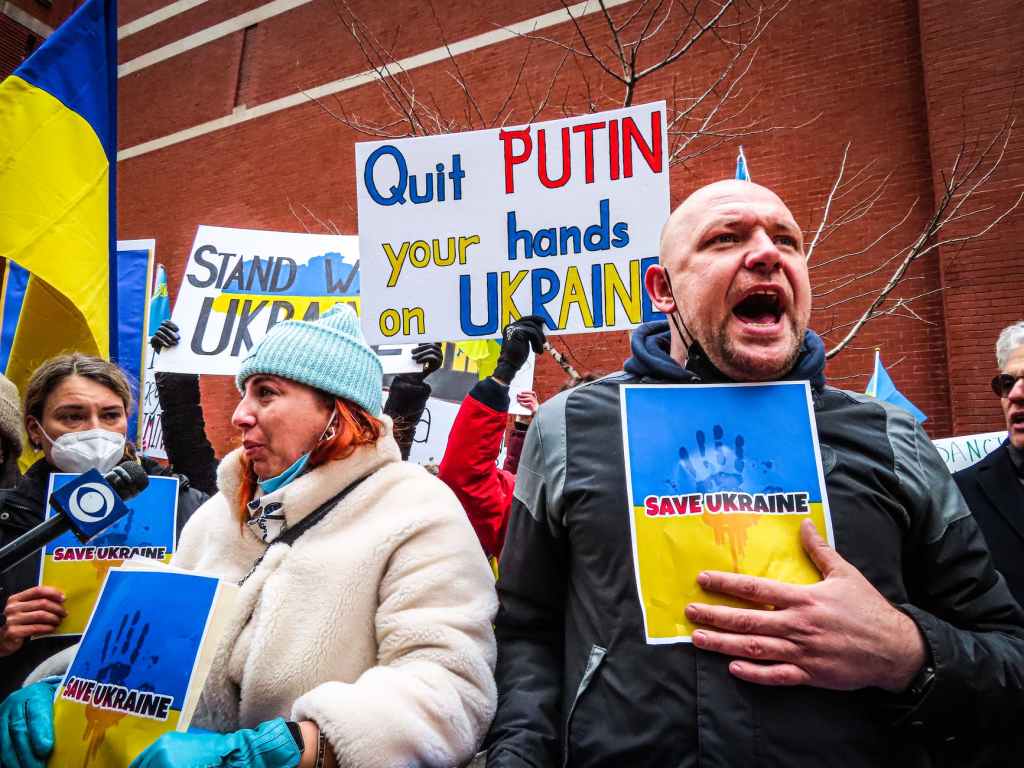
    It’s crazy how fast the world can change. While the Russian invasion of Ukraine last week was not a surprise, I still find it surreal that there was relative peace over there a few days ago. 

    Like so many, I’m struck by the senselessness of it all. Russia has invaded another sovereign nation in an unjustified and unprovoked attack, and the exact reasons why still aren’t entirely clear. Was it purely for conquest and to take back former Soviet territories? Was it to make a power play against NATO? There’s no obvious reason (that I’ve heard) as far as natural resources or great strategic advantage that makes this move make obvious sense. 

    The opening days of this war have been a debacle for Russia. Even if they overtake Kiev, it already seems apparent that they will never be able to occupy Ukraine among fierce resistance efforts and a global community who is increasingly coming to the support of Ukraine. It seems that Putin underestimated Ukraine and overestimated his military. The Russians were ill-prepared and ill-equipped for this invasion and to weather a strong resistance. 

    Putin’s miscalculation has done incredible damage to Russia. Looked upon as one of the world’s super powers, this botched invasion has made Russia’s military look incompetent. 

    But what happens next? Putin has talked of a nuclear alert in his military, though many see this as little more than saber rattling. It’s still a scary prospect. 

    All the while, the people of Russia will suffer for this. I feel bad for both Ukraine and Russia. I feel sorry for Russian soldiers who were thrown into a pointless war. It’s estimated that the Russians have lost more soldiers in less than a week in Ukraine than America lost in nearly nine years in Iraq. The world has ratcheted up economic sanctions against Russia. Russian citizens are going to suffer consequences for a war that I have no doubt that the average Russian never wanted to fight. 

    And certainly, I feel bad for the people of Ukraine who have had their lives and country turned upside down. 

    In America, for the first time in a long time, I feel like we all agree on an issue that matters. Russia had no right to do what they did. It cannot get much more clear cut of a country being in the wrong. 

    I’m not an expert. I’m just sharing my thoughts and observations today. On this day, I’m hopeful that it won’t escalate into a massive global war, but sadly, I could be wrong. But the concern that I have is still that it’s going to get worse before it gets better. What happens with Russia when this is over. Do we just absolve Putin of war crimes? 

    Will the western world cut Russia out of the club? I mean, after we figure out how to get away from Russian oil and gas. Or will we continue to condemn and sanction Russia and still be a customer? 

    Wisdom of the Crowd

    There’s this idea called Wisdom of the Crowd which is about how a greater number of inputs from people is closer to the right answer than what the average individual person would be. The classic example is if you have a jar of jellybeans and are asked to guess how many beans are int he jar, you might end up being way off. But if you have 50 guesses, 100 guesses, and if you average those guesses, it’s often pretty close to accurate. 

    I feel like the average person knows that we need to get off of Russian oil. Sadly, politicians often do not have the wisdom of the masses. 

    Thanks for reading. 

  • Catholic priest uses wrong word for 26 years. Baptisms invalidated

    Catholic priest uses wrong word for 26 years. Baptisms invalidated

    A Catholic priest in Arizona used the wrong word when performing baptisms for over a quarter of a century. Now his diocese is saying that the baptisms are invalid. 

    The issue is that the priest, the Revered Andres Arango was saying “we baptize you” when he was supposed to say “I baptize you.” The Catholic teaching is strict to their exact wording and because he say “we” instead of “I,” they are viewing these baptisms are invalid. 

    Baptism is a subject where there is a vast array of beliefs across Christendom. There are opinions on what baptism accomplishes, when a person can be baptized, who can do the baptizing, how a person is baptized, what is said when a person is baptized, the necessity of baptism. And then there are procedural questions. Are they sprinkled or dunked? If they’re dunked is it once, or is it three times (Father, Son, Holy Spirit)?  And there are many other questions. 

    Because baptism is such an important part of the Christian faith, there have been many views over the centuries. 

    For the record, my view is that baptism is an outward action that is a public display of an inward faith. True baptism is done by the Holy Spirit for a person who is regenerated. That is the actual cleansing of the human soul, and this cleansing is symbolized with water through baptism. And so in my view, I don’t take the rigidity that Catholics have on baptism where it can be nullified by a person unwittingly saying one wrong word. It’s based in places such as Ezekiel 36 and John 3. 

    Why does one little word matter so much? 

    On the website for his local diocese, they say: 
    “It is not the community that baptizes a person and incorporates them into the Church of Christ; rather, it is Christ, and Christ alone, who presides at all sacraments; therefore, it is Christ who baptizes. The Baptismal Formula (the words used in the Rite) has always been guarded for this reason: so it is clear that we receive our baptism through Jesus and not the community.”

    I find that argument interesting (I also find it to be a bad argument, but still interesting). I find it interesting that you can’t say “we” because it’s not the church who is doing the baptizing but that you must say “I” because it is Christ who baptizes…

    But in practice, it is the priest who’s doing the baptizing. And I find it interesting that if the priest says “I,” that it’s tantamount to Jesus himself saying “I.” 

    So the baptism is contingent upon the grace of Christ and (in the Catholic view) a human priest serving as a mediator. Yet, if the priest says the wrong word, then the grace of Christ can’t be conferred to the person who has made a good faith attempt to be baptized? So Jesus is gracious, but the priest can make a mistake where the sacramental benefit of baptism is withheld? Sincere question. Doesn’t that imply that the priest is more powerful than Jesus? (I’m sure no Catholic would agree with that statement). 

    This certainly goes to part of the heart of the disagreement between Catholics and Protestants. Scripture and tradition. The Catholic Church gives essentially equal weight to tradition as scripture. And so their tradition and teaching is a certain wording. And even though that wording is found nowhere in the Bible, they view their interpretation as being absolutely binding. 

    There is also the issue of human priest as mediators. The role of a priest is that they serve as a mediator between man and God. Jesus is the great high priest who mediates between us and God (Hebrews 4:14-16). This is why most Protestants don’t believe in a priestly office today. Because we don’t have fallible priests who can say the wrong thing and mess us up with God. We believe in a great high priest who is perfect, Christ the Lord. 

    Thanks for reading! If you liked this post, please share and subscribe.