2020 has been a year of tumultuous situations. Psalm 46 calls us to trust in God, regardless of what we face. God is depicted as a refuge and a warrior going before his people into battle, before reminding us of God’s greatest promise: the he will be with us.
Blog
-
Prayer day reminds us of persecution Christians face around the world

Photo Courtesy of Unsplash. Today is the International Day of Prayer for the Persecuted Church. We’ve seen crackdowns on Christianity (and other religions) in China. A recent report detailed testimonies of the atrocities against Christians in North Korea. Nigeria, which is fairly evenly split between Christians and Muslims has seen increasing hostility towards Christian in certain regions of that country. And in recent weeks in France, we’ve seen attacks against Christians. In the city of Nice, three people were stabbed to death this week.
According to Open Doors:
- Over 260 million Christians living in places where they experience high levels of persecution
- 2,983 Christians killed for their faith
- 9,488 churches and other Christian buildings attacked
- 3,711 believers detained without trial, arrested, sentenced or imprisoned
The reality of persecution should not surprise Christians. The New Testament repeatedly talks of the inevitable opposition for those who follow Christ. In 2 Timothy 3:12, the Apostle Paul says: Indeed, all who desire to live a godly life in Christ Jesus will be persecuted.
In the Sermon on the Mount, Jesus said: Blessed are those who are persecuted for righteousness’ sake, for theirs is the kingdom of heaven (Matthew 5:10).
And there are numerous other scriptures that could be referenced. The gospel is offensive to the world because it confronts people with their sin. It’s offensive to the world because it points to one way to heaven. It’s offensive because it takes man’s own goodness out of the equation for what justifies a person before God.
In America, we’re blessed to enjoy a rich history of faith and constitutional protections. But we should regularly pray for those who are persecuted for their faith.
I also think it’s important in America to appreciate the religious freedoms that we have. As we’re in the final days before the presidential election, I do see fears from some Evangelical Christians about persecution or limitations on churches if Joe Biden is elected president. While I appreciate that there are things Joe Biden supports which are totally against Christianity, I think doomsday fears of the purge on American Christianity are also an overreach.
Yes, Christians should always be attentive of what’s happening and vigilant to preserve and protect our rights. But I also think it’s important to remember the people who truly suffer for their faith, and who’s lives are truly endangered for following the Lord Jesus.
Prayer
Lord, on this international day of prayer for the persecuted church, we pray for those who are persecuted for the cause of Christ. Just this week, there were attacks on churches in France. Persecution is on the rise in many parts of the world. Lord, we pray for those who worship you at a great cost to themselves, their families, their livelihoods, and their lives. Lord, may you be near to them. Lord may those people never been far from our hearts and minds. Lord, in spite of man’s attempts to thwart your gospel, we pray for the work of pastors and evangelists in these hostile places. May the word go forth. May the truth be preached. May the message of Christ crucified be proclaimed and believed. In Jesus’ name, amen. -

ACB’s sorority shows inclusion by apologizing for congratulating her
Only women who support killing babies are capable of accomplishing things which should be acknowledged in society.
This week, Amy Coney Barrett was confirmed as an associate justice of the Supreme Court.
In the lead-up to Barrett’s confirmation, Kappa Delta – ACB’s college sorority – congratulated their famous alumna on her nomination with a Tweet which said: “KD alumna Amy Coney Barrett was nominated to serve on the Supreme Court. While we do not take a stand on political appointments, we recognize Judge Coney Barrett’s significant accomplishment. We acknowledge our members have a variety of views and a right to their own beliefs.
Reasonable. Trying to tiptoe around the politics. They faced a backlash from pro-choice members who could not believe the sorority would acknowledge a monumental accomplishment of a famous member. As many organizations do when facing pushback, KD folded.
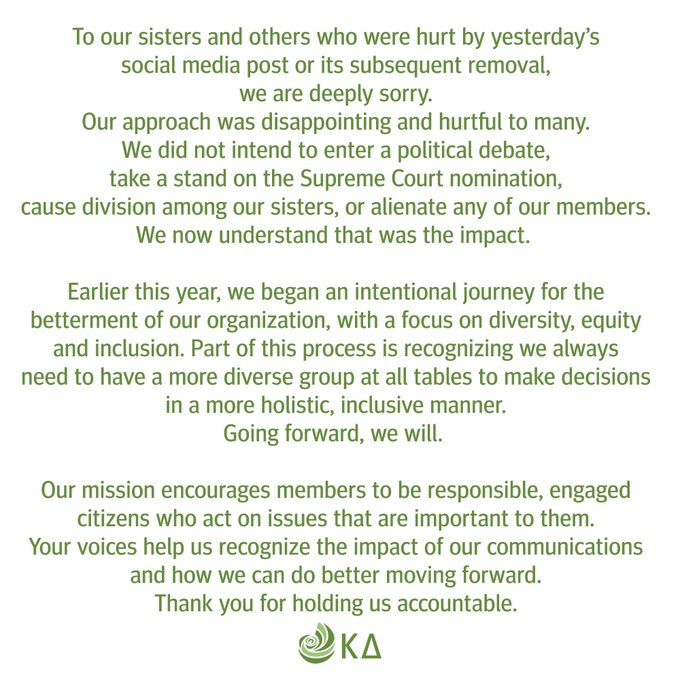
Where’s the apology for their sisters who approved of the post? The post says that they “began an intentional journey for the betterment of our organization, with a focus on diversity, equity, and inclusion.”
How is it inclusive to post about a historical moment and then apologize for that acknowledgement when some people get offended? Inclusion only goes one way. It’s inclusive when it includes a progressive viewpoint. But other views are not welcomed at the table of inclusivity. The KD statement went on to say that they’ve been working on “recognizing we always need to have a more diverse group.” And the solution is to ignore a position shared by a large swath of their members in the name of bowing to the outrage mob?
Again, Kappa Delta was not endorsing ACB. But even acknowledging her ascendancy onto the nation’s highest court is forbidden.
This isn’t the only such example .
The Girl Scouts also had the audacity to acknowledge the fifth woman in U.S. history being confirmed to the Supreme Court. Once again, the outrage mob responded.
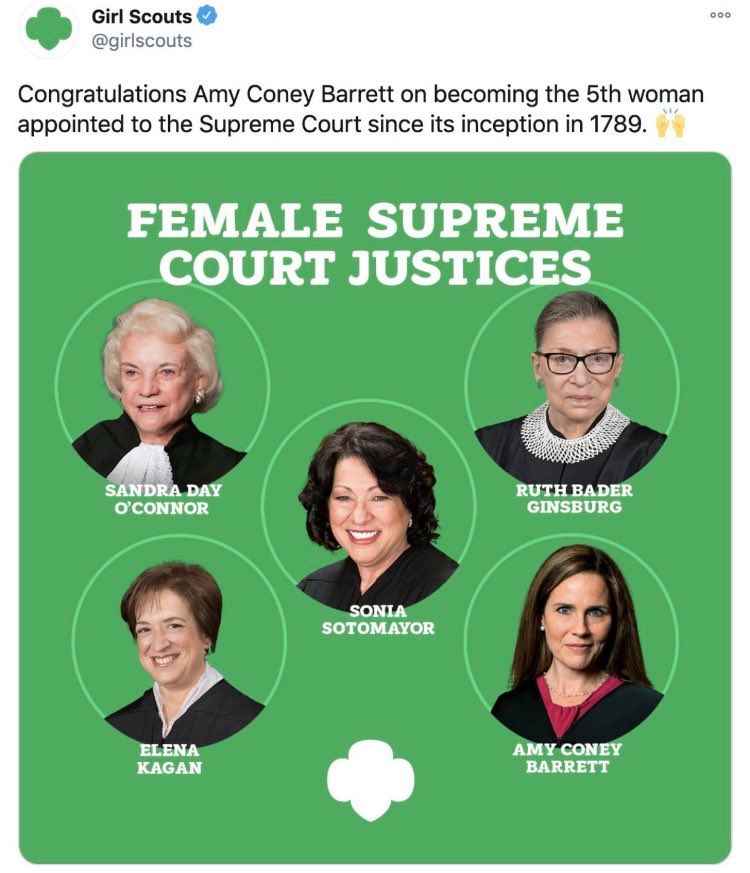
The Girl Scouts quickly backtracked and Tweeted: “Earlier today, we shared a post highlighting the five women who have been appointed to the Supreme Court. It was quickly viewed as a political and partisan statement which was not our intent and we have removed the post.”
Insanity.
Thanks for reading! If you liked it, share it!
-
Reformation Day – the day that changed the future of the church
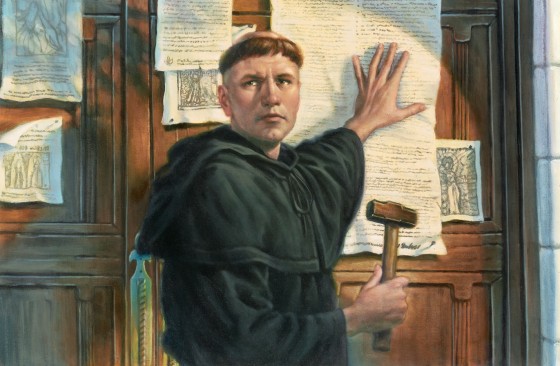
503 years ago today, the history of the Church, of Europe, and of the western world were forever changed in the town of Wittenberg Germany. Martin Luther wrote his 95 theses, a list of grievances against corrupt and unbiblical practices within the Catholic Church. The impact of this event continues to ripple throughout the Christian world.
Luther was not the first person to call for reform in the church.
Other movements perhaps had followings but didn’t have political support. Luther had that. Which afforded him a certain level of personal safety, though his martyrdom seemed inevitable at times. Another key difference between Luther and influential reformers who preceded him was the invention of the printing press. This allowed a mass volume of pamphlets to be produced. Luther was also likely helped by the fact that other reformation movements spread elsewhere in Europe during this time. Amid church abuses, Europe was at a tipping point. And while Luther was not the first to call for reform, it was his ministry that most significantly tipped the Reformation movement over the edge.
Less than 20 years later in England, Henry VIII broke away from the Catholic Church and started he Church of England in 1534. Reforms were also happening in Switzerland, most notably, the city of Geneva, eventually under the leadership of John Calvin. The Anabaptist movement sprung up who favorited believer’s baptism over infant baptism. These groups were not always in agreement, and some of them had severe conflicts with each other, but they were all in agreement that all was not well within the Church, and that there were changes which were necessary.
Against Church traditions that had become entrenched in Europe, the reformers did not think that they were doing something new, but rather were taking the Church back to its Biblical foundations.
By the sale of indulgences, it was believed that people could pay a price to have sins removed from themselves or for people for whom they had purchased the indulgences. But the issue with this was that the Catholic Church was overstepping its bounds on what saved a person. The Church was not the arbiter of what brings salvation, it is God’s grace alone received through faith alone in Christ alone. The gospel is not man’s gospel (Galatians 1:11).
The Catholic Church believes and believed that the seven sacraments impart grace by nature of being sacraments. While the Mass was in Latin and could not be understood by all people, the justification for this was that the sacraments still inherently imparted grace to a person, regardless of if they could understand. But this undermined faith. That’s not to say that Catholics (then and now) never value faith. But it can be easy to focus on sacraments and works apart from faith.
Interestingly the sacrament of confession was one which caused great angst for Martin Luther. Beginning as a devout Catholic and constantly aware of his own sinfulness, Luther lived in an ever-present awareness the this life did not live up to God’s standards of holiness. He had no assurance of salvation and lived in an exhausting cycle of constant confession. Luther would confess multiple times a day, sometimes for hours at a time, as he tried to remember every sin he committed, every hint of pridefulness, everything he should have done but hadn’t.
One verse that Luther had despised in the scriptures was “the righteous shall live by faith” which is found multiple times in the Bible (Romans 1:17; Galatians 3:11; Habakuk 2:4).
But Luther knew he wasn’t righteous.
In his confession story, Luther said:
“For I hated that word “righteousness of God,” which, according to the use and custom of all the teachers…though I lived as a monk without reproach, I feel that I was a sinner before God with an extremely disturbed conscience. I could not believe that he was placated by my satisfaction. I did not love, yes, I hated the righteous God who punishes sinners, and secretly, if not blasphemously, certainly murmuring greatly, I was angry with God.”But Luther would eventually be struck by the verse which had brought him such distress. The gospel was not about living up to the righteousness of God. It was about living for God in faith. And for Luther, that changed everything.
“At last, by the mercy of God, meditating day and night, I gave heed to the context of the words, namely, “In it the righteousness of God is revealed, as it is written, ‘He who through faith is righteous shall live.’” There I began to understand that the righteousness of God is that by which the righteous lives by a gift of God, namely by faith. And this is the meaning: the righteousness of God is revealed by the gospel, namely, the passive righteousness with which merciful God justifies us by faith, as it is written, “He who through faith isrighteous shall live.” Here I felt that I was altogether born again and hadentered paradise itself through open gates.”
Faith is a gift from God and that people are declared righteous by God as a result of faith in the gospel.
We are justified by faith. This became a hallmark of Luther’s theology. And it became invaluable to Protestantism. We are justified by faith, not by faith and works. Not through faith and Church. Not by faith and any of the sacraments (though baptism and the Lord’s Supper are things which all Christians ought to do and are commanded to do).
A critique of this view and an unfortunate consequence is that many take the “faith alone” view to mean that disingenuous faith is enough, just giving some vague assent to a gospel a person doesn’t really believe in. That wasn’t what Luther believed.
At the beginning of his 95 Theses, the first theses talks about how all of life is repentance. Faith is an all-encompassing reality and driving force of life. Living by faith in the Gospel of Jesus Christ. That we cannot earn salvation of our own merit but that it is entirely by grace alone through faith alone in Christ alone.
Happy Reformation Day!
This post was originally published October 31, 2017 as “500 years of reformation.”
Thanks for reading! If you liked it, please share!
-

Falwell sues Liberty after receiving $10.5 million
Jerry Falwell, Jr, the disgraced former president of Liberty University, the largest Christian university in America, is suing the school for defamation.
In his court filings, Falwell also cites a non-disparagement clause in his contract. Falwell’s lawsuit talks of Liberty’s “abdication of its legal, contractual, and moral obligations not to defame him.” The lawsuit also claims that “Liberty set out to destroy Mr. Falwell’s reputation through numerous defamatory statements.” The lawsuit talks about the wonders of Falwell’s leadership.
Background
The major scandal with the Falwell’s was the salacious accusation that Jerry Falwell, Jr was aware of a years long affair between his wife and a business associate. Part of that story is not in dispute. Falwell had previously acknowledged his wife’s affair (but denied the ongoing nature of the affair as well as the allegation that he had watched the two engage in the affair). But at the time, Falwell was already on leave from the university in response to a photo he had posted of himself and a woman at a house boat party with their pants unzipped.And before being placed on leave from the university, Falwell had done several other objectionable actions. He had posted a custom face mask which depicted Virginia governor Ralph Northam in a klansman halloween costume. He had lied about attending clubs in Miami. He had called people “stupid” and “idiot” on his social media.
The biggest bombshell Falwell faced was undoubtedly allegations of his awareness of his wife’s affair but he had already established a pattern of conduct which was inappropriate for the president of a Christian University (or for that matter, the president of any university). Long before these allegations, there were people who had called for Falwell to step down. There had been people who simply wanted an apology.
Resignation
In the wake of the reports about his wife’s affair, Falwell resigned from Liberty (and then he didn’t). And then he did. That was another debacle. But Falwell was given the very nice parting gift of $10.5 million to live the school.And now he’s suing.
Response
I’m not a lawyer. So I can’t speak to whether or not Falwell has a legal case. But a few thoughts come to mind. First, Falwell had previously claimed that when Liberty put him on leave, that this went against the terms of his contract. I consider that clause and his suggestion that he also had a non-disparagement clause, and I can’t help but question why he wanted all of these guardrails in his contract to protect his own poor conduct?Again, maybe he has a legal case. Maybe the school will have to pay him millions of dollars. That I don’t know. But it’s shameful that the head of a Christian University would put so many provisions in his contract which so greatly reduced the university’s ability to hold him accountable.
Second, I can’t help but question the school and why they agreed to all of these provisions and gave themselves so little ability to hold him accountable and provide oversight. Shame on Liberty’s board.
Third, did Liberty pay Falwell $10.5 million and not have him sign any sort of release or agreement that he wouldn’t sue them?!
This whole thing is a debacle.
Thanks for reading! Make sure to like, comment, and subscribe!


