The wise men come to Herod in seeking the King of the Jews. It’s so much woven into the Christmas story that it can be easy to overlook how bizarre the scene is, but the first people who seek out the newborn Jesus are pagan astrologers. There are different responses to this king. Some will seek him out, others will overlook him, and some will seek to destroy him. How do you respond?
Tag: Christmas
-

Joseph, Mary, and a huge test of faith
In the Gospel of Matthew, a young couple named Mary and Joseph receive some truly shocking news. Mary is expecting! Despite the fact that they have never consummate their relationship and that Mary is a virgin.
Joseph faced a dilemma.What does he do? They lived in a small village. Inevitably Mary was going to start to show. With the cultural sensibilities of their day, this pregnancy in an unmarried couple would have been scandalous.
Mary would make it appear as though either Mary had been unfaithful to Joseph, or that Mary and Joseph together had violated the betrothal custom and conceived a child together.
Jewish teaching at the time essentially forbade marrying someone to whom you were betrothed who had been unfaithful.
In Matthew 1:19, Joseph initially does not see it as an option to marry Mary. But he doesn’t want to shame her either, so he just wants to try to make the breaking of the betrothal as painless as possible for both of them.
There appears to be a sensible course of action until Joseph is greeted with the most unexpected news.
An angelic messenger appears to Joseph in a dream.
Matthew 1:20:
But as he considered these things, behold, an angel of the Lord appeared to him in a dream, saying, “Joseph, son of David, do not fear to take Mary as your wife, for that which is conceived in her is from the Holy Spirit.Sometimes the Lord can quickly change our plans. Joseph is told not to fear taking Mary as his wife.
The reason he needs to be told not to fear is that the religious and social expectation would be that Joseph would not take Mary as his wife, due to her apparent adultery.
For the town gossips in Nazareth, the explanation that Mary is pregnant with a child that has been conceived via divine conception is not exactly the easiest story to believe.
It would have been just as hard for someone in the first century to believe this was possible as it is for us in modern times. They knew where babies came from!
So to marry Mary is to also have to deal with the social ostracism of marrying an apparent adulteress.
But Joseph is told not to fear.
Now just because he’s told not to fear taking Mary as his wife, that does not mean that it’s going to be easy.
We don’t know a ton about the life of Joseph after Jesus was born. But the gospels give us a few snapshots, and it was hard.
In Luke’s narrative, when Jesus was born, there was no room for them.
A story that I plan to preach in a couple weeks, but when Jesus was just a baby, the King, a man named Herod hears about this King of Israel who was born and in his jealousy, seeks out to try to have Jesus killed off.
The family was forced to leave Judea and go into hiding in Egypt.
So we see an inhospitable world, danger, exile. Hardships. Church tradition holds that Joseph was already deceased by the time that Jesus began his public ministry.
Joseph is told to fear not. Why? Because he was following the will of God. But again, that doesn’t mean that following the Lord will be easy.
The disciples followed the Lord. But they had lives of difficulty and persecution, ultimately leading to the martyrdom of all but one of them.
We celebrated Thanksgiving last week.
I always think about the Pilgrims who came to this country in the 17th century. They came here in order to live out their faith. And they probably never could have imagined it at the time but they set forth a legacy which has extended into America to this day. The rich religious history that we have in this nation.
Was it wrong of them to come? Was it a bad idea to come? No.
But half of them died by that next winter. They had lives of hardship.
I think of the great missionaries over the centuries.
People who were serving a purpose greater than themselves. But the centuries of missionaries who have faced persecution and death for that calling. The work they did, the challenges and hardships they faced.
Father Damien was a priest who served a leper colony in modern day Hawaii. He served people who were the outcasts of society. He contracted leprosy himself in 1885. But he continued to serve until he died of the disease four years later.
Maria Taylor was the wife of Hudson Taylor, perhaps the most well known missionary of the 19th century. He ministered in China. Maria herself had been the daughter of missionaries. Born in Asia, her parents both died when she was ten years old. She was sent to England to be taken care of by family but married Hudson Taylor when she was 16.
In China, they faced opposition, persecution, and financial hardships. Of the nine children she birthed, only four reached adulthood. She died of cholera when she was just 33.
That’s so often not what today picture as the Christian life. We want to believe in a prosperity gospel that sells on the lie of just be good and everything in your life will be good. The problem is that it’s not true to reality and it’s not true to what the Bible teaches.
Sacrifice, difficulty, hardship.
Why would anyone want that?
Because of the great God we serve. Because of the great savior we have in Christ. Because of the great cost that he paid for our forgiveness.
God gives grace. His power is perfected in our weakness. God sanctifies us through our difficulty. As we serve the Lord through challenges, and walk with him, it is also an opportunity to grow with him.
The Bible doesn’t teach that just have faith and it’ll always be easy. The Bible teaches to trust in God even when things are difficult.
It makes no sense in the eyes of the world. But God is the only thing that truly matters. And if all we have is God, that is all we need. Again in the eyes of the world, that is laughable. It’s worthy of mockery.
Why would a good God allow his most sincere followers to suffer so greatly?
But it’s a byproduct of doing ministry in a world that is fallen. We have a savior who can identify. Jesus went to the cross. He suffered. He was betrayed. He was mocked.
In life, everything that’s truly worthwhile and worth doing involves hardship and suffering and challenges.
Marriage is a great blessing. Marriage has its difficulties. It’s difficult seasons. Difficult conflicts.
But its’s worth it.
Having kids is a great blessing. But it’s hard. You’re trying to civilize a sinful person. Now no one forces you to get married. No one forces you to raise kids. You choose those things, even though they’re difficult.
I think of those great missionaries. They had difficult lives. But still they chose that life. They could have walked away. They could have left the mission field. At the first sign of danger or death, they could have given it all up.
But things that are worth doing are hard.
In life, all of those challenges bring their own blessings, in spite of the hardship. And truly living for God, in spite of the difficulties brings the blessings of knowing God and growing with God and living to the glory of God.
It’s not always easy. But it is always worth it.
In the gospels, there’s a story of Jesus and the disciples when they got caught up in a tremendous storm. Why were they on that boat? Because Jesus had led them to it.
In the Book of Exodus, the Israelites cross the Red Sea. Why were they at the banks of the sea between the water and the Egyptian army? Because that’s where the Lord had led them.
God is not always leading us to what’s easy. But he is always leading us to what’s right.
Our world has bought into this unbiblical lie that, in this life, you’re always being led to something really great.
Not always. Sometimes you’re being led into something really hard. Sometimes people suffer, sometimes people die.
It is in eternity and in the presence of God, when everything is ultimately made right and perfected. But in life, there are trials and challenges. The good news is that we have a savior who will be with us through it all.
And so Joseph is told to fear not. Not because it’s easy. But to fear not because of who God is.
-

People missed the significance of the first Christmas – but how do you respond to Jesus this Christmas?
There are the important days that we know are important at the time. And there are the important days when we only know of their significance with hindsight.
A couple weeks ago, we had the anniversary of an important day in American history when we remembered the 80th anniversary of the Pearl Harbor attacks on December 7, 1941.
Other important days in American history.
November 22, 1963, the day President Kennedy died.
September 11, 2001.
You knew those were historic days at the time.
And that’s also true in our personal lives.
There are some days that you know are monumental days at the time.
The day you get married. The day kids are born.
But as we begin in our passage this morning, I want to talk for a moment about the days that matter but that we don’t know matter until after the fact.
On June 28, 1914, the heir to the throne of Austria-Hungary was killed. It was a story at the time, but to observers, it seemed like a regional matter that wouldn’t extend much past Eastern Europe. In reality that event was the spark that led to the outbreak of World War I, the most destructive war the world had ever seen at that time.
The days that matter that you don’t know matter.
The first time you ever heard of Covid-19 in China, you probably never imagined that it was going to turn our world upside down.
Think about the day the lightbulb was invented. The world was going to change but most people had no idea.
It’s always a fascinating thought to me. That such significant days can be days when you don’t know it at the time.
I think of one of the most significant days in my life. February 20, 2017. It was on that day that I talked to a girl on eharmony.com who I thought looked cute. I had no idea at the time, but that was the first day I ever talked to my wife.
Think about the day a famous person was born. No one knows it at the time. A future president, or leading actor, or star athlete could be in the process of being born this very morning and we wouldn’t know it.
And I think of that with the events surrounding the first Christmas Eve.
Human history was about to forever change.
For people who lived in Bethlehem on that first Christmas Eve, their little town was about to be center stage to events that we’d be talking about 2,000 years later, events that were so significant that time itself is calculated by its proximity to them.
And for the average person living in Bethlehem on that first Christmas Eve, they would have had no idea.
Think about that.
SONG – WHILE YOU WERE SLEEPING
One of my favorite newer Christmas songs of the last several years comes from the Christian band Casting Crowns. The song is titled “While you were sleeping.”
And the song considers this world-changing event. Christ coming into the world, and how it happened on – for many people – just any other ordinary night.
The song says:
O Bethlehem, what you have missed while you were sleeping
For God became a man
And stepped into your world today
O Bethlehem, you will go down in history
As a city with no room for its King
While you were sleeping
While you were sleeping
The world kept turning. On that first Christmas and over the coming weeks and months, people continued to live their lives.
For the average person living at the time, that seems to be the most likely response at the advent of Christ. Unawareness. Obliviousness.
But there were some who had heard about the birth of Jesus. You have wise men who sought this newborn baby out. You have King Herod who heard the news but who was not overjoyed at the prospect of another king living in his territory. And you have Herod’s priests and scribes, those who were most learned in the Old Testament, yet who would miss the significance of the moment.
The first Christmas, many didn’t realize what had happened. But since that first Christmas, the rest of history has been turned upside down.
It was easy to be blissfully unaware of Jesus as a baby. But what do you do with him as a man? What do you do with him as a teacher? What do you do with him as a prophet? What do you do with him as a savior? What do you do with him as Lod?
Some will continue to ignore him, some will continue to miss the significance of who he is, some will continue to actively oppose him.
But will you come to him and worship him?
It might have been easy to dismiss a baby, but that baby grew and became the savior of the world. That baby went to the cross. That tomb was empty on the third day.
What do you do with all of that?
Will you continue to overlook the significance of Jesus and who he is?
Or will you come to him and worship him as Lord?
People ignored and overlooked the significance on the first Christmas but what are you doing with Jesus this Christmas?
He invites you to come to him, to know him.
Thanks for reading! If you liked it, please share and subscribe!
-

The gospel in Home Alone
Like many Americans, one of the ways I celebrate the Christmas season is watching Christmas movies. Some of my favorites include A Muppett Christmas Carol, The Santa Claus, and Elf. But my all time favorite Christmas movie, by far, is Home Alone.
Many classic Christmas movies have wonderful redemption themes (Christmas Carol is a great example of this). But Home Alone revolves around redemption. A couple of years ago, Les Lanpere of the Reforemd Pubcast made a video outlining redemption themes and asking if Kevin’s character finds faith in the film?
It’s a fascinating argument that Lanpere presents (and as much as I enjoy Home Alone, he’s clearly put much more thought into it than I have). Now, it’s impossible for me to not watch Home Alone through the redemptive lens that Les gave to it.Spoiler alerts (although who hasn’t seen Home Alone?!)
Early in the movie, Kevin is having conflicts with several family members, his older brother, his cousins, his parents, his uncle. And he wishes that they’d all disappear. This represents sin. It’s the eve of a special family trip to Paris over Christmas.
The following morning, Kevin gets his wish! The family is running late to the airport for their Paris trip. Through a headcount mishap, they leave, thinking that Kevin is in one of their shuttle vans. With the family off to Paris, Kevin awakens to discover that he is Home Alone. At first, he has a blast, basically doing whatever he wants but he will eventually begin to miss his family. He finds a department store Santa and expresses his wish to have them back, but he sees his powerless this figure is to bring restoration. This represents the false hope that idols can bring.
There is a second conflict in the movie: the Wet Bandits, two burglars who have been prowling in their neighborhood and robbing houses when families are traveling. They know that the McCallister’s are going to Paris. The Wet Bandits essentially represent evil in this movie (though comically).
Kevin finds out about their plot to strike his home. Since he knows that Santa can’t help him, on the night of their attack, he goes to church. A choir is singing hymns. Old Man Marley walks up to Kevin. He was introduced in the movie when Kevin’s brother Buzz told Kevin an urban legend about Marley being a killer. But when he introduces himself to Kevin, Marley is kind. Marley is a Messianic figure in this movie. He asks Kevin if he’s been good, Kevin admits that he has not. Marley tells Kevin he’s come to the right place. Marley also tells Kevin about a strained relationship with his son (prodigal son).
Back at the house, Kevin works on his plans to protect his home. We all see him pray before his evening meal. The dinner scene has essentially no relevance to the movie, aside from the fact that it shows him praying. Something that the family had not previously done. The robbers are stopped time and again, but eventually catch up to Kevin. In one of the most striking theological symbols of the movie, Harry is about to “devour” Kevin (bite his fingers) when Old Man Marley comes in at the last moment to intervene and save Kevin.
On Christmas morning, Kevin’s mother (who had been trying to get back to him throughout the film) returns home. The rest of the family follows soon after. We see restored relationships. We see the bad guys defeated.
The movie is a masterpiece.
Most importantly, it is a picture of the gospel. We have sinned against God, but we have a savior who has come to rescue us. Jesus was born on the first Christmas. He came to do what we could not: to reconcile us to God, to fix the relationship that had been broken. We could not do it on our own efforts (I actually take the scene of Kevin’s plan of stopping the Wet Bandits as being symbolic of this). He was eventually caught by them and needed a savior.
That savior is Jesus. He delivers us from sin. He restores us to God. He brings us life. He came to do that for all who accept his grace and trust in him.
Let us not trust in ourselves, let us not trust in our own pursuits, let us not trust in our own efforts or plans. Like the Santa who Kevin goes to visit, anything aside from God will fail us. We must go to the Lord himself.
Originally published December 19, 2018
-
The wise men and the mission of God. Studying Matthew 2
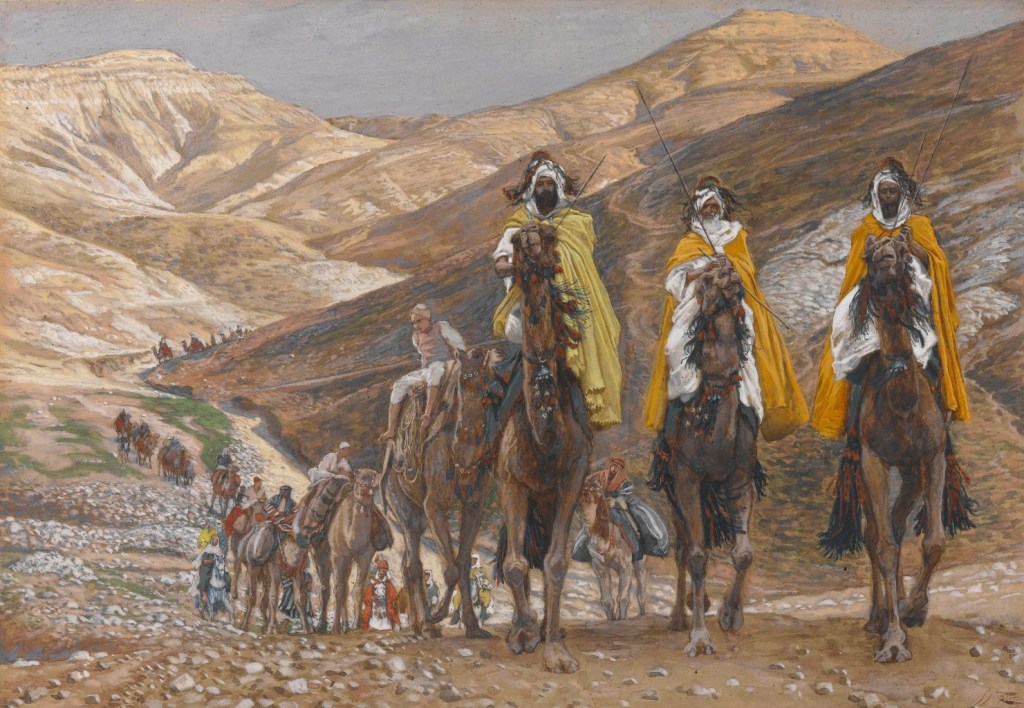
In Matthew 2, verse 1 ends by saying that wise men from the east came to Jerusalem.
The ESV says wise men. The Greek word that it comes from is magi, if you’ve ever heard that term.
They’re basically astrologers and astrology was respected in the ancient Roman world.
The text says that they came from the east. That’s probably referring to either Persia, or Arabia, or Babylon.
These wise men came from somewhere where they clearly had some familiarity with Jewish beliefs and Messianic expectations.
But, and this matters, they themselves are not Jewish.
Also – for the record – the Bible never says that there were three of them.
It seems most likely that the number comes from the three gifts they bring of gold, frankincense, and myrrh.
The text says that the wise men came to Jerusalem. That makes sense. That would be an obvious starting palace if you’re looking for the Jewish messiah. Jerusalem had been the capital of the promised land.
Before they leave Jerusalem in search of Bethlehem, Herod requests that they let him know when they find the young Jesus.
Verses 7-8:
7 Then Herod summoned the wise men secretly and ascertained from them what time the star had appeared. 8 And he sent them to Bethlehem, saying, “Go and search diligently for the child, and when you have found him, bring me word, that I too may come and worship him.”
When I read the story and Herod tells the wise men to let him know when they locate Jesus so that he too may worship him, I imagine the music in the soundtrack turning more sinister. Herod has no desire to worship Jesus. It’s a ruse.
I think of the big bad wolf dressing up as the grandmother of Little Red Riding Hood. I think of Ursula the Sea Witch pretending to care about Ariel in the Little Mermaid.
Herod is lying.
So the wise men depart for Bethlehem.
Verses 9-10:
9 After listening to the king, they went on their way. And behold, the star that they had seen when it rose went before them until it came to rest over the place where the child was. 10 When they saw the star, they rejoiced exceedingly with great joy.
Keep in mind that the wise men are not Jewish.
They’re pagan astrologers.
And with that, let’s zoom out of the story for a moment.
The wise men in Matthew
When we read any Biblical account that’s associated with Christmas, there are different aspects of the story that are embedded in our culture.
It’s part of the story that the baby was born at an inn and laid in a manger, and that the wise men followed a star and came to him.
And with the idea of the wise men, it’s so embedded into our understanding of the Christmas story, it’s such a normal part of the story to us that I don’t think we consider how utterly bizarre it truly is.
You have pagan mystics who are the first ones to seek out newborn Jesus.
That’s…weird.
Matthew tells us about the wise men. And we see them nowhere else in the New Testament.
It’s not like when Jesus does his first miracle, there are wise men who are led to that place. It’s not like when Jesus is at the cross, there are wise men in the crowd. It’s not like when the disciples find the empty tomb on the first easter, that a star leads wise men from the east to the tomb.
But they’re the first ones on the scene when Jesus is a newborn?
It’s weird!
Astrology is pretty clearly forbidden in the Old Testament.
Deuteronomy 4:19 says: And beware lest you raise your eyes to heaven, and when you see the sun and the moon and the stars, all the host of heaven, you be drawn away and bow down to them and serve them, things that the Lord your God has allotted to all the peoples under the whole heaven.Deuteronomy 18:10-12: anyone who practices divination or tells fortunes or interprets omens, or a sorcerer 11 or a charmer or a medium or a necromancer or one who inquires of the dead, 12 for whoever does these things is an abomination to the Lord. And because of these abominations the Lord your God is driving them out before you.
Yet, here we have wise men on the scene.
Why?
Why does Matthew say there were wise men?
Couple of reasons.
First, given that astrology is so strongly forbidden in the Old Testament, and continues to be frowned upon in the New Testament, I think that Matthew mentions the appearance of the wise men because it really happened.
Why on earth would you make that up?
But there’s another very important reason for the wise men in the story.
The wise men and the mission of God
The first people Matthew records seeking Jesus, finding Jesus, giving reverence to Jesus are non-Jewish pagans.
We take the idea of the three wise men. We see it depicted in nativity scenes. It’s a quaint Christmas image.
But what Matthew is once again doing is showing that Jesus is for the whole world. The gospel that Jesus brings is for the whole world. The light that Jesus gives is given to the whole world.
Even for pagans who don’t come from Israel and who have practices that would be looked at as sinful. Jesus is for them too.
There will be Jewish people we get to in this section who are oblivious, apathetic, or even hostile to Jesus coming into the world. They’re the ones you’d expect to recognize their coming king and Messiah. But instead, it’s the outsiders.
This will also foreshadow two things: Jesus being rejected by Jewish leaders when he is sent to the cross, and Jesus’s global mission when he sends his followers into the world to fulfill the Great Commission.
And that’s important because what matters is that they’ve come to seek Jesus. And a person can always seek Jesus just as they are. You don’t clean yourself up and then go in pursuit of Jesus. You don’t get all of your moral ducks in a row and then go and look for Jesus.
Jesus meets us as we are. And we to come to him, to know him, to love him, and to believe in him. And when a person does come to know Jesus, it is such a dramatic and impactful relationship that the person who truly knows him is changed by him and can never be the same.
We see the reverence they have for Jesus at the end of the passage.
Verse 11:
11 And going into the house, they saw the child with Mary his mother, and they fell down and worshiped him. Then, opening their treasures, they offered him gifts, gold and frankincense and myrrh.
Again, probably different than how we think of worship. It’s probably more along the lines of prostrating themselves before a royal figure, but they give that homage to Jesus.
The gifts of gold, frankincense and myrrh might seem like od gifts to bring to a baby.
My wife and I just had a baby. Those weren’t on our registry.
But think of them as less gifts for a baby and more gifts for a king. When heads of state visit today, it’s customary to bring gifts.
Gold is universally valued. Frankincense and myrrh are resins which can be used in perfumes.
Those were the gifts the wise men brought to Jesus.
The gift that Jesus reciprocated with is the gift of eternal life.
Thanks for reading! If you liked it, please share and subscribe!

