Josh Benner

Tag: family

  • Best of 2018. #2 Bring your fussy child to church day

    41399491_10156449724805900_4799046815594840064_n
    As 2018 comes to a close, I am sharing some of my top posts from this year. 

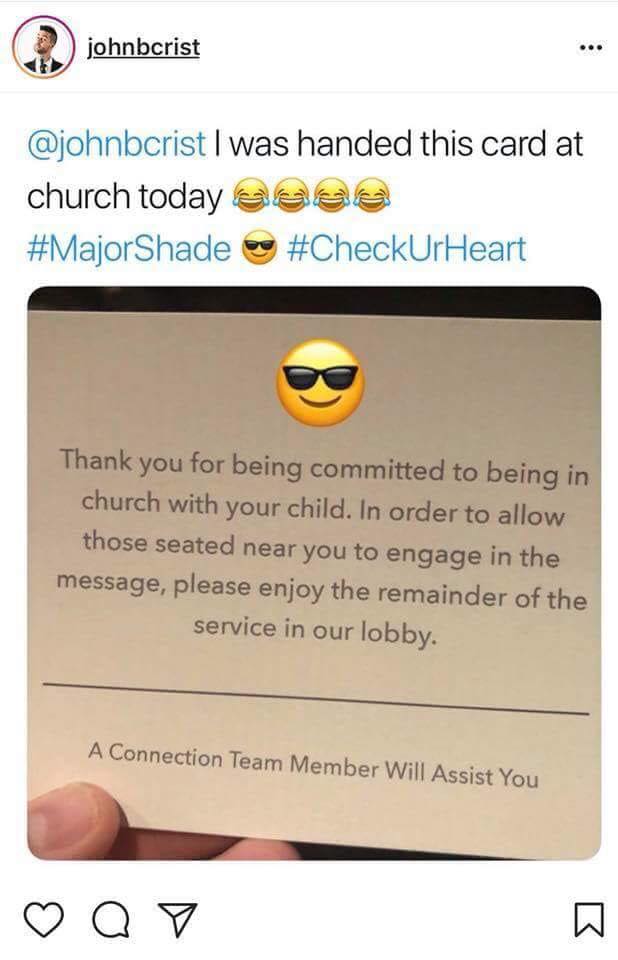
    Christian comedian John Crist shared this photo on Instagram this weekend that’s gone viral. The photo is a card from a church, apparently meant to be distributed to parents of fussy children, instructing them that a “connection team member” would assist them in leaving the sanctuary during worship.

    It’s a sad commentary on the American church that we shame parents for bringing their kids and their kids…acting like kids in a church service. (more…)

  • Bring your fussy child to church day

    41399491_10156449724805900_4799046815594840064_n
    Christian comedian John Crist shared this photo on Instagram this weekend that’s gone viral. The photo is a card from a church, apparently meant to be distributed to parents of fussy children, instructing them that a “connection team member” would assist them in leaving the sanctuary during worship.

    It’s a sad commentary on the American church that we shame parents for bringing their kids and their kids…acting like kids in a church service.

    If the gospels were written today, and Jesus was teaching to great multitudes and a child was fussing, would he ask the parent and child to be escorted away from his presence? In the Gospel of Matthew, Jesus said: “Let the children come to me. Don’t stop them! For the Kingdom of Heaven belongs to those who are like these children” (Matthew 19:14).

    A baby has just as much right to be there as you do.

    It’s unfortunate that a parent who’s tired, who’s working, who’s doing their absolute best, and on top of all of the other hassles in life, knows it’s worth it to take their young child to church, and when they do that, has to worry about the eye rolls, the murmurs, the complaints for if their child gets fussy. That should be the last place where they’re going to be criticized. Those parents should be applauded, not judged.

    Can it be annoying to hear a fussy child? Yes. Obviously. But it’s more annoying to hear a fussy adult whining about a baby. There isn’t a Biblical mandate: thou shalt wait until thine child will behave before thou shalt bring them into the Lord’s house.

    Yes, if a young child is having an absolute meltdown, of course it’s reasonable to step outside of the room for a moment. A parent has enough sense to know that. But the fact that this church had a special card printed up and ready to hand out? Yes, I realize that card compliments the parent for bringing their kid but it’s underhanded when couched in “now please leave the corporate worship service.”

    Jesus spoke to multitudes of thousands during his ministry. Those parents weren’t dropping their kids off with the babysitter. There would have been fussy children then. Other parts of the world have livestock nearby making sounds. Worship in other parts of the world is done in secret at the threat of persecution. But heaven forbid a little kid sometimes cry or speak up.

    They’ll learn. Their behavior will improve. But what’s priceless is teaching them from a young age that church is important and something that should be part of life.

    If we’re going to want to make parents feel ostracized or unwelcome because of their children, I think we need to check our own hearts in that. What do we value? Can we put up with a little bit of inconvenience so that a young child can be included in the service too?

    The church isn’t a restaurant, it’s not a movie theater. If you want to complain about a fussy child in those establishments, go ahead. But we should not approach it like our satisfaction with every visit is the supreme end of the service.

    Thanks for reading! I’d love to hear what you think, and don’t forget to subscribe! 

    Josh Benner is the associate pastor at Cornerstone Evangelical Free Church in Fergus Falls, Minnesota and has a Master of Divinity from Trinity Evangelical Divinity School. He enjoys writing about faith and culture. He lives with his wife Kari in Minnesota.

    Let’s connect!
    Facebook
    Twitter
    Instagram

  • Forgiveness in the shadow of death

    13718616_10154461283134260_1702054337548725430_n.jpg
    In the summer of 2016, Jamison Pals drove through Nebraska with his wife Kathryne, and their three young children: Ezra, 3; Violet, almost 2; and Calvin, 2 months old. As traffic slowed down for construction, a semi truck, driven by a 53 year old driver named Tony Weekly slammed into the back of the Pals family. Their car burst into flames. All five died (a sixth person in another car also died from injuries related to this accident).

    The family had been driving from Minnesota to Colorado to train as missionaries, with plans of being sent to Japan.

    Last week, the driver was sentenced. Advocating for him was an unlikely source: the victim’s own families. “We ask the court to give the maximum allowable grace,” Kathryne Pal’s father Gordy Engel said before the court.

    Tony Evans was sentenced to six months in jail for his crime.

    The grace and forgiveness of the families I find inspirational. It’d be easy to hate this man. It’d be easy to never want to forgive him.

    But the families have publicly forgiven him. They’ve embraced and hugged him, they’ve prayed for him, and shown him love.

    That’s the power of the gospel. It’s a love that doesn’t even make sense. This man’s actions took away six lives and a beautiful young family. And yet, their relatives can forgive.

    Rick Pals (the father of Jamison Pals) said in court: “I can honestly say Tony, both families have forgiven you…I know how much God has forgiven me. How could I not forgive you?”

    For Christians, forgiveness is never given as an option. We are always called to forgive others. In the face of tragedy, these two families have shown something profound, something beautiful.

    41 “A certain moneylender had two debtors. One owed five hundred denarii, and the other fifty. 42 When they could not pay, he cancelled the debt of both. Now which of them will love him more?” 43 Simon answered, “The one, I suppose, for whom he cancelled the larger debt.” And he said to him, “You have judged rightly.”

    Luke 7:41-43

    Josh Benner is the associate pastor at Cornerstone Evangelical Free Church in Fergus Falls, Minnesota and has a Master of Divinity from Trinity Evangelical Divinity School. He enjoys writing about faith and culture. He lives with his wife Kari in Minnesota.

    Let’s connect!
    Facebook
    Twitter
    Instagram

  • Would it be better if parents raised their kids without religion?

    photo-1499051702423-a69ae318af8f.jpeg
    A friend recently asked me this question. As a Christian, there are several reasons why I believe the answer is no.

    This reminded me of an article I read a couple years ago by former NFL running back Arian Foster. In an article he wrote for Yahoo, Foster was talking about his parenting philosophy. When it came to faith, he said:

    The flying spaghetti monster. There are billions of people on Earth with hundreds of religions and sects that trickle off each other. I will never tell her what to believe in. I know parents are very influential on kids’ spiritual beliefs and that can be a positive or negative thing. I can give her a basic understanding of religions when she starts showing interest and asking questions. But I will remain silent otherwise. How can I make a young mind believe this is the truth for them when they don’t yet have the capacity nor the cognitive desire to delve into something like this? If she shows interest I would advise her to fully investigate a religion and see if it fits her. And if she chooses none of the above, I’ll be fine with that as well. The values I instill in her should guide her to her decision. What’s most important, I believe, is to support her decision no matter what.

    Foster argues that he doesn’t want to push religious beliefs saying “I will never tell her what to believe in” and “I can give her a basic understanding of religions…but I will remain silent otherwise.”

    To raise a child without faith can be framed as “not telling them what to believe in.” However that’s clearly affirming and privileging a secular worldview. It’s raising someone with a default setting of irreligion.

    Foster says that he’s fine if she eventually chooses faith (I don’t doubt his sincerity in that). But he argues that what matters more than raising someone according to a faith tradition is raising them with a certain set of values. That was similar to my friends question. Instead of raising someone according to religion, why not just raise them to be good/benevolent?

    The gospel is predicated on the idea that a person can’t be good on their own. And faith in Jesus Christ is essential to the salvation of a person’s soul. For a Christian, that is part of why a hands off approach to faith does not harmonize with parenting. Any loving, Christian parent should raise their children in the knowledge and fear of the Lord. This isn’t unique to Christianity. It’s true of the major faith systems. There is no faith tradition (that I’m aware of) that says “Hey, raise your kids outside of this faith and see what they believe.”

    I understand why someone who’s not religious would have such a view that undermines the role of faith in a person’s life. Christian faith is meant to be a parent’s source of meaning, morality. It’s meant to shape your life, your family, and your parenting. The idea of not passing that tradition onto one’s kids is fundamentally inconsistent.

    Furthermore, the Bible constantly commands parents to raise their children to know the Lord. In the Old Testament, the Israelites failed to do this which was the source of a lot of their struggles.

    The Book of Deuteronomy commands:

    6 And these words that I command you today shall be on your heart. 7 You shall teach them diligently to your children, and shall talk of them when you sit in your house, and when you walk by the way, and when you lie down, and when you rise.

    -Deuteronomy 6:6-7

    For Christian parents, it’s not meant to be an option. Ultimately no one can control what someone believes. But a kid needs to be given every chance to hear the gospel. It is faith in the gospel by which souls are saved. Also the flavor of the month in our society today is about letting kids dictate everything (faith, gender, etc). But they have to be raised with a foundation.

    There’s also covenantal theology but I’ll save that for another post.

    Josh Benner is the associate pastor at Cornerstone Evangelical Free Church in Fergus Falls, Minnesota and has a Master of Divinity from Trinity Evangelical Divinity School. He enjoys writing about faith and culture. He lives with his wife Kari in Minnesota.

    Connect with me!
    Facebook
    Twitter
    Instagram
  • Is the media making truth harder to know?

    mc_escher_063.jpg
    With major news stories, does anyone else ever feel like it can be incredibly hard to even know what’s true?
     
    All of the media outlets have agenda, the spin that comes from both parties, facts getting twisted, intellectual dishonesty. I believe that truth is inherently worth knowing and pursuing and I feel like they make it so hard. I’ve read multiple articles on the border situation everyday this week. 
     
    It’s complicated. There’s a lot of context to these situations. 
     
    But it’s made so much more complicated to understand because of coverage. And I see it with stories all the time. 
     
    Every major media outlet does things that undermine their own credibility. Not saying they’re wrong on everything, but they’ve all been guilty of things to where I feel they can’t be trusted on everything. Some of the photos that are being shared aren’t even recent. Most noteworthy among them is the one of the little girl who’s crying. The one Time put on the cover. It’s not even true. She was never even separated from her mother. 
    There is no media outlet that has the credibility where they deserve to be implicitly trusted based on reputation alone.
     
    You hear different statistics and then conflicting statistics. 
     
    There are questions about what did or did not happen during the Obama administration. What Trump can or cannot do in regards to the border. 
     
    I also feel like a lot of things hinge on which side of the political aisle someone is on. Some people will just automatically assume it’s bad and wrong if Trump does it (same when Obama was president, same when George W. Bush was president). Others will generally be inclined to agree with the president if he’s in their party. But it’s shortsighted to think one president is always right or always wrong, and I feel like that biases how we interpret events in the world. 
     
    It’s so hard for there to be civility in arguments. There’s so much venom and vitriol. So much judgment and condemnation with those who respectfully disagree. So many assumptions we make about people’s character and intelligence based purely on if they agree or disagree with us. 
     
    We assume that people who disagree have their heads in the sand. 
     
    It’s hard to know what’s true! 
     
    For every statement, there is an opposite statement that someone will make where they also have a link to something that agrees with their point. 
     
    And it goes round and round. 
    Josh Benner is the associate pastor at Cornerstone Evangelical Free Church in Fergus Falls, Minnesota and has a Master of Divinity from Trinity Evangelical Divinity School. He enjoys writing about faith and culture. He lives with his wife Kari in Minnesota.