There’s often so much negativity in the news. But there are also a lot of good stories of people serving others, sacrificing for others, being good to others. I like to bookmark stories that I find especially heartwarming. (more…)
Tag: France
-
Notre Dame, the Church, and the beauty of things that are bigger than ourselves

Since the fire at Notre Dame on Monday, I’ve been awestruck by the thoughts of the longevity of that building. If you had asked me “when was Notre Dame built?” three days ago, I probably would have guessed 16th or 17th century. I knew it was old. I would have guessed it was older than America. I would not have guessed that the construction began in 1163 (around the time Genghis Khan was born). (more…) -
Notre Dame fire and Occam’s Razor

Photo courtesy of Wikimedia Commons I’ve never been to Notre Dame (or France for that matter), but I’m truly saddened by the news today of the fire at Notre Dame Cathedral. An 800 year old building that remains a marvel for art and architecture. Fortunately the entire building was not lost, but Notre Dame is forever scarred.
It is a lost for western civilization.
I was always taught that the simplest conclusion is usually correct.
An initial theory for the fire at Notre Dame was that it was linked to flammable building materials which were being used in a renovation project of the cathedral.
It’s possible.
But I just don’t see that as the simplest conclusion.
The building survived eight centuries. It’s survived wars. Notre Dame was built to last. It’s always been a high profile potential target for a terrorist attack. It’s one of the great symbols of France and it’s a symbol of the Catholic Church. It’s Monday of Holy Week. Not to mention a recent string of unsolved church fires in France. I think it’s more likely that someone intentionally set that fire than that it just happened to occur for no reason.
Where there’s smoke, there’s fire (pun intended).
Simplest conclusion is usually correct. Not always. But usually.
Time will tell (hopefully).
Update
It’s been a couple days since the fire. I’ve had a little more time to reflect. What I wrote on Monday was my initial, gut reaction. And while I think it was (and is) a reasonable thought, I do think that it was presumptuous to suggest that my view was the most reasonable or logical assumption.
I’m not dug in on a Notre Dame conspiracy theory to which no amount of contrary evidence will dissuade me.
There are arguments to the contrary of my initial assumption. Authorities were quick to say they did not believe the cause was arson. Also, no person or group has taken credit for this fire (which seems to typically happen in acts of terrorism).
Thanks for reading! I’d love to hear what you think, and don’t forget to subscribe!
Josh Benner has a Master of Divinity from Trinity Evangelical Divinity School. He has served churches in Minnesota and Illinois. He enjoys writing about faith and culture. He lives with his wife Kari in St. Louis.
-
100th anniversary of the end of World War I: 11th hour of the 11th day of the 11th month

Crowds in New York celebrate the signing of the armistice which ended World War I At this hour, a century ago, the First World War ended. They called it “The War to End All Wars.” But sadly, a generation later, the world would be embroiled in an even bigger, even more deadly, even more catastrophic war.But at the time of World War I, it was something the likes of which the world had never seen.The loss of life was catastrophic, with an estimated 37 million military and civilians dying in World War I. One of the striking features of World War I to me has always been the enormous losses of life in such short periods of time. In the First Battle of the Somme, there were over a half million casualties in a battle which lasted just 16 days. The First Battle of the Marne was an early battle in 1914. In less than a week, there were a half million casualties and over 150,000 troops killed.World War I is fascinating to me.I think for most Americans who are history buffs, our interests tend to go to one of three periods: the American Revolution, the Civil War, and World War II.With World War I, America was certainly a major contributor in helping the Allies win the war but we also got involved relatively late (April 6, 1917), after the war had been raging for over 2 and a half years.But our year and a half long contribution to the conclusion of World War I was hard fought, with over 116,000 soldiers dying (more than we lost in Vietnam and Korea combined).Much of the past century has been shaped by the First World War. Three dynasties came to an end in World War I: The Romanovs in Russia were overthrown by the Bolsheviks in 1917. The Habsburgs were overthrown in Austria-Hungary. And WWI would lead to the downfall of the Ottoman Empire, which had held influence since the 13th century.It led to an even bigger and deadlier war a generation later. One of the especially interesting things to me about World War I are the origins of the war. How the assassination of an unpopular prince in Serbia escalated to an international crisis. The alliance system pulled in several nations on both sides. The alliance system was a major factor that led to World War I, that perhaps the war was always inevitable and just waiting for a spark. World War II seems much more inevitable and unavoidable because of World War I.The national boundaries in much of the Middle East came in the aftermath of World War I, and were established by the victorious Allied nations.World War I was a modern war fought with modern weapons, but the scale of the war and the advancement of technology were beyond what the military philosophy of the day had developed. Most people thought it would be a quick war, but as countries who had large populations and who were relatively evenly equipped, it led to massive stalemates between armies. For much of human history, the populations would not have supported this style of warfare. Tragically, in World War I, armies could keep sending men into the trenches.The world changed. At the beginning of the war, the French were still wearing blue coats, similar to what they wore in the Napoleonic Wars. This made them stand out. Officers were still wearing white gloves and caps with horsehair plumes. Entering a modern war with relics of the past. One of the earliest battles in World War I was the battle of the Frontiers. In just over a month of fighting, France alone suffered more than 300,000 casualties. But while the war began with elements of bygone eras, by the end of World War I, armies were using planes (still a pretty new invention at the time) in warfare and shooting guns from them.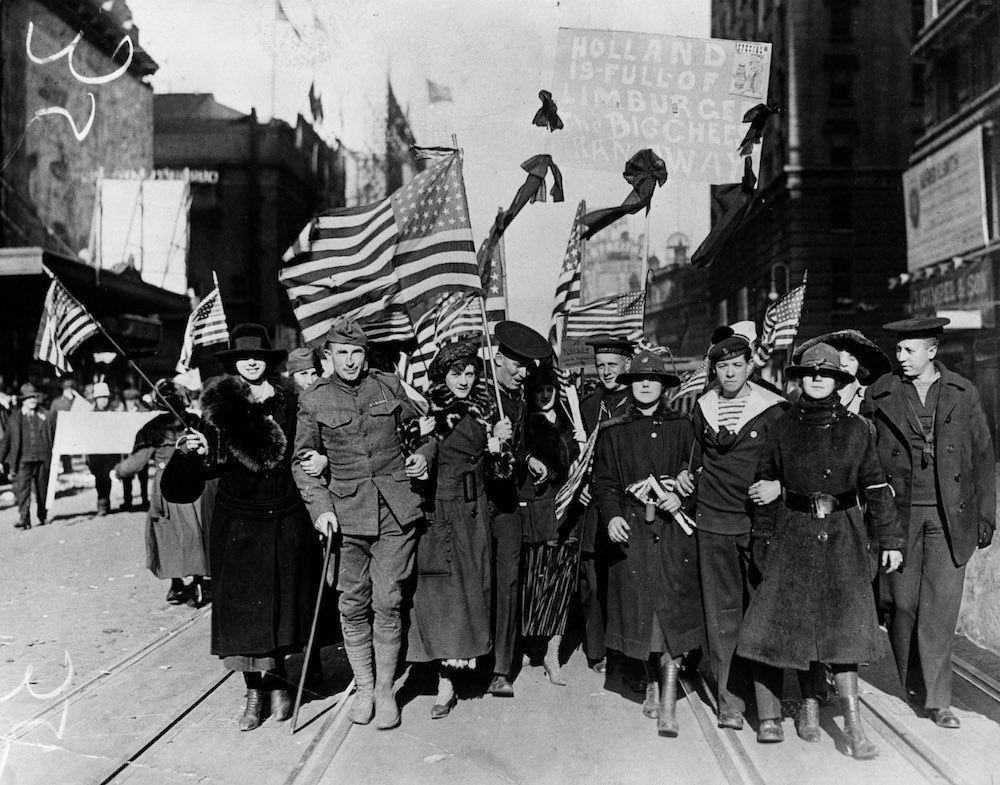
Thanks for reading! I’d love to hear what you think, and don’t forget to subscribe!
Josh Benner is the associate pastor at Cornerstone Evangelical Free Church in Fergus Falls, Minnesota and has a Master of Divinity from Trinity Evangelical Divinity School. He enjoys writing about faith and culture. His hobbies include working out, watching sports, and photography. Josh and his wife Kari live in Minnesota.

