Josh Benner

Category: Church

  • All things were made through him. Studying John 1:3

    All things were made through him. Studying John 1:3

     All things were made through him, and without him was not any thing made that was made.
    -John 1:3

    John 1:3 is speaking to the divinity of Jesus. All things were made through him. All means all. 

    The ground, the trees, the sand of the beaches, the stars in the sky, the air we breathe, the materials we use to build things, all of it was made by Jesus. 

    He made every person. Each of us has billions of cells in our bodies. Incredible complexity and structure just within our own bodies. 

    The universe is incredibly big. 

    Size of the universe

    So the distance between the earth and the sun is 93 million miles. 

    If that distance was represented by the width of one sheet of paper, the distance of our entire galaxy would be a stack of papers 453 miles high. 

    One stack of papers a mile high is about 15 million sheets of paper. 

    Times 453 miles. 

    With each sheet of paper representing 93 million miles. 

    And that’s just our galaxy. 

    There are one hundred billion galaxies. 

    If you could have an atlas of every galaxy in the entire universe and each page represented an entire galaxy, and if you spent just one second on every page and continually turned pages in the atlas, it would take you more than 31,000 years to flip all the way through the atlas. 

    The universe is incredibly, unfathomably big. There are more stars in the sky than there are grains of sand in all the beaches of the world. Yet there are more trees on earth than there are stars in our one galaxy. 

    And that’s just looking at the amazing size of of our universe. 

    There is amazing creation within our world. 

    New species of animals are still being discovered. 

    Did you know that? And they’re not all insects or really small animals. Since 2000, there have been new species of primates discovered. We don’t even yet know everything on our own planet. 

    Jesus the creator

    Yet Jesus made it all. 

    There are other passages in the New Testament which speak to this fact. 

    Colossians 1:16: For by him all things were created, in heaven and on earth, visible and invisible, whether thrones or dominions or rulers or authorities—all things were created through him and for him.

    We see this language as well in the opening chapter of the Book of Hebrews. Hebrews 1:10 referring to Jesus says: You, Lord, laid the foundation of the earth in the beginning, and the heavens are the work of your hands;

     Jesus is the creator. He made everything. And John states it both ways. He made everything.

    And also there’s nothing that he didn’t make. 

    All things were made through him, and without him was not any thing made that was made.

    He’s a mighty God. It’s a lofty passage. It’s a confrontational passage. You affirm these truths or you don’t. 

    Our society often likes to treat Jesus as something you can take or leave. Gravity isn’t something that you can take or leave. Arithmetic isn’t something that you can take or leave. Breathing isn’t something that you can take or leave. 

    Jesus isn’t something you can just take or leave. Jesus isn’t just a nice person or a nice idea. He’s the Lord of creation. Many cherry pick certain teachings. Others treat him as a great teacher or a great religious leader. 

    Jesus isn’t one good teacher among other great teachers. He’s God. 

    The sages of other major religious traditions were born. Buddha wasn’t there in the beginning. Mohammad wasn’t there in the beginning. 

    But in the beginning was the Word. 

    There have been great leaders in the world who have influenced nations and movements. Abraham Lincoln, Martin Luther King, Gandhi. Some like to just act like Jesus was a wise peace maker who came with a good message. 

    Jesus isn’t simply a great man. Jesus gave life to all of these people. And that’s not true the other way around. Any person, any thing who has ever lived or existed, lived and existed because Jesus created it or gave them life. 

    Thanks for reading! If you liked, please share and subscribe. This article is part of a series studying the Gospel of John. 

  • Apple juice for communion? Why we can’t do communion our own way

    Apple juice for communion? Why we can’t do communion our own way

    27 Whoever, therefore, eats the bread or drinks the cup of the Lord in an unworthy manner will be guilty concerning the body and blood of the Lord. 28 Let a person examine himself, then, and so eat of the bread and drink of the cup. 29 For anyone who eats and drinks without discerning the body eats and drinks judgment on himself. 
    1 Corinthians 11:27-29

    I saw quite a few responses on Twitter this evening when the rapper Lecrae mentioned taking communion at home with wheat bread and apple juice and saying “I hope this still counts.”

    It doesn’t.

    Communion is a sacred remembrance of the gospel which was instituted by Christ himself with the commandment “do this in remembrance of me” (Luke 22:19).

    There are lots of different views of communion within Christendom. Even though I pastor an independent Bible church, my view of communion aligns pretty well with Presbyterianism where I believe that communion is to be administered to a congregation by the pastor, overseen by elders, and served by deacons. It stands to reason that those people would oversee and serve communion since they’re charged with overseeing and serving the church. Last year, when churches were shut down during Covid, I saw some people partaking of communion at home. While everyone won’t agree with me, that’s not communion. Communion is mean to be COMMUNal. Virtual communion is not communion.

    Again, there are varying opinions about communion in different branches of Christendom. (Even what it should be called, such as communion, eucharist, Lord’s Supper). The Catholic view is not the same as the Presbyterian view which is not the same as the Lutheran view which is not the same as the Orthodox view.

    But they all would agree that just taking it upon yourself to have wheat bread and apple juice and to call that communion is not communion. There ought to be fidelity to Jesus and how he instituted communion, not just doing whatever you feel like.

    Thinking you can just make communion whatever you want it to be comes from a shallow theology. Any church with history would consider ad hoc communion to be sacrilegious. It comes form the modern age that makes Christianity existential, where everyone does what is right in their own eyes, and where we do whatever we want and justify it as long as it’s sincere or “from the heart.”

    Jeremiah 17:9 says: the heart is deceitful above all things, and desperately sick; who can understand it?

    There are some things where there are prescribed ways to do them and communion is one of those things.

    My point isn’t just to criticize Lecrae. Too often we try to take the sacred and just make it whatever we want it to be.

    Communion is communal. Communion is given by Christ as a sign of the new covenant. As a covenantal sign, and as such, it is meant for the church during worship. It can’t just be you taking something you’re eating and calling it communion. Even if you’re with your family, that doesn’t make it communion. There’s a Congregational aspect to it. There’s a sacred and set apart aspect to it.

    What about home churches? I can appreciate home churches. I would also hope that home churches would still handle communion in an appropriate Biblical manner and not just arbitrarily create elements.

    You can have a fellowship meal. You can thank God while you’re eating a meal. But that doesn’t make those things communion anymore than dunking yourself in a swimming pool or bath tub doesn’t mean you just baptized yourself.

    Thanks for reading!

  • Late evangelist Ravi Zacharias found to have committed sexual misconduct

    Ravi Zacharias was widely considered the greatest Christian apologist of the past generation. Zacharias died in May at the age of 74 after a brief battle with cancer. In recent months, accounts of a scandal which arose during his lifetime have again resurfaced.

    Background

    In December of 2017, Christianity Today ran an article where Zacharias was interviewed regarding a lawsuit settlement with a Canadian woman whom Zacharias had claimed sent her unsolicited and sexually explicit photos of herself. Zacharias had claimed that the couple had attempted to extort money from Zacharias.

    This summer, there were also new reports of multiple episodes of sexual misconduct from massage therapists at spas co-owned by Zacharias. Ravi Zacharias International Ministries (RZIM), an evangelistic organization founded by the late Zacharias announced an external investigation into his conduct. While the investigation is still ongoing, RZIM issued an update yesterday.

    In the statement, RZIM said:
    The interim investigation update indicates this assessment of Ravi’s behavior to be true—that he did indeed engage in sexual misconduct. This misconduct is deeply troubling and wholly inconsistent with the man Ravi Zacharias presented both publicly and privately to so many over more than four decades of public ministry. We are heartbroken at learning this but feel it necessary to be transparent and to inform our staff, donors, and supporters at this time, even while the investigation continues. We will speak more comprehensively to all concerned after the completion of the investigation.

    There can be a lot of responses for people who were fans and supporters of Ravi. For some, anger. For some, disbelief. But one thing that people should not feel is pity for Ravi. I know it can be tempting to think “he doesn’t have a chance to defend himself.” That’s not true. I think to Ravi’s handling of sexual misconduct allegations made during his lifetime. He was the one who got ahead of that story and made himself out to be the victim.

    There are actual victims of this misconduct, and even though Ravi is deceased, the truth still matters. There’s a popular and successful ministry that bears his name, and the misconduct of its founder matters.

    I loved the ministry and teachings of Ravi Zacharias. It was a great joy to be able to meet him when he visited my seminary. The fact that people like him went to Trinity influenced why I chose that seminary. I take no joy in these claims be substantiated. But when Christian leaders fall, it should be Christians who also lead the charge for what is right.

    I do think that we should appreciate RZIM acknowledging his misconduct. They also commissioned the investigation which found the wrongdoing. We don’t know if there were people in the ministry who may have known more about his misconduct and did nothing. But the organization is doing the right thing now and admitting to claims which could have a catastrophic impact on the livelihood of the ministry.

    How should people who loved Ravi’s ministry respond?

    If you’re someone like me who benefited from the teaching of Ravi Zacharias, what do you do? Do you burn any of his books you have? Do you ignore the accusations and assume he was righteous?

    We all do sin and fall short of the glory of God. And that includes our teachers. They too are imperfect. But when a scandal comes to light, that doesn’t mean that everything they ever taught or believed was wrong. There are certainly no shortage of Biblical figures who fell into major areas of sin. David comes to mind and the affair he had with Bathsheba. We still read the Psalms.

    David repented during his lifetime. For people who lead churches, Christian universities, and powerful ministries, there is often so much institutional effort to save face and to keep money coming in that there’s always a temptation to want to ignore or bury sin and scandal.

    But here’s a key difference. If the allegations against Ravi are true, not only did he never publicly repent nor acknowledge his sexual misconduct, he actually worked to control and obfuscate the narrative.

    I write so much about these scandals when they happen because too many Christians want to act as if there’s some righteousness in pretending that these things don’t happen.

    And the desire to turn a blind eye to sin is the same attitude which allows these people to continue to to real harm a they become powerful figures within ministries.

    Truth matters and truth is worth knowing. We shouldn’t make excuses for people. But as Christians, within churches, we must hold leaders accountable. But Ravi wasn’t a pastor! We must also have expectations for those who influence our thinking and theology, of those who write the songs we listen to and the books we read. Of those who we recommend to others, who’s YouTube videos we watch, and who we reference in conversations.

    So how should Christians and people who loved Ravi respond? I think we appreciate the impact that they had in our lives. You can’t just forget everything a great teacher ever taught you. And I’m not suggesting that everything he ever said or taught is now bad. But I also don’t think we should look to people who led double lives and never owned up to their sins in their lifetime for our Spiritual nourishment. There are too many other Godly teachers.

    Thanks so much for reading! If you have any questions about the podcast, or suggestions, please leave me a comment!

    Let’s connect
    Facebook
    Parler
    Twitter
    Instagram

  • Genesis 1 and John 1: the new creation Jesus brings

    Genesis 1 and John 1: the new creation Jesus brings

    Jesus brings a new creation into the world and into the lives of those who believe in his gospel.  

    I want to highlight a few words and phrases in this opening prologue to John:

    In the beginning. Word. Life. Light. Darkness. 

    Just to name a few.  

    These are all found both in John 1, but also in Genesis 1. So let’s touch on some of these ideas. My goal is really to show this creation theme in John.  

    Opening phrase of the Gospel of John: In the beginning was the Word.  

    It’s interesting in comparing the beginning of John’s gospel to the beginnings of the other three. Mark’s gospel begins with the ministry of John the Baptist as the one who points to Christ. Luke’s gospel goes back further with the birth of John the Baptist and the birth of Jesus. Matthew’s gospel goes back further still to the family line of Jesus and takes us back to Abraham, back to the beginning of God’s covenant with his people. John’s gospel goes back even further, back to the very beginning, back to eternity.  

    It’s the same way in which the Bible opens up, the first words in Genesis are: in the beginning, God created the heavens and the earth.  (Genesis 1:1)

    John starts with: in the beginning was the Word.  

    Now, it’s interesting that John says “the word.” He doesn’t say “in the beginning was Jesus” or “in the beginning was the Christ” or “in the beginning was the Lord” but “in the beginning was the Word.”  

    But, in the beginning was the Word. Why use the word Word? Borrowing an idea from D.A. Carson in his commentary on John. From the beginning of the Bible, we see references to God’s word. God is a talking God. He speaks in Genesis. “Let there be light,” and the text says “and it was so.” God calls things into being by the power of his word, and what he calls into existence exists.  

    In the Old Testament, God’s word is tied to creation, salvation, healing, and deliverance. With the incarnation of Jesus, we see God’s greatest and most spectacular form of expression to the world. The Word is an appropriate title for Jesus because it is through this Word that we have ultimate truth, eternal life, future hope, assurance of God’s promises, and God’s greatest revelation of himself to the world.  

    This Word is not some abstract idea or force. This Word exists. “And the Word was with God, and the Word was God.” 

    But just to sum up what verse 1 is saying is that Jesus is eternal, he has always existed in fellowship with God, and that he himself IS God. That’s really the major theme of John’s Gospel. Jesus is the Lord.  

    Verse 3, we see Jesus’ involvement in creation. All things were made through him, and without him was not any thing made that was made. 

    Again it takes us again to creation. When you read Genesis 1, John 1 plugs right into those events. He wasn’t just hanging out while God the Father did all of the creating, rather nothing exists without Jesus.  

    Verse 4. In him was life, and the life was the light of men.

    Two more ideas that are found in creation. Life and light. Both of these ideas will also be significant themes in John’s gospel. Let’s start with life. Nearly half of the New Testament usages of the word life come from John’s writings. In Genesis, life is created. The animals that walk the earth, the birds of the air, the fish of the sea, culminating in God’s creation of man in his own image. All life is created in Genesis. And here, in referring to Jesus, it says that life itself is found in him.  

    John 10:10, Jesus says that he has come so that his people can have life and have it abundantly. And it’s the life that can only come through Jesus. John 14:6, he says: “I am the way, the truth, and the life, no one comes to the father except through me.”  

    And he has authority to say these things.  

    Because. In the beginning was the Word. And in him was life. And he made everything. And he’s God.  

    So John begins his gospel by talking of the God of creation entering into creation to make his new creation.  

    Next theme of creation that’s found in John. Light.  

    Quoting again from our passage: In him was life and that life was the light of men.

    In Genesis, the first thing that God calls into being is light. 

    Genesis 1:3-4: And God said, “Let there be light,” and there was light. And God saw that the light was good 

    Light is a symbol for life, salvation, and the presence of God.  

    Yet John takes it to a fuller meaning.  In John 8:12, Jesus will say: I am the light of the world. Whoever follows me will not walk in darkness, but will have the light of life

    Light is contrasted by darkness. Darkness in John refers to evil and sin. Darkness is the opposite of light both metaphorically and literally.  

    In Genesis 1:4, we’re told that God separated the light from darkness. John chapter 1 says that “the light shines in the darkness and the darkness has not overcome it.”  

    Jesus will talk at greater length of light in darkness in John 3, when he says: the light has come into the world, and people loved the darkness rather than the light because their works were evil. 20 For everyone who does wicked things hates the light and does not come to the light, lest his works should be exposed. 21 But whoever does what is true comes to the light, so that it may be clearly seen that his works have been carried out in God.” 

    In that, we see why Jesus came. Because the world is sinful. People love their sin. People oppose the light, but Jesus came to bring light and life.  Again, John keeps pointing back to creation to show us a new creation that Jesus is bringing into the world.  

    Perhaps the climax of this entire introductory prologue of John’s gospel is found in verse 14:  And the Word became flesh and dwelt among us, and we have seen his glory, glory as of the only Son from the Father, full of grace and truth.

    The language returns to using the word Word. And it says that this Word, Jesus, became flesh and dwelt among us. The God who created the world entered his creation. What a profound reality that is. The Word became flesh and dwelt among us.  

    In creation, before the fall, there was fellowship with God. It was paradise. And yet Adam and Eve sinned. Cast out of the garden. But here in John, we see that the Word became flesh and dwelt among us. Jesus came into our fallen world. Because he loved us. Because he’s gracious. Because he’s good.  

    He is the eternal God of creation. And he came to bring a new creation. In the opening of John, we see the groundwork being laid for that which was lost in the fall to be regained through the gospel.

    Paradise was lost due to sin, but in the beginning of John, we see that the word became flesh and dwelt among us. Darkness came into the world because of sin, but we see that Jesus is the true light. Death came into the world because of sin, but in Jesus, there was life. Not just anyone is capable of doing that. But Jesus isn’t just anyone. He was in the beginning. Jesus is the eternal God of creation who brings a new creation. He’s here to give you a new life. He overcame the darkness by living a sinless life. He brought life through his own death. He restored the relationship by being forsaken.  

    All of it was his work. He invites you into a new life, a new covenant. He gives you a new heart.  

    The Apostle Paul said that anyone who is in Christ is a new creation.  (2 Cor. 5:17) 

    In John 3, a man named Nicodemus. He’s intrigued by this teacher and ministry and he wants to learn more. Jesus says that we must be born again. On the night before he was crucified, he told his disciples to love one another, and he called it a new commandment. In the closing sections of the Book of Revelation, John talks of seeing a new heaven and a new earth. He records Jesus saying that he’s making all things new. (Rev. 21:5). When we trust in Jesus and are born again, Jesus does bring a new creation. He does make something new. He makes a new person. Jesus is the Lord of creation and new creation.

    Have you trusted in Jesus? Is he your Lord and savior?  

    There is no other way to God, there is no other way to life, there is no other way to forgiveness, there is no other way to heaven than through Jesus. 

    Thanks for reading! If you liked, please comment and share :)

    Based on a sermon I preached called “The Word.”

    Let’s connect
    Facebook
    Parler
    Twitter
    Instagram

  • Meaning of the bronze serpent in the Bible

    maxresdefault-11.jpg

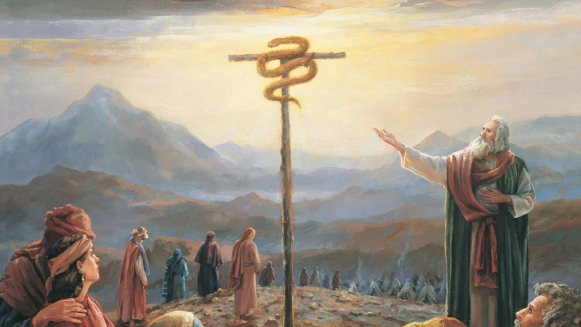
    In Numbers 21, the Israelites experience victory over the Canaanites but soon fall back into grumbling and complaining. God brings a plague of snakes upon the people. It’s a divine judgment. Their grumbling against God was to their downfall. But the people beg for mercy.

    And the Lord said to Moses, “Make a fiery serpent and set it on a pole, and everyone who is bitten, when he sees it, shall live.” 9 So Moses made a bronze serpent and set it on a pole. And if a serpent bit anyone, he would look at the bronze serpent and live. 
    -Numbers 21:8-9

    Moses prays. God tells Moses to make a fiery serpent and set it on a pole. So God doesn’t simply take the snakes away. He also doesn’t prevent people from continuing to get bitten by the snakes. But once bitten, a person could respond by faith in the Lord by looking to the serpent on the pole.It’s an odd story. A number of questions might come to mind. Isn’t that idolatry? Making this bronze serpent?

    In the Golden Calf episode of Exodus 32, Moses is on the mountain receiving instruction from the Lord. He’s there for 40 days and the Israelites get restless. They take their gold and melt it into the image of a cow. Why is it ok with the bronze serpent? It’s a totally different situation. Most importantly, because God told them to do it this time. Secondly, this wasn’t idol worship because they weren’t worshiping the serpent. The serpent didn’t represent God to the people.

    There are many wonderful gospel themes in this scene. The Israelites sin against the Lord. And so God brings a plague of snakes upon the people as divine judgment. And yet, once the people repent and the bronze snake is made, it is in looking to that by which people are healed.

    A symbol of death becomes a symbol of life 

    Snakes were bringing death, but looking to this particular snake brought the promise of healing. A symbol of judgment the Lord then uses as a symbol of victory. The cross was the greatest symbol of judgment and condemnation in the Roman world. A brutal punishment. And yet, it is to the cross that we see Christ’s victory over sin. Perhaps you look at the story and think “but why a snake? Aren’t snakes bad in the Bible?” Yeah, so are people, but it is through a man that we are saved. The Lord Jesus, both God and man.

    The gospel 

    In a person being healed because of looking to the snake, it took what they were doing out of their hands. It was entirely the work of God. So too we see this in the gospel. It is not based on us, or how good we are. We are totally helpless to heal ourselves from the disease of sin. It is looking to the cross, to looking at what Jesus has done, to trusting Jesus by faith that we can have salvation.

    It’s foolishness 

    The serpent doesn’t make sense. The world is confounded by the gospel and the message of grace, the idea that we can be freely forgiven based on what someone else has done. The world is offended by the message of salvation by grace. Paul says in 1 Corinthians that the cross is folly to those who are perishing, but to those who are being saved, it is the power of God (1 Corinthians 1:18).

    We want to save ourselves. We want to see how we measure up and to feel good about how good we are. The gospel is that you cannot earn it. You look to what Jesus has done.

    Salvation for the undeserving 

    The Israelites were grumbling and complaining and blaspheming against God, and yet God saves them. Jesus came into a world where people condemned him, polluted against him, betrayed him, and killed him. While we were yet sinners, Christ died for us (Romans 5:8). In both looking to the serpent and the death and resurrection of Jesus, what people needed was faith.

    In the Gospel of John, Jesus will make specific reference to this event in Numbers. John chapter 3, Jesus is talking to Nicodemus, the Pharisee.Jesus says “as Moses lifted up the serpent in the wilderness, so must the Son of Man be lifted up.” (John 3:14) Moses literally lifted up the bronze serpent on a pole. And Jesus was literally lifted up on the cross. There, Jesus compares himself being lifted up to the bronze serpent. For the Israelites who were afflicted by the serpent’s bite, life was found by looking to the bronze serpent. For us today, eternal life is found by looking to Jesus.

    The main idea of our passage this evening is that: Opposing God brings death but true life is fond by faith. Are you trusting in Jesus? We’re infected with the venom of sin. And it’s a killer. There is nothing we can do on our own to take out that poison. The only antidote is found in looking to Jesus.Look to him. Love him. Live for him.

    Originally published August 1, 2018.

    Thanks for reading! If you liked, please comment and share :)

    Let’s connect
    Facebook
    Parler
    Twitter
    Instagram