Josh Benner

Tag: Commentary

  • Joshua Harris kisses “I kissed dating goodbye” goodbye

    I_Kissed_Dating_Goodbye.jpg

    It’s crazy that one of the most popular books on dating written in the 90s was the dating philosophy of a 21 year old man…who was single at the time! In 1997, Joshua Harris wrote his dating manifesto “I Kissed Dating Goodbye” where he talked about…kissing dating goodbye. Instead of casual dating and having lots of relationships, Harris favored courtship, intentionality, rules and boundaries.

    It was a popular book.

    This philosophy continues to influence people. While Harris didn’t invent these ideas, “I Kissed Dating Goodbye” exposed many to these approaches and rules.

    This week, the pastor and writer announced that he is working with his publisher to discontinue the book:

    In light of the flaws I now see in I Kissed Dating Goodbye, I think it’s best to discontinue its publication, as well other supplemental resources tied to it (this includes the two books I wrote after it whose content is similar).

    -Joshua Harris statement

    In a 2016 interview with NPR, Harris acknowledged his consideration of the results espoused in IKDG: “I think it’s taken time for the consequences of the way that people applied the book and the way the book affected people to play out. And so I’m hearing these different voices saying, here’s how your book was used against me, here’s how it was forced on me, or here’s how I tried to – no one forced it on me, but I tried to apply it and it had this negative consequence in different ways. I’m trying to go back and really evaluate, you know, where did my book contribute to that? Where was it too stringent? And where was that me and what I was writing, and where was that – the families and the church cultures and so on?”

    Thoughts

    I was never a huge fan of this book. It’s not that everything in it was bad. For instance, of course it’s good to have intentionality in relationships. But Harris’s philosophy wasn’t just conservative on physical intimacy before marriage but also on emotional intimacy.

    In wanting people to not get overly emotionally committed before marriage, it risked a person getting too relationally committed to soon to people they knew too little.

    Some took Harris’s philosophy as gospel when it came to relationships. Harris argued against a culture where people hopped from one dating relationship to another to another. There needed to be more intentionality in dating. It was a courtship model where relationships were only entered into with people you could seriously see yourself marrying and where activities were largely based on building friendship.

    I think these ideas continue to reverberate through American Christian culture. While Harris warned against casual dating, hyper-intentional dating can put tremendous pressure on a couple from the outset of a pursuit. I think in Evangelical Christian circles, when two people do start dating, there can be this tendency to think “well they’re going to get married.”

    But there might be some serious reasons as to why those people are not a good fit. Dating without emotional connection (which Harris was weary of) can lead to superficial relationships.

    I think that millennial Christians tried to navigate relationships while a “hook up culture” existed for much of the rest of this generation.  And while many might not have taken dating and relationships seriously enough, I think Evangelicals pushed too far in taking dating to an opposite extreme which could be just as unhealthy, and where even the beginning of a relationship was taken with extreme seriousness.

    There is still be an “I Kissed Dating Goodbye” approach within Christian circles where courtship is seen as being inherently better and more God-honoring than dating. This is absurd, because neither dating nor courtship is the common method in the Bible of finding love.

    Some young Christians brought a formulaic approach to relationships and marriage. Almost like good things would happen for avoiding certain pitfalls of dating and relationships.

    This approach can lead to legalism and false hope that “if you follow the rules, you’ll have a fulfilling marriage.”

    In his statement this week, Joshua Harris touches on this idea that many took from his book: “The book also gave some the impression that a certain methodology of relationships would deliver a happy ever-after ending—a great marriage, a great sex life—even though this is not promised by scripture.”

    Dating should be taken seriously. But in our society, it does need to be taken casually enough to where a person doesn’t feel prematurely committed to someone who they’re just getting to know. And this isn’t just a critique of “I Kissed Dating Goodbye,” because there are other books from the same late 90s, early 2000s period which espouse similar philosophies.

    I think it’s worth appreciating the humility of Harris. He obviously took a long look at his book and its impact. It’s a book that sold hundreds of thousands of copies and put Harris on the map. For him to look at his own work and say it should be discontinued and to recommend other books, I think that take a big person.

    Thanks for reading! I’d love to hear what you think, and don’t forget to subscribe! 
    Josh Benner is the associate pastor at Cornerstone Evangelical Free Church in Fergus Falls, Minnesota and has a Master of Divinity from Trinity Evangelical Divinity School. He enjoys writing about faith and culture. He lives with his wife Kari in Minnesota.

    Let’s connect!
    Facebook
    Twitter
    Instagram

  • Bring your fussy child to church day

    41399491_10156449724805900_4799046815594840064_n
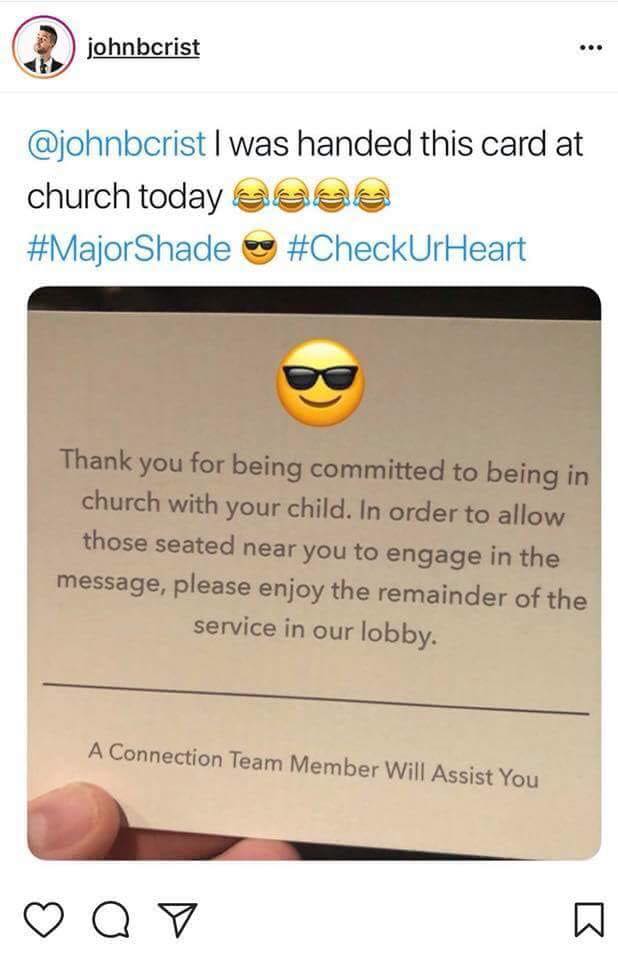
    Christian comedian John Crist shared this photo on Instagram this weekend that’s gone viral. The photo is a card from a church, apparently meant to be distributed to parents of fussy children, instructing them that a “connection team member” would assist them in leaving the sanctuary during worship.

    It’s a sad commentary on the American church that we shame parents for bringing their kids and their kids…acting like kids in a church service.

    If the gospels were written today, and Jesus was teaching to great multitudes and a child was fussing, would he ask the parent and child to be escorted away from his presence? In the Gospel of Matthew, Jesus said: “Let the children come to me. Don’t stop them! For the Kingdom of Heaven belongs to those who are like these children” (Matthew 19:14).

    A baby has just as much right to be there as you do.

    It’s unfortunate that a parent who’s tired, who’s working, who’s doing their absolute best, and on top of all of the other hassles in life, knows it’s worth it to take their young child to church, and when they do that, has to worry about the eye rolls, the murmurs, the complaints for if their child gets fussy. That should be the last place where they’re going to be criticized. Those parents should be applauded, not judged.

    Can it be annoying to hear a fussy child? Yes. Obviously. But it’s more annoying to hear a fussy adult whining about a baby. There isn’t a Biblical mandate: thou shalt wait until thine child will behave before thou shalt bring them into the Lord’s house.

    Yes, if a young child is having an absolute meltdown, of course it’s reasonable to step outside of the room for a moment. A parent has enough sense to know that. But the fact that this church had a special card printed up and ready to hand out? Yes, I realize that card compliments the parent for bringing their kid but it’s underhanded when couched in “now please leave the corporate worship service.”

    Jesus spoke to multitudes of thousands during his ministry. Those parents weren’t dropping their kids off with the babysitter. There would have been fussy children then. Other parts of the world have livestock nearby making sounds. Worship in other parts of the world is done in secret at the threat of persecution. But heaven forbid a little kid sometimes cry or speak up.

    They’ll learn. Their behavior will improve. But what’s priceless is teaching them from a young age that church is important and something that should be part of life.

    If we’re going to want to make parents feel ostracized or unwelcome because of their children, I think we need to check our own hearts in that. What do we value? Can we put up with a little bit of inconvenience so that a young child can be included in the service too?

    The church isn’t a restaurant, it’s not a movie theater. If you want to complain about a fussy child in those establishments, go ahead. But we should not approach it like our satisfaction with every visit is the supreme end of the service.

    Thanks for reading! I’d love to hear what you think, and don’t forget to subscribe! 

    Josh Benner is the associate pastor at Cornerstone Evangelical Free Church in Fergus Falls, Minnesota and has a Master of Divinity from Trinity Evangelical Divinity School. He enjoys writing about faith and culture. He lives with his wife Kari in Minnesota.

    Let’s connect!
    Facebook
    Twitter
    Instagram

  • Why Jesus? Couldn’t there be another way?

    pexels-photo-302187

    Originally published August 22, 2017

    “Atonement” is a theological word that gets mentioned. In short, atonement refers to the work that Christ has done for those who have faith in Him to earn their salvation.

    I think people sometimes approach the gospel with skepticism. Jesus died for the sins of all who believe in him.

    I know I used to ask was “why do we need this? Why do we have to believe in Jesus? Is sin such a big deal? Why is he the only way?” (more…)

  • Politics in the religious arena: VP at Baptist meeting

    800px-Mike_Pence_official_portrait.jpg

    Vice President Mike Pence spoke at the annual meeting of the Southern Baptist Convention this morning.

    The speech hit on some political themes. Newly elected SBC president J.D. Grear later took to Twitter and said: “I know that sent a terribly mixed signal. We are grateful for civic leaders who want to speak to our Convention—but make no mistake about it, our identity is in the gospel and our unity is in the Great Commission. Commissioned missionaries, not political platforms, are what we do.”

    Some attempted to raise motions to block the speech. A Virginia pastor suggested cancelling the speech in favor of a prayer time. The SBC is the largest Protestant denomination in America. Over the last generation, Southern Baptists have overwhelmingly voted republican.

    But it’s also a time of some turmoil within the denomination. One of the most influential Baptist leaders of the past generation, Paige Patterson, was recently removed from his role as the president of Southwestern Baptist Theological Seminary. This was related to improperly handling rape allegations from a student when Patterson was president at Southeastern Baptist Theological Seminary. Patterson had also made various other statements about women which were extremely controversial, such as insensitive comments about a woman who remained in an abusive marriage, after counseling the woman to stay in the marriage, Patterson saw her with two black eyes:

    “She said: ‘I hope you’re happy.’ And I said ‘Yes … I’m very happy,’ ” because her husband had heard her prayers and come to church for the first time the next day.

    These comments were met by an open letter from Baptist women, but Patterson did not issue any sort of apology until a similar letter by men within the SBC was sent. The treatment of women, how things like abuse and sexual assault are talked about and handled within the SBC have also been hot button issues at the meeting.

    There’s a lot going on within the SBC.

    It seems that another significant question among Baptists is the role of politics within the church.

    Christian historian Thomas Kidd traces politicians addressing the meeting. There was a resurgence of American Protestants to the GOP in 1979. Richard Nixon addressed the Southern Baptists in 1956 when he was vice president. In 1976, Gerald Ford was the first sitting president to speak at the meeting. Jimmy Carter in 1978. Ronald Reagan while he was running for president in 1980. George H.W. Bush in 1991. His vice president Dan Quayle in 1992. George W. Bush in 2002.

    There’s a history to it.

    So it isn’t shocking that vice president Pence would address the meeting this year. And the fact that his speech delved into both faith and politics should not be a surprise. That’s always going to be the case with any politician.

    I guess a question that I have would be, “what’s the purpose of a politician addressing the meeting?” It’s always going to be something that gets used for political purposes by the speaker. There are enough things that churches divide over. It seems unnecessary to add political viewpoints into that mix, especially in the current polarized climate. There are a lot of important gospel issues that the SBC is addressing. Having a political at this time seems like an unnecessary spectacle with respect to more pressing issues.

    The fact that there was some opposition to Pence speaking, some look at as a political shift among some in the SBC. Perhaps, to a small extent. However, with he size of the denomination, given what we’ve seen in other American Protestant denominations, I think it’s more likely that some (relatively small number with respect to the size of the denomination) churches would start walking away from the SBC before there be a major political divide within the denomination.

    I love the SBC, and I do hope and pray for what’s best for the denomination.

    Josh Benner is the associate pastor at Cornerstone Evangelical Free Church in Fergus Falls, Minnesota and has a Master of Divinity from Trinity Evangelical Divinity School. He enjoys writing about faith and culture. He lives with his wife Kari in Minnesota.

  • You can’t love God if you don’t love people

    W.H. Margetson

    Originally published December 13, 2016

    James says If you really fulfill the royal law according to the Scripture, “you shall love your neighbor as yourself,” you are doing well” (James 2:8).  points

    Royal Law is an interesting phrase. That’s the only time it’s used in the entire Bible. James follows up mentioning this royal law by saying “you shall love your neighbor as yourself” which seems to be what he’s referring to as the Royal Law.  (more…)