Josh Benner

Tag: Commentary

  • Jesus and the Last Supper – more than just a meal

    photo-1520629716099-d147346eb224.jpeg

    Originally published April 13, 2017

    As part of Holy Week, Maundy Thursday is recognized this evening. It was the night in which Jesus ate the Last Supper with his disciples. The time in which Jesus died corresponded with the Jewish holiday of Passover. And the Last Supper was the first night of Passover. An annual dinner for Passover is held, called a Seder, which is the Hebrew word for “order.” In 3,500 years, rabbinical tradition and teaching helped to form the ceremony of the Seder.

    Some of these pieces were traced back to the original Passover. Others came in Jewish history from rabbinical traditions.

    Also, once the Israelites were in the land, and after the temple was built, this impacted Passover traditions. When you had the temple, the lambs were sacrificed at the temple. But what didn’t change was that people could only sacrifice lambs that were perfect.

    I think it’s worth spending so much time in talking about Passover because I think it can help give us a greater context and understanding for the events surrounding the death of Jesus.

    In the gospels, the time of the death of Christ revolves around the Passover. That’s not a coincidence! Jesus would be sacrificed at the time that was associated with sacrifice. Jesus had gone to Jerusalem for Passover. In Jerusalem, the city within the Roman Empire that was the epicenter of Jewish culture, thousands of lambs would have been slaughtered annually. Jewish people would have been coming in from all over the empire.

    We see many traditions of the Seder at the last Supper.

    Some of them are small things. In the gospel accounts, it talks about Jesus reclining at the table (Luke 22:14).

    Jesus wasn’t sitting in a la-z-boy. He was on a couch that he was lying on, that was a Seder tradition. They had been enslaved in Egypt but being able to lie down showed the freedom and security.

    Or when Jesus is alluding to his betrayer, he says in John 13:26, “It is he to whom I will give this morsel of bread when I have dipped it.” So when he had dipped the morsel, he gave it to Judas, the son of Simon Iscariot.

    Again, I know the mental image that most of you probably have when you read this. It’s hard to know precisely where in the Seder this is, but it seems that it’s probably referring to when you take Haroset which is made from apple, nuts, cinnamon. They weren’t eating the Last Supper at an Italian restaurant. They didn’t have a bowl of olive oil in the middle of the table. But all of the elements we see at the Last Supper are part of what you’d see in a traditional Seder.

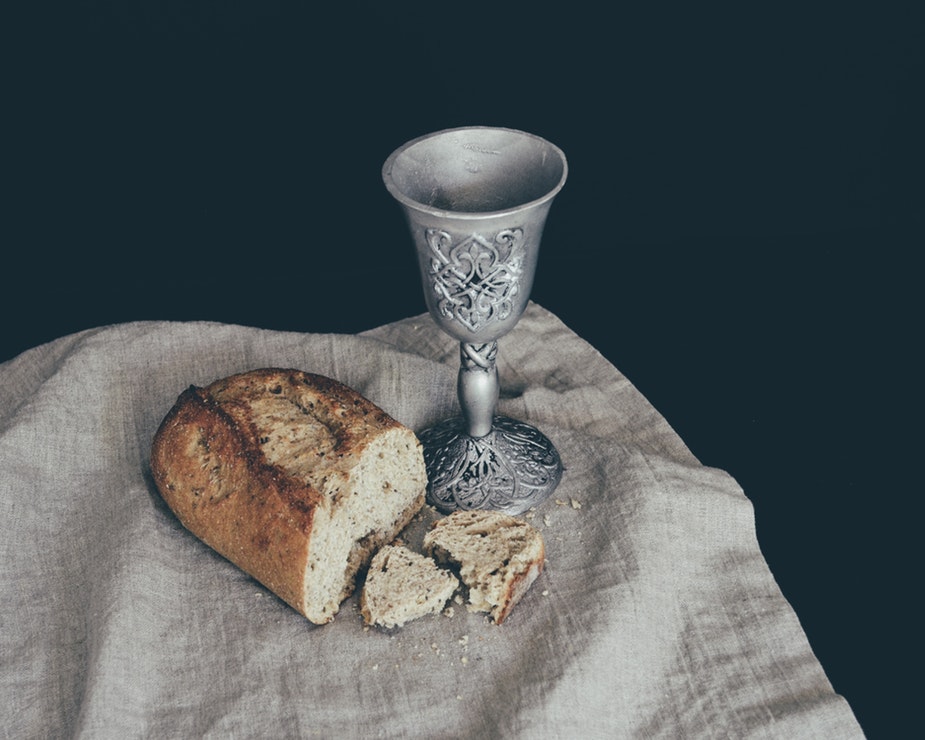
    As part of the Seder, you’d take the unleavened bread…looks like a cracker. And you’d break the bread.

    Luke 22:19, “And he took bread, and when he had given thanks, he broke it and gave it to them, saying, “This is my body, which is given for you. Do this in remembrance of me.”

    For over a thousand years of Seder dinners, bread had been broken. Unleavened bread, just like the Israelite forefathers had eaten before fleeing from Egypt.

    The body of Jesus, given for you, given for your sins. Given for your forgiveness. And he says “do this in remembrance of me.”

    What more fitting words could you say at a Seder? A meal revolving around remembrance, about retelling the story of God saving his people by the blood of the lamb.

    Remembering what God has done. Remembering what Jesus has done. Remembering the sins that he’s redeemed you from. Remembering his body that he gave for you. Remembering his death that he died for you. Remembering the grace that he offers to you. Remembering his gospel.

    Luke 22:20 says, “And likewise the cup after they had eaten, saying, “This cup that is poured out for you is the new covenant in my blood.”

    The Seder dinner involves four glasses of wine. This seems to have been the second or third glass of wine in the meal, although there’s scholarly debate.

    But how profound it is. Wine drank in remembrance of the Passover. Jesus takes the wine, he blesses it, he says it is the new covenant in his blood, at the Seder dinner.

    It clearly points backwards to the blood of the Passover lamb, the blood that was put on the door posts. And it also points forward to the blood of Christ, shed for the forgiveness of sins. The blood of the true lamb.

    At the beginning of the gospel of John, when John the Baptist sees Jesus he says “Behold, the lamb of God who takes away the sin of the world.” Jesus is the true lamb of God. The lamb who took the penalty for sins. The one who was scarified for the salvation of God’s people.

    And by trusting in him and having faith in him, that puts the blood on the doorpost of your heart. On the first Passover, there would not have been a pardon for a person who didn’t put blood on the doorpost. It wasn’t that the blood saved them, God saved them. But to not put the blood on the door was to show that a person didn’t have faith in the Lord, didn’t trust in the Lord.

    When we take the Lord’s Supper, it’s not arbitrary. It’s not just using the random items that were around. It’s all symbolic. It takes symbols important to the first Passover, the first time God had delivered Israel, and it reminds of the new Passover, from the perfect sacrifice for sins.

    The Passover passage in Exodus 12:5 says that the lamb that was used had to be without blemish. Jesus is the ultimate lamb without blemish, a life lived in perfection.

    1 Corinthians 5:7 says “Cleanse out the old leaven that you may be a new lump, as you really are unleavened. For Christ, our Passover Lamb.”

    Josh Benner is the associate pastor at Cornerstone Evangelical Free Church in Fergus Falls, Minnesota and has a Master of Divinity from Trinity Evangelical Divinity School. He enjoys writing about faith and culture. He lives with his wife Kari in Minnesota.

  • Wisdom is as wisdom does

    Originally published March 8, 2017

    There are two ways to go. The way of the wise and the way of the fool. This is based off of the wisdom tradition of the Old Testament. Which often talks about these two roads.

    In James 3:13, he asks a rhetorical question, “Who is wise in understanding among you?”

    Who’s wise?

    James has much to say about wisdom.

    There’s a difference between wisdom and knowledge. Knowledge is knowing facts. Wisdom is living out a life that is applying what God has revealed.

    Knowledge is knowing that you have brownie mix in the pantry. Wisdom is making brownies.

    Since wisdom isn’t just knowing things but living according to what God has made known, it follows that if a person really is wise, they should live a life that validates what they believe. James says, “Let them show it by their good life, by deeds done in the humility that comes from wisdom” (3:13).

    In the context of the Bible, wisdom begins with a fear of the Lord.

    The book of Proverbs says that the fear of the Lord is the beginning of knowledge. And that fools despise wisdom and instruction (Proverbs 1:7).

    There are two ways to go. The way of the wise and the way of the foolish.

    Fear of the Lord leads to knowledge, which leads to humility before the Lord.

    Fear of the Lord is reverence for the Lord, for his power and might. Fear of the Lord is fear of the wrath that can come as a result of rejecting him. Fear of the Lord is the knowledge that we don’t deserve him on our own. That it is only because God is good that we have hope. Without the work of Christ on the cross, there would be no hope. The knowledge that Jesus died a death he didn’t have to die but he did it because he loved us. That he didn’t die to save righteous people, but he came to save sinful people.

    And realizing that is the beginning of wisdom. Proverbs 9:10 says, “The fear of the Lord is the beginning of wisdom, and the knowledge of the Holy One is insight.”

    And along with having a fear of God is coming to him in humility.

    In Mere Christianity, CS Lewis said, “As long as you are proud you cannot know God. A proud man is always looking down on thing and people: and, of course, as long as you are looking down you cannot see something that is above you.”

    So we validate our faith by living out our faith. We show that we are wise by living a life that reflects our wisdom.

    We sometimes get too far into thinking that different opinions are all valid when it comes to faith.

    Now, certainly we should be loving to all people, regardless of what they believe. Certainly we live in a society where we have to function and coexist with different people who have different view in regards to faith.

    And that’s important for life.

    But that doesn’t mean all views are equally valid.

    But our society likes to think that’s true of God. That that’s how God is.

    But that isn’t reality. It is God who created us. God who created the heavens and the earth. God who rules and reigns. It is God who is sovereign over all creation. And it is we who are ultimately accountable to him alone. It is not the other way around.

    We like to judge God. We like to say how God should be.

    But all of this shows the vanity of the human heart. It shows the idolatry of the human heart. We try to make ourselves God. We try to make ourselves the judge. Too many people ignore the things that God has said. Too many people ignore the things that Jesus has said “I am the way and the truth and the life, no one comes to the father except through me.”

    We have an opinion about God that we like, and then we decide that’s just how God is. But sometimes we say things that have no Biblical basis.

    So a person doesn’t like the idea that God would judge, so they just decide that’s not how God is.

    People ignore the Bible and make arguments based on emotion or preference as opposed to what God has revealed about himself.

    Is that fear of the Lord? Is that humility with God?

    People want the good things with Jesus but they try to undermine that he alone is the way. That his blood alone cleanses sin. That his death alone paid the price.

    There are two ways in the Bible. The way of wisdom and the way of foolishness. When we try to make boxes and explain why God has to fit into that box, we’re keeping ourselves from God.

    We don’t get to invent God. The beginning of wisdom is the fear of the Lord. And in fearing the Lord, it is recognizing that God is God, and that God is the almighty creator and King of the Universe.

    True wisdom is showing humility, and at the foot of the cross, there’s no room for arrogance. In seeing what Jesus has done, in seeing his work, in seeing the death he died for the forgiveness of our sins. To see the tremendous cost of sin, the cost that Jesus paid for us, the death he endured for us. To see the life that he’s invited us to. To see the awesome holiness of God.

    To see where God is bringing us, the place he has prepared for us, the new heavens and the new earth he is making. That we are unworthy on our own. And it’s not that we can make ourselves worthy but this infinitely glorious home that God has prepared, that it is entirely because of the love of God, the goodness of God, the grace of God.

    Josh Benner is the associate pastor at Cornerstone Evangelical Free Church in Fergus Falls, Minnesota and has a Master of Divinity from Trinity Evangelical Divinity School. He enjoys writing about faith and culture. He lives with his wife Kari in Minnesota.

  • Why Jesus? Couldn’t there be another way?

    pexels-photo-302187

    “Atonement” is a theological word that gets mentioned. In short, atonement refers to the work that Christ has done for those who have faith in Him to earn their salvation.

    I think people sometimes approach the gospel with skepticism. Jesus died for the sins of all who believe in him.

    I know I used to ask was “why do we need this? Why do we have to believe in Jesus? Is sin such a big deal? Why is he the only way?” (more…)

  • What headlines are missing about new Google CEO

    According to Google’s blog, it was announced earlier this afternoon that Eric Schmidt is stepping down from his role as CEO of Google. This is true, but Schmidt is not leaving Google. He is still going to be heavily involved with the company and is simply assuming a different role.

    Larry Page who is the co founder of Google will become CEO on April 4 while Schmidt will become Executive Chairman. Page was the original CEO of Google until 2001 when Schmidt took the helm. Page has remained heavily involved with the company and serves as Google’s products president.

    Google’s other founder (Sergey Brin) is currently the company’s president of technology. His role seems like it will be much the same, and he will focus much of his time to working on new products, according to Schmidt’s post this afternoon on the Official Google Blog.

    So what will Schmidt do in his new role as Executive Director? In his own words:

    “As Executive Chairman, I will focus wherever I can add the greatest value: externally, on the deals, partnerships, customers and broader business relationships, government outreach and technology thought leadership that are increasingly important given Google’s global reach; and internally as an advisor to Larry and Sergey.”

    To the average person, this will have a largely unnoticeable impact. I get the sense that a big part of the reason was to make shareholders happy. It’s not that they were unhappy with Schmidt, but the change will more clearly define who is responsible for what and the hope of Google is that this will lead to increased accountability.

    jrb

  • Why 2011 is Groupon’s year

    Groupon is already a popular web service with over 35 million members worldwide. Since its founding in 2008, the site’s growth has occurred at a remarkable rate, and while there are millions of people who already use Groupon, I think that this is the year the site truly explodes and becomes ubiquitous within our society.

    I realize social networking is different than Groupon, but it is interesting as the popularity of Facebook and Twitter have grown, that

    As an example, there are lots of people who know about Twitter but who don’t use Twitter and who have never had Twitter accounts. With Groupon, I believe that 2011 will be the year where it trul

    The reasons why Groupon will explode so dramatically this year:

    1. While people have obviously known about Groupon before now, I feel like this will be the year where the stie truly breaks through the fabric of popular culture and becomes ubiquitous within our society. As more people start to realize the idea is about saving money and how easy Groupon is to use, the numbers of registered users will continue to shoot. Think of it like Facebook’s expansion, but coupons instead of social networking.

    2. More and more people are going to have access to the site. In the U.S., Groupon is available in over 150 cities and can be found globally in 27 countries (both figures according to Wikipedia).

    3. Their advertisements are going to tighten up this year. Earlier this month, it was announced that people are going to have more customization options in terms of which groupon offers are sent to them. I feel like the fact that this hasn’t happened already is in large part due to the phenomenol success of the site so far, and difficulties in keeping up with huge demand from businesses to partner with Groupon.

    It only makes sense to send Groupon offers where there is a higher likelihood the person will use them. For instance, where I live (Columbus, OH), my January 3 Gruopon offer was this:

    WOW!

    An 86% discount on spider vein removal treatments. That’s a great deal.

    However: I don’t have spider veins (at least I don’t think I do, but that seems like one of those medical conditions where: if you think there is a possibility you might have it, then, you have it).

    Smarter advertising will add even more street cred to the already popular site. And it will help to..

    4. Get more men signed up. Over three quarters of Groupon users are women. It will be important as the site utilizes more targeted coupon offers to start having “manlier” things.

    I love Groupon but I feel like some of their offers are things that men would have absolutely no interest in such as: spa treatments and cheap Justin Bieber t-shirts.

    5. Grocery stores and other retailers are starting to catch on to the idea of people using their phones as the actual coupon instead of physically printing or cutting something out. This will work well with Groupon.

    6. For any social site to work, it needs to have a cool factor. Groupon has it. As U.S. News and World Report mentioned this fall, a lot of people who use Groupon are not necessarily the common “coupon clipping” percentage of the population. A lot of Groupon users are younger and the site is going to continue getting more and more popular with older users as they hear about it from their younger children, coworkers, and great grandchildren.

    In many ways, the growth potential of this site reminds me of Facebook. In its first year, it went from 0 to around 1.5 million users. Now – a year after that – the site is over 35 million users. I think it is very much within the realm of possibility that the site could be over 150 million users by the end of this year.

    1.5 million to 35 million

    In March, the site was available in 40 cities and the goal of founder Andrew Mason was to be in 100 cities by the end of last year (they ended up being in over 150).

    In case you are unfamiliar: Groupon is a site that offers a daily deal, a coupon to a local business. The deal is always at least 1/2 off on a good or service. There are a minimum number of people who must signup for that day’s offer in order to activate the Groupon. In short: the consumer is saving money and learning about new stores/places/things, and the small business is making money.

    jrb