
From the beginning, God has been making a sacred space for people to dwell in his presence. Humanity was created in God’s unmitigated presence in Eden. Because of the fall, we were cast out. The story doesn’t end there. Throughout the Bible and human history, God is using the creative elements of Eden to continually point back to himself and to his gospel and our ultimate hope through Christ.
Tag: Temple
-

Jesus as God’s dwelling place among us. Exploring John 1:14
I used to enjoy a show called Undercover Boss.
It was a reality show that would feature leaders within companies, such as founders, CEO’s, vice presidents, or other executives going undercover within their own companies.
The show featured leaders for companies like Subway, True Value, Build-a-Bear, and even the Chicago Cubs.
Throughout a week, they would spend a day in various entry level positions within the company. They would work alongside typical employees. They would get a sense of the work they were doing.
But for the employees, they would be working with the most powerful person in the company and they had no idea.
It’s not that the undercover boss was their boss, he was everyone’s boss. He was their boss’s boss’ boss’s boss.
And they had no idea.
Sometimes they’d complain about corporate policies or explain ways to work around the rules, not knowing who they were talking to.
They were with the head of the company and didn’t even know it.
I think of Jesus coming into the world and I’m reminded of a similar irony in that people were interacting with the God of the universe and were mostly oblivious to that fact.
The Gospel of John says: He was in the world, and the world was made through him, yet the world did not know him. He came to his own, and his own people did not receive him (John 1:10).
Then verse 14 takes it to a more relational and personal level.
And the Word became flesh and dwelt among us.
That may be one of my top ten favorite verses in all of the Bible.
The God who created the world came into the world to save the world. The eternal God of creation became flesh and blood, skin and bone. Jesus’ divinity matters but so does his humanity.
It is because of his divine nature that he has the power to withstand and to bear the weight of sin. Our sin is an affront to God and no mere mortal is capable of redeeming himself before a Holy God, let alone redeeming humanity.
But it also matters that Jesus is human because it is humanity that has sinned. And in being fully man, Jesus is like us in our humanity. Jesus entered sinful humanity, though he himself is without sin.
His sinlessness matters because it took a sinless, perfect, and righteous sacrifice to pay for sins.
His humanity and divinity make Jesus a worthy sacrifice and atonement for sinful people.
The Word became flesh. God became man.
Colossians 1:19 says: For in him all the fullness of God was pleased to dwell
God dwelling with us
The glory of God came to earth through the Lord Jesus. There’s one word in particular in this verse that brings it to a climactic point in this passage.
Dwelt.
The English doesn’t truly convey the meaning of what’s being said here.
Let’s take a step back.
In the Old Testament, people originally exist in perfect fellowship with God. That’s what Eden was. It was a holy place. A perfect place. A sinless place.
Because of sin, fellowship with God was tarnished. The unencumbered closeness to God was lost due to sin.
We were no longer holy.
But the story doesn’t end there. Throughout the Old Testament, we see God bringing redemption to his people.
God makes a covenant with Abraham. We see God’s continued faithfulness to his covenant.
Fast forward. The Israelites were held in captivity in Egypt. After God had miraculously freed them, and while the Israelites were wandering in the desert, God gave them instructions for a structure called the tabernacle. The tabernacle was a tent that the Israelites were to travel with and it was a symbol for God’s presence with his people.
Sometimes it’s called the tabernacle. Sometimes it’s called the tent of meeting.
Exodus 40:34-35: Then the cloud covered the tent of meeting, and the glory of the Lord filled the tabernacle. 35 And Moses was not able to enter the tent of meeting because the cloud settled on it, and the glory of the Lord filled the tabernacle.
Exodus spells out very specific instructions on how the tabernacle was to be built, what types of items would be placed inside the tabernacle, etc.
The instructions are so specific because it is a sacred and holy place. Again, it represented the very presence of God in the world. But this was pointing forward to something greater.
The temple.
When the Israelites entered the land, part of their purpose was in constructing the temple. As the tabernacle had been portable, the temple was meant to be permanent.
The overarching purposes were still the same. Most notably, it was where God met his people in the word. It was his presence in the world.
The temple was the place where sacrifices were made. For the priests, there were specific instructions on what they had to do to prepare to enter into the Temple It was a sacred place.
As with the tabernacle, not just anyone could go into the temple. The priest couldn’t just go into the temple any arbitrary way they wanted.
It was a holy place. The temple was completed during the reign of Solomon
1 Kings 8:10-11 says: And when the priests came out of the Holy Place, a cloud filled the house of the Lord, so that the priests could not stand to minister because of the cloud, for the glory of the Lord filled the house of the Lord.
In both places, when the presence of the Lord comes into the temple, people can’t even stand in it because the presence is so glorious.
The temple is hugely important in the Old Testament. Building the temple is important. The specific instructions for the temple are important. But this points forward to an even greater temple. To an even greater example of God’s presence with his people.
The word became flesh
And that is the significance of John 1:14.
“The Word became flesh and dwelt among us, and we have seen his glory.”
The word translated as “dwelt” more literally means that Jesus tabernacled among us, that Jesus pitched a tent among us. It’s the same word for tabernacle that was used centuries before Christ when the Old Testament was translated from Hebrew to Greek.
Jesus is the tabernacle. He is the greater temple. He is the presence of God with his people because Jesus IS God with his people.
So it’s not simply saying that Jesus dwelt among us. But rather: in Jesus, we see God became flesh and tabernacled with his people.
Instead of a tent or a building, we have a person, we have God himself.
The greater tabernacle, the greater temple. And he’s greater because he’s everything these places were meant to represent. It was only the priests who could go into the tabernacle and the temple.
A priest serves as a mediator between man and God. Jesus is the greater priest. It is he who restores our relationship with God. These man made structures were where sacrifices were offered.
Jesus himself is the sacrifice.
And as I’ve said, the tabernacle and the temple represent the presence of God with his people. Jesus is God himself who has come to his people. The word became flesh and dwelt among us.
The Word made his dwelling among us. He pitched a tent among us. He tabernacled among us.
The God who created the world came into the world to save the world.
There was no other way for a sinful people to be reconciled to the Lord than through God himself coming into the world. But because of his love for us. Because of his goodness. Because of his grace…
The Word became flesh and dwelt among us. The creator entered creation.
In his commentary on John, the late New Testament Grant Osborne says of this verse “In my opinion, this is the single greatest sentence ever written in the history of human language, the deepest theological statement ever written. No finite human being could ever enter the realm of God and join his family. It could only come to pass if God himself were to enter the realm of humanity.”
The Word became flesh. God became one of us so we could be with him.
He is a personal God. It doesn’t get more personal than Jesus entering his creation.
Sometimes it can be tempting to doubt if God really knows what we’re going through when we’re struggling. It can be tempting to wonder if God really cares.
He knows. He knows what it’s like to live in a sinful world. He knows what it’s like to have people oppose him and not like him. He knows what it’s like to be hated for no reason. He knows what it’s like to be slandered. He knows what it’s like to cry. He knows what it’s like to be let down. He knows what it’s like to be betrayed. He knows what it’s like to suffer and feel pain. He knows what it’s like to face injustice.
He knows.
It can be be easy to focus on Christ’s glory and divinity to the point where we forget his humanity.
But we see his humanity in this passage. The Word became flesh and dwelt among us.
Thanks for reading! If you liked this post, please like and subscribe!
-

Destroy this temple, and in 3 days, I will raise it up. John 2:18-25
Summary John 2:13-25: As Jesus begins his ministry, he cleanses the temple in Jerusalem. In the first century, the temple had become a commerce center during Jewish holy days and so Jesus will drive the merchants out from the temple in verses 13-17. In verses 18-22, we see the response to Jesus
John 2:18: So the Jews said to him, “What sign do you show us for doing these things?”
That is not an inherently absurd question. Jesus is driving people out of the temple, and so they want to know how his actions are justified. It seems like they expected some grand miracle.
Instead, Jesus tells them of a future sign which he will perform.
Verse 19: Jesus answered them, “Destroy this temple, and in three days I will raise it up.”
Jesus says that’s the sign he can do.
20 The Jews then said, “It has taken forty-six years to build this temple, and will you raise it up in three days?”
The religious authorities look to how long it’s taken to build the temple and it therefore seems absurd that Jesus could possibly raise it in three days.
They miss the point.
Rebuilding the temple
At the time of Jesus, the temple in Jerusalem was actually still under construction. I always thought it was complete and when they talk about 46 years, they’re referring to how long it took to complete the work.
Incorrect.
Little bit of history.
The Jewish people built a temple during the reign of Solomon. That’s the first temple. It was destroyed in 586 B.C. when Jerusalem was conquered by the Babylonians.
About a century later, reconstruction began of the second temple. That temple was pretty modest, and it saw a major renovation which began around the year 19 B.C.
In other words, the major renovation BEGAN about 46 years before Jesus cleanses the temple here in John 2.
By the time of Jesus, they’re saying that construction had been under way for 46 years.
Construction would not be complete until 63 A.D. which was some 35 years after the time of Jesus.
I point that out because 46 years is a long time. But the actual temple renovation took more like 80 years.
And if it sounded absurd that someone could rebuild in just three days what had taken 46 years, imagine it from their perspective in the first century as they looked at a temple that was still being renovated. And someone saying he could build that in three days.
The authorities don’t challenge Jesus’ claim. But Jesus isn’t referring to the building anyway.
John makes that explicitly clear in the next verses.
Verses 21-22:
21 But he was speaking about the temple of his body. 22 When therefore he was raised from the dead, his disciples remembered that he had said this, and they believed the Scripture and the word that Jesus had spoken.
Jesus is the temple and he’s referring to his death and resurrection.
Jesus died and rose on the third day.
Jesus is the true temple
The significance of the temple in the Bible is that the temple is the place where God is with his people.
That’s why the temple was so important in the Old Testament.
When Jesus says “Destroy this temple, and in three days I will raise it up” (John 2:19, yes, it’s referring to his death and resurrection. But it is also pointing to Jesus as the greater temple.
The temple was just a building. Merchants could encroach upon the holiness of the temple. But in Jesus, we have an incorruptible temple, an incorruptible savior through whom we are brought into the presence of the Lord.
And we are again reminded of that death that Jesus would die for sin.
In chapter 1, we see Jesus called the Lamb of God (John 1:29), referring to his sacrificial death. In John 2:4, Jesus pointed forward to his crucifixion.
This book is constantly pointing to his death.
Eight full chapters of John are dedicated to the final week of Jesus’ life.
Why so much about his death?
Abraham Lincoln’s two secretaries John Hay and John Nicolay wrote an expansive biography about our 16th president. It’s 5,000 pages and they talk about his death on just 20 of those pages.
Between the four gospels, roughly one third to one half of the books are devoted to Jesus’ death.
Why? Why is there this constant focus on his death? Because it is the only way to redemption. It is the only way to God. It is the only way to forgiveness. It is the only way to heaven.
There’s no other way than through the presence of God on earth who was torn down and raised back up three days later.
Jesus cleanses the temple but in cleansing the temple, it points to himself as the temple who does not need cleansed.
The temple was always meant to point to Jesus.
In the Old Testament, you have all of these exact specifications for the temple, and its precursor, the tabernacle. You have dramatic Old Testament texts which talk of the presence of God filling the temple. You have Israel who continues to fall into sin and idolatry, in spite of warnings from God’s prophets. Eventually they’re conquered, they’re exiled, they lose the land, the temple is destroyed.
They would later be freed from exile and given the command to rebuild the temple.
But all of that is pointing forward to the true temple.
In the beginning, God created the heavens and the earth. It was the unmitigated presence of God. And humanity sinned. Paradise was lost.
God gave the law through Moses. Humanity continued to sin and God continued to be faithful.
The temple was built and sin continued. The temple was lost.
And on the grounds of a new temple, we again see sin. We see people dishonoring a holy place.
Left to our own devices, we’ll continue to lose the temple, to squander God’s grace because we’re sinful.
But instead of having a building which represents the presence of God, we’re given a person.
Jesus Christ, the eternal God of creation himself becomes the temple. We are welcomed back into the garden because Jesus left heaven. We are welcomed into the presence of God because Jesus was forsaken. We are invited into the presence of God because Jesus is the true temple.
We are given grace which cannot be lost because it was bought by a savior who does not sin.
The Word became flesh and dwelt among us (John 1:14).
Jesus came to be with us so that we could be with him.
Thanks for reading! If you liked this post, please share and subscribe.
-

The Word became flesh and dwelt among us. Studying John 1:14
And the Word became flesh and dwelt among us, and we have seen his glory, glory as of the only Son from the Father, full of grace and truth.
-John 1:14
In his commentary on John, the late New Testament Grant Osborne says of this verse “In my opinion, this is the single greatest sentence ever written in the history of human language, the deepest theological statement ever written. No finite human being could ever enter the realm of God and join his family. It could only come to pass if God himself were to enter the realm of humanity.”
The Word is referring to Jesus. And it says that Jesus became flesh and dwelt among us.
The God who created the world came into the world to save the world. The eternal God of creation became flesh and blood, skin and bone.
Jesus’ divinity matters but so does his humanity.
It is because of his divine nature that he has the power to withstand and to bear the weight of sin. Our sin is an affront to God and no mere mortal is capable of redeeming himself before a Holy God, let alone redeeming humanity.
But it also matters that Jesus is human because it is humanity that has sinned. And in being fully man, Jesus is like us in our humanity. Jesus entered sinful humanity, though he himself is without sin.
His sinlessness matters because it took a sinless, perfect, and righteous sacrifice to pay for sins. His humanity and divinity make Jesus a worthy sacrifice and atonement for sinful people.
Our verse says that the Word became flesh. God became man.
Colossians 1:19 says: For in him all the fullness of God was pleased to dwell
The glory of God came to earth through the Lord Jesus. There’s one word in particular in this verse that brings it to a climactic point in this passage.
Dwelt.
The English doesn’t truly convey the meaning of what’s being said here. Let’s take a step back.
In the Old Testament, people originally exist in perfect fellowship with God. That’s what Eden was. It was a holy place. A perfect place. A sinless place.
Because of sin, fellowship with God was tarnished. The unencumbered closeness to God was lost due to sin.
We were no longer holy. But the story doesn’t end there. Throughout the Old Testament, we see God bringing redemption to his people.
God makes a covenant with Abraham. We see God’s continued faithfulness to his covenant.
The Tabernacle
The Israelites were held in captivity in Egypt. After God had miraculously freed them, and while the Israelites were wandering in the desert, God gave them instructions for a structure called the tabernacle. The tabernacle was a tent that the Israelites were to travel with and it was a symbol for God’s presence with his people.
Sometimes it’s called the tabernacle. Sometimes it’s called the tent of meeting.
Exodus 40:34-35: 34 Then the cloud covered the tent of meeting, and the glory of the Lord filled the tabernacle. 35 And Moses was not able to enter the tent of meeting because the cloud settled on it, and the glory of the Lord filled the tabernacle.
Exodus spells out very specific instructions on how the tabernacle was to be built, what types of items would be placed inside the tabernacle, etc. The instructions are so specific because it is a sacred and holy place.
Again, it represented the very presence of God in the world. But this was pointing forward to something greater.
The temple.
When the Israelites entered the land, part of their purpose was in constructing the temple. As the tabernacle had been portable, the temple was meant to be permanent.
The overarching purposes were still the same. Most notably, it was where God met his people in the word. It was his presence in the world. The temple was the place where sacrifices were made.
For the priests, there were specific instructions on what they had to do to prepare to enter into the Temple It was a sacred place.
As with the tabernacle, not just anyone could go into the temple.
The priest couldn’t just go into the temple any arbitrary way they wanted. It was a holy place. The temple was completed during the reign of Solomon
1 Kings 8:10-11 says:
10 And when the priests came out of the Holy Place, a cloud filled the house of the Lord, 11 so that the priests could not stand to minister because of the cloud, for the glory of the Lord filled the house of the Lord.
In both places, when the presence of the Lord comes into the temple, people can’t even stand in it because the presence is so glorious.
The temple is hugely important in the Old Testament. The specific instructions for the temple are important. But this points forward to an even greater temple. To an even greater example of God’s presence with his people.
And that is the significance of John 1:14.
The Word became flesh and dwelt among us, and we have seen his glory.
The word translated as “dwelt” more literally means that Jesus tabernacled among us, that Jesus pitched a tent among us. It’s the same word for tabernacle that was used centuries before Christ when the Old Testament was translated from Hebrew to Greek.
The true tabernacle
Jesus is the tabernacle. He is the greater temple. He is the presence of God with his people because Jesus IS God with his people.
So it’s not simply saying that Jesus dwelt among us. But rather: in Jesus, we see God became flesh and tabernacled with his people. Instead of a tent or a building, we have a person, we have God himself. The greater tabernacle, the greater temple.
And he’s greater because he’s everything these places were meant to represent. It was only the priests who could go into the tabernacle and the temple. A priest serves as a mediator between man and God. Jesus is the greater priest. It is he who restores our relationship with God.
These man made structures were where sacrifices were offered. Jesus himself is the sacrifice.
And as I’ve said, the tabernacle and the temple represent the presence of God with his people. Jesus is God himself who has come to his people. The word became flesh and dwelt among us.
The Word made his dwelling among us. He pitched a tent among us. He tabernacled among us.
The God who created the world came into the world to save the world. There was no other way for a sinful people to be reconciled to the Lord than through God himself coming into the world.
But because of his love for us. Because of his goodness. Because of his grace…
The Word became flesh and dwelt among us.
The creator entered creation.
Righteousness
How do you make yourself right before a Holy God? How do you earn standing before a perfect God? How do you deserve blessings before an all powerful God? You don’t and you can’t.
God became one of us so we could be with him. He is a personal God. It doesn’t get more personal than Jesus entering his creation. Sometimes it can be tempting to doubt if God really knows what we’re going through when we’re struggling. It can be tempting to wonder if God really cares.
He knows. He knows what it’s like to live in a sinful world. He knows what it’s like to have people oppose him and not like him. He knows what it’s like to be hated for no reason. He knows what it’s like to be slandered. He knows what it’s like to cry. He knows what it’s like to be let down. He knows what it’s like to be betrayed. He knows what it’s like to suffer and feel pain. He knows what it’s like to face injustice.
He knows.
It can be be easy to focus on Christ’s glory and divinity to the point where we forget his humanity. But we see his humanity in this passage. The Word became flesh and dwelt among us.
It’s often said of people in politics who have opinions on public policies. We feel like they can’t relate to the average person. There’s the old saying not to judge a person until you’ve walked a mile in their shoes.
Jesus lived a lifetime in our shoes.
Sometimes God can seem distant. He’s a personal God who invites us to know him.
He joined us in our humanity. He came to earth so that we could have heaven. He died so that we could have life. He was forsaken so we could be children of God.
The Word became flesh and dwelt among us.
Thanks for reading! If you liked this post, please share and subscribe! This article is part of a series on the Gospel of John.
-
Notre Dame, the Church, and the beauty of things that are bigger than ourselves
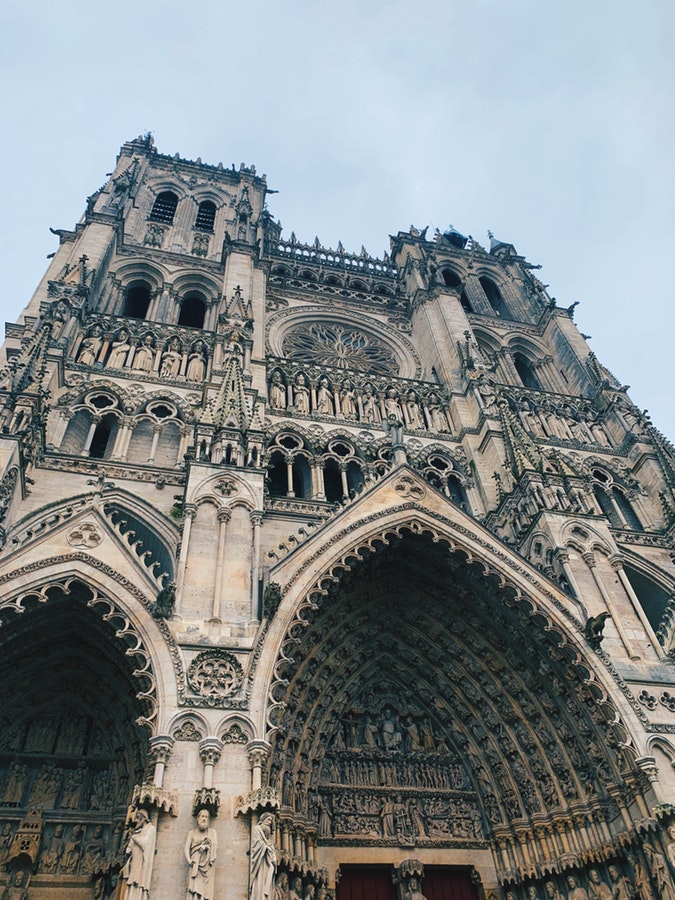
Since the fire at Notre Dame on Monday, I’ve been awestruck by the thoughts of the longevity of that building. If you had asked me “when was Notre Dame built?” three days ago, I probably would have guessed 16th or 17th century. I knew it was old. I would have guessed it was older than America. I would not have guessed that the construction began in 1163 (around the time Genghis Khan was born). (more…)

