My favorite Disney movie is the Little Mermaid, and part of why I love the movie so much is because of tall of the gospel themes.
The longing of the human soul
Ariel has it all. She’s a princess, she lives in a palace. she’s beautiful, she has an amazing singing voice, great friends, she’s adored. Yet what she really wants is a world that’s above (literally).
While her hope and aspiration is to be part of our world, her understanding of it is imperfect. She finds various items and turns to her seagull friend Scuttle to explain the things of the world to her. He’s well-intentioned but often ill informed as he tells her a fork is used for hair and a tobacco pipe is a musical instrument. We also see her imperfect knowledge of the world in the song “Part of Your World” where she keeps repeating “what do you call ’em?” “what’s that word?”
None of that changes Ariel’s desire to know our world. A world where they walk, where they run, where they stay all day in the sun. Sun is noteworthy in her association with the world as light is a nearly universal religious symbol of truth and righteousness. She desires the illumination of the world above over the dark world of the seas.
A sinful heart
Ariel has a loving father, the king, but she is also disobedient to him. She goes up to shore in spite of being forbidden. She complains about her father’s rules in “Part of Your World” when she sings: “Bet’cha on land they understand, bet they don’t reprimand their daughters.”
A deal with the devil
In order to make it to land, Ariel makes a deal with Ursula, the Sea Witch, who’s a demonic figure. Many had come before Ariel and made various deals with Ursula, only to lose and be turned into polyps.
Ariel is betting on herself. But it’s a bet she will lose. She cannot ultimately prevail in becoming part of the world.
A savior
Ariel was always a pawn in Ursula’s game. Ursula wants to rule the world of the seas. When Ariel loses her deal, her father Triton intervenes. There’s only one thing that can save Ariel. Triton exchanges himself for her and is turned into a polyp. He sets aside his crown so that Ariel can live.
Victory
Ursula is powerful. But she’s not all-powerful. In the end, she is defeated. There’s a resurrection of the people who’s lives she had taken. Triton gives Ariel what she could not give herself. He gives her entrance into the human world. The movie ends like the Bible ends, with a wedding celebration and a choir (only time in this movie) singing: Now we can walk, now we can run, now we can stay all day in the sun. Just you and me and I can be part of your world.
The gospel
There are great themes in this movie. But it also is just a shadow of the real story. That we are sinful and need grace. Jesus is the one who took the penalty of our sin for us so that we could be forgiven and have our true home in another world.
Thanks for reading! If you liked, please comment and share :)
Last week, the Supreme Court overruled an executive order from New York Governor Andrew Cuomo which limited attendance at religious services in certain areas which have been especially hard hit by Covid. This decision changed a previous ruling from the court which sided with governors. With the New York case, it was new justice Amy Coney Barrett casting the vote which reversed the previous decision.
Coronavirus is a highly contentious subject both politically, economically, socially. And some people are indeed critical of this new decision, citing the risks of churches being epicenters for spread of the virus.
Essential business
I find it fascinating that casinos are open in Las Vegas and Atlantic City. That’s ok. Every weekend, I watch college football games with thousands of people in the stands. That’s ok. In much of the country, restaurants are still open for dine-in seating. We had lots of cases this summer too and large protests happened all across the country. But churches are the problem. Lots of businesses are designated as “essential” and open.
I’ve heard people argue that churches should just stream their services online. Ok. And instead of allowing dozens of people to go to the grocery store, why not issue people boxes of food or make people order online? If it’s so essential to limit churches to “slow the spread” and “flatten the curve.” If it’s so essential that churches not meet, why isn’t it important enough for us all to sacrifice on going to the grocery store in person? Sincere question.
Essential churches
Church is essential. And more importantly, it’s constitutionally protected. Most churches in America have 60 or fewer people attending on the average Sunday (and that’s in non-Covid years). Those numbers are almost certainly down this year as some people are choosing not to go to church.
I’m not someone who acts as though Covid is nothing. I appreciate the dangers of this virus and the impact that it’s had. But I also recognize that there are other significant costs in combatting this virus. Societal and Spiritual costs also matter.
I see a lot of contempt for people who dare question or push back against restrictions. As if doing that means you actively want to kill people. I feel like our society deserves a little bit of credit. We have a virus where most people are not in an at-risk group; where most people are not at an age where they’re statistically likely to die or to have major complications; and where the vast, vast, vast majority of people who test positive survive. We’ve all had our lives and society turned upside down for most of this year. And I see the contempt for anyone who would have the audacity to want to live like a free person in a free society.
Again. All of the businesses that politicians (who regularly disregard their own commands) have decided are “essential,” and yet the desire to go to church is somehow extra reckless or uncaring? It’s insanity.
Church is not a privilege. It’s a right.
Thanks for reading. If you liked, please share and comment!
19 Now when the virgins were gathered together the second time, Mordecai was sitting at the king’s gate. 20 Esther had not made known her kindred or her people, as Mordecai had commanded her, for Esther obeyed Mordecai just as when she was brought up by him. 21 In those days, as Mordecai was sitting at the king’s gate, Bigthan and Teresh, two of the king’s eunuchs, who guarded the threshold, became angry and sought to lay hands on King Ahasuerus. 22 And this came to the knowledge of Mordecai, and he told it to Queen Esther, and Esther told the king in the name of Mordecai.
23 When the affair was investigated and found to be so, the men were both hanged on the gallows. And it was recorded in the book of the chronicles in the presence of the king.
3 After these things King Ahasuerus promoted Haman the Agagite, the son of Hammedatha, and advanced him and set his throne above all the officials who were with him. 2 And all the king’s servants who were at the king’s gate bowed down and paid homage to Haman, for the king had so commanded concerning him. But Mordecai did not bow down or pay homage.
3 Then the king’s servants who were at the king’s gate said to Mordecai, “Why do you transgress the king’s command?” 4 And when they spoke to him day after day and he would not listen to them, they told Haman, in order to see whether Mordecai’s words would stand, for he had told them that he was a Jew. 5 And when Haman saw that Mordecai did not bow down or pay homage to him, Haman was filled with fury. 6 But he disdained to lay hands on Mordecai alone. So, as they had made known to him the people of Mordecai, Haman sought to destroy all the Jews, the people of Mordecai, throughout the whole kingdom of Ahasuerus.
7 In the first month, which is the month of Nisan, in the twelfth year of King Ahasuerus, they cast Pur (that is, they cast lots) before Haman day after day; and they cast it month after month till the twelfth month, which is the month of Adar. 8 Then Haman said to King Ahasuerus, “There is a certain people scattered abroad and dispersed among the peoples in all the provinces of your kingdom. Their laws are different from those of every other people, and they do not keep the king’s laws, so that it is not to the king’s profit to tolerate them.
9 If it please the king, let it be decreed that they be destroyed, and I will pay 10,000 talents of silver into the hands of those who have charge of the king’s business, that they may put it into the king’s treasuries.” 10 So the king took his signet ring from his hand and gave it to Haman the Agagite, the son of Hammedatha, the enemy of the Jews. 11 And the king said to Haman, “The money is given to you, the people also, to do with them as it seems good to you.”
12 Then the king’s scribes were summoned on the thirteenth day of the first month, and an edict, according to all that Haman commanded, was written to the king’s satraps and to the governors over all the provinces and to the officials of all the peoples, to every province in its own script and every people in its own language. It was written in the name of King Ahasuerus and sealed with the king’s signet ring.
13 Letters were sent by couriers to all the king’s provinces with instruction to destroy, to kill, and to annihilate all Jews, young and old, women and children, in one day, the thirteenth day of the twelfth month, which is the month of Adar, and to plunder their goods. 14 A copy of the document was to be issued as a decree in every province by proclamation to all the peoples to be ready for that day. 15 The couriers went out hurriedly by order of the king, and the decree was issued in Susa the citadel. And the king and Haman sat down to drink, but the city of Susa was thrown into confusion.
4 When Mordecai learned all that had been done, Mordecai tore his clothes and put on sackcloth and ashes, and went out into the midst of the city, and he cried out with a loud and bitter cry. 2 He went up to the entrance of the king’s gate, for no one was allowed to enter the king’s gate clothed in sackcloth. 3 And in every province, wherever the king’s command and his decree reached, there was great mourning among the Jews, with fasting and weeping and lamenting, and many of them lay in sackcloth and ashes.
4 When Esther’s young women and her eunuchs came and told her, the queen was deeply distressed. She sent garments to clothe Mordecai, so that he might take off his sackcloth, but he would not accept them. 5 Then Esther called for Hathach, one of the king’s eunuchs, who had been appointed to attend her, and ordered him to go to Mordecai to learn what this was and why it was. 6 Hathach went out to Mordecai in the open square of the city in front of the king’s gate, 7 and Mordecai told him all that had happened to him, and the exact sum of money that Haman had promised to pay into the king’s treasuries for the destruction of the Jews. 8 Mordecai also gave him a copy of the written decree issued in Susa for their destruction, that he might show it to Esther and explain it to her and command her to go to the king to beg his favor and plead with him on behalf of her people. 9 And Hathach went and told Esther what Mordecai had said.
10 Then Esther spoke to Hathach and commanded him to go to Mordecai and say, 11 “All the king’s servants and the people of the king’s provinces know that if any man or woman goes to the king inside the inner court without being called, there is but one law—to be put to death, except the one to whom the king holds out the golden scepter so that he may live. But as for me, I have not been called to come in to the king these thirty days.”
12 And they told Mordecai what Esther had said. 13 Then Mordecai told them to reply to Esther, “Do not think to yourself that in the king’s palace you will escape any more than all the other Jews. 14 For if you keep silent at this time, relief and deliverance will rise for the Jews from another place, but you and your father’s house will perish. And who knows whether you have not come to the kingdom for such a time as this?” 15
Then Esther told them to reply to Mordecai, 16 “Go, gather all the Jews to be found in Susa, and hold a fast on my behalf, and do not eat or drink for three days, night or day. I and my young women will also fast as you do. Then I will go to the king, though it is against the law, and if I perish, I perish.” 17 Mordecai then went away and did everything as Esther had ordered him.
Prayer
Our heavenly father,
We thank you for this day and the opportunity to come together to praise your glorious name.
Lord, may we be ever mindful of the wonders of your goodness. May we love you with all of our heart, with all our soul, with all our mind, and with all our strength.
And we thank you for your son, the Lord Jesus Christ, who has come into the world to bring your kingdom, to shine as light, and to reconcile sinful humanity. It is Jesus alone who is the author and perfecter of our faith. Lord, we pray for your nearness. May we not be people who are stressed by the concerns and worries of the world but let us be people who walk in faith everyday.
We again pray for our time in your word. I thank you for every person here and I pray that we can again be encouraged, edified, exhorted, and enlightened through your Word. And most importantly, I pray that we can be pointed to your gospel.
In Jesus’ name, Amen.
Introduction
We’re continuing in our Christmas series through the Book of Esther.
Last week, we were introduced to the main characters of the Book.
The opulent king Ahaseurus and the great feast that he threw.
His wife, Queen Vashti and her standing up to her husband when he wanted to put her on display.
The king’s advisors influencing his decisions.
The introduction of Esther and Mordecai and Esther’s selection as queen.
And the secret she harbored. That in the Persian Empire, she was Jewish.
I had said last week that I look at the major events of Esther similar to scenes of a play.
Last week was act 1: the introduction of the characters.
This week, we come to act 2 and see the major conflict of the story. Haman’s Plot of genocide.
We’re going to look at this story in three scenes.
In the first scene of this passage, it’s the end of chapter 2.
Mordecai catches wind of a plot against King Ahaseurus.
Verses 21-22: In those days, as Mordecai was sitting at the king’s gate, Bigthan and Teresh, two of the king’s eunuchs, who guarded the threshold, became angry and sought to lay hands on King Ahasuerus. 22 And this came to the knowledge of Mordecai, and he told it to Queen Esther, and Esther told the king in the name of Mordecai.
In the beginning of the passage, we see something important. While Mordecai and Esther aren’t Persians, we see them acting in loyalty to the king.
The would-be killers are taken to the gallows and executed.
Customs in the ancient world would have called for some sort of reward for Mordecai. He had saved the king’s life, but here, he gets nothing. That’ll be relevant in the immediate context of the story and in the overarching story line that we’ll see come to greater fruition next week.
For now, let’s just focus on the fact that Mordecai is responsible for saving the king’s life and he gets nothing.
Scene 2 – the wicked promoted
We come to a second scene, where we see the last major character of the story introduced.
Quoting from the beginning of chapter 3: After these things King Ahasuerus promoted Haman the Agagite
So instead of Mordecai getting the promotion that he would be expected to receive, this new character Haman appears in the story and receives a promotion.
A brief family tree is given for Haman. He’s not an Israelite.
When the story calls Haman an Agagite, he’s probably an Amelkite, who were one of the ancient tribes with whom the Israelites had a long and contentious history.
We see the primary conflict of the story introduced.
On numerous occasions, Mordecai does not pay the homage to Haman which Haman feels owed.
3:3: all the king’s servants who were at the king’s gate bowed down and paid homage to Haman, for the king had so commanded concerning him. But Mordecai did not bow down or pay homage.
It can be tempting to think that this was for religious reasons. Not bowing down to pay homage to anyone but God.
I question if that’s what’s happening here.
We see other instances in the Old Testament of Israelites bowing and showing respect for officials.
When people meet Queen Elizabeth, men generally bow and women generally courtesy. We stand for the national anthem and the pledge of allegiance.
How is any of that different?
It simply seems that Mordecai didn’t like or respect Haman.
I mentioned a moment ago that Haman received a promotion when one appeared to be in order for Mordecai.
This is a common cry of lament in the Bible. Questioning why God allows the wicked to prosper.
We see it in Psalm 94:3:
3 O Lord, how long shall the wicked, how long shall the wicked exult?
One of the greatest examples of these questions in the Bible is found in Psalm 37.
The Psalm begins with explaining the judgment for those who oppose the Lord. It’s a 40 verse Psalm which goes back and forth in talking about ultimate judgement upon those who oppose the Lord and calls the people of God to patience and trust.
Just to give a few examples.
Verses 1-2: 1 Fret not yourself because of evildoers; be not envious of wrongdoers! 2 For they will soon fade like the grass and wither like the green herb.
Verses 10-13 again talks of divine judgment.
10 In just a little while, the wicked will be no more; though you look carefully at his place, he will not be there. 11 But the meek shall inherit the land and delight themselves in abundant peace. 12 The wicked plots against the righteous and gnashes his teeth at him, 13 but the Lord laughs at the wicked, for he sees that his day is coming.
There are so many more examples we could look to in this Psalm. But I want to look at how Psalm 37 ends.
39 The salvation of the righteous is from the Lord; he is their stronghold in the time of trouble. 40 The Lord helps them and delivers them; he delivers them from the wicked and saves them, because they take refuge in him.
It’s a reminder that God is just.
In world events, we see the wicked prosper. We see tyrannical leaders in other nations. We see powerful people who abuse others.
Perhaps we’ve seen examples in our own lives of people prospering when it didn’t seem right. Perhaps we’ve had someone get ahead of us in school, in work, in another situation but they didn’t do it honestly, or they cheated or broke the rules but didn’t get caught.
Those things happen.
And we see it happen in the Book of Esther.
God can seem distant when those things happen. The world can seem unjust when those things happen. But God is sovereign over the events of the world.
As I’ve said multiple times about this book, God isn’t mentioned in Esther, but he’s present. And while we might not always see God at work in every situation in our lives, while we might not always feel God’s presence, he is no less active in our world today.
Unrighteousness and sin will be dealt with by a just and righteous God. It doesn’t always happen on the timeline that we prefer, but it is no less true that God is working out his perfect justice.
In verse 7, it talks of Haman casting lots. Casting lots was a practice similar to flipping a coin or throwing dice. He was doing it to find what was – in his mind – the right time to go forward with a plot he had.
And that plot is introduced in verse 8.
3:8: Then Haman said to King Ahasuerus, “There is a certain people scattered abroad and dispersed among the peoples in all the provinces of your kingdom. Their laws are different from those of every other people, and they do not keep the king’s laws, so that it is not to the king’s profit to tolerate them.
Haman tries to turn the king against the Jews.
Just as a reminder, at this time, Israel is in the territory of the Persian Empire.
He brings up the different lifestyle of the Jewish people when he talks of their laws being different.
Historically, this has long been a justification for anti-semtiic thought. Especially among observant Jews, they can be very much cloistered in their own communities. Observant Jews have laws that impact their worship, which is different than the pagan world. They have laws that affect their diet, their calendar. Especially for men, their dress and appearance.
And so Haman appeals to the differences betwween the Jews and the Persians and he uses that as a justification for genocide.
And to make the offer all the more enticing to the king, Haman makes him an offer he can’t refuse.
Verse 9: If it please the king, let it be decreed that they be destroyed, and I will pay 10,000 talents of silver into the hands of those who have charge of the king’s business, that they may put it into the king’s treasuries.”
The ancient historian Heroditus estimated the total annual GDP of Persia to be like 14,000 talents of silver.
So Haman has pledged an enormous amount of money to the king, who – just as a reminder – is coming off of an unsuccessful military campaign.
So we don’t so much see animus from the king towards the Jews, but we see once again that he is impressionable and easily swayed.
The king gives Haman his signet wring. Basically royal authority in issuing this decree.
And word is sent out to the entire Persian Empire: Letters were sent by couriers to all the king’s provinces with instruction to destroy, to kill, and to annihilate all Jews, young and old, women and children, in one day, the thirteenth day of the twelfth month, which is the month of Adar, and to plunder their goods. (3:13)
It’s a holocuast. The entire Jewish race is to be plundered and killed.
The timing of this event providentially corresponds to the time of Passover. And from the time of the edict, it’s still a few months away.
Again, keep in mind that Esther is a relatively short story but the book covers several years in time.
It is interesting timing.
When you consider the original Passover.
God had miraculously intervened and saved the Israelites from the Egyptians.
But once the Israelites had entered the Promised Land, they continued to sin. And God brought judgement upon the Israelites by allowing them to be conquered and to lose the land.
Was this a further judgment? Would God intervene? What was the plan?
Chapter 4 begins by telling us of Mordecai’s response to this decree.
It should be no surprise but he’s beside himself. He’s absolutely devastated by this horrific news.
When Mordecai learned all that had been done, Mordecai tore his clothes and put on sackcloth and ashes, and went out into the midst of the city, and he cried out with a loud and bitter cry.
We see a similar response when Esther gets word of this.
Yes, she’s the queen. But it’s not like she had a role in advising the king on these matters.
Verse 11, communicating through messengers, Esther explains to Mordecai that she doesn’t even have the authority to approach her husband without being requested.
“All the king’s servants and the people of the king’s provinces know that if any man or woman goes to the king inside the inner court without being called, there is but one law—to be put to death, except the one to whom the king holds out the golden scepter so that he may live. But as for me, I have not been called to come in to the king these thirty days.”
The idea that a law existed where the King of Persia could not be approached is corroborated by the historian Herodotus. By the way, Herodotus wasn’t Jewish. He was Greek.
The passage tells us that it’s been about a month since Esther has even interacted with the king.
Perhaps part of Esther’s hesitancy to bring this before the king was that it would potentially force her to reveal her own Israelite origins.
But Mordecai doesn’t want to accept that as a dead end. She’s still the person who’s in a unique position. If anyone can help the Jewish people, it’s Esther.
13 Then Mordecai told them to reply to Esther, “Do not think to yourself that in the king’s palace you will escape any more than all the other Jews. 14 For if you keep silent at this time, relief and deliverance will rise for the Jews from another place, but you and your father’s house will perish. And who knows whether you have not come to the kingdom for such a time as this?”
Again, Mordecai doesn’t tell this to Esther directly. They’re communicating through others.
But he has given her a powerful message.
Mordecai has said a lot, but I want to focus on three things.
First, he tells her no one will protect her either if this plan against the Jews goes forward. Yes, she would be taking a risk by approaching the king. But she’s also taking a risk by doing nothing.
Secondly, we see tremendous faith from Mordecai when he says: relief and deliverance will rise for the Jews from another place.
He’s clearly putting pressure on Esther but he’s also expressing ultimate faith in God’s deliverance for the Jewish people. Mordecai has the hope that this deliverance will come, one way or another, with Esther or without her.
Today, is the first Sunday of advent.
The first Sunday of advent is traditionally associated with the theme of hope.
We see that from Mordecai. And it is an important reminder to trust in God’s promises.
We too should have hope. In God. In his promises. In his plans.
God isn’t mentioned in Esther, but he looms over this book. It is because Mordecai knows that the Lord God is his God and that the Israelites are God’s people that he can have total certainty that the Lord will bring deliverance.
And we too should have tht hope.
There’s been a lot of stress this year.
In Matthew 16:18, Jesus tells Peter:
I tell you, you are Peter, and on this rock I will build my church, and the gates of hell shall not prevail against it.
The third thing that Mordecai tells Esther, and this is probably the most well known verse in this book.
who knows whether you have not come to the kingdom for such a time as this?”
What he’s saying is that “perhaps the reason why you’re the queen is for this moment, and to act on behalf of the people.”
Sometimes we get pushed into moments where it’s required of us to do great things.
I think of major events like 9/11. People rose to the occasion.
A time such as this.
We all have meaningful moments in our lives.
We don’t always ask for those moments.
Perhaps not moments that will impact entire nations.
But we have moments that are still significant and that can impact our lives and the lives of others.
Sometimes those moments call for us to make sacrifices. Sometimes those moments call us to take risks.
Ordinary people get pushed into situations where sometimes they’re in a position to save a life.
Ordinary people get put in situations where sometimes they have the opportunity to stand up for someone else or advocate for someone who’s faced an injustice.
In those moments, there’s a choice to keep on minding your own business or to stand up for someone else.
What do you do in time such as those?
That’s the challenge that Mordecai gives to Esther.
15 Then Esther told them to reply to Mordecai, 16 “Go, gather all the Jews to be found in Susa, and hold a fast on my behalf, and do not eat or drink for three days, night or day. I and my young women will also fast as you do. Then I will go to the king, though it is against the law, and if I perish, I perish.” 17 Mordecai then went away and did everything as Esther had ordered him.
They round up the Jews to fast. That’s about the only Spiritual activity we see in this book where God, prayer, prophecies, and miraculous signs are absent.
Let us not lose sight of the faith of Esther in this story either.
For her to rise to the occasion at a time such as this, she was risking her own life.
Jesus brings a new creation into the world and into the lives of those who believe in his gospel.
I want to highlight a few words and phrases in this opening prologue to John:
In the beginning. Word. Life. Light. Darkness.
Just to name a few.
These are all found both in John 1, but also in Genesis 1. So let’s touch on some of these ideas. My goal is really to show this creation theme in John.
Opening phrase of the Gospel of John: In the beginning was the Word.
It’s interesting in comparing the beginning of John’s gospel to the beginnings of the other three. Mark’s gospel begins with the ministry of John the Baptist as the one who points to Christ. Luke’s gospel goes back further with the birth of John the Baptist and the birth of Jesus. Matthew’s gospel goes back further still to the family line of Jesus and takes us back to Abraham, back to the beginning of God’s covenant with his people. John’s gospel goes back even further, back to the very beginning, back to eternity.
It’s the same way in which the Bible opens up, the first words in Genesis are: in the beginning, God created the heavens and the earth. (Genesis 1:1)
John starts with: in the beginning was the Word.
Now, it’s interesting that John says “the word.” He doesn’t say “in the beginning was Jesus” or “in the beginning was the Christ” or “in the beginning was the Lord” but “in the beginning was the Word.”
But, in the beginning was the Word. Why use the word Word? Borrowing an idea from D.A. Carson in his commentary on John. From the beginning of the Bible, we see references to God’s word. God is a talking God. He speaks in Genesis. “Let there be light,” and the text says “and it was so.” God calls things into being by the power of his word, and what he calls into existence exists.
In the Old Testament, God’s word is tied to creation, salvation, healing, and deliverance. With the incarnation of Jesus, we see God’s greatest and most spectacular form of expression to the world. The Word is an appropriate title for Jesus because it is through this Word that we have ultimate truth, eternal life, future hope, assurance of God’s promises, and God’s greatest revelation of himself to the world.
This Word is not some abstract idea or force. This Word exists. “And the Word was with God, and the Word was God.”
But just to sum up what verse 1 is saying is that Jesus is eternal, he has always existed in fellowship with God, and that he himself IS God. That’s really the major theme of John’s Gospel. Jesus is the Lord.
Verse 3, we see Jesus’ involvement in creation. All things were made through him, and without him was not any thing made that was made.
Again it takes us again to creation. When you read Genesis 1, John 1 plugs right into those events. He wasn’t just hanging out while God the Father did all of the creating, rather nothing exists without Jesus.
Verse 4. In him was life, and the life was the light of men.
Two more ideas that are found in creation. Life and light. Both of these ideas will also be significant themes in John’s gospel. Let’s start with life. Nearly half of the New Testament usages of the word life come from John’s writings. In Genesis, life is created. The animals that walk the earth, the birds of the air, the fish of the sea, culminating in God’s creation of man in his own image. All life is created in Genesis. And here, in referring to Jesus, it says that life itself is found in him.
John 10:10, Jesus says that he has come so that his people can have life and have it abundantly. And it’s the life that can only come through Jesus. John 14:6, he says: “I am the way, the truth, and the life, no one comes to the father except through me.”
And he has authority to say these things.
Because. In the beginning was the Word. And in him was life. And he made everything. And he’s God.
So John begins his gospel by talking of the God of creation entering into creation to make his new creation.
Next theme of creation that’s found in John. Light.
Quoting again from our passage: In him was life and that life was the light of men.
In Genesis, the first thing that God calls into being is light.
Genesis 1:3-4: And God said, “Let there be light,” and there was light. And God saw that the light was good
Light is a symbol for life, salvation, and the presence of God.
Yet John takes it to a fuller meaning. In John 8:12, Jesus will say: I am the light of the world. Whoever follows me will not walk in darkness, but will have the light of life
Light is contrasted by darkness. Darkness in John refers to evil and sin. Darkness is the opposite of light both metaphorically and literally.
In Genesis 1:4, we’re told that God separated the light from darkness. John chapter 1 says that “the light shines in the darkness and the darkness has not overcome it.”
Jesus will talk at greater length of light in darkness in John 3, when he says: the light has come into the world, and people loved the darkness rather than the light because their works were evil.20 For everyone who does wicked things hates the light and does not come to the light, lest his works should be exposed.21 But whoever does what is true comes to the light, so that it may be clearly seen that his works have been carried out in God.”
In that, we see why Jesus came. Because the world is sinful. People love their sin. People oppose the light, but Jesus came to bring light and life. Again, John keeps pointing back to creation to show us a new creation that Jesus is bringing into the world.
Perhaps the climax of this entire introductory prologue of John’s gospel is found in verse 14: And the Word became flesh and dwelt among us, and we have seen his glory, glory as of the only Son from the Father, full of grace and truth.
The language returns to using the word Word. And it says that this Word, Jesus, became flesh and dwelt among us. The God who created the world entered his creation. What a profound reality that is. The Word became flesh and dwelt among us.
In creation, before the fall, there was fellowship with God. It was paradise. And yet Adam and Eve sinned. Cast out of the garden. But here in John, we see that the Word became flesh and dwelt among us. Jesus came into our fallen world. Because he loved us. Because he’s gracious. Because he’s good.
He is the eternal God of creation. And he came to bring a new creation. In the opening of John, we see the groundwork being laid for that which was lost in the fall to be regained through the gospel.
Paradise was lost due to sin, but in the beginning of John, we see that the word became flesh and dwelt among us. Darkness came into the world because of sin, but we see that Jesus is the true light. Death came into the world because of sin, but in Jesus, there was life. Not just anyone is capable of doing that. But Jesus isn’t just anyone. He was in the beginning. Jesus is the eternal God of creation who brings a new creation. He’s here to give you a new life. He overcame the darkness by living a sinless life. He brought life through his own death. He restored the relationship by being forsaken.
All of it was his work. He invites you into a new life, a new covenant. He gives you a new heart.
The Apostle Paul said that anyone who is in Christ is a new creation. (2 Cor. 5:17)
In John 3, a man named Nicodemus. He’s intrigued by this teacher and ministry and he wants to learn more. Jesus says that we must be born again. On the night before he was crucified, he told his disciples to love one another, and he called it a new commandment. In the closing sections of the Book of Revelation, John talks of seeing a new heaven and a new earth. He records Jesus saying that he’s making all things new. (Rev. 21:5). When we trust in Jesus and are born again, Jesus does bring a new creation. He does make something new. He makes a new person. Jesus is the Lord of creation and new creation.
Have you trusted in Jesus? Is he your Lord and savior?
There is no other way to God, there is no other way to life, there is no other way to forgiveness, there is no other way to heaven than through Jesus.
Thanks for reading! If you liked, please comment and share :)
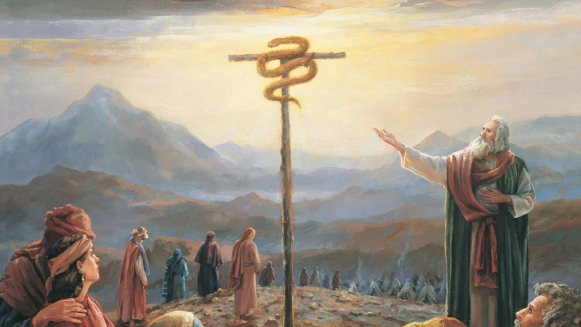
In Numbers 21, the Israelites experience victory over the Canaanites but soon fall back into grumbling and complaining. God brings a plague of snakes upon the people. It’s a divine judgment. Their grumbling against God was to their downfall. But the people beg for mercy.
And the Lord said to Moses, “Make a fiery serpent and set it on a pole, and everyone who is bitten, when he sees it, shall live.” 9 So Moses made a bronze serpent and set it on a pole. And if a serpent bit anyone, he would look at the bronze serpent and live. -Numbers 21:8-9
Moses prays. God tells Moses to make a fiery serpent and set it on a pole. So God doesn’t simply take the snakes away. He also doesn’t prevent people from continuing to get bitten by the snakes. But once bitten, a person could respond by faith in the Lord by looking to the serpent on the pole.It’s an odd story. A number of questions might come to mind. Isn’t that idolatry? Making this bronze serpent?
In the Golden Calf episode of Exodus 32, Moses is on the mountain receiving instruction from the Lord. He’s there for 40 days and the Israelites get restless. They take their gold and melt it into the image of a cow. Why is it ok with the bronze serpent? It’s a totally different situation. Most importantly, because God told them to do it this time. Secondly, this wasn’t idol worship because they weren’t worshiping the serpent. The serpent didn’t represent God to the people.
There are many wonderful gospel themes in this scene. The Israelites sin against the Lord. And so God brings a plague of snakes upon the people as divine judgment. And yet, once the people repent and the bronze snake is made, it is in looking to that by which people are healed.
A symbol of death becomes a symbol of life
Snakes were bringing death, but looking to this particular snake brought the promise of healing. A symbol of judgment the Lord then uses as a symbol of victory. The cross was the greatest symbol of judgment and condemnation in the Roman world. A brutal punishment. And yet, it is to the cross that we see Christ’s victory over sin. Perhaps you look at the story and think “but why a snake? Aren’t snakes bad in the Bible?” Yeah, so are people, but it is through a man that we are saved. The Lord Jesus, both God and man.
The gospel
In a person being healed because of looking to the snake, it took what they were doing out of their hands. It was entirely the work of God. So too we see this in the gospel. It is not based on us, or how good we are. We are totally helpless to heal ourselves from the disease of sin. It is looking to the cross, to looking at what Jesus has done, to trusting Jesus by faith that we can have salvation.
It’s foolishness
The serpent doesn’t make sense. The world is confounded by the gospel and the message of grace, the idea that we can be freely forgiven based on what someone else has done. The world is offended by the message of salvation by grace. Paul says in 1 Corinthians that the cross is folly to those who are perishing, but to those who are being saved, it is the power of God (1 Corinthians 1:18).
We want to save ourselves. We want to see how we measure up and to feel good about how good we are. The gospel is that you cannot earn it. You look to what Jesus has done.
Salvation for the undeserving
The Israelites were grumbling and complaining and blaspheming against God, and yet God saves them. Jesus came into a world where people condemned him, polluted against him, betrayed him, and killed him. While we were yet sinners, Christ died for us (Romans 5:8). In both looking to the serpent and the death and resurrection of Jesus, what people needed was faith.
In the Gospel of John, Jesus will make specific reference to this event in Numbers. John chapter 3, Jesus is talking to Nicodemus, the Pharisee.Jesus says “as Moses lifted up the serpent in the wilderness, so must the Son of Man be lifted up.” (John 3:14) Moses literally lifted up the bronze serpent on a pole. And Jesus was literally lifted up on the cross. There, Jesus compares himself being lifted up to the bronze serpent. For the Israelites who were afflicted by the serpent’s bite, life was found by looking to the bronze serpent. For us today, eternal life is found by looking to Jesus.
The main idea of our passage this evening is that: Opposing God brings death but true life is fond by faith. Are you trusting in Jesus? We’re infected with the venom of sin. And it’s a killer. There is nothing we can do on our own to take out that poison. The only antidote is found in looking to Jesus.Look to him. Love him. Live for him.
Originally published August 1, 2018.
Thanks for reading! If you liked, please comment and share :)