Josh Benner

Category: Commentary

  • Equality vs. Equity: Kamala sells impossible vision in ad


    Vice presidential candidate (and possible president, if the ticket wins), Kamala Harris shared an ad on her social media sites this weekend talking about equality vs equity.

     
    It’s a 50 second spot narrated by Harris which begins: “so there’s a big difference between equality and equity. Equality suggests how everyone should get the same amount. The problem with that, not everybody’s starting out from the same place. So if we’re all getting the same amount, but you started back there and I started out over here – we could get the same amount, but you’re still going to be that far back behind me. It’s about giving people the resources and the support they need, so that everyone can be on equal footing and then compete on equal footing. Equitable treatment means we all end up at the same place.” 


    It’s the last sentence of that ad that’s especially noteworthy. “Equitable treatment means we all end up at the same place?”

    I realize it’s a campaign ad. It’s pandering. 

    But really consider the logic of what she’s saying. The government cannot guarantee we all get to the same place because of the uniqueness of people. And the only way to even attempt to make such a thing happen would be for the government to control every aspect of life: education, industries, wages. 

    But even if that happened, we can’t all get to the same place. Because we’re different. Some people have better parents than others. You can’t guarantee equity in upbringing. Some people are more attractive than others, which attracts other attractive people. So you can’t guarantee equity in relationships and marriage. We don’t have equal genetics. Some of us are more prone to diseases or obesity. People have different skills, different interests. 

    Someone might say, “but it’s a great vision!” 

    No it isn’t. 

    She’s selling people an idea that the government should take care of every aspect of their lives. That isn’t a great thing for people. It’s dehumanizing. Because the ability to succeed, to take risks, to fail, to learn from failure and overcome adversity is part of what makes us human. Not some utopian vision of everyone having the same results in life. 

    It’s also hypocritical. She’s saying we should all get to the same place. Well she’s a vote away from being the vice president. She has the best healthcare a person can have. She has a big staff that tends to her. She has secret service protection.

    Reminds me of Orwell’s famous line from “Animal Farm” “all animals are equal, but some animals are more equal than others.” 

    Thanks for reading! If you liked, please share :)

  • Prayer day reminds us of persecution Christians face around the world

    Photo Courtesy of Unsplash.

    Today is the International Day of Prayer for the Persecuted Church. We’ve seen crackdowns on Christianity (and other religions) in China. A recent report detailed testimonies of the atrocities against Christians in North Korea. Nigeria, which is fairly evenly split between Christians and Muslims has seen increasing hostility towards Christian in certain regions of that country. And in recent weeks in France, we’ve seen attacks against Christians. In the city of Nice, three people were stabbed to death this week.

    According to Open Doors:

    • Over 260 million Christians living in places where they experience high levels of persecution
    • 2,983 Christians killed for their faith
    • 9,488 churches and other Christian buildings attacked
    • 3,711 believers detained without trial, arrested, sentenced or imprisoned

    The reality of persecution should not surprise Christians. The New Testament repeatedly talks of the inevitable opposition for those who follow Christ. In 2 Timothy 3:12, the Apostle Paul says: Indeed, all who desire to live a godly life in Christ Jesus will be persecuted.

    In the Sermon on the Mount, Jesus said: Blessed are those who are persecuted for righteousness’ sake, for theirs is the kingdom of heaven (Matthew 5:10).

    And there are numerous other scriptures that could be referenced. The gospel is offensive to the world because it confronts people with their sin. It’s offensive to the world because it points to one way to heaven. It’s offensive because it takes man’s own goodness out of the equation for what justifies a person before God.

    In America, we’re blessed to enjoy a rich history of faith and constitutional protections. But we should regularly pray for those who are persecuted for their faith.

    I also think it’s important in America to appreciate the religious freedoms that we have. As we’re in the final days before the presidential election, I do see fears from some Evangelical Christians about persecution or limitations on churches if Joe Biden is elected president. While I appreciate that there are things Joe Biden supports which are totally against Christianity, I think doomsday fears of the purge on American Christianity are also an overreach.

    Yes, Christians should always be attentive of what’s happening and vigilant to preserve and protect our rights. But I also think it’s important to remember the people who truly suffer for their faith, and who’s lives are truly endangered for following the Lord Jesus.

    Prayer
    Lord, on this international day of prayer for the persecuted church, we pray for those who are persecuted for the cause of Christ. Just this week, there were attacks on churches in France. Persecution is on the rise in many parts of the world. Lord, we pray for those who worship you at a great cost to themselves, their families, their livelihoods, and their lives. Lord, may you be near to them. Lord may those people never been far from our hearts and minds. Lord, in spite of man’s attempts to thwart your gospel, we pray for the work of pastors and evangelists in these hostile places. May the word go forth. May the truth be preached. May the message of Christ crucified be proclaimed and believed. In Jesus’ name, amen.

  • ACB’s sorority shows inclusion by apologizing for congratulating her

    ACB’s sorority shows inclusion by apologizing for congratulating her

    Only women who support killing babies are capable of accomplishing things which should be acknowledged in society.

    This week, Amy Coney Barrett was confirmed as an associate justice of the Supreme Court.

    In the lead-up to Barrett’s confirmation, Kappa Delta – ACB’s college sorority – congratulated their famous alumna on her nomination with a Tweet which said: “KD alumna Amy Coney Barrett was nominated to serve on the Supreme Court. While we do not take a stand on political appointments, we recognize Judge Coney Barrett’s significant accomplishment. We acknowledge our members have a variety of views and a right to their own beliefs.

    Reasonable. Trying to tiptoe around the politics. They faced a backlash from pro-choice members who could not believe the sorority would acknowledge a monumental accomplishment of a famous member. As many organizations do when facing pushback, KD folded.

    Where’s the apology for their sisters who approved of the post? The post says that they “began an intentional journey for the betterment of our organization, with a focus on diversity, equity, and inclusion.”

    How is it inclusive to post about a historical moment and then apologize for that acknowledgement when some people get offended? Inclusion only goes one way. It’s inclusive when it includes a progressive viewpoint. But other views are not welcomed at the table of inclusivity. The KD statement went on to say that they’ve been working on “recognizing we always need to have a more diverse group.” And the solution is to ignore a position shared by a large swath of their members in the name of bowing to the outrage mob?

    Again, Kappa Delta was not endorsing ACB. But even acknowledging her ascendancy onto the nation’s highest court is forbidden.

    This isn’t the only such example .

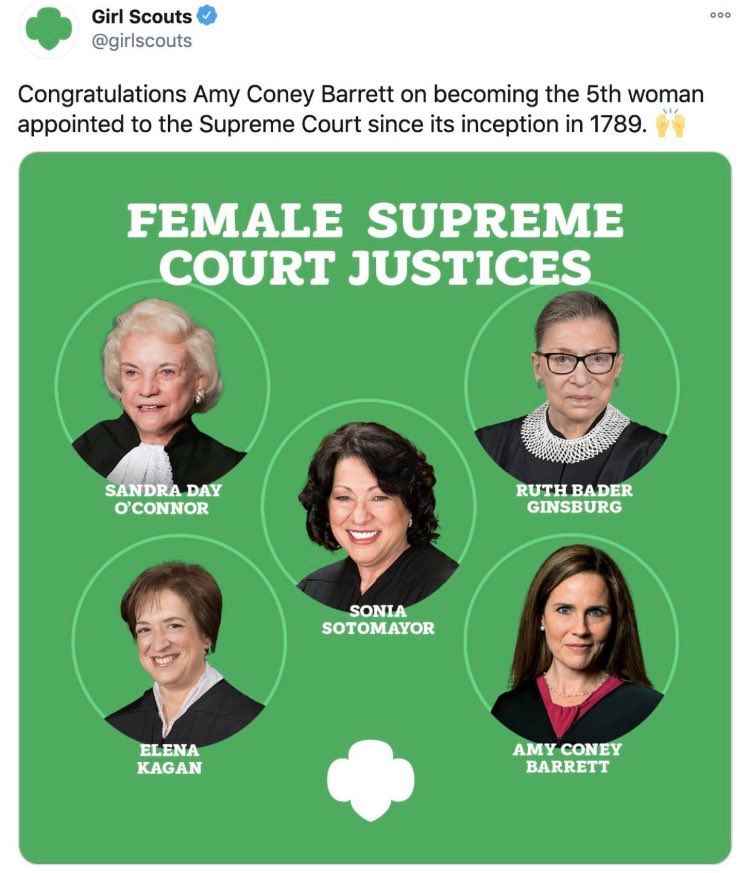
    The Girl Scouts also had the audacity to acknowledge the fifth woman in U.S. history being confirmed to the Supreme Court. Once again, the outrage mob responded.

    The Girl Scouts quickly backtracked and Tweeted: “Earlier today, we shared a post highlighting the five women who have been appointed to the Supreme Court. It was quickly viewed as a political and partisan statement which was not our intent and we have removed the post.”

    Insanity.

    Thanks for reading! If you liked it, share it!

  • San Diego school district lowers standards to combat racism

    San Diego school district lowers standards to combat racism

    San Diego Unified School District is the second largest district in California. Their district recently approved major changes in their grading system to combat racial disparities in academic out comings.

    NBC San Diego explains the background for policy changes:
    According to data presented by the district, under the old grading system, teachers fail minority students more than White students – a lot more. During the first semester of last year, 30% of all D or F grades were given to English learners. One in four, 25%, of failing marks went to students with disabilities. By ethnicity, 23% went to Native Americans. Another 23% of failing grades went to Hispanics. And 20% of D or F grades went to Black students.

    Among the changes, if assignments are turned in late, that will not count against a student’s academic score. Grading will not be based on cumulative scores throughout a term but by academic mastery of a subject by the end of a term.

    The policies also lessen penalties for cheating. Quoting from the San Diego Union Tribune:
    Under the new grading policy, when a student is caught cheating, schools must give the student a chance to reflect on what he or she did, repair trust and receive counseling or other help.

    This is insanity.

    Their grand solution to disparities in grading is to lower standards?

    Lower expectations do not help to overcome disparities. Lower expectations do not help the world to overcome racism. They make everyone worse off. Basic academic expectations such as not cheating and turning things in on time help to prepare people for life in the real world. Because in life, there are consequences for cheating. In life, there are consequences for not making deadlines. In life, your performance matters.

    On paper, that might show some improvements in these academic disparities. But at what cost? Are these making people perform at a higher level? It seems like this could far more easily have people performing at an even worse level. They’re removing basic consequences of student’s actions. On paper, grades might be better, but if they’re doing a worse job of preparing people for the real world, I ask of what value that is.

    Part of the heart behind these changes is that some students can come from dysfunctional homes and study academically. That is a sad reality. And I recognize that there is not an easy solution to these issues. But in lowering standards to boost grades, that doesn’t change the risk of harmful unintended consequences.

    Also, I question how these policies are themselves not racist? In focusing on late assignments or cheating, they say that it’s healing to fight racism to eliminate these policies? It’s the racism of low expectations.

    Thanks for reading! Make sure to like, comment, and subscribe!

  • Research says white Christians have become less motivated to address racial injustice

    Research says white Christians have become less motivated to address racial injustice

    I saw an interesting article from Barna Research a few weeks ago titled “White Christians have become even less motivated to address racial injustice.”

    From the article:
    “One might assume that the events of 2020 have increased awareness of racial injustice in the United States and motivation to address it. But the story isn’t so straightforward, new Barna research (conducted in partnership with Dynata) suggests. Yes, there are signs the past year has clarified how Americans think about racial injustice—but that doesn’t mean they see the issue, or their role within it, with greater urgency. In the Church especially, there is a sense that people are doubling down on divides.”

    The article looks at a couple of data points. They polled different racial groups with the question “do you think our country has a race problem?” Across all respondents, 46% affirmed the statement, slightly higher than 43% of self-professing Christians. When broken down by race, 33% of white professing Christians affirmed that statement (a 7% drop from the same survey a year before).

    In another survey question, Barna asked self-professing Christians “how motivated are you to address racial injustice in our society.” In the survey, the number of white Christians who felt “not at all motivated” to address current issues doubled in the past year from 11% to 22% (compared to 3% of African American responders).

    I distinctly remember earlier in the summer when there were people who refused to call out the rioting and looting. In fact, there were those who justified it. People talked about this as a response to injustice because of all of the hurt and pain. There were people who wanted to compare the protests to the Boston Tea Party. We needed to tear down statues of Abraham Lincoln and Christopher Columbus. We needed to

    But all of this was counterproductive. Violence does not engender public sympathy. It turns people away. That’s why people are less likely to talk about these issues. Because Americans have seen months of looting, fires and destruction in major cities. We’ve seen dramatic increases in crime and murder rates in major cities. We’ve seen story after story of black children being killed in the crossfire of inner city violence without groups like BLM ever protesting those deaths. We’ve seen roughly a billion dollars in property damages this summer.

    Whose lives have all of this violence and destruction helped? Who has this advanced? Who has this empowered?

    We’ve seen a rise in police officers being shot.

    Americans have been lectured all summer from the media, from sports, from Hollywood, from music, from our education systems about how racist we all are.

    So yes, its’ not a shock that some people are less likely to address these issues given the destruction that has come forth from the radical movements who are beating the drums the loudest. And this is a point which many thoughtful people have brought up which is that this summer is creating greater racial divides not helping to heal racial divides.

    I believe the these poll numbers will continue to trend in that direction.

    We’ve seen calls to defund police in democrat controlled cities. Meanwhile, all of these efforts disproportionately harm inner cities and disproportionately harm black communities. All of this works against public support. We see increases in violence and destruction. There have been young black children all over the country who have been killed in the cross-fire of inner city violence, without a word from BLM. And I think a lot of people feel like black communities are being used as political pawns to advance an agenda.

    As far as why many Christians are less likely to discuss these matters, I think there’s also the concern that the movement is ultimately supporting an ideology which is contrary to the world view of Christianity and find it unsavory and difficult to support. Critical race theory, which is the overarching ideology behind much of the current racial discussion in our culture, is popular on the political left. Modern liberalism and socialistic policies are influenced by Marxist thought, while religious people tend to be more conservative (not exclusively, but religious people are more likely to be conservative than liberal). So what we are left with is a discussion that is controlled by the left and where religious peel on the right have several areas of disagreement. All that to say: it’s not at all surprising that white Christians are less likely to talk about racial injustice.

    Is it because we’re all racist or prejudiced? The cultural Marists would say yes. Which feeds into this vicious cycle of diminishing interest in discussing these matters. Interest will continue to wane in the face of radicalism.

    Thanks for reading! Make sure to like, comment, and subscribe!