Josh Benner

Tag: Bible

  • Meaning of the bronze serpent: the gospel in Numbers

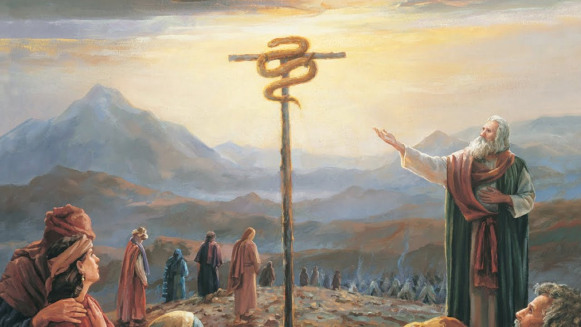
    maxresdefault-11.jpg

    In Numbers 21, the Israelites experience victory over the Canaanites but soon fall back into grumbling and complaining.
    God brings a plague of snakes upon the people. It’s a divine judgment.
    Their grumbling against God was to their downfall. But the people beg for mercy.
    8 And the Lord said to Moses, “Make a fiery serpent and set it on a pole, and everyone who is bitten, when he sees it, shall live.” 9 So Moses made a bronze serpent and set it on a pole. And if a serpent bit anyone, he would look at the bronze serpent and live.
    -Numbers 21:8-9
    Moses prays. God tells Moses to make a fiery serpent and set it on a pole. So God doesn’t simply take the snakes away. He also doesn’t prevent people from continuing to get bitten by the snakes.
    But once bitten, a person could respond by faith in the Lord by looking to the serpent on the pole.
    It’s an odd story. A number of questions might come to mind.
    Isn’t that idolatry? Making this bronze serpent?
    In the Golden Calf episode of Exodus 32, Moses is on the mountain receiving instruction from the Lord. He’s there for 40 days and the Israelites get restless. They take their gold and melt it into the image of a cow.
    Why is it ok with the bronze serpent?
    It’s a totally different situation. Most importantly, because God told them to do it this time.
    Secondly, this wasn’t idol worship because they weren’t worshiping the serpent.
    The serpent didn’t represent God to the people.
    There are many wonderful gospel themes in this scene.
    The Israelites sin against the Lord.
    And so God brings a plague of snakes upon the people as divine judgment.
    And yet, once the people repent and the bronze snake is made, it is in looking to that by which people are healed.
    A symbol of death becomes a symbol of life 
    Snakes were bringing death, but looking to this particular snake brought the promise of healing.
    A symbol of judgment the Lord then uses as a symbol of victory.
    The cross was the greatest symbol of judgment and condemnation in the Roman world.
    A brutal punishment. And yet, it is to the cross that we see Christ’s victory over sin.
    Perhaps you look at the story and think “but why a snake? Aren’t snakes bad in the Bible?”
    Yeah, so are people, but it is through a man that we are saved. The Lord Jesus, both God and man.
    The gospel 
    In a person being healed because of looking to the snake, it took what they were doing out of their hands. It was entirely the work of God.
    So too we see this in the gospel. It is not based on us, or how good we are. We are totally helpless to heal ourselves from the disease of sin. It is looking to the cross, to looking at what Jesus has done, to trusting Jesus by faith that we can have salvation.
    It’s foolishness 
    The serpent doesn’t make sense.
    The world is confounded by the gospel and the message of grace, the idea that we can be freely forgiven based on what someone else has done.
    The world is offended by the message of salvation by grace.
    Paul says in 1 Corinthians that the cross is folly to those who are perishing, but to those who are being saved, it is the power of God (1 Corinthians 1:18).
    We want to save ourselves. We want to see how we measure up and to feel good about how good we are.
    The gospel is that you cannot earn it. You look to what Jesus has done.
    Salvation for the undeserving 
    The Israelites were grumbling and complaining and blaspheming against God, and yet God saves them.
    Jesus came into a world where people condemned him, polluted against him, betrayed him, and killed him.
    While we were yet sinners, Christ died for us (Romans 5:8).
    In both looking to the serpent and the death and resurrection of Jesus, what people needed was faith.
    In the Gospel of John, Jesus will make specific reference to this event in Numbers. John chapter 3, Jesus is talking to Nicodemus, the Pharisee.
    Jesus says “as Moses lifted up the serpent in the wilderness, so must the Son of Man be lifted up.” (John 3:14)
    Moses literally lifted up the bronze serpent on a pole.
    And Jesus was literally lifted up on the cross.
    There, Jesus compares himself being lifted up to the bronze serpent.
    For the Israelites who were afflicted by the serpent’s bite, life was found by looking to the bronze serpent. For us today, eternal life is found by looking to Jesus.
    The main idea of our passage this evening is that: Opposing God brings death but true life is fond by faith.
    Are you trusting in Jesus?
    We’re infected with the venom of sin. And it’s a killer. There is nothing we can do on our own to take out that poison. The only antidote is found in looking to Jesus.
    Look to him. Love him. Live for him.

    Josh Benner is the associate pastor at Cornerstone Evangelical Free Church in Fergus Falls, Minnesota and has a Master of Divinity from Trinity Evangelical Divinity School. He enjoys writing about faith and culture. He lives with his wife Kari in Minnesota.

    Let’s connect!
    Facebook
    Twitter
    Instagram

  • Parents allowing children to decide their gender: why?

    child-childrens-baby-children-s.jpg
    A recent article from NBC talks about a Massachusetts family who are raising their twin boys without a gender. The idea behind this parenting philosophy is to allow the twins to decide for themselves when they’re older.

    In the story, the mother made the fair point about how we do have ways how we stereotype little boys and little girls that aren’t always helpful. Many raise girls to be prissy and “girlie,” while boys are raised to be tough and to not cry. These aren’t necessary aspects of masculinity and femininity, on that point, I agree. However to combat those stereotypes, we don’t need to raise children without gender. There are other, healthier approaches.

    It’s absolutely unnecessary for a person to take an otherwise normal, healthy baby and to then introduce confusion into their child’s life. Is letting a person “decide” their gender so important?

    I hear people talk about how complicated gender is.

    For the vast majority of people, it’s pretty simple. And so I return to my question, why introduce confusion? Why introduce additional complexity?

    I know to some this seems progressive and enlightened.

    It’s unwise.

    I saw a video a few years ago of a British woman who was doing this with her son. It’s heartbreaking.

    If your approach to parenting is doing something that society has historically not done and which contradicts the wisdom of human experience: it’s wrong. Raising a child is not the time to try new experiments.

    The idea that you can raise a kid without gender and then let them decide their gender is self-defeating.

    The idea that you can take a baby boy or girl and raise this child neutral of gender, and later let them decide their gender, it’ll be in the context of them having been raised as unaware to their gender. When they decide which gender they want to be, it’ll be from a context of not having been raised according to a particular gender. It’s not like you’ll decide you want to be a boy and instantly know how to do it. You weren’t shown! You weren’t taught! You were intentionally kept in the dark.

    Part of the justification that I’ve seen is that this helps a child to embrace their identity. I would argue that it actually raises a child ignorant of an important aspect of their identity. This style of parenting takes away the foundation of manhood and womanhood.

    And for what purpose?

    According to a 2016 study by the Williams Institute, transgendered people make up just over one half of one percent of the American population. And the transgender life is not an easy one. Tragically, the rate of attempted suicides within that community is 40% according to The Report of the 2015 U.S. Transgender Survey.

    With the Massachusetts family, the mother is an engineer and talks of the gender stereotypes in her field, how it is often male-dominated. That’s probably true. But how does it help that to raise boys as if they’re not?

    Gender comes from God. It’s fundamental to his creation of humanity. God made men and women and we are both created in his image. We should celebrate masculinity and femininity. Men and women compliment each other.

    Josh Benner is the associate pastor at Cornerstone Evangelical Free Church in Fergus Falls, Minnesota and has a Master of Divinity from Trinity Evangelical Divinity School. He enjoys writing about faith and culture. He lives with his wife Kari in Minnesota.

    Connect with me!
    Facebook
    Twitter
    Instagram


  • The best commentaries on Matthew (in my opinion)

    photo-1520099078215-db50d947d060.jpegLike many pastors, I’m a commentary nerd.

    Bible commentaries are scholarly books which give a verse by verse analysis of a book of the Bible. There are commentaries on every book of the Bible. Over the last 20 years, there have been hundreds of new commentaries that have been released. Commentaries are helpful to me in my studies of the Bible as I prepare sermons, Sunday school lessons, youth group lessons, and small group discussions. They’re a huge blessing to me and my ministry.

    If you’re looking to study a book in depth, which commentaries should you read?

    I’m starting a new series where I give my opinions on some of the best commentaries I’ve encountered for various books of the Bible.

    Today, we start with the Gospel of Matthew. It’s my favorite book of the Bible to study. I’ve also preached more from Matthew than any other book and I’m familiar with all of the major commentaries.

    Matthew has many great commentaries. I would put it right up with Romans as being the New Testament books with the best literature.

    1. Grant Osborne – Zondervan Exegetical Commentary of the New Testament (2010). Osborne was a professor at my seminary but I never actually had him for a class (so many great professors, it was difficult to get ’em all). I love his writing. Commentaries can be very dense and intellectual but Osborne’s commentaries (and he’s written one on every book of the New Testament) are written in an approachable manner, while still being academically rigorous.
    2. R.T. France – New International Commentary of the New Testament (2007). The late R.T. France actually wrote two commentaries on Matthew. He wrote one the New International Commentary of the New Testament (NICNT) and the Tyndale New Testament Commentary on Matthew. The NICNT commentaries can at times get highly academic, but, like Osborne, France writes with great clarity. Every time I read France’s observations of Matthew’s gospel, I feel that there is something fresh and interesting he has gleaned from the text. The Tyndale commentary is still very solid, more condensed than the NICNT, and a bit more approachable for the lay person, but still very solid.
    3. Leon Morris – Pillar New Testament Commentary (1992). Unlike any other commentator I’ve read, Morris could write with brevity while feeling like he fully captured the idea of a verse. Truly a gift. A solid Evangelical scholar.
    4. D.A. Carson – The Expositor’s Bible Commentary (1984). This is my favorite commentary in the Expositor’s Bible Commentary series. Carson is my favorite New Testament scholar. As with anything Carson does, excellent exegesis and explanations of the text. One of the things I most appreciate about Carson is his ability to explain a passage while seamlessly connecting it to the rest of the context of the passage and within the overarching book.
    5. Craig Blomberg – North American Commentary (1992). As a critique (and not so much a direct criticism of Blomberg because there are often restrictions from publishers on how long a book can be), but at times, I feel like his exposition can be too brief, and leaves me wanting more. But what he gives you in his commentary of Matthew is first rate. Blomberg approaches challenging subjects in a gentle manner.

    What’s your favorite commentary on Matthew?

    Josh Benner is the associate pastor at Cornerstone Evangelical Free Church in Fergus Falls, Minnesota and has a Master of Divinity from Trinity Evangelical Divinity School. He enjoys writing about faith and culture. He lives with his wife Kari in Minnesota.

  • The Church: being part of something bigger than yourself

    photo-1519491050282-cf00c82424b4.jpeg
    An astounding 16 million soldiers, sailors and Marines served America in the Second World War.
    And while most of our focus on World War II is on the military and combat, within the United States, there was an effort to support the war unlike anything our nation had seen or has seen since.
    With millions going overseas, Americans at home took up new jobs.
    Coming out of the Great Depression, unemployment dried up, reaching an all time low in 1944.
    The war effort affected virtually every facet of American life. Companies shifted their manufacturing efforts to supporting the war and supplying the military. Maytag went from making washing machines to making parts for airplanes. Firestone Tires made artillery shells and aluminum containers for food transport.
    Products like sugar, butter, bacon, and cheese were rationed. As were penicillin and other medicines, along with rubber and certain types of metals. Materials for clothing such as silk and nylon were needed for uniforms. Everything went to supporting a cause that was so much bigger than any one person.
    And everyone’s contributions mattered.
    To help pay for the war, the government sold war bonds. Over 85 million Americans purchased war bonds to help fund the effort. To put that in perspective, that was more than half of the entire United States population at the time.
    An incredible effort.
    The church has a mission 
    As Christians, we too are called to be part of a cause that is far bigger than any of us, but where everyone has a role, where everyone has a job to do, where everyone has a way to serve.
    The mission of God on earth.
    And that mission is to spread the gospel. To make disciples. To build up the church. To love one another.
    It’s not a passive request in scripture, nor is it a good suggestion, but something which God commands from all of his people.
    If you’re a person who has placed faith in Jesus, this applies to you.
    As the Apostle Paul said in Galatians 2:20:
    I have been crucified with Christ. It is no longer I who live, but Christ who lives in me. And the life I now live in the flesh I live by faith in the Son of God, who loved me and gave himself for me.
    You belong to Jesus when you place your faith in him.
    And part of the purpose of the Christian life is one that is lived in service of God for the mission of God in the world.
    You were made to have an impact 
    Do you ever feel like you were made for something great?
    Do you ever feel like you were meant to have an impact?
     You are made for more, you are made to do great things, you are born to have an impact in the world.
    An impact for Jesus.
    We can try to build our own kingdoms, we can try to collect our own toys, we can try to control and manipulate the circumstances in our lives to make us feel secure.
    We can do those things.
    But we were made to serve the mission of Christ in the world.
    And that includes sharing the gospel, making disciples, making Jesus known, growing together as His Church, and serving God.
    As a church, every person in the church is called to use the ways God has gifted and equipped them for the purpose of serving God and building up the church.
    That’s why we’re here.
    Writing to the Church in Corinth, the Apostle Paul said:
    Now there are varieties of gifts, but the same Spirit; and there are varieties of service, but the same Lord; and there are varieties of activities, but it is the same God who empowers them all in everyone. To each is given the manifestation of the Spirit for the common good.
    Maybe you’ve never really thought about that.
    But all Christians are given Spiritual gifts.
    Doesn’t matter how well you know the Bible.
    It doesn’t matter how long you’ve been a Christian. There’s no probationary period before you can God.
    It doesn’t matter how smart you are, or how outgoing you are, or how many people you know.
    It doesn’t matter how talented you think you are.
    If you’re a Christian, God has given you gifts to serve him and build up his church.
    Don’t fall into the trap of thinking you have nothing to offer.
    I think that’s the reason why some people don’t serve.
    It’s nonsense.
    Because everyone here has much to offer. Much to contribute.
    It can be easy to see a really talented pastor, a really gifted musician, someone who’s really outgoing, and to feel insecure about what you have to offer.
    But the unsung heroes are the backbone of congregations, people faithfully and humbly serving. Books get written about generals, but the real work is done by soldiers.
    Josh Benner is the associate pastor at Cornerstone Evangelical Free Church in Fergus Falls, Minnesota and has a Master of Divinity from Trinity Evangelical Divinity School. He enjoys writing about faith and culture. He lives with his wife Kari in Minnesota.
  • Gratitude to God in times of difficulty

    photo-1491425432462-010715fd7ed7.jpeg
    After spending a year at Mt. Sinai, the Israelites head back into the desert in Numbers 11.
    In the first ten chapters of the Book of Numbers, things are going pretty smoothly for the Israelites.
    They celebrate the Passover, they dedicate the Tabernacle. We don’t really see any major sin issues. But nearly as soon as the Israelites hit the road, they’ll start complaining, a common theme during the Israelite wanderings.
    God had saved, redeemed, and sustained the Israelites.
    But the Israelites struggled with gratitude to God for all that he had done for them.
    We don’t have control over the circumstances that we face in life. But we do always have control over how we respond.
    We can respond by complaining and grumbling or we can respond in faith and confidence in God.
    Viktor Frankel was a psychiatrist who endured the horrors of the Holocaust at Auschwitz.
    After surviving the Holocaust, he wrote a very influential book called “Man’s Search for Meaning.” And part of the thesis of that book is that the most fundamental of human freedoms is the freedom to control how one responds.
    Even in difficult situations, even in broken relationships, even in financial hardships, even in the face of sickness, you still have a choice in how you respond.
    You can despair, you can feel like it’s all pointless and futile. You can get mad at God, question his goodness and love. You can get bitter.
    You can be cynical, you can become self-centered.
    Or you can continue to grow. You can be selfless. You can take the focus solely off of yourself.
    You can still walk with God in the struggle. In the desert.
    You can still trust in God when you’re tired and warn down.
    Our contentment and joy must be found in God.
    God is leading all of his people to greater places. And if we lose sight of that on the journey, we can make the mistakes that the Israelites made of losing sight of the goodness of God.
    Numbers 11:4-6 features the Israelites continuing to complain, while they look back at their time in Egypt (in slavery) longingly.
    Now the rabble that was among them had a strong craving. And the people of Israel also wept again and said, “Oh that we had meat to eat! We remember the fish we ate in Egypt that cost nothing, the cucumbers, the melons, the leeks, the onions, and the garlic.6 But now our strength is dried up, and there is nothing at all but this manna to look at.” 
    They might be complaining about food. But the underlying issues are so much bigger than the divine meal plan.
    “Oh when we were in Egypt, the food was so much better!”
    Verse 20 summarizes the scene well: you have rejected the Lord who is among you and have wept before him, saying, “Why did we come out of Egypt?” ’
    It was wicked and sinful after all that God had done for the people: freeing them, sustaining them, forgiving them when they had fallen into idolatry and sin.
    And yet they have the audacity to say “Oh Egypt. Those were the good old days.”
    Sometimes in life, it can be easy when we’re in a season when things are generally good to go to church, maybe read your Bible sometimes.
    But the moment there’s some adversity and challenge, there’s this temptation to want to complain against God.
    Just like the Israelites, we have many great blessings from the Lord.
    Most importantly, the gift of eternal life that God has promised through Jesus Christ.
    We were slaves to sin. And God redeemed us. God gives his Spirit. God invites us into a relationship to know him. And God is bringing us to a new land too. To a New Heaven, and a New Earth, and a New Jerusalem.
    But sometimes we have to spend some time in the desert to get to the promised land.
    How will we respond when we’re there though?
    Will we criticize God and forget his goodness? Or will we trust him?
    Josh Benner is the associate pastor at Cornerstone Evangelical Free Church in Fergus Falls, Minnesota and has a Master of Divinity from Trinity Evangelical Divinity School. He enjoys writing about faith and culture. He lives with his wife Kari in Minnesota.